 Andraxxus
True, which makes me wonder; A MiG-25 can carry 4xFAB-500s to M2,6 speeds and release them at any speed it desires.
What prevents a KAB-500S from being used in similar fashion? KAB-500L, or Kr, I understand seeker glass maybe a problem, but for GPS/INS guidance? That is, I am assuming KAB-500s are essentially FAB-500 bombs with add-on guidance system, similar to mark series and GBU kits.
AndraxxusSR-71 example and logic behind that to support B-70 is severely flawed. Since shooting down of U2 caused a major political embarasment, no recon flight -incluing ALL SR-71 flights- crossed into Soviet Territory. There are several dozen stories on Soviet site and some on US side, that SR-71 was tracked, intercepted and locked on by MiG-25 and MiG-31s; and according to Soviet side “with orders to live fire missile should aircraft cross the border” In fact, MiG-31 pilot Mikhail Myagkiy claims SR-71 has no chance to maneuver and avoid a R-33 missile at altitude. Personally, I would agree on that assesment given the thin air at 70k+ feet, combined with low G limit and high speed of SR-71. So SR-71’s speed and altitude giving immunity to MiG-31 intercepts is not actually tested.
If we are talking about theory, MiG-25 is purposely designed to intercept B-70. Its kinematics, avoinics and missiles are purpose designed to shoot down B-70 and similar M3.0+ targets at 75k+ feet altitudes. Since it entered service with this single mission and purpose, I dare say its foolish to even think that B-70’s (or SR-71’s) speed or altitude will grant immunity to MiG-25.
(As for fin comment, surely missile engineers are not idiots, R-33 or other missiles with high altitude priority (AIM-54, R-40) don’t have small fins, with booster used up, and its sustainer half deplated, those missiles should have less wing loading than an F-16, and 5+ times G limit of SR-71, B-70 or similar aircraft.)
In my opinion;
-If MiG-25/R-40 was unfit to intercept B-70 or similar aircraft, it wouldn’t have entered service. It would have been redesigned, or would be a totally different aircraft/missile. If MiG-25 entered into active service as it is, then MiG-25 as a system meets its requirements to intercept high-supersonic bomber aircraft.
-If B-70’s purpose was to penetrate soviet air defences. It was cancelled, because it was unfit to fulfill this task. This is also stated both by customer USAF and manufacturer Lockheed on different occassions.
-If SR-71 was truly immune to Soviet air defenses, then Soviet air force would have requested an interceptor better than MiG-25 or a SAM better than S-200. Or at the very least, a nuclear-warhead version of R-40 missiles would have been fielded. Likewise, USAF would be hanging nukes, not cameras underneath their SR-71s, or least they would have ordered such variant, to use this capability.
AndraxxusIt means it have changed its own role: from a frontal aviation fighter with an exclusively A2A role to a long range fighterbomber .
…
light wing loading of the earlier F-16 is just another thing.
I don’t agree with F-15/16 etc actually trades-off their A2A capability for being a “fighter-bomber”. Granted, F-16A was very maneuverable, but how good A2A fighter back then?
Previous generation Soviet aircraft (that F-16 was supposed to counter) was primarily MiG-23MLA/MLD and MiG-25PD. Both had solid BVR capability with look-down/shoot-down capability. Both had all-aspect R-60M missiles. F-16’s principle armament was rear-aspect-only 6xAIM-9P for most european operators, and *maybe* all-aspect AIM-9L if operating AF was wealthy enough to buy it. By the time AIM-9M introduced into european F-16’s MiG-23MLD was already recieving upgrades to get R-73 capabilty. Without doubt an F-16A could have bested a MiG-23MLD in a gun fight. Without doubt, it would struggle get into one: On the offensive MiG had BVR capability; and if all else fails, MiG was faster and had much better supersonic climb and acceleration, to avoid a gun fight if circumstances are not favourable. After 1984, MiG-29 entered into service, matching F-16’s manueverability, adding HOBS launch capability with HMS, and exceeding its radar detection range.
In short, F-16A had truly pathetic A2A capability againist 3rd gen soviet fighters. Againist then new MiG-31, MiG-29 and Su-27, F-16A’s A2A capability was virtually nonexistent. Only after 1991, with addition of APG-68, AIM-120 capability, GE-100 engines made F-16 a truly an excellent A2A aircraft. If all that came with the cost of 2-3 deg/s reduction in turn rates, then every single gram of additional 1180kg weight increase is worth it.
AndraxxusWe all know by now that the F-35 is not a F-16, but a much larger and heavier jet.
It may have been the successor of F-16 or atleast that was the plan..
I don’t think weight is that relevant; F-35 still a successor to F-16. F-22 has 1.5 times weight of F-15C, and its F-15’s direct successor. F-35 is also 1.5 times the weight of F-16. I believe that necessarily comes along with 5th gen features.
But how does the F-35 stack up to later Flanker and Mig-29 variants with improved engines?
I’m thinking with 60% fuel load and some armaments?
That is easy to speculate; MiG-29’s improved engines come with increased weight due to increased avoinics fit; not unlike F-16. However there are differences: MiG-29’s thrust increase is puny 8% from MiG-29A to MiG-35, (compared to 36% F-16A->F-16E), but MiG-29’s avionics may not have gathered weight as much as F-16; not because its current avoinics are lightweight, its because original avionics were too heavy. Plus, recent MiG-35s come with slightly increased wing area to counter increase in weight, but it also has increased nose diameter and two seat canopy. All these increase zero-lift drag, and reduce climb/acceleration, but increased wing area will also increase ITR performance. While drag is increased, MiG-35 also has relaxed stability, so its STR will be similar to original MiG-29. All in all, I believe MiG-35 is very comperable to original MiG-29 9.12 in terms of kinematics.
Comparing F-16 block 50’s specs with MiG-29 9.12 and MiG-29G flight manual data will reveal the obvious; MiG-29 is better at subsonic, and F-16 is better at supersonic; both ITR and STR. Throughout the envelope however, there is no point these aircraft’s performance offer significant difference. So, IF F-35 can match F-16 block 50’s maneuverability; it will not be any different than MiG-29A, and will be able to match MiG-35 too.
As for heavy aircraft like Flankers or F-15, its a different story. Flanker’s high altitude maneuverability is comperable to F-15C (I had posted some STR graphs IIRC). But no one asked how F-15C compares with F-16C;
PW-229 engined F-15C @ 41500 lbs: with 4xAIM-7Ms and 10000 lbs fuel; vs F-16 @ drag index 50 with 6000 lbs fuel:
[ATTACH=CONFIG]241202[/ATTACH]
As you can see when armed and fuelled for relatively longer ranges, F-15 (and Flankers) have a significant edge over F-16. So if F-35 performs comperable to F-16; F-15, Flankers or comperable aircraft should have an edge over F-35 as well.
EDIT:
However, I would like to add, that is true if we are talking strictly about kinematics. In DACT, F-16 pilots always enjoyed an advantage over F-15 because it is smaller and much harder to see and maneuver accordingly.
AndraxxusIf you know your numbers are irrelevant, why are you trying to drown us with them?
They are totally relevant to my response, proving F-35 is NOT too heavy, has NO higher wingloading, and its NOT underpowered (judging by static thrust). F-15/22 is there for comparison. You are the one who assumes I am drawing exact maneuverability characteristics from them.
F-35 has a huge cross-section because of its much wider fuselage. Wider fuselage means higher skin drag and worse aspect ratio for the wings also resulting in much worse drag characteristics.
Duh.. You are providing nonsense because you use mk1 eyeball to compare aerodynamics, and F-16 looks more aerodynamic to you.
Skin Drag = Cf * (air density) * velocity^2 / 2 * (Wetted skin Area)
Cf (at laminar flow) = 0,664/(Reynolds number)^0,5
Reynolds number = Velocity*Body Length / kinematic viscosity.
-F-35 is longer in length than F-16, so it has higher reynolds number, leading to lower Cf.
-F-35’s has 38% higher thrust, yet its skin area is (probably) not 38% higher than F-16. You would need a 3d model to determine that.
So again, by formulazition, wide-body or cross-section has nothing at all with skin drag. For F-35, biggest concern would be humps and bumps all along its downside fuselage. But I *believe* (not that I’ve measured F-35’s skin area) F-35 has less skin drag compared to its thrust, when compared with F-16.
The F-35 is the exception, it’s a single engine design that is very similar to a dual one (due to the bomb bay).
So feel free to nitpick because I’m using informal terms, frankly I don’t care.
If you are going that way (F-35 is similar to dual engine one), I don’t see MiG-29 being more draggy than F-16. It achieves superior excess power and/or sustained turn rates at some conditions.
Ok, let’s assume it is indeed the case.
F-35 wing aspect ratio: 2.67
F-16 wing aspect ratio: 3.2
A simplified approach would put the L/D advantage of the F-16 at around 10%. Of course the reality is more complex but it’s obvious that in terms of induced drag the F-35 is much worse.
Ok, its pretty valid to think F-35’s low aspect ratio would cause more drag; However I can’t follow your calculation; I assume you are using oswald efficiency?
Cd = Cd0 + (Cl)^2/(PI*e0*AR)
I don’t see how you could derive an Cl/Cd percentage from there, however its true that low AR has negative effects to drag.
However, let me talk about another term in the formula: Oswald efficiency number (e0): “The Oswald efficiency, is a correction factor that represents the change in drag with lift of a three-dimensional wing or airplane, as compared with an ideal wing having the same aspect ratio and an elliptical lift distribution”
Subjectively, I would think F-35’s wings (both due to diamond-like shaping, and due to fact its designed via CFD) would allow for closer to elliptic lift distribution than F-16.
[IMG]http://livedoor.blogimg.jp/kino****a_yasuki/imgs/7/8/78fc660d.jpg%5BIMG]
About the F–35 and drag.. it has copious amount of it. Transonic speed regime and accelleration performance are quite telling.
Even with that big F135 pushing, its struggeling.
True, F-35 acceleration is bad, but not that bad. IIRC, new F-35’s KPP is, from M0,8 to M1,2 in less than 63 seconds with 60% fuel and 2-AIM-120s and 2x2000lb JDAMs.
On F-16, that equates to more than 100% fuel. Weight and drag indexes are:
F-16C = 20200 lbs, DI = +7
Fuel = 7116 lbs
Chaff/flare = 96 lbs
Gun Ammo = 286 lbs
2xLAU-129 in place of 16S301 = 30 lbs DI = +2 (Putting AIM-120s at wingtip for minimal drag&weight)
2xAIM-120 = 682 lbs DI = 0
2xWeapon Pylon = 562 lbs DI = +30
2xMk-84 = 4020lbs DI =+20
Gives us a total weight of 32992 lbs. Drag index is 59. (Also, lets remember, on A-A WVR config with 2 missiles and 2 additonal emtpy pylons Drag index is 21)
F-16’s acceleration data from M0,79 to M1,25: (interpolating 32k-36k lb data for DI=0 and 50, 30k-34k for DI=100)
Drag index 0 = 53 seconds
Drag index 50 = 66 seconds
Drag index 100 = 90 seconds
Linearly interpolating for M0,8-M1,2; F-16’s acceleration at 33000lbs is:
Drag index 21 = 52 seconds (with 2 wingtip missiles only.)
Drag index 59 = 63 seconds (with 2 wingtip missiles + 2 JDAMs.)
While F-35’s acceleration is exact same as F-16 with JDAMs, F-16 do benefit from reduced drag when flying next to clean.
AndraxxusThis is the downed UAV;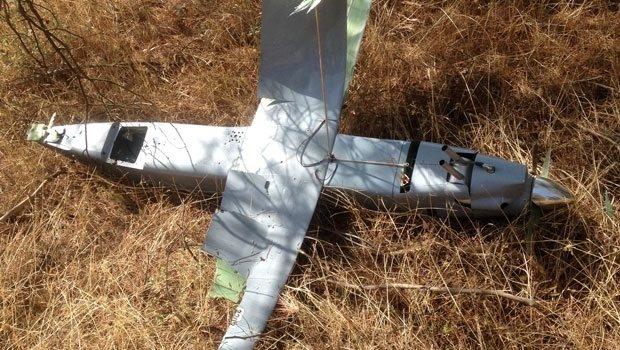
its exact same aircraft type as the Ukrainians shot down a year ago (picture below), so its probably Russian.

AndraxxusAre you saying that form drag does not affect the design? Because if it does, form drag is directly related to cross sectional area.
No it is not. If you are modelling a blunt body like a box or sphere, then your area is the cross section, and will have a drag coefficient Cx. That is not the preffered method for streamlined bodies where flow seperation is not expected.
This is the reason we use “Wing area*Drag coefficient”, and NOT “wing cross section*Drag coefficent”. Form drag, along with wavedrag is represented as an addition to Cd0, like a corrected value. I won’t be able to upload a new image right now, but let me examplify by re-using this graph from MiG-29 manual;
[ATTACH=CONFIG]241174[/ATTACH]
-On the left page, you see Cd0 graph, which slightly decrease as aircraft’s speed goes up, then Cd0 is doubled to count-in transonic wave-drag, then it drops.
-On the middle page you see delta Cd graphs, showing how Cd increase with added PTB, R-27, empty pylons, and various A-G munitions (in second graph)
However, for this MiG-29, only area that matters is still “Wing Area”. I was assuming this Cd graph behaves similar between aircraft I am comparing.
When you divide that drag coefficient Cd0, it is a summed multiplier for various drags, wavedrag, form drag, skin drag etc etc. In these forms, skin drag is a function of airframe wetted area, length and reynolds number. Wavedrag is function of cross sections (or at least treated as such), and form drag (and other form-related drags) is a complex function of pressure differences.
So if you ignore wavedrag, cross section has no meaning at all. You can have a HUGE cross section, but with perfectly analysed body shape it can have very little drag. Mk1 eyeball is not good for judging this.
F-35 is designed with finite element analysis, and computational fluid dynamics. F-15/16 belong to another age where such calculations were still mostly made by hand and trial&error in wind turbines. So F-35 may look fat, (I find it very doubtful as its 1.5 times the size of F-16, its fuselage is just about that fat) or it may look ugly (well, it is really ugly from certain aspects), but unless LM engineers live in caves, it possibly has correct “form” from aerodynamics point of view.
If I simplify all drag to Cd0 I am called a fool, If I complicate things I am called arrogant, but in the end, what matters is Cd0 representing total drag. So, assuming F-35 Cd0 curve doesn’t improve upon F-16’s (because of VLO considerations I mentioned affecting “form drag”, internal bay affecting “wavedrag”), but it doesn’t perform worse (30 years of advancement in aerodynamics, usage of CFD would naturally improve the pressure distribution, and wetted area vs internal volume ratio improving skin drag, induced drag and form drag) is not very off or biased in my opinion. I respect anyone’s opinion, but big cross section is mathematically irrelevant explaination for it.
According to small writing in this picture : then the G spec are taken at 60% fuel, 2 missiles, bomb all dropped
However that only refer to “G at maneuver weight CTOL” section Sustained G has no mention of payload and fuel. I am 90% confident its with 60% fuel, and 99,9% confident it at least includes 2 AAMs, though.
is this some kind of reversed burden of proof ?
i can’t guarantee F-35 havn’t gone through weight reduction since this leak/incident,
but i’m inclined to suspect L.M PR department wold waste NO TIME informing public that
F-35 now meet original KPP threshold
Of course, I am not claiming as such. For all I know, there is a possibility that F-35 gained weight due to structural problems, and its definitive version cannot pull 4,6Gs either. I only object to dismissing the idea 4,6G cannot be improved upon.
For PR, If, theoratically speaking, F-35 could 5Gs and that is higher than the “objective” in new KPP, LM would prefer saying “F-35 is so maneuverable that it not only met the KPP threshold, but also exceeded the KPP objective mark in maneuverability”.
The engines were more powerful than the J (J79=J RB168=K/M). Because the the engines were bigger, the airframe was made fatter, the cross-section bigger. They accelerated faster than the J but by virtue of the larger cross-section, they had a lower maximum speed.
Read FBW’s comment for the “proper” answer. Add to that two additional reasons;
1-J79 and Spey have same dry thrust, yet spey needs 20% more inlet area, to feed its fan. Obvious conclusion is that it moves more mass at slower speeds. Its OK if you burn “fan” air and achive good wet thrust at S/L and slow, but fan will not be moving (reduced mass flow) or compressing (reduced afterburner section compression ratio) air at high altitude.
2-Spey modification is still made within confinements of F-4 airframe design. Despite modifications, its intake design and supersonic pressure recovery may not be as efficient as J79 fit.
As an self-claimed engine guru, you even fail to understand each engine behaves differently… Ever wondered why PW-229 engined F-15C is much slower than PW-220 engined F-15C? Explain that with cross-sections. Or with just 8kN uninstalled thrust increase, why MiG-25 with twice size&weight go 70% faster than F-4K? Or why F-4K is NOT slower than F-4E at S/L where denser air should be causing much more drag, but slower only at high altitude?
And, Please, don’t pollute the thread. I am not interested in discussing F-4s, or engines you serviced as a technician, or afterburners in F-35 thread, and I am not in a mood or a need to prove myself to you. I will quote another user:
if you have a different theory then you need to explain your point on why you think his analysis is wrong or what your analysis would be, you cant just go to every thread and attack people
Andraxxusor anyone else who agrees with you
I think this includes me, so I would answer.
identified by the test pilot in that particular context of that particular test:
On the most realistic grounds, I am questioning this:
Do test pilot identified them or author of the source link interprets what pilot says?
Energy Maneuverability
Overall, the most noticeable characteristic of the F-3SA in a visual engagement was its lack of energy maneuverability. The test pilot had 2,000 hours of flight time in the F-1SE, experience in F-16 Blks 30/40/42/50, exposure to flying the F-18F in high AoA, and has fought dissimilar BFM engagements with each in addition to F-1SC. The EM of the F-3SA is substantially inferior to the F-1SE with PW-229s due to a smaller wing, similar weight, and “‘15,000 Ibs less in afterburner thrust. So, in general, the high AoA capabilities of the jet could not be used in an effective way without significantly reducing follow-on maneuvering potential. Even with the limited F-16 target configuration, the F-3SA remained at a distinct energy disadvantage for every engagement.
Because this is a story telling from third person POV, not direct quote of the pilot.
AndraxxusI don’t miss a point because you have none.
You don’t know the T/W difference between F-16 & F-35 (or F-22 & F-15) at altitude & speed. Like you don’t know the rate at which they bleed energy.
You’re trying to capture a complex reality using single data points. Pointless.
Save your arrogance to yourself, as it is your inability to understand what I am trying to do. I never claimed I know dynamic T/W or energy bleed rate.. Like I never claimed FOR A SECOND F-35 will definately be better than F-16.
People say “F-35 is heavy and underpowered” based on simple thrust and weight figures. I say it is not, also based simple thrust and weight figures. I DELIBERATELY use single data points TO SHOW DATA *THEY* ARE USING DOES NOT SUPPORT *THEIR* CLAIMS. Got it now?
When I say so, I do not use these simple numbers as PROOF of contrary. You are hopelessly trying to disprove something I’ve never said in the first place. So it is YOU who have no point at all.
However I would argue no improvement that could be made to F-22 would allow it to exceed climb/acceleration performance of clean F-15E, that is irrelevant to this topic.
Again you show your lack of knowledge. similar wetted areas can and do result in vastly different parasitic drags.
Oh no, it is YOU who was/is showing lack of knowlegde. You said:
So with its huge cross section, it is no surprise that a F-35 is going to struggle against a clean F-16, bleeding energy much faster.
Other than wavedrag, which is highly irrelevant to BFM maneuverability as it is likely to happen below M0,9, cross-section has NOTHING to do with airframe drag, period. I suggest reading the pdf you posted. Specifically, focus on the formulae in section 2.2.
Speaking of wavedrag, you don’t provide anything other than hot air to prove F-35 has worse cross-sectional wavedrag optimization than F-16, either.
And for pulling high G turns, its no suprise lift induced drag is several times more dominant than any other drag, again questioning your “bleed energy much faster” claim.
but apparently it’s the F-35 fanboys that can’t accept that their plane,
Now, you have shown your idiocy.
When I argue (for two pages) that F-15 carrying 12 mk-82s can go faster than clean F-35, or F-16 will have higher dash speeds in most A-A missions, and any A-G mission does not require EFT, I was called an “F-35 hater”, and now just because I say there is no indictation that supports F-35 is less maneuverable than F-16 based on “fat, underpowered or heavy” claims, I am an “F-35 fanboy”?
I wasn’t the one claiming F-35 is worse than F-16 based on T/W or Wing loading. I never claimed F-35 is better than F-16 based on those claims either. Since you are calling me foolish or ignorant, I believe YOU should share your findings numerically, enlighten us all by proving WHY F-35 is worse than F-16 in its maneuvering drag. Actually, I am not kidding, if you have anything explained by math not hot air I am really interested.
As for my ONLY claim about F-35 being better than F-16, it was this: Its 5,3G KPP threshold figures, and relaxed 4,6G “achieved” performance figure, is slightly better than Block 50 F-16’s flight manual data at same flight conditions. As proof of burden about this is on me:
Lets talk about F-16 with following equipped with 2 AIM-120s and 2 empty pylons to match F-35:
2xAIM-120s + 2xLAU-129 on stations 1 and 9 instead of 16S210 included in basic aircraft weight, 2xLAU-129 on stations 2 and 8 for previously spent A-A missiles, + 8 racks of chaff-flare + gun ammo; weigh 599kg in total.
Drag index = 21; (+1 for each LAU-129 at wingtips, +6 for each LAU-127 at stations 2 and 8, and +7 for F-16C basic airframe drag index)
F-16C Block 50, Drag indexAltittude = 15000 feet, Speed = M0,8:
22000lbs = 218 kg fuel (6% of total internal fuel capacity) == 6,3Gs @ Drag index = 0.
26000lbs = 2032 kg fuel (63%) == 5,3Gs @ DI=0, 5,1Gs @ DI=0, 5,2Gs @ Drag index = 21.
28500lbs = 3227 kg fuel (100%) == 4,8Gs @ DI =0, 4,4Gs @ DI=50, 4,6Gs @ Drag index = 21.
Now, I don’t know exact KPP details of F-35; but logically,
1- It will definately include two AAMs (as B variant has no gun, there is no point in giving it a “key performance figure” unarmed. Quite possibly, it will include 4 AAMs.
2- Logically, KPP of F-35 will at least involve 50% fuel, and judging how other KPP is given to other aircraft, it is quite possibly 60%, to include reserve fuel into equation.
I assume F-35’s specific range is consistent with its wing area and thrust increase, ballpark around 50%. Then, there are 4 possibilities;
Possibility #1: F-35 achieved 4,6Gs with 60% fuel and 2 AAMs. This translates to same maneuverability, but fuel for longer range than F-16 with full internal fuel. For same range, F-35 needs less fuel, less weight. This translates to better maneuverability.
Possibility #2: F-35 achieved 4,6Gs with 50% fuel and 2 AAMs. With this fuel, F-35 can match range of F-16 with only 88% internal fuel. This means, F-35 is slightly inferior to F-16 (by 0,1Gs).
Possibility #3: F-35 achieved 4,6Gs with 50% fuel and 4 AAMs. Then you would have to subtract some 304 kg from fuel of F-16 , and add 8 to drag index, to compare it with equal grounds to F-35’s KPP. Then F-35 will have better maneuverability for same range.
Possibility #4: F-35 achieved 4,6Gs with 60% fuel and 4 AAMs. Then, this translates to better maneuverability with fuel for better range. Translates to A LOT better maneuverability when fueled for same range.
This comparison actually favours F-16;
a) You cannot guarantee an F-16 to enter BFM with 2 AAMs and only 2 empty pylons; typically, it would almost certainly carry 2 additional LAU-129s at 3 and 7, plus MAYBE additional missiles on those pylons, non-jetisson fuel tank pylons on 4 and 6, centerline pylon on 5.
b) you cannot guarantee F-35’s 4,6G achieved performance years ago is not improved even by 0,1Gs. Maybe (just maybe) F-35 today is close to its KPP threshold of 5,3Gs?
Even if we take worst case scenario in this comparison, how on earth that justifies “F-35 can’t dogfight” idea?
At sea level, M0,66, clean with 50% fuel, an F-16 block 30 can sustain 9Gs. An F-16 block 50 can sustain 8,1Gs. An Su-27 can sustain 8,7Gs. An F-15C can sustain 7,8Gs. That is up to 15% difference in performance, yet all these aircraft can easily “dogfight” with each other. If worse comes to worst, F-35’s unclassified sustained turn performance at 15k feet M0,8 is just 3% inferior to F-16s. If F-35 cannot dogfight with F-16, then nothing in 4th generation, be it late F-16C, F-15C, MiG-29 or M2k, can dogfight with an Su-27 or an early F-16C block.
Now if you are blowing gasket, at least answer to this claim that I am actually making.
AndraxxusThere is part of a report that indicates clearly that the F35 under performs in BFM.
Some fellow members suggest that the test restrictions prevented the plane to show its full potential.This is a paradox in my mind. It kind of defeats the purpose, and there is no “clear” indication the test setup was preventative of any better performance had that been available.
If there is, the members who think there is could perhaps tell us what exactly prevented the plane to perform better.
“Clear” indication is the purpose and meaning of the test. Lets replace F-35 with F-16, how would you test an F-16’s high AOA handling behaviour in dynamically changing conditions provided by another F-16?
At 15000 feet, starting at M0,9 leading F-16 would be instrucuted to make randomly changing scissors and barrel rolls, at 7G turns. F-16 can sustain 7G turn @14 deg/s with slightly positive excess power.
Following F-16, which is conducting its test flight, would be instructed to make a lead pursuit, with a predetermined angle to force aircraft to its lift limits. When this F-16 pull 9Gs, its at its AOA limit as desired, but its also at -800 fps excess power, causing it to slow 42 knots in one second if flight is conducted in level. With each heading change, leading F-16 would roll at 7Gs, but following aircraft would fly in its AOA limits, continuously varying between roll/yaw authority limit and clmax limit; testing flight control system and overall aerodynamics. While doing so, F-16’s lift limit excess power from 5,5G to 9G varies between -600 to -1000. So by each second, F-16 conducting max AOA maneuvers will slow down by 30-50 knots each second assuming level flight.
Also assuming vertical maneuvers are allowed, and 5000 feet safety deck, following F-16 will deplate all its energy in 14 seconds or so, and will be unable to turn with the leading F-16. If leading F-16’s pilot says “his aircraft cannot sustain energy as well as mine”, then he is an idiot.
While test conditions are arbitrary example, you definately DON’T use control aircraft in its limits. Why? Because you can’t guarantee test subject (F-35) will reach, fly and accumulate sufficent data at all its test points, before the F-16 reaching any single one of its own limits. There will be a big safe zone there so F-16 will not hinder the test, but merely provide a dynamically changing target.
Again, if tests purpose was to find actual energy maneuverability of F-35, it wouldn’t be conducted as such; Test would be to fly F-35 alone, with varying speeds and G loads. For example at M0,9 7G turn, if test equipment will measure a 1 knots per second acceleration, then engineers will calculate it as 26,3 fps specific excess power, draw its SEP graphs so that it could be compared with F-16’s flight test data factually: ON PAPER.
Only a caveman would think a pilot would be instructed in the lines of “hey go turn with F-16, see how it goes”, to see the maneuverability of the aircraft. There is a purpose to this test flight, just like a stall or spin test. Going beyond that is ignorance and stupidity of the pilot, not any different than saying “hey F-35 fell like a brick in its stall tests, but following F-16 didn’t, so F-16 is better than F-35″…
but the plane does not seem to give publicly available evidence to support that interpretation.
I don’t buy the “classified” bull. The programme is in such bad light, any scrap of good publicity would be welcome by LM and the MoD.
Yet we don’t seem to be getting any.
And we will not see any evidence, until F-35’s finalised design is introduced into service and we see it during airshows worldwide. Many F-16 operating countries will also operate F-35, then we will look at what pilots think about them.
Currently introduced F-35As fly with 4,5G limit, and will most obviously (at least to me) have worse maneuverability than MiG-31.
Because out of context numbers can’t capture the reality of a complex system.
………..
IMO using single data points to extrapolate a complex system performance is risky at best, foolish at worst.
You don’t get my point by a longshot. It was a reply to “F-35 is too heavy”, “F-35 is underpowered”, “F-35 has too high wing loading” etc etc. None are true compared to F-16, and all the bragging on these issues apply more to F-22 than F-35.
Wing area linearly contributes to induced drag.
Induced drag is only one component of drag and in fighter planes (unlike bombers or airliners), form drag is a major component of drag.
……
So with its huge cross section, it is no surprise that a F-35 is going to struggle against a clean F-16, bleeding energy much faster.
What huge cross section? Frontal cross section has nothing to do with Cd0. If the term you are looking for is wetted area (Sw), to calculate form drag, then I would remind you about 50% more thrust on F-35. It sure as hell doesn’t have 50% more wetted area than F-16. I have 3d model of F-16. If you have 3d model of F-35 then we can numerically compare their wetted area. In any case, F-35’s larger dimensions allow for larger Reynolds number, and lower Cf.
However, lets not stick to details; since you missed my point, I will repeat myself; F-22, despite its IS fat and underpowered numerically, its performance is said to be an improvement over F-15. This is explained by the aerodynamic improvements made in 25 years which is supposed to reduce drag coefficients, primarily Cd0. F-35 is 32 years newer than F-16.
I ask; do physics or engineering apply to F-22 and F-35 differently? Both aircraft’s airframe differ from their predecessors with VLO shaping and internal bays. 5% improvement from F-16’s aerodynamic coefficents/curves will make F-35 better than F-16. Same 5% improvement will make F-22 inferior to F-15.
And it varies tremendously between planes, for example a F-18 has 1.5x the drag of the similarly sized F-105.
50% is very doubtful, I will have to ask a source about that.
Maximum thrust of an engine in static conditions and at at sea level is no reliable indicator of thrust at altitude and speed. For example, the Tornado powerplant is optimized for low level and endurance (with its very high bypass ratio – at least for a fighter) and will see a much higher degradation of performance at altitude and speed than say, a Mirage 2000 whose M53 is optimized for high altitude and supersonic flight.
Powerplant optimization doesn’t explain why F-35 should perform worse than F-16 at altitude.
F-35 has DSI, has 0,56 bypass ratio;
F-16 has pitot inlet with splittler plate, has 0,63-0,77 bypass ratio.
All the while, on F-22 vs F-15 comparisons, fact that F-15 has variable inlets featuring both internal and external compression mechanisms, is ignored.
AndraxxusAll planes can do “energy maneuverability,” That’s just physics. What it is about is excess Ps and the F-35 doesn’t have it. Now, they may re-engine it with a new engine which would help, but I find it quite similar to the Supermarine Scimitar, in that it has a lot of thrust and may get more, but that doesn’t alleviate the fact that aerodynamically speaking it’s a pig.
At the end of the day, this plane was never meant to be a dogfighter, and the basic numbers bare that out. It was meant to be a stealthy light bomber with the ability to have a somewhat decent self defense capability. Unlike the F-15/F-16 relationship, where the F-16 can mostly match the F-15 in A2A performance, but performs mainly attack duties, the F-22 to F-35 relationship really was meant to be the F22 as the A2A component and the F-35 as the A2G component.
All are sourceless, baseless assumptions. Since entire thread is restarted by obligatory quoting himself, I will quote my own too:
As a numbers guy, I am really curious about WHY F-35 is called bad, F-15/16 good, and F-22 phenomenal.. All F-22 lovers may trash my post all they want but;
Comparing F-15E vs F-22 and F-16C vs F-35A;
F-35 has 146,2% empty weight of F-16C.
F-22 has 138,1% empty weight of F-15E.Wing area linearly contributes to drag, and Thrust directly counters the drag.
F-35 has 153% wing area of F-16C. It also has 146% Thrust.
F-22 has 138% wing area of F-15E. It also has 121% Thrust.In thrust/drag department, all else being the equal (I am not saying it is, just making a point), F-35 is 4% inferior to F-16, and F-22 is 12% inferior to F-15E.
At their empty weights;
F-35 has 99,8% T/W of F-16C.
F-22 has 87,8% T/W of F-15E.F-35 has 95,4% Wing Loading of F-16C
F-22 has 99,7% Wing Loading of F-15E.Now I generated a term equalised fuel, based on aircraft’s SFC and Cd are all the same, wing area alone will dictate thrust is required to move the aircraft, and this thrust will be directly proportional to range. ie, if F-16C carries 27,87*X amount of fuel, F-35 will need 42,7*X, because its more draggy. Taking X=50, at this equalised weight;
F-35 has 99,1% T/W of F-16C
F-22 has 87,7% T/W of F-15E.F-35 has 96% Wing Loading of F-16C.
F-22 has 99,8 Wing Loading of F-15E.*I assumed F-22’s engine thrust to be 156kN. If anyone has better value I can input that, but I must say, F-22 needs 177,8 kN thrust from each engine to match F-15E’s T/W.
Heres the table;
Now according to these values, F-35 is much more closer to F-16 than F-22 is to F-15. Any assumption due to advances in technology (improved aerodynamics, improved SFC) that may benefit F-22 would benefit F-35 even more because its newer.
Its true that F-35 looks ugly as sh!t, and F-22 is cool and looks more aerodynamic, but on numbers alone, it doesn’t give one reason WHY F-35 is underpowered, (it fares just as well as F-16, far better than F-22), or unmaneuverable (Very similar wingloadings and general layout and features).
On the contrary, F-22 looks clearly underpowered when compared to F-15E. Though addition of several aerodynamic features (negative stability, LE flaps etc) would offset this disadvantage, its important to remember F-35 has them too.
My point? Every claim about F-35 cannot dogfight (based on its heavy, or underpowered or have small wings) must also apply to F-22; either that or this claim is wrong.
Every simplification favors F-16 and F-15 most and F-35 the least, which was kinda my point actually.
…
To make F-22’s T/D equal with F-15E, either Cd curve or dynamic thrust must be improved by 15%. That is where all “simplifications” come in, so lets count them all;
Thrust:
1- a fixed inlet can never exceed a variable inlet. It may -at best- closely match it for a very limited part of the envelope.
2- Boilerplate exhausts have far greater losses, compared to round exhaust.
3- F-100 has lower bypass ratio than F-119, so higher % of thrust retained at high altitude.
Drag:
4-F-22 is newer design, so advancements like CFD should improve Cd0
5-F-22 has VLO considerations whereas F-15E is solely designed to be aerodynamic.
6-F-22 is negative stable F-15E is not.
7-Thrust vectoring may assist in trim, but may also have little or no effect at all.
8-F-22 has LE flaps so drag while maneuvering would decrease, and lift at hard turns increase.That is 4 vs 4, with most important ones being 1,2,6,8 its 2 vs 2. So speaking of features doesn’t look very bright for F-22 is it?
Speaking of videos, F-22 sustains some 18deg/s at airshows. Immediately claimed that F-22 flies under G limitations in airshows. Its real funny to talk about G limits for an aircraft that flies for 25 years and in active service for 10 years but OK, lets swallow it and compare; an F-15C with half fuel needs puny 5Gs to sustain same 18deg/s. IF F-22 is better than F-15C, how strict can it be limited so it performs same? 4Gs? 3? I dare say, Something must be REAL wrong if you limit your 9G capable aircraft to just 3-4Gs. Even unmaintained, old, 7,33G capable F-14 had ended their career at 5,5G limit. In any case, F-22’s instantenious turns in videos show the problem is not pulling Gs, its sustaining them.
Then people claim a miracle happens when both aircraft climb to 20k feet, and F-22 suddenly becomes a monster that defeats anything else. No, I don’t buy it. The thing is, all these features like negative stability or LE flaps etc are ALREADY making difference at S/L too. Other then air density, NOTHING changes between M0,85 S/L and M0,85 30k feet.
Some F-22 lovers may call me biased, but I am merely asking WHY? If F-22 had so low wing loading that it would hold it back at low altitude, but give an edge at high altitude, or it had so tremendous T/W that it overcame the drag came with higher AOA needed for high alt maneuvering, I would accept. But TVC trimming? No, not a sufficent answer.
-Both F-35 and F-16 blk50 have same wing loading
-Both F-35 and F-16 blk50 have same T/D assuming Cd0 and inlet performance is the same.
-Both F-35 and F-16 blk50 have same T/W assuming inlet performance is same.
-F-35 has DSI F-16 has fixed pitot inlet. By all reports, there was slight performance increse when DSI is tested on F-16.
-GE-132 has lower bypass so it should work better than F-135 at high altitude.
-Both aircraft have negative stability.
-Both aircraft have LE flaps, but F-35’s TE flaperons are way larger and Flybywire algorithms improved.
-F-35 is 25+ years newer so cd diagram should improve.
-F-35 has VLO concerns, F-16 is pure aerodynamic.All in all, there is nothing to indicate F-35 should perform any worse than F-16 but people are clearly convinced it is *significantly* worse. (while on the contrary F-22 has IMO clear indications that makes it worse than F-15E, people have no problem believing F-22 is much better).
And plus the other factual comparison (I’ve posted those before; too lazy to find and quote them)
-F-22’s demonstrated sustained G performance at 20k feet as written in KPP is inferior to clean F-15A, and its exact same as F-15A with 4xAIM-7 and 4xAIM-9 missiles. (flight manual data).
-F-35’s both KPP threshold and achieved sustained turn performance datas are better than what F-16 blk 50’s performs *clean* at same flight conditions (flight manual data), assuming F-16 carries fuel for equivalent combat persistance.
So, once again, there are many more indications that F-35 will be more maneuverable than F-16, then F-22 being more maneuverable than F-15.
AndraxxusAll Russian ships use the same 53cm torpedo tubes as their Submarine counterparts. They also use exact same torpedoes and same missiles like RPK-2. With a little software update, I don’t see a reason why a Slava shouldn’t launch a Kalibr from its torpedo tubes.
AndraxxusCorrect. but constant pressure combustion does not mean pressure is same throughout the cycle. For example, diesel reciprocating engines are also have constant pressure combustion.
While ideally exhaust stage of a gas turbine is also isobaric (that Turbine exit pressure is same as compressor inlet pressure), its not in the case of jet propolsion engines. Turbine does only the Work of the compresor, and pressure at turbine exit is still much higher than atmospheric pressure (that is also equal to compressor inlet pressure). Afterburner stage is also at constant pressure combustion, happens at the turbine exit pressure. Only because of that afterburner is so inefficient; lower pressure ratio = lower compression ratio = lower efficiency.
However, what I meant before is, brayton cycle is valid for steady state; when you change the conditions of the system (change Qin for example), it stabilizes at a new steady state, all the pressures, and mass flow of the previous state are invalid.
AndraxxusYou do meet so many who claim to be professionals, and yet, they are unable to answer a simple question in their field of expertise…..
Thats not it; A test flight’s purpose is designated by engineers, to test the aircraft who designed by engineers.
Man in the cockpit of tested aircraft is only tasked with flying the plane, and doing things as instructed by engineers. Flight data is recorded by instruments, and relayed to engineers. This is even worse for the man in the cockpit of the other aircraft, as he is probably not even instructed to the details of his role in the test flight.
In analogy, we have two cars, car#1 is making a turn, and following car#2 is purposely drifting while following. Then driver of car#1 comments “he oversteered all the way the turn, that means car#2 can’t turn as car#1”. And we would be laughing at it, as you can follow a vw beetle with a corvette, while drifting.
The very fact, pilot claiming test flight is about F-35 testing its kinematics vs F-16 is the proof of his lack of knowledge.
If such comparison was really wanted, F-16 flight test data is already available. F-35 would take-off, conduct maneuvers at incrementally changing various flight conditions and land. Comparison would be made *numerically* on the ground. “Hey F-16 can turn 19,65 deg/s, with 123 fps excess power. F-35 can turn 19,3 deg/s with 123 fps” It would not be in the lines of “hey go turn and burn with F-16.” and “how did it go, it was good yes?” Only a caveman would think test flight are made in such manners.
But thats ok. Its completely excusable for a pilot think such things, just as a engine technician is not expected to know how to design a jet engine.
@Robbiesmurf Since your very post obviously implied ME not answering to your “how afterburners work” question…
I was delibaretely not answering your question because you were polluting the several different threads by constantly asking highly irrelevant to the topic question “how afterburners work” and you were not asking it to learn from the answers, but to prove yourself (by asking a question that no one can answer, then answer it yourself); make us acknowledge your “extensive knowledege” about jet engines. You know, last “The truth about the F-22” thread ended just because of your futile attempt to prove your greatness; for that alone, I think you should have been banned.
And your answer to the question you asked was “Its a Temperature ratio, its a percentage blah blah” garbage.
Question was “how afterburner/engine generates thrust.” Me, and a dozen answered correctly in the lines of “it happens at nozzle with “pressure and velocity” change” etc. FalconDude even suspected and said “I believe your question is not complete“, but no, you were both too arrogant and too ignorant to notice your own mistake OR accept the answers of others.
Your answer was the answer to the question of thermodynamic equibilirium, not the dynamics on how *THRUST* is generated.
Even then, temperature does not matter inside engine beyond material properties. The correct value you are looking for is not T, but H, the enthalpy. What you are doing, (in actual engineering POV) is this:
You are assuming air is ideal gas in an isentropic process and use this form:
entaphy change dH = Cp*dT + V*dP*(1-(1/V(dV/dT))*T)
Then you are assuming coefficient of cubic thermal expansion=0, or pressure change is 0, Cp is constant, So your enthalphy change is proportional to T change. Then, if you assume 100% efficiency on an isentropic nozzle in all working conditions, and airspeed = 0, you can say T is proportional to thrust in terms of thermodynamics.
Since no one asked about thermodynamics, you are answering to a question that no one’s asked. That is by ignoring 7 of 9 terms of enthalphy equation and taking 8th as constant, making a dozen assumptions, all the while you are dismissing everyone’s comment as “wikipedia quotes” or simply “wrong”.
There is a difference between simplifying, and OVER-simplfying. Actual understanding of the subject tells you what you are doing is “simplifying” or going towards “way too inaccurate”. While you were trying to accuse me of “not understanding”, I didn’t answer at first, because I was exitedly waiting how you will humiliate yourself while you are trying to answer your own question, and your answer was “Temperature change, its a ratio, a percentage”. Well, thats what happens you try to be a smartass by reading a “how engines work” book directed at elementary school children. Since then, I am ignoring you on this subject; in case you haven’t noticed.
Oh, you have also dismissed because I’ve said pressure change inside engine due to isentropy, you said “NOO pressure is the same.” Why? because your book says so? No, pressure is the same at *steady state*, that is you are picking one condition that thermodynamic equibilirium is valid. when you change RPM, fuel ratio, afterburner, pressure inside the engine DO change. Pressure even changes when aircraft is climbing or cruising at exact same RPM. I ignored your post because I was not in the mood of explaining compressor map to you starting from “systems theory” to explain what “constant pressure process” is and going through entire turbomachinary course. Its simply not worth it.
Don’t mistake “ignoring someone” with inability to answer his comments.
AndraxxusSo you are implying that the F-35 can indeed do so much better, but rather, the choice was not to, although the aim of the test was to examine the aircraft performance at some of the extremes.
What he (mkellytx) and the pilot in FBWs post explains F-35 is being tested for high AOA behaviour, ie controllability. Now;
a) Controllability has ZERO relation with performance. While our pilot says nothing about this, it doesn’t mean anything even if he did.
b) high AOA performance has ZERO relation with energy maneuverability. It, alone, doesn’t indicate ANYTHING about available turn performance either.
So we have a caveman claiming to be a pilot, who says F-35 cannot do energy maneuverability, and that is based on maneuvers done in high AOA controllability test? Lets just dismiss it as yet another BS from another pilot quote and be done with it. To be honest, I doubt an actual pilot can be so ignorant.


 Sign In








