 Andraxxus
What option they have? They can detect Su-35 from 800 km away assuming no LPI on Su-35 part, OK, but they will eventually have to close in to kill them.
AndraxxusThe Simulator’s AIM-120D and Meteor have pretty much the same specs (except for radar signatures) in the sim. 75nm maximum range, and both have a PK of around 45% at terminal phase which gets adjusted by range, target maneuverability and target speed.
Here’s the F-35 vs Su-35 detection ranges for the default database aircraft in CMANO.
[ATTACH=CONFIG]239830[/ATTACH]
Those are all nonsense. Let me be a smartass for a minute.
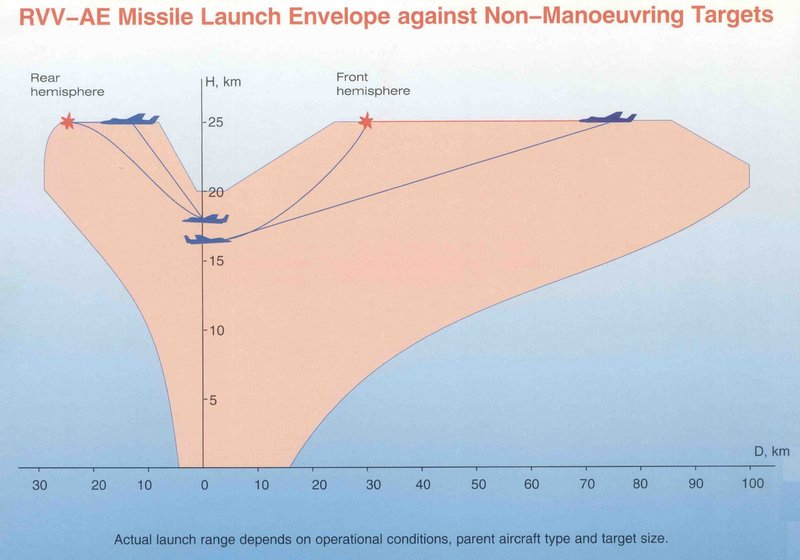
To “count-in” the difference of Meteor, double these ranges… 200-250 km max range is overly optimistic for it.
Lets make verbal “simulation”.
-I am in lead of Su-35 group. I have typical armament of 2x R-27RE, 2xR-27TE, 2x R-77, 2xR-73 and Sorbstiya ECM pods.
-I am aware I am againist VLO targets, So I am flying at sea level, my radar is in high PRF at maximum volume scan, IRST on, and I am cruising at M0,9. One of my wingmen is jamming.
-If F-35 tries to fire Meteor at 10+ km altitude, it will barely reach Su-35 at 40 km range, even if Su-35 continues head-on towards the missile. At the same time, this means Su-35 is scanning clear sky from 15 degree below F-35 (also scanning the bottom not just front), while F-35 is trying to discriminate 3x Su-35s from ground clutter while actively being jammed by the one that fell behind.
All the while F-35s are maneuvering for trying to sneak vs Su-35s, why should Su-35 guys just wait? Againist VLO targets only a fool would fly straight in level, zig-zags in every few minutes will cover much greater volume of air, and would force F-35 to maneuver and match the Su-35’s course changes, exposing their higher RCS sides, and cut the enemy’s missile range by half.
-An F-35 with overly optimistic 0,001 sqm average RCS will still be detected from 54 km, well before it could launch its Meteor missile. However, RCS doesn’t work that way. There will be minimal points maybe as low as 0,0001 sqm, but there will also be spikes as high as 0,1+sqm, changing frequently with closure angle. Don’t start with “F-35 has 0.000X sqm RCS” crap, a human has 1m2 RCS. A bird has 0,01 sqm RCS; be reasonable. With constant operation of control surfaces, constantly changing approach angles, F-35 will not be completely invisible. It will fade-in and out of radar for quite a distance before it could be reliably detected. This is more than enough for Su-35s to act accordingly and not get ambushed.
Point? Its not a mere X vs Y detection range, X vs Y shooting distance, X vs Y’s missile’s PK etc etc etc. I wouldn’t be suprised if F-35 defeats Su-35 in BVR, but not with computer game levels of simplicity. In fact, it will likely be just as hard as AIM-7 equipped F-16A defeating AIM-7 equipped F-4Es.
AndraxxusBut the radar equation suggests that a 0.01 sq.m frontal RCS
Wrong, calculating for given range gives us 0,00062 sqm RCS for F-35. Yet Another BS; No stealth aircraft can maintain such average frontal RCS.
IRBIS has 400 km range vs 3sqm target, that gives 96 km range aganist 0,01 sqm target.
AndraxxusMeteor integration is part of MS20 upgrade package, the software is being finalized and Meteor is completed
The very link you quoted says
Full Meteor integration will be delivered to the Swedish Air Force as part of the MS20 systems update. When MS20 enters service in 2015, Gripen will be the first platform with an operationally effective Meteor capability.
and has title
Gripen closes in on operational Meteor capability
Meteor is operational in SweAF
There is no single Grippen that is both operational in SweAF and capable of firing Meteor missile.
AndraxxusMeteor went operative 2015 in sweden, as the first operator
Source? IIRC, it was “will be operational in 2015” since 2012 or so. As far as I know, Meteor is still not yet in service.
AndraxxusIn all fairness, I think we should only compare what exists.. Meteor with clipped fins does not exist yet. An F-35 which can embrace Meteors does not exist yet… Point..
+1 for meteor, By the time meteor gets operational on F-35 in 6-8 years, god knows what will be operational on Su-35.
However what exists is insufficient for comparison; If we look at it this way, F-35A/C doesn’t have IOC yet and F-35B has IOC with 4,5G g-limit and M0,6 airspeed limitation.
AndraxxusLooks like someone wanted to make F-35 winner. For the sake of argument, if we are testing two aircraft againist each other, why this?
As support, the F-35s have an E-3D AWACS and Rivet Joint.
I think this is the most laughable part about this. Support 10 Su-35s with AWACS and Command/ELINT aircraft and pit them againist 10x Su-35, they will come with certain 10-0 ratio againist non-supported Su-35s.
In fact, with AWACS and Command/ELINT aircraft support, even good old MiG-29S or Su-27S could fare pretty favourably aganist Su-35s.
AndraxxusThe combat radius of a MiG-29 flying at Mach 1.5 and carrying 6 missiles is not 300nm – try 150nm.
[ATTACH=CONFIG]239753[/ATTACH]
Have fun playing with numbers
“But if we start a mission with 4400-kg of fuel, start-up, taxy and take off takes 400-kg, we need to allow 1000-kg for diversion to an alternate airfield 50-nm away, and 500-kg for the engagement, including one minute in afterburner. That leaves 2500-kg. If we need 15 minutes on station at 420 kts that requires another 1000-kg, leaving 1500-kg for transit. At FL200 (20,000 ft) that gives us a radius of 150-nm, and at FL100 (10,000 ft) we have a radius of only 100-nm
You are quoting a “real world” scenario to compare with an on paper scenario. On paper a Su-27 will reach 1760 km combat radius if it flies at optimal cruise with 4 missiles, fires its missiles mid range, and flies back at optimal cruise. In real life, it won’t reach half of it, due to reserve fuel, loiter AB usage etc etc.
Compare apples to apples. On paper, F-22 will reach 450 nm combat radius with 100 nm supercruise flight. Direct comparison is for MiG-29 to do the same; 100nm AB flight at M1.5, and optimal cruise for the rest. In fact 300nm is very conservative;
1- MiG-29 is 100nm capable of flight at full AB at M1.5 PLUS 689nm optimal cruise.
a) very first math is incorrect; it makes 789 nm flight, I’ve downgraded to 600 nm flight to count in take-off climb etc, which is way too conservative. A mere full-AB take-off and climb for 10-15 minutes will definately not shave 189 nm from flight range.
b) assumption of full AB to fly at M1.5 is incorrect, throttling back after reaching M1.5 will reduce given fuel flow, which I’ve ignored.
c) assumption that flight only takes at M1.5 and M0,9 cruise is incorrect. If you look at Full AB graph, acceleration from M0,9 to M1,5 at full AB requires less fuel flow than constant full AB at M1.5, and there is deceleration part, which requires idling engine while aircraft still covers distance at average speed of M1.2
2- I have not counted the reduction in drag after the missiles fired.
3- I have already said in real life MiG-29 would operate around 150nm from its base, freeing up the AB usage much further.
In any case I doubt if there are many aircraft which can catch an F-22 penetrating airspace at Mach 1.7, perhaps MiG-31.
If we are swalowing pilot quotes, Su-27 can maintain afterburner in supersonic flight for more than 30 minutes; and that is in real life, which involved fuel for taxi/take-off, reserve, diversion to another airbase, cruising, climbing and AB checks at various altitudes. Can F-22 supercruise for 30 minutes? In real life, when you subtract fuel reqiured for mentioned tasks, can it even supercruise for 15 minutes?
Really, do you know any aircraft that can do better?
fly for 100 nm @supersonic plus fly for 800nm @subsonic? CFT or CL fuel tank equipped F-15C/E and Su-27 can both definately do much better than that.
Think of it this way; A Su-27 can ferry for 1900+ nm. Thinking linearly, assuming 500kg bingo fuel, Su-27 would need 3750 kg to fly for 800nm, leaving 5150 kg of fuel to be used in supersonic flight. Assuming same SFC between AL-31F and RD-33, (and ignoring all the benefits of AL-31F over RD-33), a Su-27 would require 50% more fuel flow than MiG-29 due to 50% higher thrust. That means at full AB at M2.0 at 15000m, a Su-27 can fly for 10,8 minutes, translates to 206nm range, more than twice what F-22 is capable of.
Or think of it another way. When compared to Su-27, F-22 has 25% more wing area to generate drag, 21% more weight to increase induced drag and 27% more thrust to feed with fuel. All the time, F-22 has 13% less fuel than Su-27. During the “optimal cruise” surely F-22 will consume at ~25% more fuel than Su-27. By the time a Su-27 consumes 3750kg, F-22 will have consumed 4680kg. Assuming 500kg bingo fuel for both, Su-27 will have 5150 kg for afterburners, and F-22 will have 3020 kg for supercruising? Even if supercruising is twice efficent -which I would really doubt- a Su-27 will still reach slightly longer range with these fuel ratios. (remember F-22 has 25% more drag than Su-27)
(again maybe MiG-31)
And your “maybe”s for MiG-31 is very amusing; MiG-31 can reach 390nm combat radius at M2.35.
Playing with the numbers specified for F-22: 600nm combat radius = 400nm subsonic + 50 nm supersonic combat radius, for same mission. Simple linear math would tell us F-22 can supercruise to around 200nm combat radius with full fuel.
So F-22 has around half the range of MiG-31, when flying at 2/3 speed of MiG-31. Surely you can speculate how much further MiG-31 fly should it slow down to F-22’s speed? Seriously there is really no comparison there.
Of-course, there are many assumptions involved in my math in this post; however differences are TOO big to be dismissed by poor assumptions or math errors.
AndraxxusThe F119-PW-100’s dry thrust is truly mighty (113kN)
This is not official. In fact we have nothing about the DRY thrust of the F-119. As its a derived number from god knows who, I would derive a different number. Going from history;
Fighter Aircraft Turbojets:
J75 = 109kN / 70,28kN = 1,55
J79 = 79,37kN / 52,9kN = 1,50
AL-21F = 109,8kN / 75kN = 1,46
R-35 = 127,5kN / 83,6kN = 1,52
Fighter Aircraft Turbofans:
F-100-PW-220 = 107,8kN / 64,9kN = 1,66
F-100-PW-229 = 129kN / 77,62kN = 1,66
F-110-GE-129 = 127,8kN / 76,3kN = 1,67
AL-31F = 122,6kN / 75,2kN = 1,63
RD-33MK = 88,6kN / 53,5kN = 1,65
Xian WS-9 = 91,26kN / 54,29kN = 1,68
D-30F6 = 152kN / 93kN = 1,63
117S = 142,1kN / 86,3kN = 1,64
117 = 147kN / 88kN = 1,67
As you see, as an update of an old engine, 117 gets its thrust ratios pretty much similar to legacy engines and their modern derivatives. However, new recent clean sheet designs differ in generating more dry thrust:
Snecma M88-2 = 75,62kN / 50,04kN = 1,51
Eurojet EJ-200 = 90kN / 60kN = 1,50
PW-F-135 = 191kN / 125kN = 1,52
I don’t exactly know the reasons but we have an emprical ratio of “1.5” for modern engines. PW F-119, and 35000 pound class engine, which has thrust between 153 kN and 158 kN, it should have DRY thrust of 102 to 105 kN. (By the way, I’ve just noticed how powerful the R-35 engine of MiG-23 is. Its more powerful than AL-31 or PW-220 in AB, it has more dry thrust than all others, excluding F-119, F-135, and D-30F-6)
AndraxxusWith 10% more thrust the plane could supercruise, which would decrease the probability of detection by IRST. It would also help have more speed to escape. An F-16 or F-15 could possibly supercruise with a centerline tank and external pylons.
No and No. A supercruising engine require other differences than thrust, and speed itself is not directly related to static thrust of the engine.
An PW-220 engined F-15E can supercruise at ~M1.03 at DI=0.
An PW-229 engined F-15E can supercriuse at ~M1.14 at DI=0.
21% Thrust increase results in 11% speed increase, or 65 knots better speed, which has no tactical use whatsoever.
Anyway, no need to talk theory: Vmax Switch, heres what flight manual says about it:
Vmax Switch
Use of the Vmax Switch is prohibited. The Vmax switch is below the left canopy sill. The switch has a guard which is wired down. When the wire is broken and guard raised, the switch may be placed to Vmax which arms the system. With the system armed, the throttle in MAX AB, and airspeed above MACH 1.1, the engine control schedules 22 degrees celcius increase in FTIT and 2% increase in rpm. Main engine and afterburner flow is increased about 4% and thrust is increased about 4%, maximum continuous time in Vmax is 6 minutes. Each use of Vmax must be reported so that a hot section borescope inspection may be performed. Maximum total Vmax time before engine overhaul is 60 minutes.
And that is for just 4% increase in thrust.
Any idea about using such feature for cruising is nonsense -supercruise or not-. Use it and aircraft’s engines are in for a special maintenence to see if it cracked, warped bended or anything. If it is, engine is discarded and replaced with a new engine. In the best of circumstances, if pilot uses it 10 times for 6 minutes, engine goes for an overhaul. Its a very specific emergency feature, not for saving the pilot from missile or anything, but probably for intercepting supersonic strategic bombers in time.
PS: You are putting too much emphasis on supercruising. Any aircraft flying slower than transonic wavedrag (around M0.8) will be much more efficient. When you need fast, you have afterburners, So “supercruising” is ONLY useful for when you need to go fast for long flight ranges, not combat but penetration etc.
If you are in an F-22 which can go M1.7, it MAY have some use, as it would require some effort to catch it. However, its said 100nm supercruising cuts 600nm combat radius of F-22 to 450nm. Assuming done at M1.5 on average, thats less than 7 minutes on supersonic flight. And 100nm supersonic flight cuts 300nm flight range. Although altitude and flight conditions are unkown, that doesn’t sound impressive to me.
A MiG-29 9.12 going at MAX AB at 16000 meters has top speed of M2.3, and fuel flow rate of 5,5 kg/sec @M2.3. A MiG-29, needs 4,54 minutes or 1499 kg of fuel to fly 100 nm at M2.3 speed, and it will still have 1632 kg usable fuel left to cruise; with 2 AAMs, that makes ~494nm range. On a more realistic scenario, a MiG-29 armed with 6 AAMs and EFT, can fly at M1.5 @16k meters with 3,3 kg/sec fuel flow (assuming Full AB, probably less in reality). It takes 1577 kg fuel to do so, and leaves 2759 kg fuel for rest of the flight; with overly pessimistic 4 kg/Nm fuel consumption, that makes 689nm flight range; lets call it 300nm+ combat radius including take-off, combat, acceleration and landing.
F-22’s supercruise ability is good, but definately is not out of this world, and definately not a game changer; a MiG-29 flying Ground-Alert-Interceptor mission just 100 nm from its base will easily pursue and catch F-22 no matter how long it supercruises. And remember, MiG-29 is not exactly renowned for its range and combat persistance. I wish I had such detailed fuel consumption graphs for Su-27S, but I havent, but suffice it to say it has 184% more fuel to feed 50% higher thrust when compared MiG-29.
AndraxxusTrue, a 42% increase in thrust can make huge difference; actually allows good old MiG-21 to counter 4th gen fighters with a 2nd gen fighter in climbs and acceleration. In wartime that would be acceptable, otherwise a MiG-21 has no use other than being a target practice to modern aircraft (as proven by F-15). If such application ground your fleet in 3 weeks, thats good because otherwise you would lose them in 3 days.
However, for modern applications, even if increase in thrust translates directly to climb, acceleration and sustained turn performance, what difference a ~10% thrust increase would make in emergency? Sustaining 11 deg/s instead of 10 deg/s, or accelerating to 300 to 410 knots instead of “only” 400 knots won’t save you the day in any real life scenario.
And remember, such big increase was possible to R-25 engine due to decades of advances in science&engineering. Engines like EJ-200 or F-119 are already latest in technology. I don’t think anyone could squeeze more out of them without severely compromising longevity of the engine.
AndraxxusWhat you are describing is “War Emergency Power” and such feature is/was present on many aircraft/engine:
-P-51H Mustang’s piston engine could deliver 2218 hp in combat mode instead of 1380hp.
-MiG-21bis’s R-25-300 normally produce 68,5 kN thrust, can be boosted to 97,4 kN for 3 minutes in specific altitude conditions.
-F-15A/C’s PW-100 and 220s have Vmax switch to give ~5% more thrust.
-F-16 J79 had Combat+ mode to give up to 16% more thrust for short durations.
-MiG-29K’s RD-33Ks had a setting to boost thrust by 7% at carrier take-offs.
There are other examples, but the reason its not used commonly (on F-15A/C usage of Vmax is forbidden according to flight manual, and its not present on F-15E) is severe stresses to the engine; for example on MiG-21, 1 second in such mode counts as several minutes on engine lifetime. Not good if each usage shrinks your engine life by 3-4%.
AndraxxusScrew supercruise and super agility if size and money doesn’t matter then the most powerful air superiority fighter would be the combination of this
Added to an Tu-160’s airframe with bunch of VLO material 😀
AndraxxusEdit- LM “fast facts” had the F135 at 40,000lbs thrust. P&W has 43,000lbs listed it’s specs chart.
Well that’s understandable, as both F-35 and F-135 engine is under development, I can explain that by saying “F-135 had/supposed to have 40k lbs thrust at one point, then its uprated (or required to be uprated) to 43k lbs” And when I google af.mil, current official number is 43000 lbs;
http://www.af.mil/AboutUs/FactSheets/Display/tabid/224/Article/478441/f-35a-lightning-ii-conventional-takeoff-and-landing-variant.aspx
And you can’t take 35k thrust class as totally accurate.
http://www.af.mil/AboutUs/FactSheets/Display/tabid/224/Article/104506/f-22-raptor.aspx
F-22 flies for more than a decade with same engine, with “35000 thrust class” remains there for what? 15 years?
I too remember “Dozer” the F-22 pilot’s post stating upwards of 37,000lbs, and the first air shows that the F-22 appeared the pilot was quoted as saying 37,500lbs of thrust from the F119.
While there is little open source information on the F119, it is hard to discount the significant anecdotal evidence that the engine produces something in excess of the 35k of thrust stated.
Well, unfortunately, an anectode is hardly an evidence of anything. In mere 3 second google search, I can quote an F-16 pilot, trash talk MiG-29’s dogfight ability, and a MiG-29G pilot who says just the opposite.
Speaking of subjective evidences, I am equally a doubter when it comes to PAK-FA’s performance. Because of obvious G/AOA limitations, PAK-FA’s airshows felt like a flying brick. But even in these uninteresting, even boring maneuvers, there were moments that really showed the power of the aircraft:
https://youtu.be/LoFmbLm-oKg?t=3m54s
When you see such combination of vertical climb and quick acceleration at 3:58, it kinda convinces you to be open to the possibility of T-50 exceeding Su-27 in climbs and accelerations.
Subjectively, IMHO, F-15 looks more impressive and powerful than F-22; It completes 360 turns better, accelerates better; it even rolls equally good.
https://www.youtube.com/watch?v=Y-4EwvGVYxE
I am fully aware that this doesn’t prove/disprove anything, but it clearly fails to give the impression that F-22 is unmatched in its kinematics.
I would think 50% fuel is a reasonable estimate.
Me too. OK, comparing F-22’s 3,7G achieved sustained turn at 30000 feet at M0,9 to F-15A at 50% fuel flight manual data. F-15A can pull;
4,3Gs when clean,
3,7Gs with 4xAIM-7, 4xAIM-9 and CL tank pylon;
3,5G with 4xAIM-7, 4xAIM-9 and CL EF tank.
3,1G with 4x AIM-7, 4xAIM-9, CFT, Cl tank pylon, and 100% internal fuel.
F-16 at DI=50 can pull 3,26Gs at same altitude/speed @26000lbs (roughly equal to 6 AAMs and 50% fuel)
There goes another number vs. number comparison that does not support F-22’s claimed superior kinematics.
Because it is in their interest to keep the number low on purpose.
Why so? If they dont wan’t to reveal it, they can call it “classified” and be done with it.
The same way F-22 is SC able at M1.5+ and top speed of “Mach 2 class”.
AF says “Mach 2 class with supercruise capability” and its true, F-22 is Mach 2.0+ capable, and has supercruise capability.
AF says “greater than M1.5 supercruise speed” and its true. No disinformation about it.
AF says “35000 thrust class engine” is different; If engines have even 36000 lbs thrust, then they would belong to a different class, and this means AF is openly lying in a factsheet. I don’t recall this has ever happened. Like other data, they could have easily said “greater than 35000 lbs thrust”, but they didn’t, they gave a specific thrust class instead.
Ok, I’ve gone too much off-topic perhaps I should keep quiet.
AndraxxusI could be wrong but I believe Dozer also claimed a significantly higher thrust on fence check before his posts were deleted. As far as the accuracy of the article cited, you can take it up with the author, he is an active member here.
Well, as neither can provide something solid to convince me that official Airforce datasheet is wrong and they are right, there is no point.
[ATTACH=CONFIG]239675[/ATTACH]
Do we know the exact fuel regarding “sustained 3,7G @30k” and “M0,8 to M1.5 acceleration in 52,4 seconds”? I am currently looking at the F-22’s SAR 2010 report, it only says “**Indicates Operational Readiness Document (ORD) Key Performance Parameters (KPPs).”, do not give any weight/fuel/payload data. I think its safe to assume its for 50% fuel? I would really want to see how F-22 would compare againist legacy aircraft.


 Sign In







