 Andraxxus
IMHO, you need to define “variant” a bit better. You are talking about modified fuselage (and modified wings as a result), modified internal bay etc etc, and entirely different avionics suite. I ask; is Tu-22M3 a variant of original Tu-22?
In simplest terms, you are asking for a fifth gen version of the Flanker; interceptor (Su-27P) air superiority (Su-35), multirole (Su-30), naval (Su-33) and ground attack (Su-34). All the qualities flanker has (long range with internal fuel, good payload, powerful radar, maneuverability) is related primarily to the Flanker’s size. If you try to do it with a 12-13 tons, with a 5th gen avoinics package and VLO airframe, you will have to make severe design trade-offs. Such design will be a F-35 copy. If you want a fifth gen flanker, it will weigh 22+ tons empty and cost more than T-50 or F-22.
Speaking of F-35; everyone talks sh!t about F-35, but I really don’t know how F-35A could have been better for A-A roles within its size/weight constraints. Its fat, but it has to be. It carries MORE fuel than F-15, even more than F-14, not to mention the internal bays. It is ugly, but this comes with being VLO. In fact, any suggestion that would make F-35A better in A-A role will necessarily end up with a much larger airframe.
If we are talking solely about performance, F-35 should have never existed at all when there was F-22. Then again, F-16 shouldn’t have existed when there was F-15. F-5 shouldn’t have existed when there was F-4. If we are talking solely about costs, F-22 program cost 66,7 billion$. USAF could have bought 2223 F-15Cs instead of building F-22. It makes F-22 the single most useless weapon on the face of earth. There should be a balance between quality and quantity and F-35 is not a bad plane in that respect.
AndraxxusLMAO @ idiots at warleaks calling them fake.
Played DCS even before it was called DCS, and this is CLEARLY NOT a DCS (or Flaming cliffs to be precise) model; DCS game model does not represent ventral auxillary intake movement and negative stable elevator motion correctly.
Now one may call it an all new model, but “bad graphics” claim is also BS.
Lightning does not correspond to any 3d graphics artifacting. Raytracing in mental-ray etc will not produce ANY, and shadow map and area shadows will produce squares adjacent to the light direction; Such artifacting will however appear throughout the model, not an area, because its dictated by the map size of the light source. What we are seeing is likely to be mpeg-4v10 compression artifacts we are seeing in this video. In less geek terms, bad video quality.
Lets assume I am wrong, and those ARE shadow map artifacts; eliminating such artifacts is quite simple, ie, increasing map size, or sample range. Something that can be done in 5 seconds or so. I don’t think an appearantly 3d-guru spend a week for drawing Su-27 including exact materials, spend at least 4-6 hours setting up sunlight and skylight, exposure control, global illumination, final gather etc etc exactly right, spend 1 hour for keying animation and yet he stupidly missed two simplest settings while making 800+ other parameters exactly right.
By the way, here’s the image of the aircraft in question:

Andraxxus3. The radar control missile firing, may “Monolith”
3- Same radar is also present on Vietnam’s Tarantul corvettes, which are equipped with Kh-35 but no ADGMs.
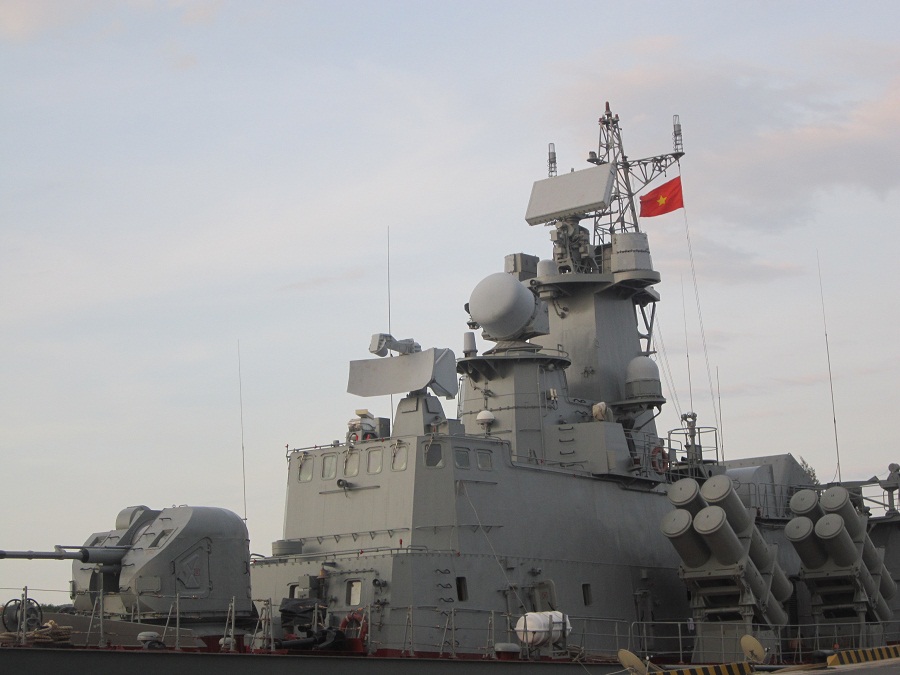
So they are not likely to be illumination radars for SAMs. They are not for gun control either, so its possibly a some kind of surface search radar for anti-shipping.
SAM FCS radars are likely to be the square-like radars located below the navigation radars.
AndraxxusThe advantage in a dogfight at low altitude has more to do with sustained turn rate. The mb-339 does not have hardly any drag induced by high AoA turns like those induced by the knife edge airfoil of the F-15. In the very thin air of high altitude this kind of drag is not as much of a factor and so the mb-339 loses this advantage
I disagree. Mb-339 has 19,3m2 wing area, vs F-15’s 56,5m2. If they use same airfoil F-15 has 3 times drag at same AOA, but it also has 12 times engine thrust. F-15’s airfoil is NACA 6 series, by definition this series is designed for subsonic laminar flow. Mb-339 may have thicker airfoil than F-15, but it also adds to drag while improving the lift for instantenius turns and stall speed. For sustained turns, thinner airfoil is better, but still it wont be enough to overcome the better engine thrust of F-15.
Actually Mb-339 will have better chances when high and slow, due to its very low wing loading, when F-15’s smaller wings will struggle to generate enough lift.
AndraxxusMethod of supporting front line units depends heavily on circumstances. For example while fighting with terrorists, shelling enemy postions with heavy artiller appear to be most useful, but after terrorists escape into mountinous areas, artillery and fixed wing aircraft cannot reliably find and target them, and helicopters are the only sure way of pursuing them.
One has to remember CAS is not only about protecting ground troops or hitting points they designate. There are scenarios fixed wing aircraft will work better (better response time, better payload etc) and there are scenarios rotary wing aircraft will do better.
AndraxxusPAK-FA’s bays are said to be 4.6 meters long, and wide enough to carry two Kh-58UShKE; IMHO for each station, 2x FAB-500 can be put in tandem. For KAB-500, its not possible. As for R-77, there are two stations, a double MER for R-77 will simply not fit, and there is no 2-to-3 ejector rack; neither planned nor wanted.
hi-res version:

It doesn’t look very official or reliable to me.
AndraxxusDoes it specifically say internal bay? Because it also says 8xRVV-AE too. KAB-500Kr has some 3m length, and IMHO its 4xKAB-500 internal and 4 additonal on pylons.
Though I believe they can fit 4xFAB-500 M54s per bay if they really want it, its length is around 2.2m.
AndraxxusAre you saying that the Defense Science Board report is wrong?
After spending half hour skimming through the C-130T flight manual, I am starting to think all the Wing relieving fuel thingie is full of crap due to wrong numbers and estimates..
Aircraftweight limits may be divided into two categories: grossweight limits and limits on cargo-fuel combinations.
The grossweight limits in this chapter are designweights onwhich airframe strength is based. Taxi and landing gross
weights are limited by the strength of the landing gear and the related fuselage structure. Takeoff and flight gross
weights and cargo weight are limited by wing strength and the effects of fuel weight and distribution, airspeed,
maneuver, and turbulence………. Alternatively, airspeed andmaneuver load factor may be limited bywing and empennage strength, cargoweight, and
fuel weight and distribution. Fuel weights for taxiing and landing are limited by wing strength and landing gear
shock-strut reaction.
In short, DSB is right about there IS a limitation about fuel and cargo weight combinations.
[ATTACH=CONFIG]235671[/ATTACH]
And according to the Sheet2 of figure 4.6, there really is a need for a Wing relieveing fuel. Following “not recomended” area E; any payload greater than 49000 lbs to 60000lbs, (not 35000lbs as DSB predicts) there is a need for 3000 to 25000lbs of fuel to stay in “recommended” Area C.
Operating below 49000lbs, Fuel/cargo weight relation appearantly doesn’t really affect take-off/landing performance, but it both affects maximum allowed load factor, and maximum recommended airspeeds. according to sheet1 of figure 4.6.
[ATTACH=CONFIG]235673[/ATTACH]
Also this graph is self explainatory; more fuel the outboard fuel tanks have, more MTOW the C-130 is capable of. However with secondary fuel flow (means manually operated by pilot) C-130 can take-off at 155 lbs, deplate all inboard fuel first, then gross weight drop sufficently so deplating outer fuel tanks completely is still allowable.
Heres the further text from the manual regarding limitations.
[ATTACH=CONFIG]235674[/ATTACH][ATTACH=CONFIG]235675[/ATTACH]
AndraxxusThus, it seems all the peculiarities are for structural reasons. In effect, the theoretical maximum payload is an overload payload for relatively short distances only, & if you’re not loaded to the brim, the basic C-130 should be more efficient & longer range than the -30 – but I’ve not found any figures which confirm that.
I don’t think thats the case:
“Range with 35,000 pounds of Payload:
C-130J, 1,841 miles (1,600 nautical miles)
C-130J-30, 2,417 miles (2,100 nautical miles)
” says the factsheet.
Without WRF, C-130J-30 still has longer range. I think IMHO, my explaination is more valid; with numbers:
C-130J = 85000lbs empty, 35000lbs cargo, 155000 lbs MTOW. On board fuel = 35000lbs.
C-130J-30 = 88000lbs empty, 35000lbs cargo, 164000 lbs MTOW. On board fuel = 41000lbs.
Standard reserve fuel for C-130 is 4500lbs;
(41000-4500)/(35000-4500) = 20% greater non-reserve fuel capacity.
As this 20% additional fuel would be used solely for cruising (both aircraft will use similar fuel for take-off/climb/landing), it could easily explain the additional 31% range.
According to C-130T manual; C-130T (equal to A/B/E/F/G/H/K models) has following fuel capacity;
33646 lbs main tank only.
45900 lbs main tank plus auxillary tanks.
64654 lbs main tank plus auxillary tanks plus external tanks.
Fuel capacity is by itself irrelevant, as both aicraft will be half filled while lifting 35000lbs due to MTOW.
AndraxxusTake-off & landing weight are related primarily to landing gear strength. Without changing anything else, stronger landing gear (or simply stronger tires in some examples) can lead to greater take-off weight.
Havent run the numbers, but only explanation is that due to limited MTOW, C-130J may need to take off with less than 100% fuel at given payload, but C-130J-30 may be able to take off with greater amount of fuel plus the same payload.
Or simply C-130J-30 has greater fuel capacity and we dont know about it. However, factsheet also says C-130J-30 has ~6% greater MTOW than C-130J, and ~6% less range when both aircraft is at their max payload. This can be explained; same L/D 6% increase in lift (level flight) will also increase drag by 6%, cutting the range by same amount, I dont believe there is mentionable fuel capacity difference.
AndraxxusBoth vanilla birds are horribly outdated in any case.
Su-25SM3 really should be the bare minimum for any new CAS purchases/modernizations. Flying either the A-10 and Su-25 without DIRCM today is just stupid.
I agree that DIRCM and MAWS is a must for any new modernization/purchase today, but I don’t think flying without them is stupid or not having them automatically makes aircraft obsolete. MANPADS weren’t a lesser threat in 1985. Its true seekers have improved in last 30 years, but so does the countermeasure flares. Vanilla Su-25 did well enough in 1985, IMHO it will do just as well today; by simply using flares, tactics, maneuverability and armor.
Andraxxusit would make such slow and heavily armoured types like A-10 and Su-25 fairly irrelevant – no wonder the USAF have been trying to get rid of the A-10 for years.
True, if everything works as advertised. Eventually, when technology will guarantee every target can be detected and destroyed from long ranges, they will be irrelevant. USA, Russia or even Ukraine has aircraft to use PGMs from distance to bomb a specific location. And even in the latest conflicts like afganistan, georgia or ukraine A-10 and Su-25 is heavily used. So for today getting close to enemy is still a necessity and heavy armor is still useful.
Wrong. These aircraft would not survive most modern air defence systems like you mentioned (Tor-M, Tunguska), not a chance.
Why have you got this fixation on the idea of the Su-25 carrying out SEAD? I don’t think this is the assigned role of the Su-25 in RuAF service and they are unlikely to be equiped for the task. Su-24 and Su-34 are Russian SEAD attackers.
We are not comparing assigned role, but available capability. Su-25 is capable of SEAD. IF needed, and no other aircraft is available, Su-25 can do it. And by definition of SEAD, it can not only survive, but also take out Tor/Tunguska or similar systems from distance.
For example both Su-25 and A-10 are capable of carrying A/G munitions on outermost pylons. Should I ignore this capability as well, simply because it isnt used in real life?
AndraxxusI personally have never understood the fuss about the GAU-8/A. People get carried away by its enormous proportions completely forgeting that sheer size and weight are negative parameters, not positive. IMO, this cannon is way too heavy, too complex and too maintenance intensive for what it delivers.
I agree 100% on this and rest of your comment, however I still think gun’s firepower was not a high priority on Su-25 as it was on A-10. I mean, GSh-6-30 was readily available back then; Now one may argue there is not much difference between GAU-8/A and GSh-30-2, due to former’s spool up time and low rate of fire, but GSh-6-30 is another monster. Gas operated so it could spin up very fast, 6000rpm would double the rate of fire, sustain it 3 times as well (barrel count). Plus it was similar in length to GSh-30-2, and only 40 kg heavier. It could fit easily, and extending the airframe by just 24cm would make room for 1000+ 30×165 rounds.
IIRC, Sukhoi considered GSh-6-30 on Su-25 and appearantly didn’t like it then GSh-30-2 was designed for Su-25 (and Mi-24P). In fact, this reminds me one important advantage of GSh-30-2, over GSh-6-30 or GAU-8; it was built primarily for reliability and ruggedness, esspecially in dusty environments, so its possibly more reliable than most aircraft guns out there. Its actually quite heavy when compared to other GSh guns: GSh-301 = 45 kg, 1800rpm; GSh-6-30 = 145kg, 6000rpm; GSh-30-2 = 105kg, 3000rpm; all firing the same 30x165mm cartridge at similar muzzle velocity.
All in all, both guns are capable to deliver roughly the same kinetic performance.
On this I have to disagree. While 30×165 projectiles hare slightly heavier than 30×173 (AP rounds: 400g vs 395g, HE-I rounds: 389g vs 378g) GAU-8/A has 13% higher muzzle velocity, equals to 29% higher muzzle energy. This should translate to better armor penetration and better accuracy at longer range. For Russian equivalent, kinetic performance of GAU-8 is more similar to 2A42 gun. Also GAU-8 can fire for several seconds without even worrying about barrel overheating. Those are some clear advantages of GAU-8/A on paper. How important are these in real life? Possibly irrelevant, as aircraft will be moving fast towards its target, zone that GAU-8 can kill the target but a GSh-30-2 can’t is really tiny.
AndraxxusSu-25 doesn’t use a gattling gun, Gsh-30-2 is a gast gun. GAU-8 weigh ~3 times as much as GSh-30-2, and A-10 carries ammunition for ~3 times long firing time. Simply put, A-10 is built around GAU-8, Su-25’s design doesn’t prioritize a gun and have it in the lightest way possible.
I don’t think anyone can know anything about RCS of Su-25 or A-10, but I don’t think A-10’s RCS will be smaller, when it has two huge fans faces in the open and a much more complicated shaping, and a larger airframe.
AndraxxusThat’s a strange way of looking at the survivability of an aircraft – I don’t think Tu-160s or B-2s carry anti-radar missiles either, nor do most Su-27s or MiG-31.
If you look at it this way any payload has nothing to do with survivability.. However the post was strictly about payloads, and some others “considered” PGMs are an advantage of A-10 in (terms of survivability), so that it would be further away from the SAM threat and not get shot down. I agree to that perspective; I believe munitions that can deal with the enemy better, quicker, or further away from the enemy is a KEY part of survivability.
A-10/Su-25, are CAS aircraft, they are expected to operate right within range of enemy SHORADS. For a pre-planned attack againist a tank brigade that is protected by numerous Tor-Ms, Tunguskas etc, sole ability of carrying Kh-25MP, Kh-58U and Kh-31P (on newer variants), improves survival chance more than anything; armor, PGMs, maneuverability, DAS etc. In fact a pair of anti-radiation missiles can improve survival chance from close-to-zero to very-high.
Judging past examples, I can confidently say Georgian BUK/KUB had little means of shooting down an Su-25, should the presence of those SAMs were foreseen and/or discovered, well-prepared Su-25s could also have done a SEAD while going into Georgia. (Perhaps they did, and only the ones they missed caused problems. We’ll never know for sure) Thinking about Iraq, I can’t say the same for A-10; it had little means of fighting back the SAMs that shot them down. How is this irrelevant to survivability? I find it strange that you find this idea strange.
Your Tu-160/B-2 Su-27 MiG-31 example is nonsense to say the least. a) none of these aircraft is expected to operate under constant threat of getting shot by variety of SAMs, b) their mission has no direct relation to SAMs. If you are expecting Russians would oparate Tu-160 within eye-sight of enemy SAMs, that is a strange idea too.


 Sign In







