 Andraxxus
I don’t think its misleading at all. Thing to consider is, AIM-120 do have 9 second boost, but it does not only gain M4.5 airspeed; it also gains 15++ km altitude during that boost. Gliding at M3.0 on average at 25000+ meters is hardly draggy, due to extremely low air denisty. Flying about 50 or so km at 20km altitude, then hitting a non-maneuvering target at 15 km altitude at 95km. It doesn’t need M1.5 for such terminal approach, it would only need to reach target point. Effective? No. Possible? Yes. IMHO, its also possible to reach a non-maneuvering target at 42 km range at 25km altitude.
Comparing with known data; R-27RE has 117 km maximal head on range, but its effective kill range is 65,5 km. Assuming same ratio applies; AIM-120C-5 wont have effective kill range greater than ~53 km @ 15km altitude.
Andraxxusyou can NOT take the V out and write:
(V/2G)d(V)/dt
Otherwise you’re right in saying that there’s an acceleration as V^2 is increasing and d(V^2)/dt is positive.
I can’t? Math 101;
Its a matter of simplification has nothing to do physics behind it. v*dv/dt = 0 if a = 0
345m/s is not M0.9 at any altitude unless it’s a very hot day at sea level.
MiG; engineers say othervise. MiG-29;
[ATTACH=CONFIG]229939[/ATTACH]
Also General dynamics engineers;
F-16@22000 lbs has 1000 feet per second = 304,8m/s @ M0,72 = 247m/s. Note that I circled STD DAY conditions.
[ATTACH=CONFIG]229940[/ATTACH]
Or McDonnell Douglas engineers of F-18;
[ATTACH=CONFIG]229941[/ATTACH]
Not to mention Boeing engineers of F-15, Sukhoi engineers of Su-27? But they are ALL wrong and you the lukos the infallible is right, right?
The equation you’ve written actually gives the rate of change of V^2 not acceleration. There are simpler ways of estimating acceleration. I.e. the specific excess thrust, which is actually:
They are indifferent from energy gain AND MATHS (see above) perspecive, I don’t know how one can be so thickheaded to comply with this.
So once you use that excess power to achieve maximum climb rate, V is no longer equal to 309m/s, otherwise a climb rate of 345m/s would be impossible.
Still you are not getting the point AT INSTANT V=309m/s, MiG-29 achieves 345m/s climb rate. There is no “no longer” thingie about it. Its irrelevant if this is physically possible or not; this is not “MiG-29 can climb 345 m/s @V=309m/s” statement. It is “MiG-29 has excess power equivalent to potential energy gain of 345m/s climb rate”.
That is why you are completely wrong in your following calculations:
Vertically,in a stable climb, (T-D)sin(Aoc) = ma x sin(AoC) = W = mg
ma x sin (AoC) = mg
a x sin(AoC) = g
Even going completely vertical at 90 degrees; an object with airpseed of 309m/s cannot have greater than 309m/s climb rate; but MiG-29 is known to have 345. So Your climb angle calculations are invalid due to (T-D)sin(AoC) = W cannot be valid;
Since you like accurate numbers, let me explain this way;
(T-D)/W*V = 345 when V = 309m/s;
(T-D) = W*345/309;
(T-D) = 1.116*W
You have to take arcsin of 1.116 which you cant, and due to you ignore the validity for input/output range, you take the the arcsin of 1.116^-1 (0,896) which gives out your 63,64 degrees, which is WRONG.
It’s not really that valid. If you look at the equations above, it’s using the wrong ratios and therefore getting the wrong answers.
SO YOU CLAIM TWO EQUATIONS PLUS THREE CLIMB RATE GRAPHS ON MIG-29 FLIGHT MANUAL AERODYNAMICS BOOKLET IS WRONG????
Andraxxus is wrong, Amiga500 is wrong, 800+ engineers in MiG design bureu are also wrong, they designed MiG just by pure luck, only lukos is right. Why? because he is right and he also has PhD.
Perhaps its you who is using wrong ratios and getting wrong answers?
AndraxxusPS : can anyone calculate max ceiling for F-35 ?
Sometime ago I’ve made an excel file calculating F-35’s performance with sh*tloads of assumptions that everything is as generic data (cd,cx change as generic area ruled aircraft, inlet efficiency same as fixed inlet etc etc) It had its own topic I wont get into details, but same model can be used to calculate level flight envelope (by M0,05 intervals; drawing the area if aircraft can sustain 1G+)
It yields this graph (note the billions of factors that would contribute to inaccuracy).
With 50% fuel and 4 AIM-9 missiles (assumed internally, only contributes to weight) F-35@17847kg
[ATTACH=CONFIG]229933[/ATTACH]
Also for 1G specific excess power with same payload, MIL thrust and full ab thrust;
[ATTACH=CONFIG]229934[/ATTACH]
For top speeds, looking at SEP=0 points indicates these 4 things;
F-35 can go ~M1.1, 1360km/h @S/L with Full AB;
F-35 can go ~M0,96 @S/L with MIL thrust.
F-35 can go somewhere around M1,66@30k feet @Full AB;
F-35 can go M1,08 with MIL thrust @30k feet; I would not count this as supercruise as any 4gen is capable of such speeds when clean.
AndraxxusBy the way; your calculation is fundementally wrong;
V = { [T-Wsin(AoC)]/[0.5 x Cd x A x Density] } = 429.015m/s
You are trying to find V in meter/second; (kg*m/s2)/(number*dimesionless*m2*kg/m^3) will give you m2/s2 not m/s
Truly a fatal mistake for anyone to claim himself an engineer; let alone having degrees or PhD etc.
AndraxxusYou need to show your working from first concepts because at the moment it just look plain wrong.
Like I said, I don’t go vectoral calculations; I go from energy calculations, take L=W and dE/dt = (T-D)*V. SEP is irrelevant of W; dividing both sides will give dH/dt = (T-D)/W*V as SEP or inst. climb rate;
Then I ratio them, assuming same V; so dH1/dH2=(T1-D1)/(T2-D2)*(W2/W1).
W can be ratioed accurately; but I use, (T1/T2)-(D1/D2) in place of (T1-D1)/(T2-D2); I know its inaccurate; but better than nothing.
This is where I disagree, V will not be the same and cancel and must be recalculated based on some kind of force balancing or account of a maximum on a SEP graph. Assuming the same Cd, or same climb angle (AoC) is fine but V will change and will likely be greater for aircraft with a larger T-D value. There are also problems with the mathematics of how you’re doing the ratio besides that and because of it. Because the different optimal V will also lead to a different optimal D, so it won’t move linearly with A. .
You are right if you are absolutely through and exact; However from experience; most aircraft achieve this around same airspeed (MiG-23@M0,85 MiG-29@M0,9 F-16@M0,82 Su-27@M0,84 etc etc). Its a valid assumption to simply ratio things.
The bit in bold. Assuming V is the axial velocity, you obviously can’t get climb rates >300m/s if V is limited to M 0.85 @SL and you aren’t even going directly up.
In fact, its pretty logical if you look at from energy gain point of view; A MiG-29 @12800 kg has 345m/s climb rate at M0,9 as its manual suggests; Even if climb angle is 90 degrees; Vsin(theta) will prevent actual rate of climb to be greater than 309m/s. So what happens? 309 of the 345m/s excess power is wasted on vertical climb, and remaining 36m/s is used for acceleration while conducting vertical climb.
To make it more scientificc; typically this is where this formula has its use;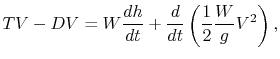
Divide both sides by W; assume W doesn’t change with respect to time so move it out of differantial part; eqn becomes
(T-D)*V/W = dH/dt +d/dt(V^2/(2g)
You know MiG-29’s SEP (T-D)/W*V = 345 m/s and max current rate of climb is 309m/s as limited by Vsin90;
345m/s – 309m/s + (1/2G) dV/dt*V where dV/dt is acceleration, positive indicating MiG-29 is accelerating in a 90 degree climb; math will follow to find the exact value.
SEP gives impressive statistics about aircraft performance; take dH/dt = 0, and it will give you level flight acceleration of the aircraft by;
345m/s *2G/V = acceleration@M0,9 for example. Check the formula by its two dimensions m and s; (m/s)*(m/s2)/(m/s) = m/s2 and see it to be true.
Assuming you’re just using that as a starting point for the climb, calculating the increase in SEP at this speed from ratios is incorrect because if I take a simple situation where:
T = 10
D = 5
W = 5(T-D)/W = 1
If I increase T by 50% and D and W by 10%
(T-D)/W = 1.72 = [(15-5.5)/5.5]
1.72 is nowhere close to (1.5-0.1)/1.1 = 1.27 out by >26%.
W can be ratioed; but you are most definitely right that T and D can’t be ratioed that way due to addition/subtraction, we cannot get it out of paranthesis and group as a ratio. However as I don’t know T = 10 and D = 5; I have no means of implementing this; This is the prime reasion why I rated accuracy so low, because margin of error is huge(not because I assumed Rafale has same Cd as M2k); from numeric analysis POV, this should work as long as T is close to D; and margin of error will increase with their differences increase.
I assumed 60 degrees as best angle of climb (BAOC) because that seems to be roughly what fighters seem to use. You’d do well to go through that calculation.
Its still wrong, however because you are still taking this as actual climb; see MiG-29 example I mentioned and calculated above; source
[ATTACH=CONFIG]229927[/ATTACH]
I added some number and lines in paint don’t bother them; It was for another topic, too lazy to reupload the clean image.
Explain these figures with your methodology and I will go with your calculation;
M0,5; V= 171m/s -> 180m/s climb rate.
M0,7; V= 240m/s -> 280m/s climb rate.
M0,9; V= 309m/s -> 345m/s climb rate.
Assuming you accept MiG engineers are capable enough to provide correct climb rates for the aircraft they designed; tell me; what BAOC would MiG-29 require? 60degrees? 90degrees? 90+? Or perhaps its time you accept your methodology is wrong when talking about “climb rate” that means “specific excess power”.
PS; You made me notice an interesting thing; MiG-29s Vy*is always greater than the V*sin90 until M0,9, meaning it could go vertical climb and still accelerate at below M0,9 airspeed @ S/L, 12800kgs.
AndraxxusI’m referring to a zoom climb not a sustainable climb.
Indeed you are. and problem is, even in zoom climb, your energy gain will wont change. In my calculation you will gain X amount of PE and 0 amount of KE. If you go through long version, You will gain X+Y amount of PE and lose Y amount of KE; net result will still be X.
Well the word is confusing because they’re actually talking about something that’s sustainable at that point in time.
Yes! Finally we are talking in the same language. Its called instantenious because the instant aircraft gains 1 meter altitude, there will be change in air density, so all thrust drag and weight will be affected; as aircraft gains altitude, it will lose climb rate even though airspeed stays the same.
The problem is that whilst max climb rate is given by max excess power, given by:
[(F-D) x V]/W
The V in the equation is not the climb rate. Even in the equation pertaining to a Mirage 2000, the V is not the climb rate, the result of the whole equation is. That V which delivers maximum climb rate will change from aircraft to aircraft in a none linear manner. SO plugging in 285m/s V is complete crap and deserves, Accuracy 0/10.
I NEVER said that. V is the velocity; Assuming same V (which pretty valid for max climb rate, always around M0,85 and S/L); if you ratio New vs Old at same speed;
NewClimb/OldClimb = New(F-D)/Old(F-D)*(OldW/NewW) and “V” will cancel out.
What I assumed is Cd will be same between New and old, so D relation will be dependent on wing area alone.
As I have no initial data; I used “(NewF/OldF)-(NewD/OldD)” instead of “New(F-D)/Old(F-D)” Inaccurate I am fully aware of it, (hence why i called it so inaccurate; it would have much greater accuracy othervise).
Now explain how that applies. It’s just stating this with different symbology:

same as this actually; but as dV/dt = 0 you have to ignore KE change. If you dont; aircraft will trade PE for KE, and you will go through long and useless calculations to find same dE/dt or dH/dt, more likely you will make a mistake in your assumptions or calculations.
AndraxxusMaximum instantaneous climb involves starting from maximum speed in level flight KE and going into a vertical climb. At this point T = D, so you need to work out level flight V based on T, A, Cd and air density.
WRONG WRONG WRONG. Instantenious climb rate is where of KE change is 0 and the ability of aircraft to gain altitude AT GIVEN SPEED.
[T/(0.5 x Cd x A x Air Density)]^(0.5) = V
Horsesh*t
You start with KE and Rate of change in KE = Rate of change in PE. So
WRONG; If you were corret, all aircraft would have better climb rate at M2.0 than it has at M0,8. And ALL aircraft would have same SEP. Neither is the case.
Essentially this but T-D = 0 because you’re starting from maximum level flight speed and we’re assuming instantaneous transition to vertical climb.
WRONG. Instantenious climb rate is given FOR a specific speed. Just ignore “instantenious climb rate” and focus on “specific excess power” if the word “climb” troubles your mind.
Rest of your post is nonsense, because what you post is correct, but you simply don’t know what you are calculating.
From MiG-29 Aerodynamics booklet;
Vy* = (P-X)/G * V = (P/G-(Y/KG)*V = nxV
[ATTACH=CONFIG]229907[/ATTACH]
I don’t know how one can be proven WRONG so many times and still try to be smart-a** without a face. But of course; you know more than the MiG engineers too right? And since you can never be wrong, its the MiG engineers must be wrong. Also, typhoon is the best !!!11 . Have a nice day…
Andraxxus1.14 I don’t see an origin for.
Weight ratio. as SEP is irrelevant of weight, I would need that dimensionless ratio too.
AndraxxusCorrect, with the thrust and drag being addition/subtraction, a simple ratio cannot be applied.
Entirely true, for subtraction we would need to know exact data. As I don’t have I simply ratioed them.
Andraxxus@lukos Again you are spreading BS without slighterst idea of what you are talking about.
Force = T-W-D = 0 (not T-D)
D = T-W
and this is the apex of it. Firstly you cannot add forces in different planes like that; Secondly Drag = Thrust-Weight ROFL; WTF?????
Thirdly; an aircraft at an equlibrium state has L=W and T=D. This is also equal energy state because as Fnet is 0, dE/dt = 0. This state does not change if aircraft climbs or dives; an aircraft gained 1000 meter in altitude will lose 140m/s airspeed, but total energy of aircraft will newer change. Only way to change this energy state is increaing the T.
A 10 ton aircraft with 300m/s climb rate has 10000kg*9,81*300m/s = 2,94 kW excess power. It can use it for climb, accelerate, or for ANY combination of two. It can even dive, and accelerate quickly, but ability of this gain wont change, period.
This excess power is provided ****ONLY**** by “Thrust-Drag” equlibrium.
You can calculate any sh*t you want, it doesnt change SEP; you waste your time calculating how in change in KE affects PE or vice verse. Energy is a SCALAR quantity that doesn’t give **** about your calculations involving climb angle or anything.
In order to calculate a energy state; you assume level flight where L=W, but (T-D)*V will give energy gain rate on level flight. Then you convert this to dH/dt or dV/dt to find acceleration or climb rate at that instant. THIS IS THE METHOD TO DO IT, as its shown in fluid dynamics II, turbomachinary, advanced aerodynamics, and thermodynamic I and II courses, PERIOD. *** removed by moderator***
Andraxxus@TomcatViP
The problem is there is no certain coefficient or even a certain method to determine how much lift improvement or how much reduction in drag occurs without also knowing elevator cl/cd Cg distance etc etc. More, Phi angle is continiously variable during flight conditions, impossible to guesstimate that;
Take Su-27S for example;
[ATTACH=CONFIG]229866[/ATTACH]
Even for level flight; Su-27’s stability behaviour continiously changes; Its completely negative stable at 2000m or 6000m, with instability increasing at transonic regime. At 10000m, it behaves just opposite, aircraft switches to positive stable at transonic, and gets negative stable at high supersonic if armed, etc etc.
Now worse, we are talking about a maneuvering aircraft adding even more to this variation. I can’t even do it for Su-27, even though I have this graph. My estimates are spaculations without slighest info about wings cg or anyting specific to the aircraft. There is really no way to add this to the equation.
AndraxxusNo account of rate of climb being a velocity and therefore involving a squared relationship to drag. They’re the most bafflingly incorrect calculations I’ve ever seen. Wrong inputs, wrong methodology.
If I was working out a climb rate, which I wouldn’t, I would start with T-W. The difference is then taken up by the drag force, which is proportional to velocity squared. So it would go something like:
New figure = Old Figure x (1+[[(T%-W%)/D%]^{0.5}])
Your way of thinking is correct, but resulting mathematics is, as usual, wrong.
-Energy = Force * Distance
-Energy gain rate with respect to time = dE/dt = Force * Distance/dt
Force = Thrust-Drag
distance/dt = Velocity
Potential Energy = mass *g*Height.
Potential energy gain rate = dE/dt = mass * g*dH/dt
Equalizing energy gain rate to potential energy gain rate gives us dH/dt = (Thrust-Drag) * Velocity / (mass *g)
this climb rate in m/s gives *specific* excess power; simply by multiplying with “mass*g” will give dE/dt, energy gain in Joules.
Again, no; “Thrust – Drag” affects climb rate linearly.
AndraxxusAre flight manuals completely reliable sources of an aircraft’s flight performance parameters?
YES THEY ARE. They are far more reliable than *ANYTHING* out there. They are the results of comprehensive testing done a)by the manufacturer b)for the pilots who fly them c)on scientific grounds; not better worse; XX amount performance by YY aircraft at ZZ altitude in AA air conditions BB. In fact they are the single FACTUALLY RELIABLE source, as they are inherently objective, no reason to pimp up, or undermine a performance. Its about what aircraft can do, or can’t do.
He effectively ranked unknowns based on total bollox and didn’t even do it with a nod to basic physics in the absence of figures, hence why some aircraft are definitely out relative to each other.
By definition, if you are estimating something, you fill unknowns with assumptions, ratios etc etc etc. I dont claim they are accurate, in fact I am the first one to say its inaccurate.
From that list, there’s no official data on the:
F-22;
F-35;
Typhoon;
Rafale; or
Gripen.
Again I never quoted an official data about them, so I rate my estimates with low accuracy; Go and look at the dictionary meaning of “estimate”
A Rafale out-climbing a Typhoon?
I don’t say that, you are -once again- showing your ignorance; what greater instantenious climb rate means greater excess power at 1G state. It could translate to better acceleration or climb at an instant, but an acceleration from X to Y speed or X to Y altiude is an average value.
E.g. F-22 lower STR than F-15. How?
Frankly, I dont care s**t about which one has higher STR. I run the numbers for the defined condition and I post them here. Dislike them? Your problem. Only thing to verify is F-22 flight manual, which none of us have. You can run your own estimates by timing 360 turns of F-22 in airshows, -which are not impressive either- And I will listen. No, some BS spread by a clown general doesn’t count, its SUBJECTIVE IDEA.
Using flawed empty weights from wikipedia for the F-15.
Once again, If I have the flight manual, I take the data from it, I have no reason to use wiki. Oh wait, I will spam this post with pages from the manual -WHICH I HATE DOING-, lets see who is flawed;
F-15C Empty weight;
[ATTACH=CONFIG]229864[/ATTACH]
Typhoon lower climb rate than Rafale? How?
Why not? Is Typhoon a divine product that no other aircraft can be better than it?
Wrong inputs, wrong methodology.
Then why don’t you do your own?
the guy also states about 28deg/s STR for the Raptor. Is it bull****?
Yes, more than bull****
The problem is that the wing loadings are the same (in fact the F-15’s wing loading is probably higher if you take the loaded weight of an F-15C), the Raptor is a generation later and probably has a far more optimised lifting design, plus the TVC on top of that. So it’s not really even a well placed assumption.
Problem is, we are not talking about LOADED F-15C or loaded F-22. I have no problem accepting there will be conditions, where F-22 could outperform F-15C. TVC has nothing to do with ITR or STR.
Some of the predictions in Andraxxus post does not take into account the negative stability that was introduced with 4.5 gen a/c. I believe that has a large impact on agility, especially supersonic agility.
Negative stability was also present in F-16 and Su-27. It does have impact, I don’t deny that, however, TBH I have no means of implementing that into my estimates. So going estimating F-22 by using F-15 or Rafale by Mirage2k may not be exact, but a) but I don’t have anything better. b)such way of estimating (by ratioing things) is never supposed to be accurate anyway.
Andraxxuscan you do the same for interceptor like mig-31 and f-14 ? And old fighter like mig-19 , mig-21bis
I have flight manuals for some I’ll see what I can do tomorrow.
btw why the f-16 fly like a brick there :-?especially compared to gripen and mig-29 despite all are light weight fighter and the range here is only 500 km. I always thought it was the most agile 4 gen
It is most agile depending on conditions; MiG-29 has very efficient engines for cruise, but they are very fuel hungry at full AB; For example If your criteria was “2 minutes on full AB M0.85 S/L” instead of “500 km range” F-16 would need 1148 kg of fuel; MiG-29 on the other hand would need 1680kg of fuel, and F-16 should perform better than MiG-29. Likewise heavy fighters like F-15 would have been affected more; an F-15 has ~0.16nm/lb fuel efficiency compared to F-16’s 0.20nm/lb. However their full AB fuel flow are 2200lb/min and 1265lb/min respectively. In short, comparing F-15 to F-16, there is only ~25% increase in fuel consumption while cruising but 174% fuel required for full AB maneuvering. So if mission demands more sustained combat at less range, F-16 should perform better than F-15; however when fueled for same range only, there is nothing that can beat a Su-27 or F-15 on paper.
How fast will it go at 18k meters ?
Btw why the mig-29 can fly much higher than f-16 ? What the different ?
[ATTACH=CONFIG]229845[/ATTACH][ATTACH=CONFIG]229846[/ATTACH]
Ceiling mostly depends on the ability to generate lift at thin air; which is achieved by a) larger wings b) very high speed; F-16 at 24000lbs is the equivalent of MiG-29 envelope (@50% fuel); MiG-29 has lower wingloading and variable inlets; former assists in moving the ceiling up and latter allows higher ceiling at high speeds; very well pronounced if we are to look at the ceiling at M2.0.
Also there many figure for f-35 service ceiling on internet ranging from 50k feet to 60k feet which one is more likely true according to your aerodynamic model ?
My model merely calculates kinematic performance at two different altitudes, with slight alterations it should give a ceiling data; note that its a simple excel file and inherently inaccurate, but I will look into it
Andraxxus@lukos; You have a problem or you post just to show your idiocy? Still having problems sleeping after half dozen forum members laughed at your face because of your inability to admit you are wrong?? Just STFU if you have nothing to contribute.


 Sign In







