 Andraxxus
F-22 is muhc faster than F-15 even without the moving ramps (which it has some nice alternative solutions for). T/W is only one thing – thrust to drag is another. Few planes go as easily through M1.0 as the F-22.
Funny thing is you neglect the fact moving ramps clearly effect the “Thrust” part of the Thrust/drag ratio. While we are talking about drag;
F-15 airfoils: NACA 64A006 root, 64A203 tip; F-15 wing area 56,5 m2
F-22 airfoils: NACA 64A?05.92 root, 64A?04.29 tip; F-22 wing area 78,04 m2
-While camber is undisclosed; this shows F-22 wing has nearly same % thickness at the root; and its thicker at the tip, which should mean higher Cd at same AOA. F-22 weigh 24300 kg and F-15C 16392 kg. 42% increase in weight, compensated by 38% greater lifting area. Similar airfoils ensure lift and drag coefficients remain similar. As F-22 needs to to generate 42% more lift to remain in the air, this also means generating ~42% more drag in the process.
-In terms of static thrust, F-22 has 45% better thrust to compensate its 42% percent drag; which begins to degrade as soon as aircraft reaches M0.85, due to lack of variable ramps. So yeah, F-22 should have comperable acceleration at subsonic, maybe better acceleration at transonic, but at above M1.2, I don’t see any single quaility in F-22 which makes it even slighltly faster than a clean F-15.
Note that this comparison is strictly on wing/weight/thrust basis. Neglecting the aerodynamic sacrifices F-22 may have by following a VLO shaping, and the need to carry internal bay / larger fuel tanks etc etc.
Oh; before dismissing the importance of variable intake ramps, simply look at how F-16 compares to MiG-29 from M0,8 to M1,2 acceleration (8 seconds faster = 23% superior) and from M1,2 to M1,6 acceleration (9 seconds slower = 34% inferior). Inlet ramps not only mean higher speed, they DO help in supersonic acceleration.
AndraxxusSince when was the F-22’s acceleration specs released? And am I supposed to believe that the Su-35S accelerates better in the supersonic than the F-22?
No. In fact with 50% fuel, Su-27/35 has inferior acceleration to most aircraft types. However when fuelled for equal range its quite possible.
However, if we are talking about precise validity of the graph, none of these numbers are factually correct. Here are some numbers from their respective flight manuals:
F-16: M0,8 to M1,2 -> 34 seconds; time to M1.6 (from M0,8) -> 69 seconds; top speed = M1,91 (which looks correct in the graph)
MiG-29: M0,8 to M1,2 -> 42 seconds; time to M1,6 -> 68 seconds; top speed = M2,25
F/A-18C (with 2x AIM-9+2xAIM-7): M0,8 to M1,2 -> 48 seconds; top speed M1,51
F-5E: M0,8 to 1,2 -> 84 seconds; top speed M1,45 (looks correct)
To add some other known aircraft to these;
F-15E (PW-229, with 4x AIM-7): M0,8 to M1,2 -> 36 seconds; time to M1,6 -> 66 seconds; top speed = M2,1
Su-27S: M0,8 to M1,2 -> 50 seconds; time to M1,6 -> 83 seconds; top speed = ??
MiG-23ML M0,8 to M1,2 -> 48 seconds; time to M1,6 -> 75 seconds; top speed = M1,8
F/A-18E (with 2x AIM-9+2xAIM-7): M0,8 to M1,2 ->~54 seconds top speed = M1,46
As for Su-35; it has same aerodynamics as Su-27, and due to increased fuel capacity, it has same (or similar) T/W with Su-27 at 50% fuel load, so I expect same acceleration from it.
As for F-22, It has same T/W as F-15E and similar aerodynamic layout. Sure it does have some aerodynamic improvements, but it also lacks variable ramps so, IMHO, those values are greatly exeggerated and F-22 fall very close to F-15/16 and may even fall behind them at some speeds.
As for F-35, altough fat and underpowered, its roughly comperable to F-18E in acceleration, so I find 57 second estimate (M0,8 to M1,2) to be valid. However, none of the other aircraft performs as good as the graph claims.
AndraxxusTwo thoughts…
1-Why is always “Kinematic performance comparsion” turns into “x can defeat y before blah blah blah” argument? We all know F-35 can easily defeat MiG-21 in BVR. Most will also agree on that MiG-21/K-13 combination has little to no chance againist F-35/AIM-9X combination in WVR, not to mention VLO airframe and all the equipment F-35 carry. If we are done with stating the obvious, I am very much interested about the results.
2-Any kinematic comparsion is valid; One can compare MiG-25 with F-22 or even C-130 with F-35 and find out there are some parts of flight envelope where one bests the other.
From MiG-21UM manual;
-MiG-21 can -slightly- exceed M2.1 at 13000 meters -> Logically, it should have superior acceleration, climb and turn performance to F-35 around and above M1.6.
-At sea level, MiG-21 can pull 7G s at M0,51 at sea level, leading to 22,25 deg/s instantenious turn rate. F-35 should be able to pull better ITR due to its 9G limit.
-On MiG-21, there are serious AOA limitations at M0,97 for all altitiudes. While this does not affect S/L performance (as aircraft is structurally limited), this limits aircraft to 5,7Gs at 10000 meters, and only 3Gs at 15000 meters.
-Due to said reason above, MiG-21 can only pull 1,7Gs at M1,35 (only 1,8 deg/s turn rate) at 15000 meters altitude. F-16 can pull 5Gs (~6,4 deg/s) due to its max elevator deflection limitation, F-35 with bigger elevators should be able to pull at least 7Gs (9 deg/s).
My conclusion is: While F-35’s kinematic performance is classified, if we consider it to be 10% around F-16’s, there is little chance MiG-21 can outturn, outclimb or outaccelerate the F-35 at speeds below M1,4-1,5.
AndraxxusPlane just looks to wide to be a mach 2+ in my totally non expert opinion.
Every other mach 2+ plane seem to follow a longer narrower approach.
Aerodynamics evolved much from 70s,80s. Observe;
F-18:
or F-14 and F-15:
http://birch.family.tripod.com/f14sb8.jpg
http://www.f-16.net/attachments/iaf_f15i_pass_sound_barrier.jpg
And now the F-22, current pinnacle of supersonic performance:
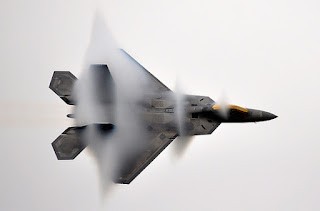
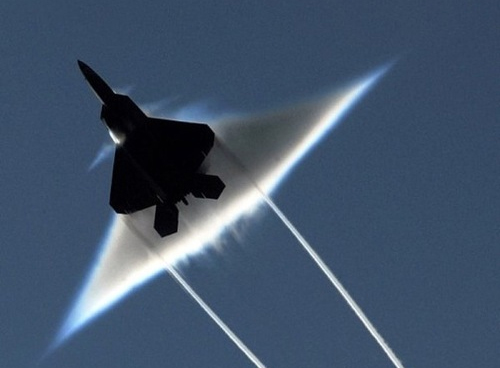
Did you notice the difference? The secondary shockwave forms next to the inlets?? Such mechanisms are used to delay the shock wave formed around the main wing, and reduce the wavedrag while going supersonic. In the old days, having wide wings/body was bad, because more of the airframe would be in supersonic flight and be very draggy. CFD analysis changed all that. In other words, today, you can have wide wings, and have some kind of mechanism to deflect shock wave away from the main wings so they would remain subsonic and cause less drag. Both F-22 and F-35 uses such mechanisms. It was first applied on X-15, then on SR-71 and YF-22 YF-23 and X-35. If T-50 design needs, such mechanism are already implemented into the design.
[ATTACH=CONFIG]221324[/ATTACH]
AndraxxusThe rest of your post has been neglected, because you just presumed that velocity of the exhaust for MiG-25 must be higher than F-15, F-22, Su-35 etc…..
Ignore all you want, but understand what I am comparing first; MiG-25’s R-15 has higher WET exhaust velocity than AL-31s or F100’s DRY thrust. In short; thrust = mass flow * (exhaust velocity – aircraft’s velocity) If your exhaust velocity is too low and its subsonic or close to it, you can’t go supersonic no matter what Static T/W you have on paper, period. Because in reality, aircraft have dynamically changing thrust, depending on airspeed, altitude, inlet performance, engine diffuser/exhaust performance. If the engine has sufficently high exhaust velocity than airspeed (which is also changing with the factors I mentioned), we can talk about increasing mass flow to increase thrust to overcome drag.
However I didn’t see your reason for MiG-25’s higher drag coefficient.
I didnt say “drag coefficient” but drag. Ok simple reasoning: MiG-25 can reach M2,83 at 41,2 tons MTOW. If it has same Lift/drag ratio of F-15, it will have twice the drag simply because it has twice the weight. Somehow, i dont expect it to have half the Cx of F-15.
Compared to contemporary engines, even F119 has a very large diameter, even if smaller than F135.
Its not only about fan diameter but a million different factors. For example F119 also has larger engine core. We dont know the exact specifics of how engine behaves. For example, how much thrust is generated from cold section and hot section at different speed/altitude?
AndraxxusThat doesn’t really answer the question. I wasn’t trying to imply that the Flanker was slow or some sort of inferior aerodynamic design.
Basically the question is: which is the draggier design at say, Mach 1.6 – 2.0, between Su-27 and F-15, between T-50 and F-22?
Such direct comparison is very difficult. Maneuverability demands will determine required CL hence wing profile, and wing area. Having engines seperated to accomodate a lifting area there should have no greater impact than having larger wings. Added bonus is you can have useful empty space to put fuel or equipment in there. (Very much like a flying wing). For a direct statistical comparison, I don’t have sufficently solid data for Su-27, but I have for MiG-29 from its flight manual, and some info for F-15, which is obtained from a soviet information booklet about western aircrafts’ aerodynamics, so may not be 100% accurate, (but I find it to be very close):
MiG-29;
1- Drag coefficient (Cx0) graph with respect to mach number, 2-delta Cx with for payloads 3- Maximal Lift coefficient with respect to mach number:
[ATTACH=CONFIG]221323[/ATTACH]
F-15;
Third graph on the left page (13) is drag coefficient graph with respect to mach number.
First graph on the right page (14) is the Clmax graph with respect to mach number,
Second graph on the right page is the delta cx graph for 4 AIM-9s or 4 AIM-7Fs.
[ATTACH=CONFIG]221322[/ATTACH]
To summarize;
-MiG-29 has higher drag coef than F-15 both at subsonic and supersonic speeds, and it has higher increase of drag coef. at transonic regime.
-MiG-29 has higher lift coefficient than F-15 at all speeds. (max 1,5 vs max 1,1)
As Su-27 has even higher Clmax than MiG-29, expect it to have greater drag coefficient.
Higher Cx, combined with larger airframe, Su-27 is surely draggier than F-15 (at straight line), both at subsonic and supersonic regimes.
However that doesnt lead to a similar comparison between F-22 and T-50. By using different wing profiles, F-22 may even turn out to be both draggy and more maneuverable of the two. We just have no solid numbers about them.
Andraxxus*So why is the turbojet the bees-knees when it comes to high speed flight? ‘Cos there is less massflow rate required by the turbojet at highspeed, the inlet nozzles are more easily optimised and all of this (reduced relative to a turbofan) airflow is passed through the compressor, where it generates more thrust per unit massflow than if it were sent through a fan alone. Its not the nozzle that generates the thrust, its the fan/compressor.
Uh, like I’ve said less mass flow and high velocity makes turbojets more effective in high speeds, but nozzles do generate thrust. Because they simply modify the velocity of the mass flow. You can design and engine without a fan (turbojet) or compressor/turbine assembly (ramjet) but not without diffuser or nozzle.
AndraxxusYeah but this is what I don’t get – in the second pic, the vortex comes off the lerx/chine and over the wing itself,but not the body – and the stabs are in the ‘correct’ position to fend the vortices – which is similar to raptor’s config. I never saw a vortex over the lifting body on t-50. Am I missing something?
What you are seeing is vapor clouds formed due to sudden pressure drop. Seeing less is actually a good thing, and thats what the LEVCONS also provide. Slower the pressure drop = less chance of flow seperation and no vapor clouds. Vapor clouds do form on the T-50s body, however they do so at the same time with wings, which is -again- a good thing. Pressure-drop above the body is just well controlled as it is on the wings.
Thanks. It was a good read. I thought you meant straight line acceleration, not the SEP.
Just to clarify – I didn’t mean frontal projection, but this (I’m sure you will recognize):
[ATTACH=CONFIG]221052[/ATTACH]
Those are the frontal cross sectional areas, graphed in the x axis of the aircraft. Important for area ruling, but not for incompressible aerodynamics.
Yeah, that’s where T-50 comes in. One thing I don’t quite understand – how is it going to deal with the vortices coming off its ‘nose’ over the levcon when stabs are set relatively further apart than on the flanker? Or am I derping…
Judging from the looks of it (I mean I am estimating, i didn’t run an analysis on it), those vortices not something to be dealt with in T-50, but its also desired. At high AOA, on a regular aircraft having a nose with cylindrical cross section causes an phenomenon called vortex shredding, which is a repeated asymetrical flow seperation and vibrates/destabilizes the aircraft on yaw axis:

This is worsened -a lot- by the fact vertical stabs are in the way of this disturbed airflow, and their effectiveness is also reduced (or completely eliminated). So F-16 or Su-27 has verticals at their bottom to stabilize the aircraft at high AOA.
However like I’ve said, PAK-FA uses hexagonal nose cross sections. While it wont prevent flow seperation, it will produce two symetrical vortices which does not destabilize aircraft, Much like Su-34;
As these vortices are symetrical, they are harnessed and this vortices are just like LERX vortex of the wings, they form right above the body, however, to contribute body lift (instead of wing lift).
How much lift compared to total lift is provided by the space between the engines. That space is very huge in volume.
Its added to wing area. Not only the tunnel but any area having the airfoil shapes. Lerx/chines contribute to lift, so they are added too. Su-27 does not really have 62 m2 wings. If you calculate from the blueprints VictorK posted Su-27 has around 37 m2 main wing area and around 11 m2 elevator area. Same for F-22, it does not have 78 m2 wing area. It has 40m2 main wing and 13 m2 elevator area (approximately)
AndraxxusYou are going all wrong about supercruise. MiG-25 has less wet T/W than the dry T/W of the F-15/16/22 Su-27/35 etc etc. Surely it is draggier than all those types. Then how can it go M2.83 with 4 missiles? As I mentioned sometime ago somewhere in this forum, supercruising is not about the amount of engine thrust but the velocity of the exhaust.
1-Engine thrust = mass flow * relative exhaust velocity. If you have 100kg/s mass flow and you have 100 m/s exhaust velocity, you will get 10 kN thrust at 0 airspeed, and exactly 5 kN at 50 m/s airspeed, and no thrust at 100 m/s airspeed.
2- If you want to achieve supercruise, you need to achive your thrust via high exhaust velocity, not high mass. It doesnt matter if you put a 500 kN+ GE90 engine on a Extra 300, it still wont supercruise. Because GE90 simply moves large amounts of air at slow velocity. As airspeed increases, thrust will reduce, it will even go negative (fans or propellers moving air slower than the airspeed contributes to drag). Its the same with F135 engine; it achieves its thrust via large fan/engine diameter. If you put it on F-22, it wont supercruise like it does with F119s.
3-To design a supercruising engine, one has to understand the engines first. The problem with turbofan engines is cold section of air is *always* subsonic. While hot section can reach supersonic speeds due to turbine section’s own nozzle, it has smaller mass flow and does not make overall flow supersonic. When pilot turns on afterburners, engine’s mass flow remains (mostly) unchanged, however as afterburners burn the air behind turbines (hence the name) air pressure just before the nozzles increases. Then the variable nozzle changes it shape from converging to converging diverging. At the smallest throat area of the nozzle, airflow is still subsonic, but at tremendous pressure due to heat. So when it expands (much like a rocket engine) at the diverging section, supersonic velocities are achieved. (Hence the noise).
In order to supercruise,
a)engine needs to achive M1.0 velocity and >1 atm pressure before the nozzle, without using afterburners.
b)engine internals must be designed as such that it will operate in much greater pressure differantial, ie not break or stall.
c)engine control must dictate nozzle shape accordingly to airspeed. One practical application (I am not saying this is the only way of supercruising) is after a point, con-di nozzles shape to reduce massflow and increase velocity, to the M1.0 point (where velocity can never go supersonic at the converging section of the nozzle) so it compresses the air to increase the pressure. Which should be a more inefficient mode of operation than normal, but way more efficient than afterburners.
If you have AL-31 or F-100 or any legacy turbofan engine, you will only go around M1.1 at best, because engine simply pushes the air too slowly. This has little to do with airframe configuration, dry T/W or drag. For example (from flight manuals)
PW-229 engined F-15E can go M1.15 at between 30-32k feet if clean.
PW-220 or GE-129 engined F-16 blk50 can go M1.04 at 26k feet at if clean.
MiG-29A can go M1.03 at 7000 meters if clean
F-18C and F-18E can both go to ~M0,95 at 26k feet with 4 missiles.
If you have an engine pushes the air fast enough, in other words designed to supercruise, it will go much faster even if it has similar or even less amounts of static thrust. So all the talk about comparing and complaining about “thrust” of 117/117S is meaningless.
AndraxxusSorry but… any bird is draggy when pulling high AOA. That’s why it’s called instantaneous. In fact, Su-27 design (as in, any LERX/aerodynamically unstable design) strength is that it requires less alpha per G, therefore inducing less drag while turning. It is easily noticeable in airshows – its control surfaces barely move when entering a turn.
Also, less than impressive acceleration? Compared to what? It may have been a tiny bit more reluctant to go faster than f-15 while already going supersonic, but it has more to do with rather huge bypass ratio of al-31f (fuel economy is more important than supersonic acceleration, I guess) than anything. Yeah, there’s higher wavedrag due to 10% wider wing and the fact that supersonic speeds tend not to like oblique contours, but you also have to remember that Su-27 max cross sectional area/midship is rather tiny for the largest 4th gen aircraft – its cross sections peak at about the same as f-15’s – roughly 3,95 – 4,2 m/sq (depending on your calculating method/errors), while nominal wet thrust is 20% more.
We all know the effects of negative stability. What you say, is equally correct, however this is not exactly what I am talking about. Firstly, it really doesnt matter what frontal cross section is we are not talking about cars here. When aircraft is concerned, the “A” or area in Cd*A for any aircraft is wing or -lifting body- area. Other than inlet area, nothing really contributes to aircrafts drag at high AOA maneuvers. Lift and drag during a maneuver is all related to airfoil shape. Secondly, such inefficiency I am talking is not necessarily a bad thing. This is a slight trade-off for much higher available turn rates. With my lacking english I possibly wont be able to explain it, so I will put some numbers here. For the sake of argument, lets compare F-16 blk50, and Su-27S. Both have same T/W of approx. 1,2 at 50% fuel. lets only talk about subsonic regime, to rule out wavedrag, bypass ratio and inlet related differences, and stick to subsonic aerodynamics. Numbers alone should tell how (and why) is Su-27 is efficient in sustained turns, or inefficient in instantenious ones.
At Sea level M0,5, I will state Gs, and the excess powers of F-16 blk50 and Su-27S respectively.
-1,0g: 630 fps and 590 fps. (this gives an idea how Su-27 design is draggy in straight line, but i will get into that later)
-3,0g: 590 fps and 525 fps (this is the condition where both aircraft pulling 9,2 deg/s turn)
-5,0g: 200 fps and 260 fps (this is the condition where both aircraft pulling 16,1 deg/s turn)
-6,0g -050 fps and 060 fps (F-16 can sustain 19,6 deg/s turn rate, Su-27 can sustain 20,2 deg/s at this speed)
-7,0g -400 fps and -200 fps (22,7 deg/s turn rate)
Despite having similar T/W, Su-27 has less excess power than F-16 (nearly) at all times simply because its more draggy, while this does not translate to maximal horizontal sustained turn rates, it will translate to inferior acceleration and climb performance to F-16 when pulling smaller amount of Gs.
However here is the interesting part: F-16 reaches its lift limit at 7,4Gs by pulling 24 deg/s turn rate. We know the aircraft weight and G load to find lift force, and from that (we know wing area) ClMax; which is 1,56.
At the condition where F-16 maxes out (7,4Gs with approx -500 fps), Su-27 only requires Cl of 1,39. This happens at very comfortable 16,5 degrees AOA, with only -310 fps SEP (I can post a dozen charts here but its too offtopic, I posted them on this forum some time ago you can find them via search) In short, Su-27 excels at sustained turn rate, and also at any turn rate between F-16’s STR and ITR. This is the part you are correct, however this point is hardly a cornering turn for Su-27; As flight manual states, Su-27 is capable of 24 deg AOA to achieve Clmax of 1,85 at M0,5!! This means if Su-27 pilot wants, it can go on and on to pull 9,66Gs at M0,5 to achive 31,44 deg/s turn rate. (You may say its overloading the airframe but we are talking about aerodynamics here) How efficient Su-27 actually is at such ITR? its at -850 fps, which is twice of F-16’s SEP at Clmax. This is the inefficient part I am talking about.
Let me put MiG-29 into my case as well. MiG-29 shares very similar layout to Su-27, but its Clmax is limited to 1.5 due to much thinner airfoil. Result is, it can pull comperable STR to Su-27, but max out at 7,9Gs (which is more comperable to F-16 than Su-27). However, much thinner airfoil means less drag, so MiG-29 has much higher climb rate (345m/s vs 300) and acceleration (600 to 1100 km takes 13,5 seconds in MiG-29 and 15 seconds in Su-27).
Going back to Su-27. Flight manual says, its wings are not stalled at 28 deg AOA. As wings are not stalled, their lift coefficient will keep increasing until 28 deg. Then why is the Clmax occurs at 24 deg AOA? My only explaination is that sudden drop of lift coefficent of the lifting body, due to localised stall.
What I was trying to say in my previous post was this: PAK-FA uses high lift devices to improve lift above its body to both increases lift and delays stall, In a sense, if MiG-29 had used such LEVCON devices, it would have retained same incredible climb and acceleration performance, and we would be seeing cl max to jump to at least 1,7 (assuming linear increase in lift due to delayed stall, excluding the increased cl due to pressure distribution levcon may provide) performance to reach 8,9Gs at M0,5 instead of 7,9. Now imagine what PAK-FA can be if it simply uses the MiG-29 airfoil: (comparing to MiG-29 and Su-27). If we assume pakfa is 23 tons with 50% fuel, PAK-FA will have a T/W of around 1,35 even with current 117 engines. With MiG-29 airfoil, it will have only 10% inferior T/D ratio (as Cd will be same) and 12% better T/W ratio, resulting slightly better (by 1,4%) acceleration and climb rate than MiG-29. With clmax = 1,7 PAK-FA will be able to pull 10,49Gs with its currenly known wing area, which will translate to 34,2 deg/s turn rate @M0,5, 8,7% better than Su-27. Of course, this paragraph is merely a rough estimate, but shows the potential of PAK-FA design. Impressive considering it also has an internal bay within.
P.S. Now that makes me wanna see how big is t-50’s midship.
Probably just as big, but that doesnt matter. Again, cross section means little. If you pull a flat plane with zero theoratical frontal cross section, it will still create drag. (and great amounts of it. Calculation of this drag is a common problem in fluid mechanics) Thats why such objects with long finese Cd is the drag coefficient of upper cross sectional area. *Not front* If you want to compare drag, simply compare wing areas. While they have different Cx, this would be far, far more accurate than comparing their frontal areas. PAK-FA will be draggy, it doesnt matter if its thin as hell. Due to L/D always positive, every single kg in weigh directly translates to induced drag. Heavier aircraft, greater wing area (or greater AOA), greater drag. Its simple as that.
AndraxxusWhat is the hardest g impact that is accounted for at a landing ?
It all depends how steep the landing is. However to give some numbers, 1,1 Gs is considered a hard landing for a Boeing 737: http://www.boeing.com/commercial/aeromagazine/aero_14/conditional_fig1.html
On aircraft carrier landings, pilots withstand 3Gs, mostly due to rapid decelration.
@Jo Asakura:
I have to disagree on this too;

Pylon + adapter assembly for BrahMos is long enough to clear Flaperons and LE flaps. IMHO, that is a possible sign for wing carriage. Otherwise, why not make it short like Kh-41 adapter? It would be both simpler and more practical. Plus, they managed to mount 8 meter long Alpha missile on wings of Su-34 (with some models showing 4 missiles) I don’t think that would be an issue.
AndraxxusHere you can see Irkut’s Su-30KN is cleared for only 2 KAB1500KRs. The KNs were essentially the developmental forerunners to the Su-30MKI and will have a structurally identical airframe (apart from the canards). It also supports the supposition that the structurally stronger Su-34 & Su-35S can carry only 3 KAB1500s as a load distribution factor.
Impossible for them to have identical airframe, considering Su-30MK has two additional pylons on its wings and 4+ tons greater MTOW. Its very likely that Su-30KN shares its wings with Su-30/27PU/27S.
I’ve posted image of MKI carrying 4xKAB-1500s. KN can carry 2x because of absence of inner pylons.
Here is Su-30MKK with 6x Kh-31s, KN, is likely to carry 4 due to same reason above.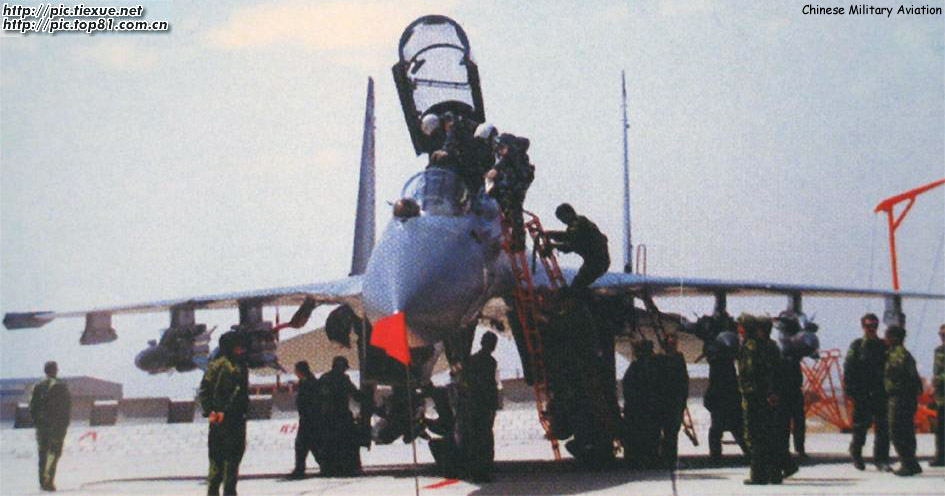
However, IMHO, there is still some inaccuracy in the data. Site says Su-30KN can carry 6 RBK-500 or PB-500 bombs, where Su-27SK flight manual says Su-27 can carry 8, with double MERs on 3 and 4.
Hence (imho) it is highly unlikely that the Su-30MKI can accommodate 2 of the 2.5T BrahMos’ and would explain the strengthening of the MKI airframe for the centreline pylon to accommodate it:
Its ok if we disagree about our opinions. My opinion is, they want to modify the airframe not because it can’t carry in its current state, but because, they require better aircraft performance while carrying BrahMos missile. Obviously going supersonic or pulling some Gs with missile on single pylon would be problematic (difficult to stabilize due to inertia of the long missile) leaving only centerline pylon for the task. And another possibility is the aircraft lack necessary wiring/software to accomodate a centerline guided missile. (I maybe wrong about this one, but has anyone seen MKI carrying a guided A-G munition on centerline?)
AndraxxusWould it be too difficult to modernise IAPO to produce Su-35 and eventually PAK-FA? They need to do it anyway.
AndraxxusHow does this defines as war crime? Anyone passing borders illegaly is already violating international law. Mi-17 pilot is warned he is approaching the border, and he crossed the borther nevertheless. If he heard the warning, he deliberately ignored it. If he didn’t, well, its not Turkey’s problem if pilot is incompetent, or his equipment is malfunctioning.
AndraxxusLast year, Turkey has already declared -after RF-4 incident- they changed their rules of engagement towards syrian military assets. As stated, any Syrian aircraft approaching in hostile manner towards Turkey (not necessarily crossing border) would be shot down. Since then we have around 40 short range SAM vehicles at the Syrian border. Also according to radar tracking info, missile is fired from 1nm of the target, possibly after visual identification.


 Sign In







