 Andraxxus
Are sure those aren’t KAB-500S-Es? Here’s 3 KAB-1500s aboard the Su-35S during external load validation @ Zhukovskii. Needless to say the 35S has a significantly strengthened airframe compared to the Su-27 (or Su-30MKI for that matter).
No, those are KAB-1500s;
KAB-500s have fixed forward wings and proportionally much larger rear wings: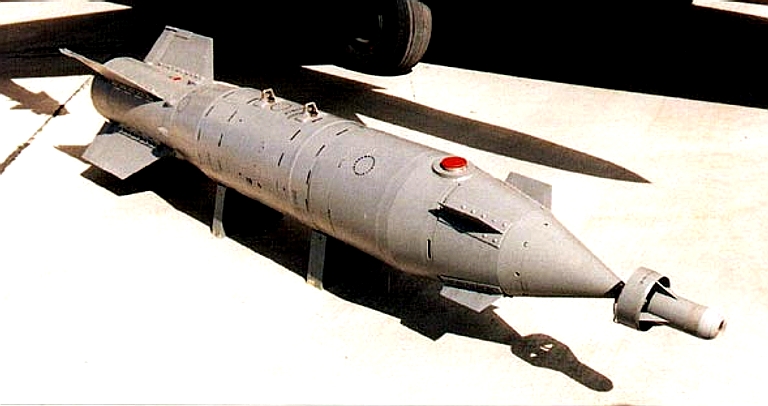
KAB-1500 have folding forward wings and has smaller rear wings with an additional mechanism behind them: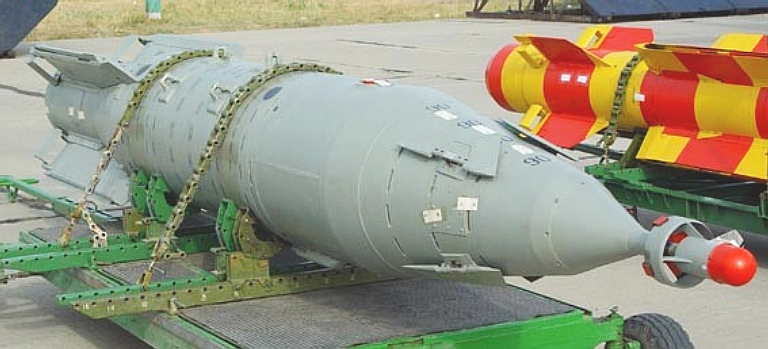
AndraxxusI see where your argument is coming from, but I still doubt the Su-30MKI will be cleared for 2 (let alone 3) BrahMos’, given that the Su-34 may well be cleared for only 3 KAB 1500s (or 6 KAB 500s)*.The pic of ‘blue 43’ with the ‘Alpha’ missile is all very well, but that’s just one of those promo shots for visiting generals, it was never seen on a runway with that ginormous (dummy) weapons load- let alone in the air!
KAB-1500 on pylons 3,4,11,12.
However what is actually cleared is very difficult to determine. Most of these charts are fan-made over a debate what should be possible and what should be not. Pylons 3,4 were the orginal Su-27’s pylons for heavy payloads.
BTW, that alpha missile was not mock-up/dummy, it was the one of the operational prototypes. As missile never go beyond prototype stage, its understandable if there is no picture of it.
could the su-35 carry two brahmos?
Going through the Su-27SK manual: Su-27SK carrying 2xFAB-500 on each wing pylon puts such limits (ie, pylon is also able to withstand this)
V < M0,85 and G = 5,5 (which means both pylon and hardpoint is able to withstand 5500 kg of load)
If we put a pair of BrahMos on to baseline Su-27S, even it should be able to carry it, if we limit it to 2,2Gs and M0,85 (I am assuming a single brahmos has comperable drag to a pair of high-drag FAB-500s plus its multiple ejector rack) As for Su-35, it should be able too, depends on how much they are willing to limit aircraft performance.
AndraxxusAbout pt 1:
[ATTACH=CONFIG]220770[/ATTACH]
What do you see here? Simultaneous release ? But you said it yourself: in short notice… So why do we hve to disagree so vehemently ?
Mk84 on most aircraft are released in pair. Brahmos is a missile. You don’t release that stuff in pair.
I was merely talking about sudden mass or inertia changes. Not in detail related to a scenario. What I am saying is, Su-30 can fly with 8 ton mass, and release it easily.
Brahmos on centerline… Never said that it was not what it would be done. Centerline carrying solve a lot of problems inherent with an asymmetrical load-out.
Since you don’t release simultaneously in pair there is an interval of time where your configuration is unbalanced. This asymmetry is principally balanced by the the inertia of your plane with the help (on some aircraft) of your flight ctrl surfaces.
Obviously, wing pylon will create 2 additional unbalancing actions: yaw (due to asymetric drag) and roll (due to asymetric weight). However, I believe we at least agree on the remaining pitch rotation and 3 axis movements remain controllable.
If the load is carried under the wing, yes the overall mass of the system (plane + loadout) is the same. Inertia is not. Moments of inertia are depending of the distance of the mass from the axis of references (here passing by aircraft own CG). But you certainly know all the stuff that comes with the Mechanical modelling of a system (I write it with no irony so don’t over-boil for nothing )
About pt 2:
An aircraft travel at a non negligible speed and doing so it exposed all of its surfaces to a free stream of air. Those imply great forces acting on the surface on each body exposed to that stream. Lift is one of them, you are right. But there is also, surfaces force like the force of the stream impacting the body and drags.When an aircraft loaded symmetrically flies perfectly straight (never true since there is always a residual bank and yaw angles what many tends to forget) all those forces are perfectly balanced . If you remove at a time t a large object attached under the wing, the system (plane + residual load-out) will found itself unbalanced by the lack of drag, lift and side forces of the missing body. At t+ the attitude of the plane and hence its trajectory will be modified to reflect the new state of balance. The amount of accelerations of this modification is dictated by the inertia of the system and it’s kinetic energy. This is where you see aircraft dropping bombs bumping to quote you. But the same is true on the perpendicular axes and all three angles (in fact you can observe pilots pushing on the stick). Aircraft ctrl surfaces are the only active correcting meaning of the induced motion (give bank, add teta etc..).
Now I understand where you are getting at. In short, you are saying a store release will unbalance the aircraft, and larger rotational inertia will give more time for control surfaces to act accordingly, right? The problem with your statement is, something on wing pylon (away from CG) will increase the rotational inertia of the aircraft much more, exponantially related to the distance between CG and the CG of the missile.
And I believe we have some misunderstanding about terms. Whether we put missile on wing pylon or centerline, inertia is the same, but moments of inertia (or rotational inertia) is not. If we are talking about store release and finding out rotation on pitch axis, rotational inertia is also the same (because length^2 remains unchanged if we are looking directly from pitch axis direction).
Store separation is in fact a more complicated problem since when you start to link two object together in a dynamic scenario with a non perfectly rigid links, interactions occurs. Immerse them in a free stream of air and aerodynamics interactions adds themselves to the list. Jõ has given a partial list of all the problems you can observe so I won’t comment further in that direction.
Here is a good example (I’ll left that one un-commented):
What you can see now, I sincerely hope, is that the example of the car in a curve is a 2D simplified approach (not really 2D in fact) of the 3D problem faced in the aircraft situation: a sudden modification of dynamic balance.
On a dynamic scenario just like you describe. Simplest solution is to model entire structure (in this case wing itself) for finite element analysis; ie each link is represented as a flexible spring, and a dampener. I wont go further into details, but airflow is represented as force at the pressure center. Most aircraft wing designs are required to be overdamped to defeat buffeting. What is happening in this video is wing flutter, which is exeggerated by additional mass on the system. Greater the mass, greater the rotational inertia, so greater the motion before wing dampens the unwanted movement. However, wing flutter is an aerodynamic/aeroelastic phenomenon not directly related to payload, or asymetry. On Su-30 MKI, if wing flutter wont occur with 3500 kg bomb load (some of which are closer to the wing tips), it wont happen with a single 2500 kg missile either. So your example is completely unrelated to this (well not completely but anyway).
About stores release; it really has nothing to do with buffeting, flutter or anything else Jo mentioned (I am 99% sure he mentioned problems for carrying such load).
Lets put some valid numbers, to be more accurate in our comparison:
-On Su-30, distance between pylon 12 (inner wing pylon) and centerline is ~4,5 meters, distance between pylon 4 (2nd inner wing pylon) and centerline is ~6 meters.
A KAB-1500 on pylon 4 will produce 1500kg*6 meters = 9000 kgm rolling moment. Same bomb will produce its 6*Fd amount of yawing moment. The extra rotational inertia due to distance from centerline is 1500*6^2 = 54000 for both situations.
A BrahMos on pylon 12 will produce 2500*4,5 = 11250 kgm rolling moment, and will prodce 4,5*Fd amount of yawing moment. Extra rotational inetria is 2500*4,5^2 =50625 for both situations.
Compared to KAB-1500, a brahmos will produce slightly higher rolling motion, quite possibly less yawing motion, and have less rotational inertia to disturb wing flutter. I wouldn’t be suprised if Su-30MKI turns out to be capable of carrying 3 Brahmos missiles; two wings, and 1 centerline.
AndraxxusIt might be due to ground/wheel clearing,
Maybe, its a valid point but;
[ATTACH=CONFIG]220768[/ATTACH]
Su-34 had no problems carrying Alpha missile, which is just as long as BrahMos.
or perhaps the brahmos is so long it require tandem pylons
Its a mockup, but it does not look like thats the case: http://upload.wikimedia.org/wikipedia/commons/2/22/BrahMos_MAKS2009.jpg
A plane flying in the air is just like a coin balanced on top of a needle. Remove such a weight and drag suddenly and the control surfaces hve to compensate fast enough for the lost balance.This is why big aircrafts like bombers are more suited to deliver large bulky loads (more inertia).
Imagine an Austin mini loaded on the roof with an 100l pressurized gas tank. Now drive it around a curve. If suddenly the gas bottle is detached, the car will over-steer and probably crash. Now do the same with a truck. When the gas bottle is detached, behind the wheel You’ll notice no differences (inertia Vs accelerations).
Nonsense due to two factors:
1-Su-30 is capable of carrying 32xFAB-250 bombs, and have zero problems deploying them all 8000 kg payload in short notice. This was also demonstrated by baseline Su-27S during acceptance trials. Each BrahMos weigh 2500 kg, which is less than 4xMk-84 bombs, which is hardly a problem to drop; even for an F-16. Also, we all know upgraded Su-30 will be able to carry a centerline BrahMos. It makes zero difference if the said load is detached from the centerline pylon, or from a wing pylon. Mass and inertia are the same.
2-Aircraft is not a car. On an aircraft flies in a balance, decrease in weight will simply bump the aircraft upwards due to lift. It doesnt matter if computer -or pilot- balances the lift in 10 seconds, aircraft will simply gain a few meters of altiude. Nothing bad will happen. If you are talking about CG motion, yes, there will be an AOA change, and will correct itself on a stable aircraft, or it will be auto-corrected on an unstable aircraft before pilot even notices it. Again, nothing bad will happen.
It’s not just a matter of weight. Strapping 2 of these HUGE missiles to an airframe the size of the Su-30 will have major implications for airframe stress and hence life. This is derived from factors including significant changes to trim (normal force & side force), normal & transverse buffet (particularly transonic), area rule & peak pressure drag coefficients (@ variable M), lift and static & longitudinal stability (Cg and mean aerodynamic chord) etc.
Those are all valid points, but then, those apply to most payloads, and result in limitations for the aircraft performance. I can easily debate already M2.5+ capable brahmos would have far less effect than carrying 6x FAB-250s on multiple ejector racks but thats not my point. My point is, if we strap two BrahMos on current MKI, and if this limits its pefromance to M0.85 and 2.5Gs, no one would be unhappy about it.
AndraxxusPlanes right wing is more chambered giving it more lift for upward rotation and the right LEVCON is at higher AoA producing more lift.
Planes left wing is less chambered (less lift) and aileron is putting the pressure down for downward rotation. Left LEVCON is in negative deflection (decreasing the lift and putting the pressure) which supports downward rotation.
This maybe something additive. Example: on the above picture demanded motion is left yaw at high AOA.
->Initial AOA = 25 deg so deflect both LEVCONS and both LE flaps 25 degrees downward. (In real life, there will be many multipliers, or max deflection interrupts, but numbers just for the sake of argument anyway)
Left yawing requires TVC, but like you stated, side-effect is also left roll motion. To counter this, right roll is needed, and LEVCONS (along with elevators) are one of the control surfaces that has some air moving around them (due inlet/exhaust plus viscosity of air). So FCS dictates;
->Right max roll = deflect left LEVCON 30 degrees down, and right LEVCON 30 degrees up.
Add those to achieve final result = Left LEVCON deflected 55 degrees down, right levcon is 5 degrees deflected upwards. Same right max roll command would likely to deflect elevators and inboard flaperons too.
Result is the pictures ogami musashi posted.
AndraxxusWhat is the proof of this, testing a failure? Again, all controls are in perfect harmony to make a left yaw motion, possibly at high AOA resulting in a counter clockwise flat spin.
Its nonsense to test control surfaces in such way. Whats next? Remove one of the elevators or rudders to see how aircraft behaves? IF a levcon fails and deflects in such way at high speed, the distance between pressure center and the hinges will create a moment likely to tear the levcon apart from the airframe.
While everyone is making speculations about the function of LEVCONs, i had my own for some time: Surely we all heard, Su-27 has its body made out of airfoil sections, resulting in a blended wing/body design. Its wings have LE flaps and LERX vortices to allow perfect controllability until 28 deg AOA and achieve 33 deg critical AOA. However, (after seeing pak fa) I question, what happens to the flow above the body? Because it has no such mechanisms, airfoil shaped body would be stalled before wings do. This might explain why Su-27 achieves its max available turn rate, and CLmax is at 24 deg AOA; because (in my opinion) contrubition from body lift decreases. From engineering POV, this can be mitigated by using thicker airfoils which stall at greater AOAs however this would result in a draggy airframe at 0 AOA, hindering in-line acceleration. If I am correct, it would explain why Su-27 is draggy when pulling high AOA instantenious turns, and why it has less then impressive acceleration with all that thrust.
PAK-FA, is a further evolution of Su-27 concept. In a sense, Su-27 design was incomplete, PAK-FA perfects it. PAK-FA still has LERX structure, and LE flaps should provide same impressive performance on its wings. However, to adress (undelayed) stall of airflow above body, Sukhoi implemented LEVCONS and non-cylindrical aircraft nose cross-sections. (In my opinion) LEVCONS act as LE flaps for the entire body, both increasing lift and delaying stall. While this lifting body does not have LERX, it doesn’t need one because non-cylindrical (and constantly increasing) cross sections of the nose will produce symetrical and intensity controlled vortex above this lifting body. This would allow thin airfoil sections (have you noticed how thin PAK-FA is?) to create great amount of lift. End result is best of both worlds; great acceleration capabilites (due to less drag at ~0 AOA), and even better-than-Su-27 high-lift performance.
AndraxxusStructurally?
AndraxxusNo way either ‘Super 30’ or Su-34 can carry 2 BrahMos, btw.
Reasoning?? BrahMos weigh 2.5 tons. Most flanker variants can carry FAB-1500 on its wing pylons. Surely it can carry it even without any modification, but it would only able to pull 60% of the G available with FAB-1500s.
AndraxxusAdd Turkey as F-4 user and a candidate for F-5.
I don’t deny that, the reason I chose the Phantom is it’s versatility, which is in a different league to the others.
Just as F-15 is in a different league than others. A longer version of the explaination:
MiG-21 is a 2nd generation light fighter, which directly compares to F-104.
Mirage III is a 2nd generation interceptor, which directly compares to F-106 or Su-9/11.
F-4 is a 3rd generation fighter/interceptor, which compares to MiG-23 as a fighter, Su-15 or MiG-25 as interceptor.
F-5 is a 3rd generation light fighter, which compares to MiG-23 by mission, to MiG-21 by weigh class.
If we are here, comparing MiG-21 and Mirage III with newer types, that should tell enough about how succesful they are, compared to others.
AndraxxusThe RuAF has made it clear it wants the Su-34. No amount of internet mental gymnastics will change that.
We are all aware of that. However we can debate whether that decision is right or not. This is the purpose of the forum isn’t it? Info/idea exhange. We are not saving the world by talking here anyway.
that Russia should’ve piggy backed off Indian Su-30MKI and standardized off the MKI albeit with a Russian version (in other words what would become the Su-30SM?) and not go for Su-34,35, and all other strange variants of the 30.
had they standardized on the MKI, they probably would’ve had more advanced flankers in service by now and retire more Fulcrums and early flankers.
On one hand, I tend to agree about the MKI part. I will never, ever claim MKI approaches to Su-34’s performance in strike role. Cockpit design, armor, range and nearly 22 tons of useful payload is clearly far ahead of what Su-30 is offering at the cost of less maneuverability. However, MKI was operational in 2002, Su-34 deployment took another 10 years. With money spent on Su-34, MKI could have been modified to be better suited to strike role. Lacks Range? Add wing EFTs. Lacks avionics? Upgrade radar and/or put a dedicated targeting pod. Lacks armor? Add MAWS and better ECM pods to compensate. Lacks Payload? Strengthen the airframe. Those would be simpler solutions to designing a new airframe and new radar/avionics set from scratch. With required modifications, MKI would match the Su-34 in many ways, excluding cockpit design, of course.
On the other hand I disagree, because Su-34 was in development since 1990s, and all the hard work on avionics and airframe was already done and by 2000s, there were 7 pre-production prototypes. Depending on the state of development, it might have required more money to upgrade MKI than building Su-34. For a paying customer (RuAF), it would be more tempting to wait for a few years to get a more capable product for similar price.
However I clearly disagree about going for Su-30 instead of Su-35. As an airframe, Su-30MKI only adds canards to to Su-30M, which is related to Su-27PU, and that is just the two seater version of baseline Su-27S. In other words, (I may be flammed for saying this but) Su-30MKI’s airframe is evolved/derived from, Su-27S and not much different technologically. IMHO MKI is the final evolution of the Su-27S airframe, where they reached the limit on engine size/thrust, avioncs fitment etc etc. Then come Su-35. Su-35 and Su-27 -if I understand correctly- is just like MiG-29 and MiG-29M: Looking similar from outside, but completely rebuilt internal structure. Such redesign would make Su-35 both lighter and stronger airframe which would support more powerful 117S, and possible provision for even more powerful engines. Bigger/different avionics bay to accomodate modern equipment. A redefined CG for newer electronics would improve agility. As such, I believe Su-35S is a leap ahead of Su-30MKI, and RuAF was right about pursuing it.
As for India, they already operate numerous MKI and they are already pursuing PAK FA, so I don’t think its logical for them to introduce Su-35 as a new aircraft type at this point.
AndraxxusFailure? Not at all, all control surfaces combine to produce a left roll command at very slow speeds.
http://www.youtube.com/watch?v=b7kP7_vViSk
at around 9:27, during the first turn of the flat spin there is a similar levcon motion.
AndraxxusThose are the four engagements that are regularly discussed. Do you have a source that says those were the only four?
Four according to dozen sources, if we are talking about gulf war only.
Gee, I don’t know, maybe killing a high value target? There is value in disrupting an opponent but considering the Mig-25 is an interceptor it should be graded on more than its ability to survive an engagement by running away.
From mission POV, a tanker/AWACS/EW aircraft drawn out of position is no different than shooting it down. Your expectations for “killing a target” is utterly childish. Other side is not fool, they will always withdraw if they feel they are about to lose the airplane.
In reality there isn’t much that can run down an F-15 intent on running away and that has kept its speed up. In straight-line speed the F-15 and Eurofighter are similar. Even if we were talking about a slower fighter like an F-18 it is very problematic to run down a fleeing opponent.
Nonsense. A MiG-25/31 routinely conduct intercept M2.0+ with full missile payload, same goes for PAK-FA and F-22, which will always fly clean. An F-15 or Eurofighter will almost always rely on external fuel tanks. Former types will always go fast and high at will. F-15 or EF can go fast, but those will require some mission planning. If you think about it, even a baseline Su-27 will have no problems running down an F-15 or EF in R/L.
It takes huge amounts of fuel and you are running away from your base/tankers while he is running toward his. You also run a very real risk of running into some better fueled, armed, and generally ready opponents while you are focused on chasing your target.
Its amazing same logic does not apply to MiG-25, which you expect nothing less than a kill to accept its success, yet his targets running towards allied bases, air defenses, and other escorts just as you describe.
According to the always infallible Wikipedia Iran lost ~10 Mig-25s to F-14s during the Iran/Iraq war and one of those kills was shared with an F-5. Who knows? People have made an effort to research the Iran/Iraq air war and it is pretty dicey due to the absence of reliable sources on both sides.
Of the confirmed kills, there were only 1 MiG-25RB and 1 MiG-25PD lost to F-14s which was posted some time ago on this forum. I was talking about gulf war simply because its more reliable.
You also missed the F-16/Mig-25 engagement over the no-fly zone. (First AMRAAM kill.)
I wasn’t counting post gulf war incidents. Scenarios are very different there.
Here we disagree, there are several 4th generation fighters that would present a greater BVR threat.
Which type for example?
Mig -31s trying to attack an aircraft escorted by F-35s would be rolling the dice in a big way. It is unlikely they would have any means of detecting the F-35 escorts and would just have to race in and hope for the best.
The F-35s meanwhile would not simply be flying off the wing of the aircraft they were protecting… they would be stationed well ahead of their charge and would need only move to interpose themselves between the target and the Mig-31.
Very dense ECM jamming from dedicated EW aircraft hinders sensors of MiG-25s, 8 F-15s around and well ahead of EF-111s, likely attempted to interpose themselves between MiG and EF-111. Result is MiG-25 fired his missiles towards its target and withdrew unharmed. Bring any bells?
You are blaming me for being stuck in 1960s, yet your weakness is over emphasis on “modern” technology too much. Its not impossible for MiG-31 to detect F-35, it has IRST, and big + networked Zalson is not totally helpless againist stealth either. IMHO its much more likely than utterly obsolete MiG-25 detecting all the aircraft, discriminate between bombers, EW escorts, and escorts of the EW escort, and dozens of other aircraft in air, and acting accordingly (evading escorts, tracking/attacking target, ignoring everything else).
Given that the Mig-31 is anything but stealthy the F-35s could expect to track it at long ranges giving them plenty of time to react. The Mig-31 could not do the same with the F-35s, see where this is going?
No. MiG-31s are already closing in at around M2.5 whether they detect F-35s or not. With R-37, they have the means to hit their target at 300+ km. F-35s would react how exactly? Lit their afterburners to move in, and give away their position? MiGs would simply increase to approach angles and reduce F-35s effectively launch range. If F-35 closes in, it will enter the no escape zone of R-77s, if not, it requires much speed to move to a favourable position to launch amraams. On paper, F-15 is 21% slower than MiG-25. On paper, F-35 is 43% slower than MiG-31. You are be expecting F-35 to do something F-15 couldn’t back then. A few minutes of headstart -due to stealth- wont make things any better.
AndraxxusNo, you still aren’t getting it. A recon mission is planned from the start to avoid contact with enemy fighters. It is one thing to dart in and out briefly at a time and place of your choosing and another thing entirely to go after a heavily defended asset. It also isn’t completely clear the extent to which the Mig-25 recon flights were “penetrating” defenses. Crossing a border is one thing, but again, that isn’t the same thing as going anywhere at will.
How does it different from a MiG-31 strike at an awacs or a tanker group with R-37s? “Dart in” fast, avoid enemy fighters launch missiles and withdraw. This is not off topic at all, it is what T-50 will also be capable of.
Disrupting an enemy strike package is a success, but again, that is an isolated success in a conflict where the Mig-25s proved ineffective in general. If you want to argue that Mig-25s weren’t totally useless then I would of course agree with you. What I don’t see is any particular support for the argument that they had the capacity to “blow through” escorting fighters and destroy high value assets. I would argue that they tried, and in at least one case might have come fairly close, but never actually succeeded.
This is laughable. In desert storm, MiG-25 is used 4 times in air to air combat.
1- On 17 Jan, two MiG-25s engaged two F-18Cs and shot down one, and withdraw.
2- On 17 Jan, two MiG-25s attacked two F-15Cs and the escorted EF-111 with missiles, EF-111 withdrew, F-15C pursued, along with two additional F-15s, Of the 10 missiles fired, none catched the MiG-25s.
3- On 18 Jan a single MiG-25 eluded 8 escorting F-15Cs and attacked the EF-111 EW aircraft. This succesful mission kill resulted in a SAM kill of a bombing aircraft, I dont recall type.
4- On 19 Jan two MiG-25s engaged F-15Cs, F-15s evaded the missiles and in ensuing dogfight, shot down MiG-25s with AIM-7s.
-3 out of 4 records, point out high survavibility due to speed: in three incidents, MiG-25s did retreat, and in one, theys simply didnt attempted, and entered a dogfight instead.
-On all 4 records, MiG-25 were aggressors, and fired before the enemy, and at the target they chose.
-On all 2 records, MiG-25 were inferior in numbers to much newer F-15Cs, one occasion, outnumbered 8 to 1 yet survived.
-Of total (at least) 9 R-40 missiles fired, One resulted in downing of F-18C, and two resulted in mission kills of high value targets.
This is more than impressive record. In the end, Iraqi lost. What else were you expecting?
If a Mig-25 had zero success against AIM-7 armed 1991 F-15Cs, then why would you expect it to do any better against a Eurofighter?
Worse comes to worst, MiG-25 can run away after firing its missiles. A 1991’s F-15C simply cant do the same againist a Eurofighter. So my logic dictates, Even if Mig-25 is -obviously- inferior to 1991’s F-15C, it has higher survivability to Eurofighter than F-15C. Simple as that.
I would also be interested in seeing some support for the assertion that Mig-25s “easily attacked F-15Cs on many occasions before the F-15C did.”
See above, a simple google search will reveal them.
Here is the relevance to this post; What you neglect to see is MiG-25 is 3rd generation interceptor. No other 3rd gen fighter was able to shoot it down in Iran-Iraq war, (that I know of, feel free to correct me) yet it did shot down numerous F-4 and F-5s. Its speed was a troubling asset even againist 4th gen fighters. Out of only 4 usages againist 4th gen adversaries, 3 were succesful because of its speed, and 1 was unsuccesful because its speed wasn’t utilized.
Due to this, in my opinion, speed is a very important tactical asset, and proven by MiG-25 to be so.
As such, I concluded MiG-31 as a 4th gen fighter, with similar cons/pros to MiG-25 (compared to its generation), will prove much dangerous than any other 4th gen fighter in BVR, and will pose same threat to slower 5th gens, just like MiG-25 was to 4th gens. (In short, I see MiG-31s attacking an tanker escorted by F-35s will have very high chances of success)
I also conclude F-22 and PAK-FA will be very survivable to any other 5th gen, even some VLO detection methods are invented, will be nearly invulnerable to 4/4+ gen fighters, and will continue to pose a threat to 6th gen if they dont value sustained high speed as much.
Edit: A simple question. Even today, could a lone Eurofighter or Rafale or anything 4+ gen, can attack and force withdraw on a Su-24MR escorted by 8x MiG-25PDs?
AndraxxusWe are talking about fighters shooting down high value airborne assets. A reconnaissance plane is doing something fundamentally different.
One aircraft is required to intercept a non-cooperative target that is escorted by fighters itself, the other will avoid enemy fighters at all cost, even if that means it aborting its mission completely.
You dont get the point. Aircraft mission was recon, it past the defenses, and conducted it. If mission was shooting down an awacs, it would be just as succesful. However some quotes from desert storm:
In another incident, an Iraqi MiG-25PD, after eluding eight U.S. Air Force F-15s, fired three missiles at General Dynamics EF-111A Raven electronic warfare aircraft, forcing them to abort their mission and leave attacking aircraft without electronic jamming support.
In yet another incident, two MiG-25s approached a pair of F-15s, fired missiles (which were evaded by the F-15s), and then outran the American fighters. Two more F-15s joined the pursuit, and a total of 10 air-to-air missiles were fired at the MiG-25s, although none reached them. According to the same sources, at least one F-111 was also forced to abort its mission by a MiG-25 on the first 24 hours of hostilities, during an air raid over Tikrit.
Does these count as succesful engagements?
disagree completely. A Mig-25 is faster and if it has sufficient situational awareness it can run away. What the Mig can’t do is press the engagement and win against a Eurofighter, especially considering that it is armed with thoroughly obsolete semi-active missiles.
1x SARH missile + 1x IR missile. Remind you, those missiles downed an F-18, and easily attacked F-15Cs on many occasions before F-15C did, outranging them in a denser EW environment than any Eurofighter could ever provide. Also, I am not saying it will win againist a Eurofighter. I am saying it has better chances of winning than any other 3rd gen fighter, and most 4th gen fighters. There is a big difference.
AndraxxusIf those Mig-25s had penetrated defenses and shot down a high value target then I might agree with you, but with the exception of the F-18 shootdown over Iraq they generally only succeeded in that they were not shot down themselves. There is no doubt some value in harassing your opponent but generally you can’t declare success based simply on the fact that the Migs were often able to escape the engagement alive.
Why? MiG-25RB mission is to penetrate enemy defense, take some photos and escape alive. It did this superbly, and anything of its generation couldnt stop it. According to your analogy, U-2 is also unsuccesful because it didnt bomb anything?
One kill against an F-18, and one against a predator falls well short of what I would consider working very well, especially given that several Mig-25s were also shot down over their operational life.
They are a threat, certainly, but nothing in their operational history suggests they are any greater a threat than other fighters of similar vintage. You can point to the AMRAAM’s success rate in combat, which is excellent by any reasonable standard, but where is the track record for the Mig-25/31?
Track record is nothing without considering the circumstances. If we take kill/loss ratio, even Harrier is just as succesful as F-15 in air dominance, just less frequently used. Considering circumstances, a pair of 20 year old MiG-25s going againist hundreds of fighters, ships, AWACS, ELINT, and EW aircraft, -all having the most recent in military technology- and shooting one F-18 without suffering a loss is a miraclous performance.
Point is, higher speed is proven to make aircraft more survivable in BVR environment. For a Eurofighter pilot, going againist an F-4 or a Mig-23 is target practice. Going againist a blk30 F-16, eurofighter has an edge in virtually all parameters. However MiG-25 is different in that it can fire before Eurofighter does -which would depend on circumstances- and it can retreat at will. That is I would call a greater threat.


 Sign In







