 Andraxxus
I would doubt that until I saw the data. If an F-16 was pulling 9G’s at high speeds, an MK-84 would be putting at least 18,000lbs of force on the few fasteners securing its pylon + aerodynamic forces in numerous directions. Unless I saw it on the 1-2 document, I’d never believe it.
You got me wrong, there are g-limits for ordnance, for example as low as 5,5G for some A/G munitions, and 8,5G for 370 gals etc. However there is no g-limit for the airframe with varying payloads. If I understand it correctly, 7,33G limit for Mk-84 is due to weapon itself is not designed to withstand higher G loads, so same limit should apply to any aircraft carrying it.
Well if you want to use the laser seekers on your JDAMs for better accuracy, you need a pod.
Specifiacally, which current JDAM model has laser seeker integrated?
AndraxxusI am not convinced anything else in USAF inventory can match close air support ability of A-10. In a fight againist any adversary with MANPADs UAV is a joke, so does B-1. PGMs is not a good solution for constantly changing battlefield conditions, not to mention the cost and availability of PGMs. Take Georgian war; Su-25s are perfectly capable of using most PGMs in russian inventory, but they relied upon FAB bombs and rockets. Why? They are practical: pilot sees an enemy convoy, fires his rockets, withstand the all punishment enemy can bring, and move away. A PGM would require constant monitoring from launch platform, has no area effect, and less numbers can be carried by the aircraft, and even more problematic when enemy has smoke grenades or IR jammers, and fires back againist the fragile F-16 or F-35 (IMHO likely candidates for CAS role).
I love B-1, but I think there is nothing a B-52 or F-15E can’t do sufficently good as B-1. USAF wouldn’t miss it.
AndraxxusFYI, the speed limit of the f-16, as most of fixed inlet modern fighters isn’t related to the thrust/drag ratio but to the fact that the fixed inlet can’t handle the airflow coming faster than the speed indicated as “the limit” (add to that speed the safety margins and you could pretty consistently reach speeds like 10-15% higher, like M2.2-2.3 for an f-16 before compressor stall)
Correct. Its not the lack of static thrust, but the lack of dynamic thrust that affects top speed. All current turbine based aircraft reach their top speed because their engines lose so much thrust with increased mach number. Like MSphere stated, inlet configuration is the most decicive factor in top speed. Guessing numbers just for the argument, F-16 may only produce 10% of its static thrust at M2.0 and 30k feet, but it may produce up to 30% in M1.8, and 50% at M1.5. So if doesn’t really matter having 50% increase in overall drag coefficient when aircraft will have 3-4 times more thrust, just because its flying at slightly lower mach number.
Another good example: X-1E achieves M2.0+ with only 26 kN thrust, with straight wing and unimpressive aerodynamics. Why? Because rocket engine does not lose its thrust with increasing speed, and 26 kN is more than enough to overcome all the drag aircraft produces.
AndraxxusThanks, but for MK-84 there is no caveats around maximum carriage speed, just rules about jettison speeds, carrying with Aim-7 mounted behind…etc. So it seems the M1.19 speed limit still applies to this weapon.
Again, you are correct but that is for CFT version.
Incorrect, I deliberately used the non-cft specs for all screenshots.
Did you? Then can you explain why there are no CFT LH/RH pylons on the 610 gal tank pages you posted, but they are present on the Mk-84 graphs? It IS the CFT version, I can post the whole page If you like. However I am posting too much graphs and there is a limit on total size of attachments.
These rules are not imposed because the aircraft doesn’t have the power to reach those speeds,
Tell that to naysayers around.
they are there because the immense drag under the high dynamic pressure or high G will cause stress on the pylons and possibly damage the aircraft and sometimes the weapons themselves. Its not something that will differ much between aircraft models or whether they have CFT’s mounted or not.
It IS something to differ what load the wing is withstanding; Rest is true, but there are many factors and reasons to consider. As far as F-15 is concerned, addition of CFTs limit aircraft to M2.0 because that is the max limit CFTs can withstand high dynamic pressure. 610 gals are limited to 1,5 when full because increased drag would rip the pylon or structure apart; They are ultimately limited to M1.8 because tanks themselves cannot withstand higher speeds. CFT + Mk-84 limitation can be different from non CFT, because there is additional drag and weight from CFTs. Also note that there are at least 3 CFT types on F-15 manual. basic CFT as in F-15C manual, -4CFT and -5CFT; Possible difference is their structural strength with different payloads and the number of pylons, I have no info about that. Add to this, F-15 imposes G limits depending on payload, at transonic speeds, OWS allowed airspeed can drop to 4Gs with extremely heavy payloads.
When limits are concerned, F-16 is A LOT different than F-15; for example, F-16 does not have any G limits depending on payload; It can pull 9Gs even at MTOW, provided the wings are capable of generating such lift. Instead, it has an AOA limiter when heavy payloads are attached; This makes me conclude, the F-16’s structure has no problems withstanding heavy forces, but needs to control the angle this force is applied. That is my speculation though. With no info about pylon limits, and no mention of those, I have no reason to believe such limit exists.
Also, you’ll notice on the rules for the lantirn pod screen that it requires a CFT fitted. So with weapons requiring it, CFT’s must be fitted, not that they make a whole lot of difference to these limits.
You are correct; however see my other posts with basic question: Is LANTIRN always necessary?
No, it seems you’re posting from the F-15A-D manual…. document ID is on the right of your screenshot.
Actually I am posting from both:
You are referring to this one from F-15AD manual;
[ATTACH=CONFIG]217781[/ATTACH]
I was referring to this one from F-15E manual;
[ATTACH=CONFIG]217782[/ATTACH]
Note that one flight envelope limits at M1.8 because of Centerline drop tank limit, and other only limits at M2.0 due to CFT. Suprise!
@JamesDean; You know there are reasons I am not responding to everything you have posted?
…just looking at the T/W ratio…
And this is the point where knowledge, physics, logic and common sense fails.
http://en.wikipedia.org/wiki/SR-71#Specifications_.28SR-71A.29
http://en.wikipedia.org/wiki/Mikoyan-Gurevich_MiG-25#Specifications_.28MiG-25P.29
Care to explain how these aircraft exceed well over M3.0 with 0,44 and 0,41 T/W ratios? You don’t have to know everything, but for gods sake, use some common sense. If I should stay in school, then you should stay in a cave.
I am tired of repeating this, so this will be the last time: Speed has NOTHING to do with Thrust/Weight ratio. You can have T/W of 0,1 and you can go M10.0+ if you have enough T/D.
AndraxxusFinally! Someone with actual numbers in his hands (albeit incomplete);
Has someone been a naughty boy or am I missing something?
…….
Couple external tanks?
you see a big “1” inside a circle right??? Sometimes, reading the remarks at the right side actually helps when it says “Above 20000 feet, empty tank is authorized to 800 knots/1.8M”. Above 660knots/1.5M, OWS information is invalid..
Limitations such as these usually happen to be shown on the flight envelope graph like this (1 cl tank, 4 empty pylons and 4 aim9s):
[ATTACH=CONFIG]217749[/ATTACH]
See the “design limit” line?
If I haven’t misread the document, wouldn’t it be ironic if it turns out that the chubby little stealth fighter will be the one chasing down the mighty tiffy/rafale/gripen/su-35 when they had no option but to instantly turn and run when shot at from outside the range where they can counter?
Maybe they’d have to drop their stores (not cheap if you’re carrying a pair of $10-25 million jamming pods) and scarpa. That could get really expensive if a whole flight of fighters had to dump, turn and run INSTANTLY when shot at like someone intimated earlier in the thread.
Again, the big 2 and 3 in circles leads to remarks. Since 20+ years have passed, i bet they installed the so called “improved radome” on the pods, and lifted that restriction? Also you can see you can’t just drop the pod.
[ATTACH=CONFIG]217751[/ATTACH]
Also just noticed the G limits imposed by external weapons too, wow it’s quite restricting dangling your gear out in the wind.
You noticed that now? Yes, F-15 imposes G limits in relation to gross weight, and F-16 imposes AOA limits in relation to payload configuration (see CAT-III limiter)
Your mk-84 restrictions are correct, but for CFT equipped F-15Cs. non-CFT F-15Cs have no such restriction for example (IIRC, too lazy to reopen the manual).
Also, in case you havent noticed, I have posted from F-15E manual, and I carefully choose unlimited payloads. (No EFT for example)
AndraxxusIn post #1030 you calculated that an F-16 loaded with:
2 x AIM-9
2 x AIM-120
LANTIRN
2 x GBU-10
2 x 600 Gallon tanks
CFT
(and possibly one CL 370 gallon tank)Would have a radius of 814nm.
We also have a Lockheed graphic advertising that an F-16 with an almost identical configuration would have a 630nm range. (They added an ECM pod to their jet, which would remove the CL tank if that was included.) Lockheed clearly felt the 630 nm range was exceptional given that they devoted a marketing slide to it. Even if you replaced the ECM pod with another tank you aren’t going to get close to 814 nm.
Seems like a significant disparity does it not?
To you because either you dont read what I am writing or posting from fm, or you don’t understand my english or the graphs.
Total mission radius depends on entry to the combat zone.
An F-16 with
2x AIM-9
2x Mk-84
2x 370gal tanks
will have 657 nm total mission radius if combat zone entry is at 554nm; flying 103 nm at low altitude dash.
will have 688 nm total mission radius if combat zone entry is at 600 nm; flying 88 nm at low altitude dash;
will have 810 nm total mission radius if combat zone entry is at 810 nm; no low altitude flying.
Similarly, F-16 with the payload cited will have 814 nm TMR, IF CZR = 88nm as in the previous example? Got it?
Similarly in the same document you have been citing it includes this note:
“Drag index is a numerical factor which provides a means for quantifying the effects on aircraft performance of adding stores to the basic aircraft. The drag index system provides accurate corrections for store effects at all subsonic speeds (less than 1.0 mach). At supersonic speeds (greater than 1.0 mach), the size and shape of the store(s) affect drag to a significant degree, and a single value of drag index can no longer exactly represent all stores and combinations at these speeds. Therefore, it should be noted that actual supersonic performance may vary from that predicted by the performance charts.”To what extent do you think the numbers you have generated deviate from those that would be achieved in the real world, and how?
It depends on the combinations and actual size of munitions, because it will disrupt area ruling. With increasing combinations, esspecially ones with short length and high cross section, (ie, 600gals + 6x Mk-82s on TERs), total area will increase very sharply around the middle section of aircraft, and will deviate the from sears haack shaping, causing an increase in wave drag, which drag index system does not accurately represent. However when minimalist payloads concerned (2x Mk-84s for example) same deviation will also occur on the flight tests with dummies and will reflect upon the techical data represented, so it would have no effect at all on non-combined payloads. However, 2x 370gal + 2x Mk-84 payload MAY perform a little less than what is advertised. (Or it may not, if that is the precise payload they used for testing higher drag indexes, or it may perform even better, if they tested DI150 -for example- with packing Mk-82 on TERs). How much? I cannot calculate without CFD, but my estimate is 2-3% for most of the useful payloads, and maybe up to 10% on extremist “dream” payloads we see at airshows.
An F-16 simply CANNOT go M1.85 with two mk82. There, you’ve been enlightened.
Info from your a** is hardly enlightening.
Yeah, i’ve regrettably come to the conclusion that he doesn’t really have any real idea what he talks about. Much like the case of another chap in this thread its simply not worth wasting anymore time on debating his highly dubious calculations.
Your conclusion is favorite aircraft will outperform F-16 no matter what data is given to you. Until now, you haven’t provided anything but BS.
I have to agree, far too many amatuer hobbyists on this forum spreading misinformation by making ridiculous calculations with no real idea what they’re talking about. The people come along and cheer that misinformation, which is remarkable in itself because the cheer leaders have no idea what they’re cheering for in the first place.
amateur hobbyists making ridiculous calculations: = a mechanical engineer with turbomachinary working area, now aviation engineering masters degree student.
misinformation = All data taken directly from Greek Airforce Block50/52 F-16 supplemental flight manual.
More likely is you don’t like/accept things that do not fit into your dream world.
Andraxxus – great and informative post.
Thank you. Certainly cost you a lot of work. You must know that for many forum members it is a precious source of knowledge.
I think You shouldn’t nerves, because some people can not prove the truth.
I reccomend you to follow the sentence :
“You’re right, and I have peace and quiet”
Do not waste your precious time arguing with some people, because some people do not believe in any source, but only in their own speculations (of course they don’t give any solid sources and argument to the disscussion).
Thanks, I would agree because its pointless repeating myself. I said what I have to say, and provided solid enough data. If people don’t like my interpretion, data is there, everyone can draw their own conclusions. I wont derail this thread if there isn’t something new to discuss.
AndraxxusLook at the normal F35 flight profile. I would describe it as a high alt with a quick dive.
So there is very little difference. Both will spend most time cruising at optimum altitude. Only one of them will have more missiles and longer range in the specific config.
It is the typical hi-lo-lo-hi mission with optimal cruise (involves slight climb as wingloading decreases with spent fuel), dive, accelerate and conduct a low altitude penetration mission.
AndraxxusWould have to check up with some F-35 experts, iirc the drop tank integration has been canned or deferred.
IIRC 4x 426 gallon tanks were to be integrated. IDK if that has changed.
AndraxxusBeware, a rather long post coming:D;
Not necessarily. A Harrier can out-accelerate a Tornado but the Tornado has a much higher top speed – Top speed and acceleration are two different things. Acceleration can have it’s advantages of getting to point ‘A’ to point ‘B’ in a specific time frame but it doesn’t always means it translates into a high Mach figure, an aircraft needs that fine balance of airframe design, aerodynamic efficiency, thrust, engine design amongst other elements.
Acceleration and top speed is not always linked, but harrier is not a good example for this. As others have said, Thrust = mass flow * exhaust velocity; Pegasus achieves most of the thrust is achieved by moving large amounts of air via LP compressors. It doesn’t have convergent-divergent nozzles, clearly pointing out it has subsonic exhaust velocity. Tornado’s engines on the other hand, use afterburners and con-di nozzles to accelerate air exhaust gasses to high supersonic speeds, but have far less mass flow. Also, Tornado has variable intake ramps while Harrier is uses a pitot inlet. Not exaclty an apples vs apples comparison.
It may sound illogical, but even in your example, top speed have a relation to acceleration; For example, if both start accelerating at M0,5 Harrier can be faster in the first 30 seconds, but after 60 seconds, Tornado would have much greater airspeed, because it can maintain his “lower” acceleration to much higher speeds, and in practice have greater acceleration on average. (I am guessing the time, but you got the point)
However F-35 and F-16 are not that different in this regard. Both have fixed inlets, both are single engined and both share similar layout. One with greater top speed, will have significantly greater acceleration as speeds close the the slower one’s top speed.
Wonder how long it’ll take till the sceptics call Billie Flynn a liar too…
Not too long. Now, if you are flying any aircraft (or any object in the air) and pulling 9Gs at 400 knots, you will have 25,15 deg/s turn rate. If you are pulling 7Gs at same speed you will have 19,48 deg/s turn rate. In the past, every single USAF pilot praised F-16’s sustained turn rates, because it was (at most) 2,5 deg/s better than F-15. Now the same USAF pilots say nearly 6 deg/s is not even a measurable difference. I would not only call that a lie, but BS.
The acceleration seems to be at 30,000ft 9,000lb fuel and 2x aim-120 left after dropping the 2×2,000lb
so I would have the f-16 with CFT 6-7,000lb fuel at this stage, may need more, litening and any EW pods and 2xaim-120 on pylons ..the aim9 and drop tank pylons can be debated, the drag has to be in the calc
So according to data you have provided, the acceleraton from M0,8 to M1.25 in 55 seconds is the threshold, for an F-35 at 38500 lb gross with no external stores? Excellent, because we know F-35 has barely exceeded acceleration requirements but have not met the goal, which was 40 seconds; so acceleration is slightly better than 55 seconds. We can use this as basis for any clean payloads, with a basic assumption that L/D remains the same. Also, we now know the condition the acceleration is made, so we can have direct comperison with F-16, which I will later in this post.
Andraxxus seems to be the troll, and a very successful one at that (good show sir!). As if there wasn’t enough subterfuge regarding the F-35 we now need to make up garbage about a 40 year old design based only on drag charts? Its one thing to debate the still unknown F-35, but it takes some serious suspension of belief to say that an F-16 can go Mach 1.8 with that kind of load out when the F-15 Manual restricts it’s air to air loaded top speed at 1.8. Bravo troll, Bravo.
I am impressed. I look forward to more wild assertions based on a single aspect to the exclusion of all other factors as “hard proof”. That takes talent, and I’m glad snafu here was able to recognize it, and recognize you for it of course. That is like taking the highest number shown on my speedometer for my 1976 Ford Pinto as the top speed of the vehicle. If you believe a F-16 loaded like that can go mach 1.8, you probably believed my 76 pinto can go 100 MPH. Its so incredibly, horribly, terribly stupid, That I am bookmarking this page, and will make sure to come back to it to have a good laugh in the future, and keep it in mind for each of you whenever you post. Its stupid. as is anyone who believes it for even a second.
In your example what I am doing is looking at official, ford published manual of your car to get its 0-60 times, and top speed, load and tow capacity. What people are trying to is to find some Pinto drivers, and hope they are telling the truth about their 0-60 times or top speeds. Which as you know in real life, very few car drivers do.
If you have “hard proof” that F-16 cannot do ANYTHING I have claimed, please share it. If you don’t, then save your insultive attitude to yourself and STFU. What is terribly, horribly stupid here is your bias towards provided proof, and your inability to read the charts I have posted. I think you are the ONLY troll here, even bullsh*tting about what F-15 manual restricts, without any source:
[ATTACH=CONFIG]217727[/ATTACH]
BAL = Basic aircraft limits, for AIM-9s for both carriage and employment. For AIM-7M, carry it all speeds and fire it up to M2.3 or 800 KIAS.
You are half correct about M1.8; in that it is the max speed PW-100 engined F-15A/C can reach with 4xAIM-9 + 4xAIM-7 config and a Centerline tank pylon. I have posted from PW-229 engined F-15E manual. Welcome to 21st centaury, F-15A flight envelope versus F-15E flight envelope for A-A configuration:
[ATTACH=CONFIG]217728[/ATTACH]
Can you read to what speed F-15E can reach with CFT and 8 missiles on STD day conditions? Or do I have to do it for you?
Funny thing is, AIM-120 missile has drag index of 4; a Mk-84 bomb has 9. People have no problems believing F-16 will perform just fine with 6 AMRAAMs, but give a bluescreen when we are talking about 2 AMRAAMs and 2 Mk-84.
I wouldn’t so far as to call him a troll. He’s just someone who isn’t fully aware of the limitations of hanging bombs under wings at speeds approaching Mach 2.
Englighten me.
And whilst I don’t know about the F-15 (i’m fairly certain he’s wrong there though) I do know the F-16 will not reach M1.85 with bombs because it’d disintegrate a fair while before that.
Problem is there. You are certain I am wrong without proof, and I am certain because FM data says so. Reposting:
[ATTACH=CONFIG]217656[/ATTACH]
How I am wrong exaclty? If I am wrong, the graph is there for you to explain it yourself. However, the engine type, aircraft weight, payload stated in the aircraft configuration, and the lines for STD day are crystal clear to me.
LANTIRN Pods are also for navigation are a part of not only acquiring targets but feeding coordinates to other guided munitions day and night, recent versions (Litening SE) can share data.
From wiki
….
As wiki states, navigation pod is for Low Altitude navigation in adverse weather or night conditions, and targeting pod is for guiding laser and TV guided munitions to its targets (Like I said before).
-JDAMs use GPS, and they are preprogrammed; does not use targeting pod: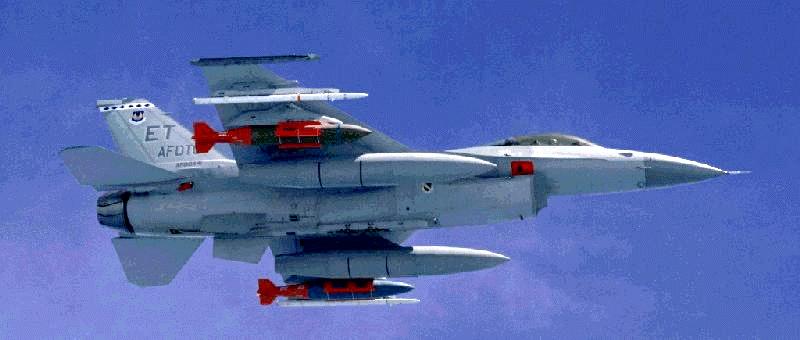
-Dumb bombs use the bombsight generated in hud, which has no relation with LANTIRN at all.
-AGM-154 does not need LANTIRN also, I have personally seen them utilised without pods.
I am aware that there are situations where JSOW or JDAM would need to be retargeted by sniper pods or LANTIRN (is lantirn capable of that BTW?), but thats not always a necessity.
What use is an unarmed F-16, flying with 2 370 gal tanks?
Considered reading to what I have replied? (which is a reply to something I’ve wrote previously)
2x Mk-84 and 2x AAMs is the basic weapons loadout I have selected from the beginning. I meant that payload plus 2x 370gals is good for 688nm radius. (See the page from mission planning section I will be posting later)
There’s no mission where an F-16 has an 814nm combat radius, without aerial refueling.
On the contrary, F-16 can reach 810nm total mission radius even with only 2×370 gals (and 2x mk84 + 2x AIM-9s of course), if entry to combat zone is 800 nm after take off (ie only 20 nm flight is at low altitude). (See the mission radius – entry point graph) There is no mission planning example for CFTs and 2×600 gal + 300 gal centerline tank, and I am too lazy to make a planning myself; however that config will yield 14645 lb of fuel, a 25% increase compared to the given example. I don’t think any calculation is necessary to conclude F-16 will do just fine at 814nm with that fuel load.
…..
As for the 623nm figure it is the 590nm number with maneuvering included as per the mission profile. Othes have calculated it to 613nm but when it comes to the F35 i always use the highest estimates so I can’t be blamed for being biased.And here are the numbers again, that is the simplified radius where maneuvering is assumed to be at 900-1000km/h (same when i compare the Gripen and others).
F35, 2xAim120 + 2x2000lbs bombs – 623 nm (the 590/584 nm figure + maneuvering)
F35, 2xAim120 + 2x900lbs bombs – ~670 nm (the 610 nm figure + ~15 min maneuvering)
F35, 2xAim120 + 2x500lbs bombs – ~673 nm (the 673 nm figure)Happy with sources so far? Another interesting thing to add is that the Rafale on penetration mission (strike with heavy load) has a maximum radius just over 1’000nm. That is pretty sick…
I am happy, however maneuvering is part of “combat” so I don’t think its fair to add that to given figure. I will do a comparison sometime just waiting for “opposition” reach consensus on operational range, speed an acceleration. I may have some free time in the next few days, (either that, or a very busy week), and I am hoping to generate a very simplified aerodynamic layout of F-35 by selecting an NACA 64Axxxx airfoil based on the assumption threshold maneuverability values are reached, to find out its maneuvering performance.
@jackster; If you look at the mission planning example I am posting, F-16 will have drag index of 72 and 27610 lb GW at the point of combat zone entry (also example clearly shows EFT drop is in fact planned), and just after the stores release, drag index is 51, and weight is 22290 lbs:
F-16 mission planning with 2xAIM-9s, 2xMk-84s, 2x370gals for 688nm hi-lo-lo-hi mission. This is a given example so dont start with numbers are wrong issue.
[ATTACH=CONFIG]217722[/ATTACH]
To all, here are long list rather boring calculations, you can just skip to summary. To make everyone happy, I am assuming F-35 can reach same 688nm combat radius on full internal fuel.
Now going to the acceleration data.
[ATTACH=CONFIG]217725[/ATTACH]
For 22000lb weight drag index 50, (just after the stores released condition) we can find F-16 accelerates from 0,79 to 1,25 in 40,5 seconds. Amazingly, 40 seconds was the goal F-35 never achieved.
Personally I am not at all suprised about this. Now lets go the a more advanced level; acceleration at the combat zone entry, where both are still armed with mk-84s.
With drag index 75 (interpolating from 50 and 100 graphs) and 28000lb GW; F-16 accelerates from 0,79 to 1,25 in 71,3 seconds.
Finding Acceleration value of F-35:
acceleraton from M0,8 to M1.25 in 55 seconds is the threshold, for an F-35 at 38500 lb gross with no external stores?
Mission demands combat zone entry at 600nm or at 87% of the mission. %50 fuel is already present on 38500 lb config, so I am adding 13% of the already spent 50%, which makes 1170lb. If we also add the 2000lb bombs, weight at combat zone entry becomes 43670 pounds.
We have 13,4% increase in total mass. Also this is the exact amount of increase in drag, because Lift = Weight for level flight, and Lift/Drag stays nearly the same for minimal AOA changes. This means F-35’s acceleration in combat zone entry is 55*1,134^2 = 70,76 seconds.
Acceleration just before EFT release (which I still say has no use, but lets calculate for the sake of argument)
F-16 is at 29495 lb GW and 132 drag index. by interpolating drag index 100 and 150 graphs, same acceleration takes 107,5 seconds.
By that time F-16 is at 496nm, 72% of the total mission range. Adding 2511 fuel just like in the previous example, and 2x 2000lb bombs. Total weight is 45011 lb, our dimensionless multiplier is 1,16911 both for increase in mass, and increase in drag. 55*1,169^2 = 75 seconds.
Summary;
Performance comparison on a A/G mission to 688nm radius, with 2x Mk-84 and 2xAIM-9 as initial payload.
*F-16 also carries 2×370 gallons to reach this mission range, and it is assumed F-35 will be able to conduct this mission on internal fuel alone.
Comparison of acceleration from M0,8 to M1,25:
Before EFT drop; F-16 = 107,5 seconds, F-35 = 75,17 seconds, F-35 being 43% better than F-35.
At combat zone entry; F-16 = 71,3 seconds F-35 = 70,76 seconds, F-35 being 0.7% better than F-35.
After stores release; F-16 = 40,5 seconds F-35 = 55 seconds, F-16 being 35% better than F-35.
Comparison of max achievable top speed;
Before EFT drop; F-16 = M1,45; F-35 = 1,61; F-35 being 11% better than F-16.
At combat zone entry; F-16 = M1,75; F-35 = M1,61; F-16 being 8,7% better than F-35.
After stores release; F-16 = M1,87; F-35 = M1,61; F-16 being 16,1% better than F-35.
Satisfactory everyone?
AndraxxusNo worries mate, I’ll leave you with your opinion, if you wan’t to change it ..go have a look at page 179 of the f-16 manual and do a bit of maths
you might come up with a lightly loaded f-16, drag 100, weight 30,000, 79 sec M.79 – M1.25, where the f-35 was 64 sec
Was F-35 carrying full fuel and 5000lb of payload inside? Leave drag aside, with increasing weight acceleration drops by simple F=mass*acceleration rule. If its empty and half fuelled it weighs 38000 lbs. with additional 9000lb fuel and 5000lb payload will drop acceleration by 27%, making 0.8-1.25 run in 81 seconds, just due to increased mass. Also, increased weight would require more AOA to maintain level flight, hence higher drag.
Andraxxusyou need more fuel than internal and a CFT which is getting close to 1/2 a f-35, the centre line tank is a start and 2 x 600 gal
aim9 and CFT = 0 f-16 = 7
drop tanks 2 x 600 – drag 76 + CLT 25 = 101
lantrin = 54
2x aim-120 = 20
2x GBU-10 34 plus pylon 30 =64
246 ……….about 250with out any weight/drag frame limits, what was the max speed @ 250 drag? page 161 says it’s subsonic..can you see any mistakes?
when we work this out..we can do weight and sustained turn too
No, math is very accurate, but comparison logic is slightly flawed:
An F-16 with only 370 gal tanks have 688 nm combat radius. For that range figure, F-16 carries 9632 lb of fuel (page 487). On the configuration you made, F-16 carries 12605 lb of fuel. For drag index 250, it would make an additional 252 nm flight, adding 126 nm to combat radius (814 nm). F-35’s undisclosed combat radius is 590 nm with full internal fuel load of 18500 lb. For F-35, to reach 814 nm combat radius, it needs fuel tanks; How many? Assuming “miles per pound” stays same -which is not possible due to increased drag and weight-, it will need at least ~7030 lb of fuel, which equals to 1064 gallons.
Now I am asking: For equivalent scenarios, can F-35 with 4x 600 gallon tanks + 2 external AAMs go supersonic? If drag index system stays same, it means F-35 will be at drag index 162 to match F-16’s range at drag index 246. That is what I was trying to say in my previous posts. Yes, if you overload F-16 too much, its top speed will drop even below supersonic we all know that. However, if you want to overload F-16 to compare with F-35, put equivalent fuel and payload in F-35 too. F-35 cannot carry GBU-10 internally for example; add drag to the external payloads it has to carry.
Another thing is the necessity of targeting pods. Why are you guys put LANTIRN on all configurations you are making? F-35’s internal payload is GBU-31/12/38 JDAMs, mk and cbu series dumb bombs, SDB, GBU-12 and AGM-154 (anything I am missing?). Of all these munitions, only GBU-12’s laser guidance requires targeting pod.
Andraxxusjackster, weight has little impact on top speed. From the supplemental manual, we can get any performance data for any situation, however we have little data for F-35 to compare.
Flight envelope graphs are there, if you want to add CFT, its data is at Appendix C, from page 482 to 722. Level flight envelope graphs start at 631 and we STILL see F-16 with CFT + drag index 50 can reach M1,8. With drag index 100 + CFT, it drops down to M1.5-M1.6. You can play with drag indexes to see with which payload equals to which drag index. A simple example is at page 11, and full list of missiles/bombs/tansk, and their pylons, launchers and adapters starts from page 15. For example you want to have 4 AIM-120 + 2 AIM-9 configuration? 2 AIM-9s on 1 and 9 are included in basic drag index;
Then you go to page 17 and see AIM-120B missile has drag index of 4 and it requires a launcher and adapter. Go to page 16 and you will find out LAU-129 Launcher + adapter has drag index of 6. So each AIM-120 will have drag index of 10. Add 4, and you will have drag index of 40. Then you need basic aircraft drag index; which is different for C/D models, we want C model, so we add additional 7 for subsonic or 6 for supersonic. We can add weight for individual components in the same manner. Total number gets to 47, which is ~50. All the graphs showing drag index 50 will be exact for this payload configuration. Different fuel weights? No problem, you just follow different lines on flight envelope graphs (writing 36 30 24 etc) to see how it goes, or refer to GW Effect graph found on turn performance graphs, to add/subtract turn rates.
David, I think when you add all the kit and fuel, the f-16 will be lucky to even hit Mach 1. The manual is there, Andraxxus will no doubt do a spread sheet on 2×2,000 LGB with missiles, pods CFT drop tanks etc Also the specification speed of the f-35A is 700kts LIMITED to M1.6 with LGB. missiles, fuel, It’s hitting M1.6 around 25,000ft
Nonsense! You have the manual, configure the F-16C (drag index 6) for CFT (drag index 0), 2x Mk-84 (drag index 24 each) , and Lantirn pods (drag index 54 in total) and see it for yourself. Let me put it this way; F-16 with drag index 200 can still go supersonic (barely but still).
How much payload would we require to achieve drag index 200?
F-16C = 6
AGM-84 harpoon missile + pylon with hiak = 25 each
Mk-82 bombs on triple ejector racks = 9 each
Triple ejector rack 66j45517 + pylon = 24 each
Centerline tank + pylon with stors at 4,6 = 25
AIM-120B + launcher + adapter = 10 each
With 2x AIM-9, 2x AIM-120s, 6x Mk-82s, 2x Harpoons, and a centerline tank, drag index is 199, and flight envelope graph says F-16 can still go supersonic.
Not likely considering the F-16 tanks are M1.6 restricted, which is of course the same speed as the F-35’s top end (though they do intend to take it faster than that in flight testing). And an F-16 won’t have a kinematic advantage loaded like that due to the CAT III setting needed when using fuel tanks.
There is no mention of such speed limit for the tanks in the manual; If there were, it would be stated. CAT III limiter is AOA limitation. It has no impact on climb, acceleration, high G performance at supersonic speeds (this is what it counts for BVR kinematics).
I was chatting with a former mil pilot last night and though he’d never flown Eagles or Vipers he has flown with and against them a fair few times. He didn’t accept the figures saying “approaching just shy of Mach 2 with a bomb load doesn’t sound posssible”.
Nothing concrete I know but I think many of us are having a real hard time believing this. Like I said before calcualations are one thing but doing it in the real world is something entirely different.
Tell that to the Lockheed Martin. They have written 722 page long supplemental manual to precisely describe their aircraft’s performance on any and all circumstances. I am sure they wouldn’t need every pilot to accept the data they have collected from flight tests. Problem is, you are talking to the car driver if his car can make 200 km/h (or in your case, a car he never driven but he raced), I am using manufacturer tested -and confirmed- data. I dare say, even an F-16 pilot says flight manual is wrong and he is right, I would question his credibility…
Real world is not any different from calculations. During flight tests, they fly the aircraft with varying dummy payloads (for example clean at first, 6 AAMs next, 12 mk82 bombs next etc etc) and record the data. Put it in flight manual. Than they also fly aircraft with single mk-82/84 etc to find out how much drag it creates, and put it on the flight manual. Then to test payload interference, they combine different payloads, (ie a single bomb or a triple ejector rack next to wing tanks), to see how it effects their drag. Then they use all these collected data to create a drag index system so pilots and mission planners can interpolate between graphs. In other words, F-16 going M1,8 with Mk-84 is not just a theoratical calculation based on estimates or assumptions. It is what is tested and recorded during flight tests.
@bring_it_on I am fully aware of it and I am not questioning F-35 as a complete platform. I am questioning IF F-35 can really match F-16’s performance or not, judging with data we have.
AndraxxusTaking one parameter doesn’t tell the story, the manuals can be downloaded from here and studied
http://publicintelligence.net/hellenic-air-force-f-16cd-flight-manuals/
GR1F-16CJ-1-1 is the exact same manual I am currently posting these values from.
AndraxxusAssuming an F-16 were carrying nothing at all but two bombs and two AIM-9s… this is not a configuration you are likely to see in the real world. If as is much more likely the F-16 were carrying at least a targeting pod and likely a pair of AIM-120s as well things change very quickly.
Even using the configuration with just the two bombs and Sidewinders you are still going to blow through a big chunk of your fuel to reach that speed from cruise speed.
The question is whya Fighter needs acceleration or high dash speeds on a A/G mission? The answer is a) when a high speed penetration is required, b) aircraft is attacked and needs to retreat. On both occasions, F-16 will drop EFTs. Surely, F-16 would not be carrying 2 bombs + 2 AAMs, in real life, but thats the payload F-35 can ever reach M1.61. With any greater payload, be it an extra pair of Mk-84s or AAMs, drag will be affecting F-35 just as same as F-16. There is no point in comparing F-35 with an F-16 flying with drag index 250, where F-35 also be at drag index 150. One thing is clear: F-16 flying with total drag index lower than 100 will have greater top speed than F-35 and logically better supersonic acceleration and climb rates. Playing with various configurations gives us:
1- F-16 with 4x AAMs and 2x600gal tanks can go faster than F-35 with 4 internal AAMs, and out range it. Possibly have kinematic advantage at most of the supersonic envelope.
2- F-16 with 2x 1000lb bombs and 2x AAMs plus lantirn OR ALQ-131 OR centerline 300gal tank can go faster than F-35 with same payload on a short range mission
3- F-16 with same A/G payload but with EFTs is inferior to F-35 in terms of kinematic performance.
What we are trying to find out is what is the importance of these 3. IMHO, #1 is very clear, where F-16 will have beter kinematics on most if not all A/A configurations. I understand what you are saying, #3 is the most realistic scenario in real lifre, but what I am trying to say if pilot or mission planning demands, F-16 can switch from condition #3 to #2 at any time.
(Why start at M1.1? ) Time and fuel consumption will also vary with altitude.
Arbitrary number to show supersonic acceleration. Of a 50 minute mission, such acceleration would only a few minutes for F-16. I don’t see a proof Supersonic envelope is any less useable for F-16 than for F-35.
As far as the F-35 goes, its acceleration will suffer a far smaller penalty for fuel and bombs as long as they fit internally. When talking about acceleration to supersonic speeds drag is by far the biggest concern. Added weight certainly won’t help, but the F-35’s drag won’t increase appreciably as long a the load is internal.
We all know drag is very important; What you dont understand is this: A clean F-35 will make M1.61. An F-16 with drag index 100 will make M1.7. A Clean F-35 is ~90km/h slower than an F-16 with 4x Mk-84s. That should tell how draggy F-35 actually is.
I don’t think there is really any way to compare them. It is too easy to skew things just by tweaking assumptions about time/burner use in the target area, the exact distance spent at low/non-optimal altitude, etc.
We are not planning for specific circumstances. Rated combat radius is a theoratical number anyway.
Agree on the Su-27 and F-15, but I wasn’t counting them among the F-16’s competitors as they are far larger and more expensive aircraft.
I agree its a different weight-class, but not incomperable. With 13.3 tons of weight, F-35 is heavier than F-15C. F-35 is 3x / 4x more expensive then those types.
As far as how close the F-35 comes to matching/exceeding the F-16’s performance I believe they have achieved that provided a realistic load out is used. F-16s aren’t flying around clean other than two bombs and wingtip Sidewinders.
“Realistic” term is debatable. If payload is realistic so must be the scenario. Lets assume a realistic scenario where kinematic performance really counts: On a A/G mission without any backup, pilot gets a warning from RWR that he is spotted by enemy early warning radars and enemy CAP (lets say good old MiG-29s) have target lock and moving to intercept… At that point lets assume aircraft is flying at M0,85 at sea level.
-On an F-16, pilot would jettison EFTs, turn tail and light up the afterburners. Within less than 5 minutes aircraft is at 30k feet and M1.5+ and running away from pursuing enemy. If worst happens, F-16 pilot can also jettison his Mk-84s, and be light enough to engage MiGs under these circumstances and actually have some chance of winning.
-On an F-35, it doesnt matter if it jettison his payload or not. Assuming he has similar performance of the F-16 with drag index 100, he will be at ~20k feet and around M1.2, giving his a** to pursuing MiG-29s at 45k feet M1,5+. If MiGs catch, F-35 is energatically in a dramatic position, and cannot match the maneuverability of MiG-29.
This is what I understand from kinematic performance. What F-35 is relies upon is not getting spotted by enemy radars in the first place.
AndraxxusThe Saudis has replaced the PW F100-229 engines of the F-15Ss with GE F110-129 engine … what they have done with the PW engines, i think some (many?) must be in good condition. Could they fit them in their F-15Cs to bring them to an new and better combat level – I read about an interview with an F-15 testpilot, who quotes that an clean F-15E (without conformal tanks) with the PW F100-229 engine would be an hard match in an dogfight, even for an F-22 Raptor.
Imagine how an F-15C with the new better responding and much lighter FBW, APG-82 or APG-63 III radar, the new ECM system and the PW F100-229A (with 165KN!) could perform – I really wonder why none is thinking about re-engineing the US F-15C Golden Eagles which should serve for much more years with more powerfull and better engines !?Greets F-15fan
F-15E has slightly larger and different engine compartment to recieve PW-229. I am not sure about F-15C, but F-15A/Bs cannot accept 229.. Also, F-15E is structurally A LOT stronger than F-15C. If you somehow manage to fit a 165kN engine in a C variant, engines are likely to come out of air intakes on Max AB. even basic 129 kN -229 would be a 20% increase in thrust, and can be too much for C’s airframe to handle.
Actually, sustained turn and acceleration performance of -229 engined F-15E is not any different than -220 engined F-15C. F-15C has slightly better Instantenious turn rates, because same wings are carrying lighter aircraft. Also, both variants have same OWS g-limits but F-15E is heavier, so higher fuel loads or missiles will lower F-15E’s available G more drasdically. For dogfighting, I would take F-15C over F-15E any time.


 Sign In








