Andraxxus
2 Rafale cannot kill Su-35 as there is no missiles in Rafale that can be launched at safe distance. combined that with weak aerodynamic performance the NEZ for missiles launched from Rafale is reduced even further.
-1st Rafale jams at 300km+ 2nd Rafale goes in radar silent, getting target telemetry from the 1st via datalink. Irbis is blinded, and reduces the gain to see the jammer source. Su-35 moves to engage 1st Rafale and only be aware of second rafale after ARH seeker on its MICA/Meteor triggers its RWR. By then, 2nd rafale would be closing in at 30k+ feet and M1.5 and it would be very difficult for Su-35 to disengage let alone fight back.
A simplistic 2vs1 scenario. Though it would be just as easy for 2x Su-27S to teamwork and defeat a lone Rafale.
Andraxxus“That which can be asserted without evidence, can be dismissed without evidence.”
+1
This RCS discussion with guesses and assumtions on no solid ground are starting to get boring IMHO.
AndraxxusOf course I’m not specialist of the AAMs, but I didn’t read any sources claimed R-37 – 8g, and Novator – 12g.
I always thought that RVV-SD and R-77M is Su-35S special BVR weapons against agile fighters, as it is less draggy and Su-35 can gain energy better with more number of lighter weapons. Of course I could be wrong.
Something about R-37 was already posted ->
[IMG]http://www4.picturepush.com/photo/a/12608572/img/12608572.jpg
[IMG]http://www5.picturepush.com/photo/a/12608578/img/12608578.jpg
As for KS-172 not the greatest source but google search provided:
http://warfare.be/db/catid/262/linkid/2175/title/ks-172-rvv-l/
However we know it is derived from the BUK-M1 system and on APA site;
http://www.ausairpower.net/APA-9K37-Buk.html
It is claimed to be capable to intercepting a 12G target.
Andraxxusanother evident
if you read about it , you may know that MBDA bought R-77M design to make meteor ( and as you already know R-77M is rated as having range = 160 km )
and as said before with equal weight ramjet will have much longer range than normal missiles ( reason = re-read a couple of page before )
but then there is missile weight.
Basic R-77 or RVV-AE weigh 175 kg, and it has 80 km range.
Ramjet version R-77M1 or RVV-AE-PD weigh 225 kg with 160 km range.
If we assume 50 kg is for warhead, seeker, electronics, body, wings, actuators, that would leave 125 and 175 kg for propolsion. If you look at engine weight efficiency in km/kg, you will easily see how Ramjet is more efficient (~42% more in this case).
However if we make same assumption (50 kg for anything minus engine) for Meteor, it would only leave 135 kg for propolsion. If it has exact same propolsion and aerodynamic layout of -PD version, it would have approximately to 135/175 = 60% range. Obviously on smaller missile, drag would be lower, but so does mass flow to the engines, in short without improving design thats about it.
Andraxxuswrong Ks-172 can turn 12 G max compared to aim-120 can turn 35-40G ( not that it can intercept target that turn 12 G 😎 )
Max maneuverabilty of Ks-172 is not published, only target Gs. However it will be derived from 9M38 and it has 20G max maneuverability. It is (like Ks-172) desgined to hit 12G targets.
Meteor max range is 160 km so i think the direct is about 75-80 km :p
I was sticking to official 100+km figure. Like I said, Meteor outranges R-77 in any case, there is nothing to talk about it.
Andraxxus8G is too much for such a heavy missiles:
Missiles like AIM-54, R-33, R-37, Novator are not design to kill fighter aircrafts.
Manufacturer says it can kill fighters up to 8Gs, and some naysayers come up and claim it cannot do so because
a) its too big and heavy
b) it looks similar to AIM-54 or R-33, and neither can effectively hit fighters.
No offense, but that is nonsense.
If point a) was true, how can Su-27 be FAR more maneuverable than an F-5?
If point b) was true, how can MiG-25 and F-15 has exact opposite flight characteristics?
If a missile is designed to maneuver, it will do so, no matter how it looks or how big it is.
R-33: Can be launched at max M2,83 or max 5Gs, againist 4G targets.
AIM-54 can be launched max M1.6 or max 6.5Gs, againist 5G targets.
If one concludes “neither can hit a fighter” I would agree but,
R-37 designed againist 8G targets. If R-60, R-27 Super-530 or AIM-7 (all rated vs 8G targets) can be used againist fighters, than so does R-37. My logic is simple as that.
As far as Novator Ks-172 goes, I am always amazed when many respected posters make such ..baseless.. claims. Ks-172 missile is (will be) derived from 9M38/9M317 missile of the BUK system. If someone said “BUK system is only designed to kill bombers, it cannot be used figters” we’d all be laughing at him. Then how does the very same missile becomes ineffective when its launched from Su-35?????
AndraxxusSufficient in Meteors case to push it up to 4 times the speed of sound though so, thrust curve or not, in BVRAAM application its a moot point. Bayern Chemies view as follows: http://www.bayern-chemie.com/ramjet.htm
Sorry I wasn’t clear enough. I meant rocket powered BVR missiles like R-27 or R-77 also have slow burning rocket motors. My point is ANY rocket can be easily designed to sustain as long as, and even longer than a ramjet engine.
Throttling a solid fuelled rocket?. You can have a dual pulse motor with differing burn profiles but thats a little different. Ducted rockets and ramjets have similar characteristics so, for the purposes of the exercise….ie differentiating between a solid rocket and an air-breathing motor, they can be considered as the same. The only context I’ve heard of throttle-able solid motors is in spaceflight with very complicated electrical variance of specialist solid fuels burn rate. Nothing applicable to missile weapons.
Solid fuel rockets can be throttled by liquid oxidizer, but in any case it has no military application, I was comparing only rocket vs ramjet in general.
Right and wrong. Maximum kinematic range and maximum effective ranges are very different numbers. As is well documented here the latter is even dependent on engagement geometry.
The big difference is in the operative flight profile dictated by the propulsion option. If your motor impulse is 15 secs then even at M4 basic arithmetic tells you that motor burnout is just over 20km downrange and after that point energy expended is only being replaced by trading altitude….hence the loft profile.
Are you implying a 100 km ranged ramjet missile follow a direct path and would rocket sustain thrust for 80/90 km?
Ramjets CAN follow a ballistic path…but they dont HAVE to as they can exceed a direct profile solid rocket comfortably without recourse to it….see earlier comment about gliding ramjets.
No, ramjet turbojet turbofan etc, all missiles can reach twice the range by following a ballistic path. Even anti-ship cruise missiles follow a ballistic path to increase their range. Ramjets can, and HAVE TO follow a loft profile if they want to get their max range from same amount of fuel.
….but, as you have explained yourself, the thinner the air and the lesser the available oxidiser…there is a tradeoff.
No the rocket booster is needed to get sufficient airflow into the ramjet for the engine body to compress for fuel injection and ignition. Ramjets commonly have boosters to achieve this. The NASA scramjet technology uses similar process.
See X-43, Seperation from B-52 carrier at 43k feet. Pegasus booster rocket carries it to 95k feet M4.0+ and seperates. Ramjet further carries it to 112k feet and M9.68.
Obviously the is a trade off, for example it possibly wont work at 200k feet. However, this example alone tells us a) ramjet will work up with thin air up to 112 k feet b) as it uses a booster rocket to get into high altitude, it will work better than it does at low altitude. (Otherwise a lot smaller booster would be used to accelerate in a straight line, and ramjet would use its own power to climb)
…and this was the original contention. We were discussing NEZ’s of a Meteor equipped Rafale with an RVV-AE/SD carrying Su-35. This was before the revelation that Su-35’s standard warload will be at least 4 R-37 type weapons!!!. Who knew!?.
RVV-AE has 20km less max range than Meteor. Obviously it will have 10 to 20km less effective range/NEZ. I don’t see anything to discuss about it. Su-35 carrying R-37 type weapons is not a revelation to me. Even during its first appearance in MAKS-2007 it had KS-172s with extended range boosters under its wings. That missile (if produced) will also have 300-400 km range 12 target G capability.
After a brief googling the testing seemed to suggest that the direct flight profile for R-37 gave a range of about 80nm or 160km. Loft trajectories accounted for the great ranges beyond that. Hence my earlier question as to whether R-37/RVV-BD was capable of 8g in the end game AND 200km range at the same time or whether it was a case of 8g terminal manoeuvre OR 200km+ range.
Obviously. Like I’ve said earlier. direct path range =~ half the max range. Just as IF Meteor has 100 km max range, it will have around 50 km on direct flight.
AndraxxusAndraxxus
Would I be right in thinking that the R-27 uses a single burn motor and a loft profile to get the range figures you mentioned?.Thats not the case…ramjets dont tend to coast very well as they invariably have great big drag-inducing air intakes. The value of the ramjet is exactly that it is burning relatively longer than an equivalent rocket motor and does away with the ballistic boost-coast profile that earlier weapons require. Weapons such as, I believe, the R-27 and -37’s….though I am, of course, willing to stand corrected on that.
The relative NEZ’s for the ramjet weapon, compared to the rocket weapon, are therefore larger as the latter must rely on the energy from remaining inertia which, once expended in manoeuvre, cant be recovered…where the ramjet weapon will still have the energy to catch as its still, on direct profile, under power.
Yes, but the single burn motor is rather slow. I don’t have exact info with me right now, but CAC missiles typically burn for 2-3 seconds where BVR missiles can burn for 15+ If required a rocket motor can be made to be throttled and burn slower. Thats not the ramjet is for, there is a lot of false assumptions about it IMHO.
A rocket produces a chemical reaction and extracts reacted mass to propel itself. It needs to carry different chemicals (be it solid or liquid) and catalysts which contributes to weight. A Ramjet is an air breathing engine, ie it burns air with fuel. Thus requiring a lot less amounts of weight for fuel. The end result is a ramjet missile can match the range of a rocket powered missile with twice the size and weight.
Ramjet, or rocket powered, missile will run out of gas before its max range and glide the remaining path. Ramjets do follow ballistic path and they do it even better than rockets, as higher the altitude = less drag = higher speed = higher mach number = more compression = more efficient ramjet becomes.
Thats why all the NASA s hypersonic projects use rocket boosters or carrier aircraft before ramjet is activated.
“Ramjets sustain thrust more than rockets” is an incomplete estimate. If they are of the same size and weight, of course. However if one missile weigh 4 times its very questionable:
Meteor maxes out at Mach 4.5 at some point on its flight path, and reaches 100km range (or be it 150km)
R-37 maxes out at Mach 5.0 at some point on its flight path, and reaches 400 km range. This alone gives us a clue that R-37 does have significantly higher boost + sustain time than Meteor. People keep saying R-37 is a draggy missile; True, but in order to reach a greater range, a draggy missile would needs even longer sustain time.
AndraxxusR-37 was never designed for target maneuver 9 G , stop making up number
I read the posted images incorrectly. Still, 8G is already impressive, considering R-60M and R-27 family is also rated againist 8Gs. No one considers them merely an airliner killer.
this doesnot really show anything :pairframe can stay 12 G but human can only stand 9G
Not really. There are numerous instances where USAF F-15C pilots pulled 11+ Gs in various conflicts. However I agree it doesnt show anything; most 4th gen aircraft can exceed 9Gs, just as they can exceed their rated top speed.
deceptive jamming ( different from noise jamming) is not very affected by different in power 😀 ( they can even use it to jam ground radar )
No, againist any kind of jamming, a radar that can over-power the jammer will see through so size does matter on this one 😀 . Only deceptive jamming currently present (that I know of) is RGPO, and that would be ineffective againist any electronically scanned radar, as radar posseses the ability to change PRF at will, depending on target approach speed, and can do so with very small increments, unlike the simple HI MED switch on older radars.
it have advantages vs normal engine in term of cruise , terminal speed and maneuver , however it much easier to be detect by IR , and i dont think it can operate in super high altitude like 100000ft
Technically, ramjet has the advantages you quoted, but its also a lot more inefficient in lower speeds and initial acceleration. So like any tech around, it has its pros and cons.
AndraxxusOne word:
Fuel consumption.Those 117S engines are massive and there is two of em, the fuel gallons gets going.
Oh not exactly. At supersonic speeds (where AB would be used other than dogfighting) inlet design has direct impacts on fuel consumption. On Su-27 (or F-15 MiG-31 etc) pressure recovery is so great that FADEC governs the engine by running leaner so it wont overrev or overheat and destroy itself (like it did on MiG-25). At high altitude Su-27 can maintain AB for more than 30 minutes IIRC. OTOH 117S has more power with similar SFC, so it may consume a little more.
AndraxxusAFAIK , no aircraft from the Flanker family including the Su-35 is cleared to use the R-37 , none . It is reserved to the Mig-31BM . Then , it is designed to attack airliner size aircrafts and not a fighter because the missile ‘s end game agility is simply not good enough . I don ‘expect such missile to be a real threat to 4 or 4.5gen aircraft .
It has been stated on this thread that R-37 was designed againist targets maneuvering up to 9Gs and will be integreted into Su-35 eventually. If you are talking about now, Rafale is not cleared to use Meteor either.
I agree that if we give Meteor/Mica to the Rafale and R-27/R-77 to the Su-35 , they both have similar ranged weapons . But something is telling me that I should give more credits to the European weapons as far as efficiency goes.
Agreed 100% on this.
Secondly , Rafale flew at Mach 2 but is limited to Mach 1.8 to preserve engines lifetime . From Mach 1.5 to Mach 2 , the Rafale keeps accelerating so the 1.8 limitation is not a burden.
Be it M2.0, then. My point stands, Su-35 has positive excess power at M2.0 with 6+ missiles and far greater fuel load, Rafale has zero SEP even when clean. This points out that at any high supersonic speed, Su-35 will have superior excess power which will lead to better STR, climb and acceleration performance.
IIRC it has been tested it up to Mach 2.0 and they put a M1.8 limitation to prevent overheating to canopy and avionics bay. Engine life has nothing to do with it. God knows how fast the Su-27 is tested before M2.35 limitation is reached. For example it has been tested up to 12Gs but its still a 9G fighter, with further peacetime limitations reducing it to 8.5 to 7.5Gs.
This is HIGHLY debatable to say the least . “Miniature RCS difference” ? What is the Su-35 ‘s RCS ? Twice less than a Su-27M , thanks to the bit of work done by Sukhoi ? That gives us 10m square clean , 100 times bigger than Rafale ‘s 0.1m square .
I am not going to teach you that smaller your RCS is , easier it is for your own ECM/ECCMs to do the job . Also , the deceptive jamming can start later than if you fly a 10m square RCS aircraft which has an impact on discretion . You also need less output power for the same result .
No offense but there are a zillion sources on the net that claim Su-35 has RCS less than 1 sqm and Rafale has exactly 1 sqm. For example a Su-27 never had 20 sqm when CLEAN, etc etc. Googling all the “claims” and taking the smallest number for the fighter you love and biggest number for the one you hate is bias to say the least. No manufacturer ever released RCS info on their aircraft, so IMHO, all those RCS claims are crap. I would debate as RCS treatments on Su-35 and Rafale are more or less on same level (non stealthy airframe with nice verticals, some ram coating here and there), their RCS difference is more or less related to their sizes. I agree on the rest (jamming etc), but does not apply when I believe both aircraft with CAP payload will have RCS around 5 to 10 sqm. Again, there are no reliable sources to disprove my numbers, nor I have any to support them.
:rolleyes: First , you don ‘t need to “focus” to get vector data and secondly , the radar doesn ‘t have to give up LPI either . In fact , closer the target is , easier it is for the radar to use LPI simply because the output power of the train-pulses can be very weak and still get a clear echo.
An AESA can do that -in theory- by varying the frequencies on independent T/R modules, so each pulse will be below the threshold of EW. Care to explain how LPI works on RBE-2 *PESA*? In the end to get a higher resolution, radar will have to use more power from the *SINGLE* Transciever, and while reading/interpreting via multiple reciever modules is efficient, from RWRs point of view, its no different than a mechanically steered dish radar. I doubt LPI on a PESA will even work at extreme ranges againist Rafale or Su-35’s RWR.
Basicaly , who will see the other first
With tremendous power output, module number, dish size and coverage advantage on one side, and considering both are nonstealthy aiframes, my money is on Su-35.
and more importantly , who ‘s gonna be the first to fire with a close to decent probability of kill (pk) ?
Meteor vs R-27RE? Clearly Rafale. With Meteor vs R-37? Clearly Su-35.
We know that good deceptive jamming can divide the range where a lock is possible by 2 or more (depending on the capability of the ECMs) .
You really have no idea how the jamming works. The second Rafale activates its jammer, even N001 on Su-27 (let alone Irbis) will know its being jammed and automatically switch to HOJ mode. This will give bearing (azimuth and longtitude) about where the source jammer is, but no range or vector data.
Su-35 pilot on this situation will activate his own jammer and he will simply blind fire a on HOJ mode. Even R-27RE is capable of this however this brings some drawbacks: on HOJ mode, missiles cannot lock and fly in a ballistic trajectory, as source aircraft cannot provide mid course updates (because it doesn’t know the range to target), pilot could either give an estimated range, which is highly unreliable, or could configure the missile to follow a linear path to target, rather than ballistic, trading perhaps 2/3 of the effective range.
However, as Su-35 has switched on his ECM, Rafale would be in same position. Irbis has far superior power output, and will likely to burn thruogh jamming more easily, and if Su-35 pilot happens to have a missile with 400km range, a simple, non-ballistic shoot would be pretty lethal as R-37 would be homing passively to the jammer, no RWR warnings until MAWS see it.
Add to that a low RCS
Lets say, relatively low RCS.
and a good Aesa radar (and Spectra)
SPECTRA’s single jammer vs a radar with 6600 mm2 array area and 20kW power output,
2x KNIRTI SAP-518 jammer pods plus 1x SAP-14 centerline jammer vs 2800mm2 sized antenna and 3-4 kW power output.
If you really believe former has higher chances of success than you are alone in that assumption.
Andraxus,
Meteor is still under thrust in that range bracket. What are you basing the above statement on?.
Do you have details of the motor burn/ flight profiles of the R-27 variants you listed?.
I took the numbers from R-27 manual. Like I said, I guesstimated Meteor’s numbers according to its 100 km max range. Be it ramjet or not, all missiles will coast to its target after sustainer rocket is exhausted. If ramjet on Meteor was running after 100km it would have greater, say 150km, range.
how is R-77SD equal to Mica. Mica is slightly heavier than R-73. R-77SD is in Meteor weight class.
Thats the inability of Russians in making smaller missiles. In terms of range, mission, seeker head they are equivalent.
in my opinion ramjet missiles have much better terminal , cruise speed , but they seem to be easier to be detected by IRST than normal missiles
Ramjet is not a magical design, its just another type of engine. Kh-31s are ramjet, for example.
Right, goes to show how total crap these sources really are.:rolleyes:
Thank you!
AndraxxusBut how come that same f16, using less thrust at same altitude, 60k feet, maintains same speed? Shouldn’t it go faster, if everything else is the same except for thrust?
Its not about maintaining an airspeed. Numbers are only fuel flow at fixed throttle position at a certain airspeed and altitude, which is independent of acceleration/deceleration climb/sink or payload/drag. It would explain itself better if I posted the page here;
[ATTACH]213206[/ATTACH]
AndraxxusFuel flow depends HEAVILY on speed and altitude. Take F-16 with 7000 pounds of fuel.
For example an F-16 blk50 flying an MIL power will consume 17000 lb/h at M0,9 and Sea Level.
Yet very same F-16 blk50 flying at MAX AB power will consume only 4000 lb/h at M0,6 and 60k feet. (less than 25% of the previous dry thrust condition)
On max consumption F-16 blk50 flying at MAX AB will consume 96000lb/h at M1,3 and Sea Level.
Lowest possible consumption at max MIL power is 1000 lb/h at M0,6 and 60k feet.
If you are looking for max possible time, 1 hours 45 minutes for little F-16 which will not take you anywhere. However minimum time is somewhat useful for a S/L dogfight that is 4 minutes 22 seconds.
Andraxxuson another hand, anything flying supersonic will make so mild turns that any missile sent its way inside its flight envelope has a good chance to hit
Supersonic flight is limited by the G load of the fighters, at 9Gs at 30k feet @ M1.5 translate to 11.07 deg/s turn rate. Obviously too low, however pulling 9Gs at these circumstances deplate energy fairly quickly, around -1500 FPS specific excess power, and if fighter needs to avoid a missile, it can always perform a high yoyo to trade airspeed for altitude, pull tighter instantenious turns, and dive to regain energy.
On the other hand flying high and fast is a must in BVR combat if you want to a) give your missiles better boost b) maintain a clear LOS c) maintain a good energy state for evading maneuvers or for merge.
then there are electronics.. missiles like the R-27 series may have long legs in some versions, but as far as efficiency goes… er… what’s the latter to go far if you can’t see (and hit) anything?
AIM-120 is said to acquire its target at 19 km away;
9B-1348E seeker head on R-77 acquires targets at 15 km.
9B-1101K seeker head on R-27RE acquires targets at 25 km.
9B-1103M seeker head on R-27AE acquires targets at 20 km.
If their rated targets is the same -that is a very big if I must admit- R-27 variants are still comperable in terms of target acquisition range. However they are rated for targets pulling up to 8Gs.
**********
Whatever the missile’s capabilities are, an opponent will still have to break lock and waste its energy to make evasive maneuvers. In any scenario that max range really matters, most (if not all) BVR missiles would be expanded long before their effectiveness become a question.
For example lets assume Su-35 carries R-27R (not RE) variant. It has 75 km max range and according to Su-27 manual it has
42.5 km head-on and 7.5 km tail-on effective attack range. From these values, we can calculate;
25 km effective range that is running perpendicular to launching aircraft
Meteor has a big 25 km range advantage over R-27R so i will estimate (pull some numbers from my a**) just for the sake of argument;
100 km max range
60 km head on max range
35 km running perpendicular effective range
10 km tail-on effective range
On the first part of the BVR only range matters. Pilot would know he could be hit if he doesn’t evade, and seeker capabilities are irrelevant here.
-from 100 to 75 km distance, Meteor can be fired and will reach Su-35 but only disturb it, and wont be effective.
-from 75km to 60 km distance, both missiles can be fired and force their enemies to make evasive maneuvers, but wont be effective.
-Meteor can be fired at 60 km, but will be countered by Su-35 simply changing approach angle, same goes for Rafale after 42.5 km.
Until 35 km, each missile would only force enemy to disadvantegous position but would not kill. Huge range advantage (also equals higher kinematic advantage in less than max range shoots) of Meteor on this scenario would put Su-35 in a less favourable position (as it would be more difficult to evade more energetic Meteor missiles) This is a position where Su-35 pilot should know he is in danger and break off while he can.
At this point, with both aircraft approaching at ~1 km per second there is a little superior range and kinematics can do, and all it matters is type and effectiveness of seeker heads.
After 35 km, Su-35 requires to make 90+ deg turns from the target and would need to break its target lock. By now, Su-35 pilot has lost its SA and the ability to fire back because it needs to illuminate target to guide SARH missiles, and cant do so while evading incoming missiles. In this scenario combat should over if a missile manages to hit Su-35, or Rafale will merge in a extremely superior energy state and finish with Magic IIs or gun.
If Su-35 also had fire and forget ARH or IR missiles, he would have forced Rafale pilot to lose his SA, and chances would be more or less equal, with Su-35 having wasted more energy to defeating Meteor missiles.
My point is, 10-20 km range advantage of any BVR missile is not a key factor in its effectiveness, as they will be fired only to be wasted on their extreme ranges. And my second point is R-27RE can do the same job in this case. So a mixed payload of R-27RE/AE, R-77, R-73 would equal Meteor and Magic combination in most of the real life circumstances.
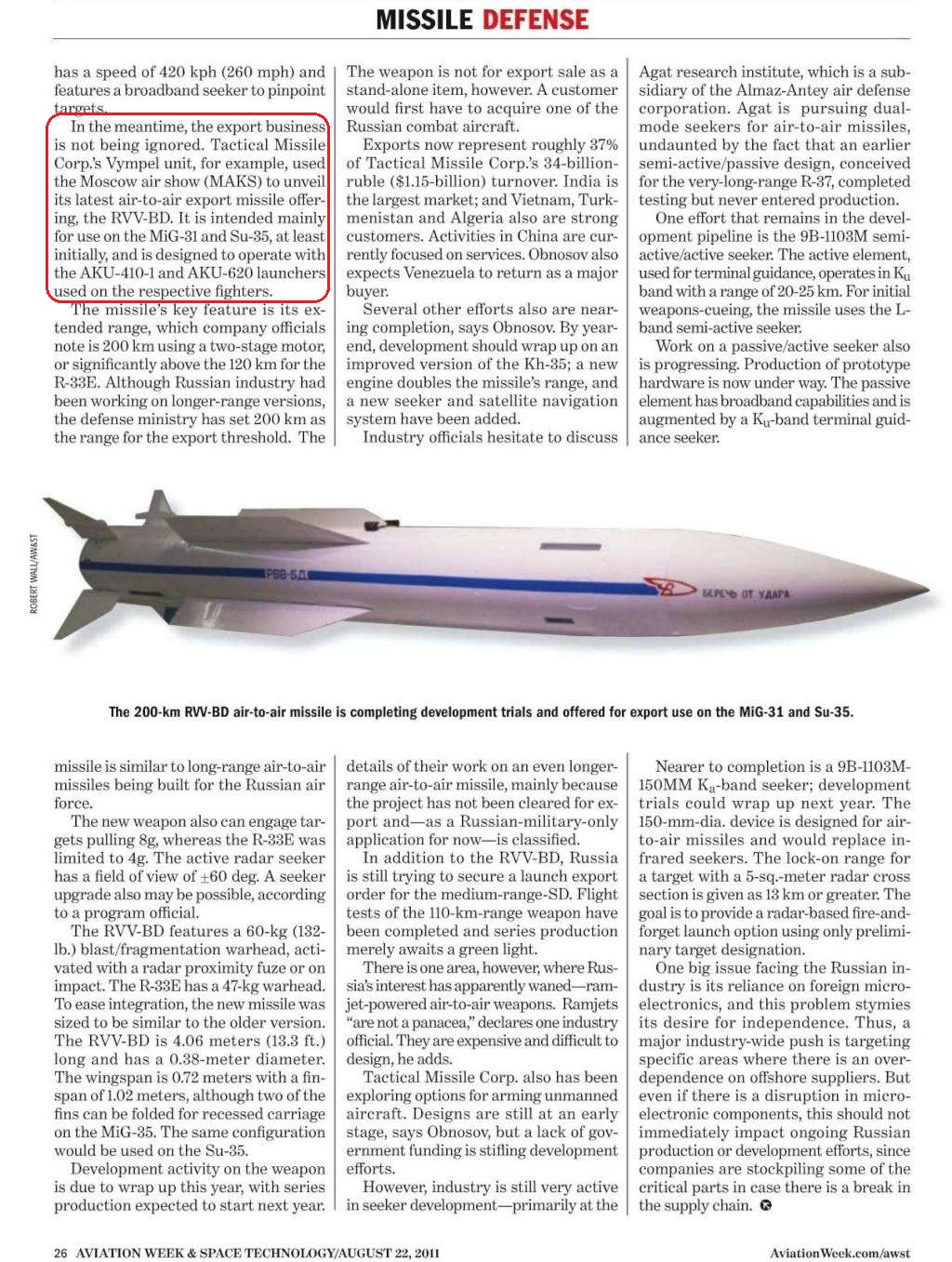
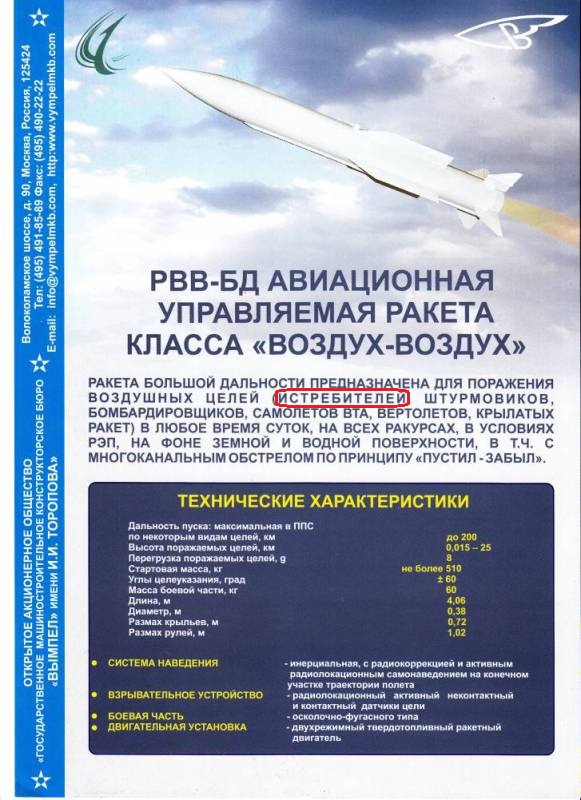
AndraxxusWhats with the Meteor vs. RVV-BD really? Meteor is not even in service, and yet to be intagrated to Rafale. Same goes for RVV-BD and Su-35. Current loadout of Rafale is MIRA IR/AR and Su-35 carries R-27T/TE/R/RE/P/AE and R-77.
R-77 in terms of weight, size, range, seeker etc etc, is equivalent to MICA AR. R-27RE and R-27AE outranges both by a quite margin. Then we have MICA IR, which is roughly matched by R-27T, and outranged by R-27TE. WHEN Meteor is finally integrated on Rafale, its range will easily be matched by R-27RE and R-27AE missiles.
As for a payload’s effects on Su-35, I agree with JSR and Sens on this one. For whatever reasons, Su-35 can reach M2.2 with 2x R-27RE 2xR-77 and 2xR-73 missiles and Rafale can not. Reason -like Kovy stated- is the variable intake ramps on Su-35, but the reason is irrelevant here. VG inlets increase inlet pressure, that increases dynamic T/W at supersonic speeds, and that has positive effect on supersonic acceleration, climb and turning performance. Rafale doesn’t have them, and its engines will be generating less than a third of their advertised thrust at high supersonic speeds. With equivalent 6 missile payload, Rafale will likely struggle to climb or accelerate or sustain a turn at anywhere above M1.5, but Su-35 wont.
How much performance degradation would occur if R-27 missiles (350kg 23cm diameter) were to be replaced by R-37 (600kg, 38cm diameter)? 500kg increase on a fighter that weight 25+ tons at NTOW? or a 0.1125 m2 increase of frontal area on a fighter that has a wingspan of 15,3 meters? My answer would be: quite negligable.
Comparing Meteor with R-37 (or RVV-BD) is non-sense IMHO. Despite the Ramjet engine, Meteor is rated at 100+ km range and R-37 missile is rated at 400km. Obviously latter is bigger and more draggy, just as AIM-120 is more draggy than AIM-9.
Irbis/R-37 combination will outrange RBE-2/Meteor combination irrelevant of the miniature RCS differences on a two non-stealthy fighters. For the sake of argument, lets assume for a second Su-35/Irbis combo is inferior to RBE-2/Rafale, and assume EW on Su-35 could not detect the LPI mode of RBE-2. What would happen? As soon as RBE-2 enters STT it will have to give up LPI mode and focus on target to get vector data, and be detected to EW on Su-35. If that happens 90km, Meteor would barely reach Su-35 and most likely be evaded, but 90 km is likely to be within NEZ of R-37. If Rafale pilot waits to force Su-35 into NEZ, it would be detected by Irbis and Rafale would be already R-37’s NEZ.


 Sign In