 Teer
TeerThat’s not exactly what I meant. and India does not yet have those 272 Su-30MKIs. Its still in future tense.
India already has around 170 Flankers, in fact more. Check up the numbers in the IAF thread for specifics.
What I meant was the PAF is more concerned about the M2K as an individual platform than the FLANKERs.
And where has the PAF said this? I believe this is your assumption, based on further assumptions about each platform.
Here are some of the differences on the top of my head.
1. M2K: quick turn around, massive sortie rates.
Su-30: slow turn around, high on maintenance, maintenance is time intensive
What are the specific differences in MTBF & MTBR for specific systems? Please tell us MMH/FH and also the number of aircrew tasked per Flanker as versus Mirage (which can compensate for even substantial differences). Point is you dont have any data here.
2. M2K: High instananeous turn rates with HOBS missile. Lethal combination
Su-30: lower instantaneous turn rates.
Absolutely wrong. The MKI has TVC and incredible ITR. Plus it has HMCS & R73E to use. The Mirage does not compare.
3. M2K: Excellent high altitude – high speed performance. This is really important in BVR combat
Su-30: Higher wing loading than a JF-17!
Cherrypicking wingloading, without even quoting under what loads- war/fuel – they were obtained at, is meaningless.
4. IAF has a problem recruiting enough quality pilots. The Su-30 increases this problem by demanding two pilots. At some level I think the PAF is happy to have an enemy tie down so many pilots and maintenance resources on a huge and maintenance intensive plane like the FLANKER.
All AFs are picky about pilots. Pakistan will be facing much the same. And here again, you are wrong. The IAF has dedicated pilots & WSOs (aka non pilots) for the Flanker.
I doubt the blase conclusion you have drawn about the PAF being happy about the enemy “tie down” pilots and crew with Flanker-H’s. Earlier those crew were flying MiG-23 BN/MF, older MiG-21s, and MiG-27s. Now they are trained for & being re-equipped with Flanker-H. Guess which is more potent?
I think the IAF understands this thus the whole point of the MRCA. Rafales would be a challenge far greater for the PAF than the FLANKER can ever be.
Both would be a huge challenge for the PAF, because both have no equivalents in the PAF.
The MKI is a peer of the Rafale in terms of many capabilities, and the Rafale provides the usual two source stability the IAF likes.
5. Add to this the low rate of production for FLANKERs because of its inherent complexity…
IAF overcame the low initial rate of production, by importing additional kits (CKD/SKD) from Russia. They now have around 170+ Flankers.
To be fair to the FLANKER, they can be used very effectively to deter China. Doesn’t need that long a leg to be relevant to the Pak-India scenario.
Ah yes, the Flanker can deter China but somehow Pakistan wont be.
6. There is a slight lag in controls of the flanker, a very slight delay or lag.
Nice joke.
7. The time to take off is a bit longer for the FLANKER because of various checks, etc.
Any complex aircraft like a Flanker will take more time to take off versus a primitive F-7, with barely a fraction of the systems onboard. Which does not mean the AF does not plan for it & initiate protocols taking that into account.
All these things add up…
A lot of your statements are not grounded in reality.
8. In the Indo-Pak scenario, its a sensor rich environment. That huge radar is less useful in such a sensor rich and networked environment as compared to say, Easter Russia or Tibet or places like that. Both sides
have ground based and airborne sensors. Soon both sides will have satellites. We are looking at a modern European theatre equivalent… Notice the hardware predominantly used by Easter Europe… MiG-29s and MiG-23s…
What satellites does Pakistan have? As versus India already having them? What networked environment does Pakistan field that is a) not already compromised (two SAAB AEW&C out of commission) and cant be degraded through SEAD/DEAD b) how do limited number of GBAD/AD sensors compensate for sensor inferiority on the platform itself?
FLANKERs are not to be discounted but the big threat in the near future may in fact be the PAKFA and the Rafale.
In the current term, Flankers have capabilities PAF will struggle to counter. That is a fact.
TeerBasically, their religious ideology is that India should be one.
That’s just your belief I am afraid. Most Indians want nothing to do with Pakistan, given the state it is in. And unlike Pakistan, India is not a state founded on the basis of religion. As such there is no state mandate to retake Pakistan or make India one.
Recently, there is the Cold Start Doctrine which basically looks to grab territory in a limited way (or so its says publicly) but its suspected to split Pakistan across the waist-line.
Cold Start is entirely about limited warfighting as versus splitting Pakistan using strike corps. What would be the point of smaller, less powerful IBGs if their mandate was the same as the larger, more powerful Strike Corps.
I don’t think India can do that. I do think that the main concern is that there may be some insurgent attacks in India and they may try to act like the US and try to do “precision strikes” on Pakistan. Such a move is what deterrence is all about. This could of course quickly escalate into a full scale air war.
If Pakistan based/supported terrorists continue to attack Indian targets, there is always the possibility of a full blown war, not merely an air war.
TeerIAF is a much more professional force than RSAF and RMAF, I wouldn’t put them all in the same brackets if I were you.
The point was about equipment induction being dictated by finances, whether it be India, Singapore (Rep of Singapore AF…or even it was Royal Saudi AF, the point would stand), same for Malaysia…
So not about professionalism at all..
As I said earlier, there is no photographic evidence, so take what you will of my opinion, or not.
Its not just that theres no pictorial evidence, but that there are no citations either.
TeerPAF has been simulating R-Darter launches in its exercises and it is widely known informally among those following the PAF that R-Darters are available with them.
Widely known? As far as I know, there is no firm evidence, photographic or otherwise that shows the PAF having the R-Darter on the Mirages.
Glad to be corrected though.
True, but if you ask my opinion, and I’ve followed the PAF for over 20 years and visited airbase and manufacturing facilities, the PAF is constantly considering the IAF, and is wary of being big enough. They are particularly careful to not be half the IAF’s size, because of specific tactical and strategic reasons. This means that an IAF which is 700 fighters big will need at least 400 fighters to deal with…
Honestly, in the Subcontinent no one cares what is going on elsewhere. PAF’s main threat is the IAF, and every calculus is made according to this perceived enemy.
Simple fact is that it all boils down to economics. The PAF may want to be a 400 or 500 fighter force, but where is the money? Thats the reason why they have to persevere with medium/low tech replacements, as versus buying the best technology available as other AF’s (IAF/RSAF/RMAF etc) are doing.
TeerThere are some 9 Su-30 MKI squadrons, and a tenth is in the process of being started up.
Reference my own post:
http://forum.keypublishing.com/showthread.php?122228-Indian-Air-Force-Thread-20&p=1991408#post1991408
Basically, here’s what is in the IAF today:
Around 119 aircraft by HAL and 50 from Russia, 4 crashed, so that was around 165 aircraft when i made that post.
Now, http://hal-india.com/HAL-CONNECT/HAL-CONNECT-ISSUE-65.pdf, its around 134 by HAL, so 15 more aircraft since then, thats around another squadrons worth.
Apart from that, IAF has the following right now:
Upgraded aircraft:
-~3 Jaguar squadrons, rest in process
– 2 Mig-27 squadrons. Rest will be phased out as the Rafales start arriving.
In process
– MiG-29 upgrade project
– Mirage 2000
New aircraft arriving.
– Su-30 MKIs
– Tejas
Deal yet to be signed – Rafale.
But these are just raw aircraft numbers. I think the biggest change in the IAF is in terms of the implementations around network centricity, force multipliers and its upgrade/replacement of its GBADs (new radars, SAMs etc- pretty massive orders there).
The recent exercises had the IAF evaluate a two front war scenario, and they turned out ok.
IAF can fight a two-front war on its present strength: Senior official
Press Trust of India | Updated Apr 16, 2013 at 11:03am ISTNew Delhi: Considering the threat perception from both China and Pakistan, the Indian Air force (IAF) has upgraded its capabilities to meet any challenge from the two fronts simultaneously. These capabilities were tested successfully for the first time during the recent three-week war games ‘Livewire’ in which over 400 fighter jets participated, IAF sources said on Monday.
In the exercise, which commenced on March 18, the IAF created a simulated scenario of a challenge from both eastern and western fronts simultaneously.
All the major aircraft of the IAF including the Su-30MKI, Mirage 2000, Jaguars, MiG 29, MiG 27s and the MiG 21s took part in the war games. They said the force kept the required number of aircraft in the western front while mobilising the majority of its assets including the mid-air refuelling aircraft towards the eastern front, they said.
This was the first time that such an exercise was conducted by the IAF where it tested its capabilities on both the possible war fronts, sources said.
During the exercise, the biggest aerial mobilisation of assets in the IAF was carried out with more than 2,000 tonnes of load being shifted in around 100 sorties, the sources said. The IAF also practised special operations involving its recently-inducted C-130J Super Hercules aircraft from the US, which were used to paradrop Army Special Forces, national Security Guard commandos and its Garud security guards.Heliborne operations were also carried out using the new Mi-17V5 choppers from Russia which allowed the force to practise internal security operations. The IAF planes flew around 8,000 hours in the three weeks to validate its war-fighting concepts.
Barring two incidents of a mix-up with the commercial airliners, the whole exercise was hassle free, they said. The IAF is in the process of increasing its operational strength from 34 squadrons to 42 squadrons and once that level is reached, the need for such an asset shift would not be required to a large extent, the sources said.
The IAF, which has a traditional edge over Pakistan, has been increasing its presence and strength in the Northeastern areas by deploying squadrons of its frontline aircraft Su-30MKI at Tezpur, Chabua and other bases there.
It has also upgraded the infrastructure for operations of its fighter and transport aircraft at the ALGs and air bases in the region along the China border after the Chinese side created a big infrastructure for its military on its side of the boundary.
The IAF said in 2012-13 it has registered its lowest accident rate in the last 30 years with only five major accidents among which three were caused by technical defects while two were due to human error. The IAF said it has implemented various new techniques and studies to bring about the improvement in its flight safety record, which includes induction of large number of simulators for training the pilots.
Basically, the IAF has been far ahead of the Indian Army, in terms of pushing through its inductions & having a steady stream of equipment inducted for its modernization.
The way things are going on the homegrown front, with higher sophistication items being produced locally – e.g. radars including AEW&C, ecm suites, programs on PGMs, missiles etc, the IAF will retain a strong edge over Pakistan. The Chinese are now the bigger long term challenge, which will see more focus from the IAF.
TeerWow. Apparently, PAF has had 2 (of its 3 SAAB AEW&C aircraft) severely damaged in the raid mentioned before, apart from having one aircraft destroyed outright.
March 21/13: Need a fix. Saab announces a 5-year, SEK 1.1 billion ($170 million) contract that runs from 2013-2017, and covers “a comprehensive set of spares and support services for a previously delivered system, Saab 2000 AEW&C (Airborne Early Warning & Control).” Unfortunately, “The industry’s nature is such that depending on circumstances concerning the product and customer, information regarding the customer will not be announced.”
The answer seemed obvious. Air forces using Saab turboprop AWACS include Sweden, Thailand and the UAE (Saab 340), and Pakistan and Saudi Arabia (stretched Saab 2000 variant). Pakistan’s sale is well known and hasn’t been secret, so a Saab 2000 AEW&C customer insisting on secrecy must mean… Saudi Arabia.
Except that we might have been wrong. What even the February revelations in Pakistan hadn’t disclosed is that the attack on Minhas AB in Pakistan happened with 3 Erieye planes on the ground. One was destroyed – but 2 others were very badly damaged. That leaves Pakistan with a fleet of just 1 plane, until it gets those 2 fixed.
That could explain this $170 million contract, with the sudden secrecy invoked because Pakistan doesn’t want to publicly admit the extent of the loss; indeed, if Saab doesn’t announce a separate SEK 1+ billion support contract soon, the default assumption for this deal must become Pakistan.
The problem for Sweden, says Sweden’s Dagens Industri in an April 10/13 article, is that the original purchase was funded by a 2006 credit arrangement of SEK 7.4 billion from the Swedish Export Credit and Export Credits Guarantee Board. Now they’ll have to add SEK 1+ billion to cover this, all to a country that isn’t viewed as a terrific credit risk.
Our Swedish source says that Dagen Industri is about to break a follow-on story involving “questionable commissions” related to the sale. No, we’re not shocked, either. But Sweden has laws that will be enforced, even if Pakistan’s aren’t. Saab Group | Dagens Industri [in Swedish].
http://www.defenseindustrydaily.com/sweden-finalizes-saab-2000-aewc-contract-with-pakistan-02377/
Net, if Sweden does not refinance the repair of these two aircraft (if they are repairable to begin with), PAF is down to one SAAB AEW &C, and the 3-4 Chinese AEW&C.
Its AEW&C fleet effectively halved, and its plans of relying on these mobile aircraft based radars versus recapitalizing its GBADs scuppered.
TeerI must thank you and everyone else who brought to my attention the fact that at least in its present form, the Akash has no seeker. In my line of business as a defence consultant, I try wherever possible to stick with official facts rather than what is unofficially reported, claimed, alleged etc.
In the case of the Akash, the DRDO has not helped matters by saying in its current description of the Akash (which I obtained from the DRDO website, and not from Jane’s!) that it uses “dual mode guidance, initially on command mode from a phased array radar and later radar homing guidance”, and listing the development of a missile radome as one of the programme’s accomplishments.
The radome exists because that’s where the antenna of the RPF (Radio Proximity Fuse) is located.
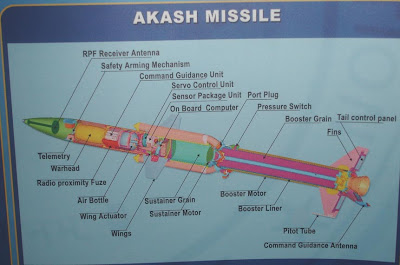
That description on the DRDO site is clearly out of date and reflects the original plan for the missile which was to incorporate a seeker, but which was dropped. More current information is available at the link I previously gave plus their newsletters, which are periodically updated.
While one professional ‘missile-watcher’ I consulted today confessed himself unable to say what form of guidance the Akash uses, and could only cite the contradictory statements that had emerged from DRDO and what had been reported in the Indian press, I now had it confirmed from an official source that only command guidance is being used. Yet the missile still seems to be fitted with a radome. Hopefully the Paris Air Show will shed further light on the situation.
There is little to “shed light on” at least regarding the seeker situation (you’d be wasting your time in that sense), because the information that Akash does not have a seeker is fairly well known, and has been public domain from a decade back.
TeerBut in the meantime, given the importance you rightly give to fact checking, perhaps you do a little bit of fact checking on your own posting, and explain the grounds for your assertion that I am a journalist. Or is this a case where you too were relying on your memory rather than taking time to check?
Uh, I am just going by your own posts, wherein you alternate between posting away reams about the tons of “consultancy” that you do, and alternately taking umbrage at anyone getting upset at the current low standards of defence journalism.
Tell you what, you decide where you are, think about which profession you wish to represent, whose unofficial spokesperson you have chosen to be on this fora, and then come back and inform us. That’ll do.
I fear you may have read too much into my statement that I have had articles published in the technical press. Last weekend, I read a 1970 article published in the professional journal ‘Production Engineer’ written by one of my old bosses in industry – the head of a radar-development team. Does writing that that make him a journalist?
Aw gee, so whats up with all the “i take offence” stuff when something “mean” was posted about them “pore” defence journalists, eh?
The manner in which you react whenever somebody points out anything about those exalted souls (akin to a scalded cat) – for instance taking umbrage at comments not even directed at you…one would be well within their rights to think you wish to wear both hats, taking one off and wearing the other as and when it suits you, in order to score a few debating points..
TeerAs I understand it the Jaguar re-engining program isn’t going to be complete for another decade at best. How long does the IAF plan to keep the Jags around? The cost/benefit of the program vs. simply building more Tejas Mk.2 seems questionable.
Tejas MK2 could replace the Jaguar (or at least part of them) but the issue is simply that the IAF needs all its airframes around. Its at 34 squadrons now, and even with inductions may reach 42 in another decades time, this when previously sanctioned strength was 39.5 squadrons (now raised marginally to 42). It cannot afford to lose airframes especially those with life left in them, which is why the Jaguar upgrade makes sense.
The role of the Jaguar is deep penetration strike. The tejas is hardly suitable for this. I think the Jaguar will be replaced by the Rafale in the role.
Well, the DPSA needs to be understood with regards to context, namely the IAF at the time of the Jag purchase was predominantly a tactical air force with predominantly short range fighters . So for the IAF, Jaguar was DPSA. However, the Jaguar is no Rafale range or payload wise, which is why a Tejas with fuel tanks can still approach Jaguar level capabilities.
Plus at the end of the day its more flexible.
The IAF is now looking at 124 Tejas MK2s per a report, as versus reports of 83 earlier.
The Rafales will of course come in and replace retiring fighters, but to be honest, the IAF is likely to allot fighters to the squadrons available, whether numberplated or still flying the older types like Jaguars. The punch provided by the Tejas/Rafale/Su-30 MKI plus the upgraded MiG-29s and Jaguars dwarfs the capabilities of the earlier MiG based fleet.
TeerEither way, the Su-35S is still going to spot the ‘dirty’ (RCS compromised) Rafale @ ~300km, which will give the former valuable time to impart kinematic performance to its RVV-SDs. They will have developed tactics specifically for the Eurocanards/Meteor combo, hence I would highly doubt the Su-35S driver will ‘switch on his jammers and pray for the best’.
It appears both the Russians & Americans have discontinued meaningful developments of ramjet motors for future incarnations of R-VV and AIM-120, they probably feel the advantages are marginal.
I don’t doubt that the MBDA ‘Meteor’ is a formidable weapon, but if the PLAAF doubled their Su-35S order and deployed them near the Indian border, you may find the IAF’s confidence in it’s newest acquisition, shaken (particularly for strike). Sweaty palms for sure!- if not brown trousers (yet).
Got to disagree with you here (for once ;))
A few points.
1. The IAF intends to deploy its “Super Sukhois” – Su-30 upgrades to the Indo-China theater plus Rafales. These should be enough to counter any limited numbers of Su-35s and then some. India is upgrading at least 80 Su-30s in Phase 1, and plans 126 Rafales (with 63 more ordered as a definite possibility given the desire to build up squardon numbers). IMO, in avionics, the Super-30 is likely to be ahead of the Su-35 the same manner in which the Su-30 took the avionics of the earlier Su-35 and improved on them, and the manner in which todays Su-35 took what was on the Su-30 and improved on that. In terms of airframe performance, the Su-35 will retain the edge. But with the avionics being a critical factor in the detect-acquire-engage chain, the Super-30s should be able to hold their own. But the fundamental thing is that a single Su-35 cannot be in two places at one time, and this is the biggest advantage of the Indian side. It will have more numbers of comparable platforms. IMHO, I’d rate the Su-35 (full up Russian version) as more of a threat than a TD/or even MK-1 J-20 but its limited numbers limit its punch.
2. Even with large-ish scan angles of the Bars/Bars++/Irbis type mech assisted PESAs- both sides will seek every edge that they will get. Which means AWACs on both sides. Phalcons/EMB-DRDO AEW&C on the Indian side and KJ-2000/200 etc on the PLAAF side. Which basically means the radars on the fighter platforms will be used judiciously & it wont become a simple case of Su-35 sees Rafale first or vice versa.
3. In terms of RCS, the Su-35 claims to have reduced RCS by a significant amount, but again, will PLAAF receive these RCS reduced Su-35s with Russia giving up its advances in that area or for PLAAF to inspect and benchmark local efforts even if they cant reverse engineer? I doubt it. I’d rate the Rafale to be superior to the Su-35 in the side aspect & equal/superior in the frontal aspect. With semirecessed carriage & Spectra, plus AESA, it should be the equal of a PLAAF intended export Su-35, carrying an external payload.
4.The Meteor argument holds. Is the RVV-BD in service yet, has it cleared state trials? Is it available to China to boot..Ramjets are fundamentally more efficient as A2A missiles especially those that can be throttled, like the Meteor. Its only “weakness” is that it has a RF, not a hybrid seeker, but again, ECCM on the Meteor should be fairly strong and may have the edge in initial engagements till suites are upgraded to match. Again, with limited numbers of Su-35s obtained, the edge goes to the Indian side, if it acquires Meteor. The reason the Americans and Russians don’t seem to be pursuing ramjets in A2A missiles are because they are complex to manufacture let alone design and develop. Easier to keep plugging away with iterative improvements to the baseline rocket motors or develop alternatives like dual pulse motors. But the Meteor appears to be game changer (if the seeker holds up), and its the biggest advantage of the Rafale/EF/Gripen over all Flanker variants (Su-30/Su-35) till the RVV-BD enters serial production, and even then, it may still be more flexible than the latter thanks to its ramjet propulsion (which means a much larger NEZ with the missile able to retain energy through a larger part of the envelope).
Interestingly MBDA states its willing to export Meteor for even Flankers. Question being though whether India would be willing to work with MBDA on this. Simpler to just have them on Rafales in the short term.
TeerIndia is running no surpluses for luxuries.
The re-engine is not a luxury but a necessity. The Jaguar came up short in the hot and high conditions during the Kargil War and it suffers from low thrust, when loaded up, at medium altitude. Strike profiles against heavily guarded (MANPADS, SHORADS and ack-ack) installations mean that medium altitude with PGMs will be more and more a requirement for Jaguars, even if part of the strike profile (e.g ingress) to the attack area was low alt.
TeerHoneywell isn’t even working on that program anymore.
Thats just plain wrong. Both Honeywell and India/IAF are pursuing the program.
http://www.flightglobal.com/news/articles/aero-india-honeywell-tenders-for-jaguar-engine-upgrade-382049/
http://articles.timesofindia.indiatimes.com/2012-10-16/india/34497758_1_stealth-fifth-generation-fighter-aircraft-jaguar-strike-fighters-mmrca
The Jaguar re-engine contract is one of the cornerstones of Honeywell’s biz drive in India.
By the time they did a complete DARIN III upgrade it probably cost less to build something like a Tejas. You basically are settling for something between the Gripen or M2K. If it needs more capability than that then they may as well buy F-16’s at that point.
The Darin-III upgrade does not make the Jaguar an equivalent of a Tejas which is a far more modern airframe, and has much more sophisticated, capable avionics, pound for pound. Net, its also going to be more multirole (than the Jaguar will ever be) and also more expensive than an upgrade, of a legacy platform which has extensive infrastructure already in place. Operating costs of the Tejas over its life cycle will be a plus for the single engined platform though.
TeerWhat is the relevance of China buying 24 odd Su-35s versus India purchasing 126+63 probable Rafales? Hardly a game changer.
One Su-35 cant be in two places at once.
TeerWhile i dont follow Indian defence publications i can imediatly think of Shiv Aroor and Vishnu Som has dam good journos. If a Portuguese can think of some good Indian defence journalists it cant be all that bad, can it? :confused:
Som is a human interest story reporter. Technical details are not his forte & to his credit, he doesnt claim to be somebody much into them either. He has had the opportunity to fly several of the MMRCA aircraft & has done detailed vid shows on them, plus IAF exercises in the past. But more & more, he is taking up a general news anchor role on the Indian channel NDTV.
Aroor is rubbish. To give you an example, when Arjun tank trials were going on, he was very eager to give an impression the tank was doing badly, since had run an anti DRDO series previously of which slagging the Arjun had been a big part. And that series was to further his own interests – his boss at the time was a well known DRDO baiter. So Aroor promptly went ahead and updated a post saying the Arjun tanks were suffering “torsion bar failures”. Only problem – the Arjun does not have a torsion bar suspension.
This is but one of many cases, where he has been caught with his pants down or posting deliberately inflammatory statements which he knows to be untrue, so as to drive views to his blog.
Another example of his “ethics”. To drive eyeballs to his blog, he used to routinely visit Indian Govt sites, download presentations etc, anyways released to the public, and put them up as “my sources tell me” with prominent watermarks of his blog name. He only stopped doing it after online forums caught him out and started linking to the original sources each time he made such “disclosures”.
There are only a handful of Indian def. journalists who have both connections & the ethics (and self belief) to report things as they are or not twist the words of their interviewees.
Many of the others write for Janes, AWST etc – but their quality is hit and miss.
TeerIn the case of newspapers and broadcasting the standard of defence reporting is indeed low, as is to be expected when staff are moved from one subject area to another. The traditional defence correspondent was an ex-military man, but this is no longer the case.
But what Teer was commenting on was the specialist defence press – he specifically mentioned Jane’s and Aviation Week. People who work for these titles are defence specialists. They have a huge range of technological areas to cover, and I suspect that few of us could fill their shoes.
Which just goes to show you have little idea of either magazine’s history of subcontinental coverage, despite your statements of being omni-aware of all things defence journalism & having been an industry specialist etc etc etc and how their regional stringers are – and this is not something unique to India either.
Both magazines have made DOZENS of bloopers when it comes to India, South Asia/ several other regions. Their quality ranges from good (from some of the articles under AWSTs unnamed “Asia Pacific staff” byline who is clearly a connected guy writing anonymously) to the pathetic work by some of the other regional folks writing for AWST. The one accurate guy who was writing for them, despite bad prose, did have good data, now writes & operates his own blog – I gave the links above.
Janes makes AWST look like a gold standard.
Mercurius, suffice to say, you don’t have the foggiest about either of these magazines are when it comes to non mainstream/non home markets. They publish anything & everything their correspondents turn out.
Sweetman et al concern themselves mostly with the high profile WW programs, rest – less said the better.


 Sign In







