 Teer
Teer^^ They have orders, meeting domestic demand takes first priority. The Akash orders stand at 16 batteries for the IAF, and 12 batteries for the Army, with some 1800 missiles between the both of them.
TeerJang,
90 Kn itself is going to make the MK1 perform pretty well. At a public event, I had asked a bunch of LCA program guys about LCA topics, and in a passing comment one of the folks remarked that much of the hype about the LCA weight etc was overblown. He was ex-MiG-21 himself and said that with the new engine (he meant the Ge404 IN20) for the MK1, the LCA would be very competitive performance wise & meet most of the IAF requirements. Only payload would not be as high as originally required, but it was not such a big deal since with precision missiles & air to air armament (HOBS missiles, RF BVR) the LCA MK1 could still carry significant punch with decent fuel inside. Now the extra 8-10 kn (the Ge414 INS6 rating is not available AFAIK at this point of time) will not have to deal with a massive increase in weight for the LCA MK2. The weight increase will only go for some extra structural weight to increase the MTOW and also for some more fuel. Overall, the TP, who watch the program with a hawks eye, were very positive.
Coming to the size of the plane and composites, well you are mixing up causes and effects. The LCA went for a composite structure because there was no other way to meet IAF weight and performance requirements in the form factor they wanted – MiG-21 class platform which would be able to operate out of all the MiG-21 basing (HAS, Aprons, taxi/runways etc) without upgradation.
Also, there is no given issue that if the aircraft is using composites today, it can’t use better technology tomorrow. For instance some of the LCA’s composite structures will be replaced by other composites which are lighter, as strong and in some cases are cheaper and faster to produce due to advances in manufacturing tech. locally. Also, its a fallacy to believe that if you have an all metal, “simple” aircraft, you can “composite it” later. Composites in many cases need to be designed for in the specifications of the platform itself. They can’t just be used as one to one replacements for legacy designs.
Net, the “world’s smallest, lightest” tag thingy – that was not the intent by itself, as mentioned before, that flowed from the replacement of the MiG-21 class platform. Now, does that put more stress on designers and manufacturers, absolutely. It does make life much harder. But in which case, the requirements from the IAF should have been relaxed to begin with. In India as the budgeting for the LCA came entirely from the MOD under a separate head, and the IAF budgeted its capex differently, there was no unified understanding of the impact a complex form factor would have on development costs and timeline, as versus the costs of an infrastructure upgrade to accomodate larger aircraft.
Overall though, by developing a complex system of systems project with associated avionics, they are better placed for follow ons. Right now for instance, the DRDO/industry team has met ww standards for the bulk of mission avionics, a development and deployment time of 2-3 years. Flight critical systems, the world over, take some 10-15 years, on account of both complexity, redundancy and safety issues. They have pretty much crossed this hurdle as well, with a fully local DFCC and local control laws. Its now just a matter of time (and consistent effort) till the IOC/FOC stages are crossed.
Finally, coming to the light fighter issue, what must be understood is that the IAF has moved on from the light fighter dominant force it once was. The PAF is still somewhere there. The IAF on the other hand has to face both the heavy fighter deploying PLAAF & the PAF which has significant numbers of medium class fighters (or at least aims to deploy the same). As such the IAF has gone for heavy platforms in a big way. The earlier ratio was light (MiG-21):medium (MiG-23,27,29, Mirage) in a round 60:40 ratio, later coming in at around 50:50. Now, the ratio is changed with the deployment of the Sukhois. Taking the PAKFAs into account, the ratio will be around 50 (heavy):25-30 (medium):25-20(light).
There are 272 Su-30 MKIs planned for instance, plus the PAKFA at around 250 planes (214 mentioned, whereas other reports mention upto 250). These will supplant a part of the MKI fleet. Whereas the MMRCA/Rafale comes in at 126-189. The LCA at similar numbers! The AMCA will replace the Mirage 2000s and MiG-29s, plus remaining Jaguars (which have not been supplanted by the Rafale). That’ll add upto around ~200 planes. Overall the heavy fleet will continue to dominate.
Its all about trends, and frankly, the IAF is firmly moving towards the heavy end of the spectrum. It needs light/medium fighters on account of cost effectiveness, but the LCA alone is not the answer to the IAF’s need for larger, heavier platforms.
Its interesting to see that for all the issues with slow decision making etc, the correct decisions have been taken. The light fighter is firmly in Indian hands, and so is the medium class, whereas the heavy class is being codeveloped with a geopolitically tested partner. Basically, we are firmly moving from an era where everything in the IAF was imported, to one where we will meet the bulk of our demands either domestically or via joint ventures.
Teer1244 to be exact 🙂
Thanks! Apparently the range for the AEW&C is a 2 sq mtr target at 200 km, and 250 km in extended mode. With a full blown ESM and CSM suite and sensor fusion, plus a fair number of work stations, SATCOM, V/UHF datalinks etc, and a comprehensive Self Protection suite to protect it – this is a very decent force multiplier for the IAF.
TeerYes, from the document :-
They are basically sub vendors.
Thanks. Whats interesting is that for some products, BEL is producing the TR modules itself.
At Defexpo they displayed high power L Band TR modules (presumably for the L Band LRTR) and C Band 20W quadpacks (based on the band, I’d say they were for SATCOM, possibly ISRO).
A total of 4-5 partners for TR module manufacture is pretty decent for DRDO to progress with.
You may criticize Aroor but he has good inside connections that he is most of the times the first to come up with such images. Now Teer and a few others may be more knowledgeable but haven’t see anyone else in any blog, posting things faster than Shiv.
There is a reason why Livefist won the Defense IQ blogging award.
Quad,
He is the “first to come up with such images” because he is lazy and lacks ethics, pure and simple. What he is doing is ripping off presentations made by DRDO/ADA/HAL guys and selectively dumping stuff on his blog to drive his own popularity upwards. Others would actually come up with updates based on their own work & some interpretation plus analysis.
If you want to see actual journalism – look at how Ajai, Ananthakrishnan M and others interview people and post their findings. That’s ethical journalism. One may differ from their views on topic to topic or even point out errors (neither is infallible), but their work is singularly their own.
Ajai on Arjun – ie detailed access to and ability to understand what CVRDE says: http://ajaishukla.blogspot.in/2011/11/improving-arjuns-already-great.html or actual first hand own imagery like this, properly credited to the owners: http://en.wikipedia.org/wiki/File:Arjun_Mk_II_graphic_courtesy_Ajai_Shukla.jpg
Compare to silly self glorification from Aroor when he visited CVRDE and video shoots of him preening around the complex! Almost zilch in actually talking about the product in detail.
Or take the combination of human interest and technology here:
http://tarmak007.blogspot.in/2011/01/world-beaters-fly-by-wire-fcs-will-take.html
Aroor is unfortunately reflective of the shallow, read low standards Indian journalism has. Little to no knowledge of the topic, a prima donna complex coupled with a very cavalier attitude towards crediting work and sources. This shows up in his so called articles.
TeerRFJ comes up with phenomenal turds, of that there is little doubt, despite doughty Mercurius’s charitable defense of his colleague.
If the achievement baseline is as low as RFJ’s was, then his subsequent work is indeed a positive. His reports on any non western industry, are usually so full of goof ups and patronizing rubbish.. that it makes anyone following his claims, usually shake their head about where this chump got to write for such acclaimed journals.
Having access to sources is worth little, if the gentleman in question won’t spend half a hour questioning or cross checking what these sources say.
I recall one instance where he was making claims, quite recently, about India’s problems with the LCA MMR to lack of antenna technology, because after all mechanically scanned array radars require complex brazing tech., and the Indians would struggle to have such stuff. This is what his “sources” told him. And the MMR issues actually stemmed around A2G signal processing (for which Israel stepped in) – India had already, by that time, exported several antenna arrays (using brazing, duh!) to Poland for their maritime program. Further, India is fielding multiple classes of mechanically scanned radars & even a websearch would have thrown up multiple references to what sort of manufacturing capabilities exist within India. This from 2003 for instance: http://drdo.gov.in/drdo/pub/techfocus/june03/techjune2003.pdf
Another phenomenal example of RFJs capabilities. When the MKI was being developed, this man was singing the dirge the loudest, claiming Sukhoi-HAL would never make this plane, the entire thing was vapourware, Sukhoi-Russia was so corrupt etc etc..i have an article from that time from this gentleman, and he talks about everything bar the aircraft itself.
The amount of gaffe’s he made in his work are immense. He appears quite similar to some of my nations defence journalists – such as Aroor, Bedi etc and that is not a compliment.
TeerActual AMCA intake
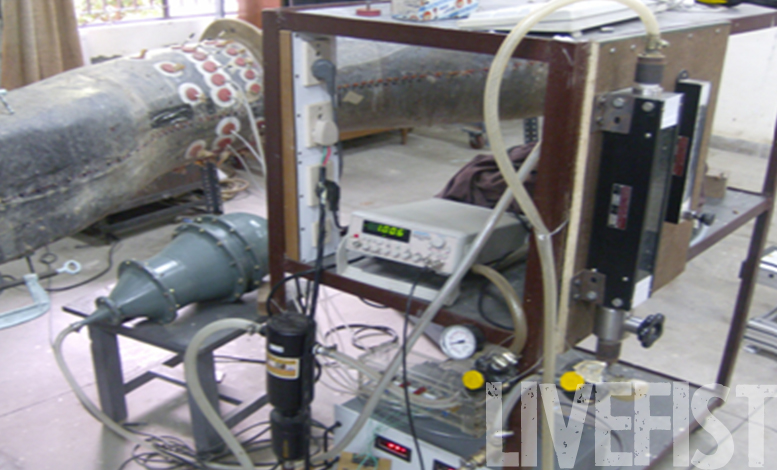
TeerThats actually the duct for the IUSUAV.

Ignore the watermark, the so called journalist releasing them..Aroor lacks ethics and routinely puts his watermark on images released and owned by the Govt of India, such as this one from DRDO shown at a presentation in Sweden.
TeerI have to dig up the exact report which said this, but ADA mentioned they would be working on the AMCA and FGFA Flight control systems, and mention the AMCA fcs as triplex, FBL. This makes me wonder…is cooperation already planned with Sukhoi for the MCA?
Also, does anyone know what FCS is on the T-50, will it be FBL? I’d anyday prefer that India work with Russia on core tech., like FBL, actuators & even the engines..despite all the troubles and price issues, Russia is still a reliable partner when it comes to meeting Indian strategic requirements. The US has yet to demonstrate its a reliable partner at the political level. Their sanctions and deliberate targeted treaties eg MTCR etc have given much grief to Indian programs. The LCA in particular suffered years of delay.
In the process of work with Russia, if common tech., is developed for LCA, MCA and FGFA, its a big plus.
Possible areas of cooperation include stealth shaping and materials, subsystems like actuators (where India continues to be reliant on the US), propulsion (ditto), flight control systems & testing..
TeerLR/MRSAM continued
Interesting thing I found
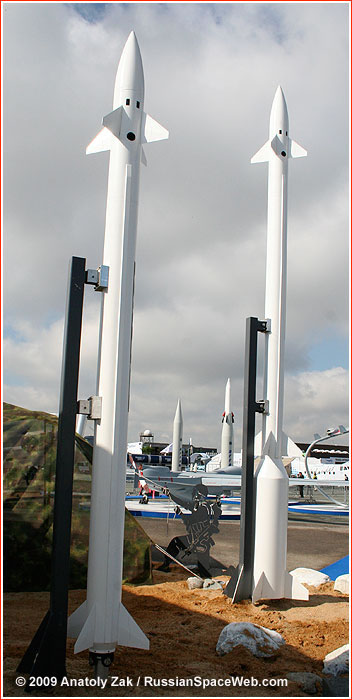
Only pics so far of the actual Barak8 aka MR/LRSAM being developed by DRDO/IAI missile tests.
http://defense-update.com/20111130_new-photos-of-barak-8-test.html
Two images taken during the Barak 8 test firing show a flight testing of the propulsion system (left) and vertical launch system (right). Both versions were the basic barak 8 missile (without booster). Photos: Tamir Eshel, Defense Update
The missile was developed by Rafael Advanced Defense Systems in Israel with the booster for the extended range version provided by India.
Per this report, India supplies the dual pulse motor + the booster. Base missile performance: 70 km.
Further details from the Paris Airshow in 2009 about base missile.
The new generation Air and Missile Defense weapon system currently provides a complete solution to every type of airborne threat, whether that threat be from aircraft, tactical missiles, helicopters, or unmanned aerial vehicles. The system has two versions – maritime and land-based – each relying on an advanced, phased-array radar integrated with an advanced launch system containing “smart” missile interceptors, and a state-of-the-art command and control (C2) system, altogether providing full 360° coverage.
…….The system is designed from the start to intercept planes and tactical missiles such as air-to-ground missiles and naval anti-ship missiles. The Barak-8 is based on advanced concepts of defense system architecture, including advanced seekers, warheads, high performance maneuvering capabilities, and the ability to be optimally controlled. The missile can receive and process continuous updates on the position and flight trajectory of the target, and use these updates to adjust its own flight to best intercept and destroy the target. The unique missile propulsion system allows the missile to maintain energy, even after it has been airborne for an extended time, and reserve sufficient energy for the end-game or the target’s final engagement and hit. It must be remembered that the enemy missile is also trying to maneuver and evade the Barak-8.
Teerguys, watch the whole series of that interview. it’s a mine of info.
Yes indeed. Kudos to the reporter for asking to the point questions and Dr Saraswat for his detailed, exact replies.
Some additional pics..of stuff I came across via Google images..
PGM – the Indian Sudarshan LGB
http://i843.photobucket.com/albums/zz352/20enlightened1/sudarshan_LGB.jpg
BTW, this is a pretty interesting pic of the IRDE (DRDO) Sudarshan seeker.
http://4.bp.blogspot.com/-47oYjtI8SNY/T3yyyKniqJI/AAAAAAAABKg/sDpc3mCB6j0/s1600/IRDE-1.jpg
Has received a bunch of orders already from the IAF.
What they’ll be doing now is taking those MEMS based INS/GPS/GLONASS kits developed for the missile program and adapting them to this kit for longer range and JDAM type equivalents. Might be already there in the current Sudarshan.
Look at the second one, all the way back from 2009.
http://www.bharat-rakshak.com/media/AeroIndia2009/pkartikk/RCI-RLGFOG.jpg.html
Air to Air seekers
This is a BMD program seeker from its design, probably intended for the AAD.
http://1.bp.blogspot.com/-TLf6zifdyqM/T3tKD0-OHWI/AAAAAAAABIo/ctDhDgxhDH0/s1600/DSC01814.JPG
This is the earlier BMD program seeker for the PAD (larger Prithvi based interceptor) from 2009. It was developed from the design of the LCA MMR!
http://www.bharat-rakshak.com/media/AeroIndia2009/pkartikk/ActiveRadarSeekerKABand.jpg.html
SSM Seeker
Interestingly a seeker is being developed for Brahmos type SSMs as well but multifunction against both land and sea targets
http://3.bp.blogspot.com/-jOo44ZfisZI/T39N6YfwkUI/AAAAAAAABMY/1UeR3ja609g/s1600/DSC00836.jpg
LR/MRSAM project details
Breakup by country (India to license produce the parts developed by Israel as well, per reports) – works against supersonic sea skimmers as well. Which means India may be using its own supplied test rounds..
http://3.bp.blogspot.com/-pRWKN98mKrE/Tecp5fTgxdI/AAAAAAAANM8/R-mWjIDMyLk/s1600/111.jpg
System deployment configuration for MRSAM – IAF
http://4.bp.blogspot.com/-rzAxuh0BA_E/TuqeqW1hkoI/AAAAAAAAAmo/dZC41fvqXpA/s1600/15MRSAM.jpg
Wonder which radar will be used here. A license produced Elta derivative or the DRDO MPR..
More on the system details here: http://tarmak007.blogspot.in/2011/12/mrsam-india-israel-developing-450.html
The missile numbers are understated of course. The pic clearly shows 48 missiles per firing unit. Thats 24 ready to fire, plus one reload. 18 firing units would mean 864 missiles (at the minimum), and 1296 missiles with 2 set of reloads.
TeerTeer,
Thanks for the links. But a question. Are they going to have the same kind of thing for the ground units also?Ok, I can understand the commonality factor, but there has to be consideration for the logistics and footprint of the unit also. In the spec, we see the antenna being mounted on a detachable long trailer. I do consider that it may not be a problem during deployment due to the nature of the radar, but still…
My personal view is that it would be better if they change the dimension of the unit to more squarish stuff which can be mounted a 4×4 or 6×6 or a 8×8 truck.
BoGo.
Hi Jang..
This is the first AEW&C radar, so its the exact same shape and design to test it out fully. This is basically the AEW&C radar array itself being tested out on the ground before a similar one gets integrated on the first AEW&C this year.
The Ground Based radars being developed for the AF will be entirely different and with different modes (e.g. fire control has been mentioned as an addition, which means these radars can be used even for SAMs). While of course there may be reuse of some hardware, software, algorithms and even design concepts, those radars will be fundamentally different..
In terms of performance, the MPR for the IAF will be more powerful than the one on the AEW&C which does 200km-300km for a 2sq mtr target. The MPR is designed for >300 km ranges. The LLTR will be a replacement of the Rohini radar, with AESA tech, and will be in the 150 km+ class.
You will have the more squarish form factor of the antenna or rectangular..and they will be rotating arrays (only the LRTR is fixed angle AFAIK because of the fact its a very heavy long range antenna, which can cover an entire geographical sector from which missiles are expected and hence does not need to rotate).
The Ground Based radars (LLTR, MPR etc) are all meant for both aircraft and missiles and will be able to rotate. The LLTR will likely be mobile, which means the array will be on one vehicle, the processing unit (with personnel) on another (to protect the radar crew from ARMs) and the power generation vehicle unit on another.
The MPR will usually follow the pattern of a single radar unit, with the crew in a standard ISO container form factor habitat (with the associated data/radar processing) and the power generation unit separated.
TeerDont understand your point, are you highlighting how far delayed the whole LCA circus has gotten?
I am pointing out that you are being disingenuous and dishonest in pushing the dumb bombs only issue when it is clear the LCA employed both PGMs and dumb bombs.
I am pointing out that your own link mentioned the same and you are deliberately pushing this issue only to salve your own ego because everyone else can see the facts that you were wrong in your claims.
There is also the point that the IAF is asking for integration of all sorts of munitions on the LCA (guided and unguided) on the LCA.
There is also the point that your statements about A2A missile testing not being done and hence the LCA only being used for A2G, were rubbish, as the A2A missile testing is to be completed after IOC is complete, for FOC.
Now, you should have – hopefully – understood all of the points.
TeerMatra BGL was deemed too costly in Kargil where the efficacy was uncertain.Or unproven.
What I heard was that the BGLs and even a lot of the Russian PGM stocks were hoarded because they were required for an all out war. The BGLs were far more expensive than a Paveway, and reportedly could be used against hardened targets. So the decision was made not to use the EO Russian PGMs and the BGLs and use Paveways for “marking the target”, and then use conventional bombs to massively attack the target.
This was the approach used in Muntho Dhalo for example. For strikes which required pinpoint accuracy throughout (where the frontline was very close to Indian positions), they used Paveways.
Post war, the Russian EO PGMs- I believe these were Kh-series missiles were very effective. Apparently, the life expired units were used in a live fire exercise at Pokhran. The MiG-23/27 pilots scored repeated hits again and again, with these missile coming in at steep trajectories and scoring huge fireballs.
I think there has been a lot left unsaid about the other IAF inventory during the Kargil war. I was told off hand that the MiGs pulled several initial EW and PGM missions (presumably the upgraded MiG-23BNs which were at the time hush hush but are now retired) and the Canberra’s didn’t do just recce but EW roles as well (they per later reports employed an Indian ESM fit + Italian jammers fitted to them).
Now that these aircraft types are all out of service, hopefully someone in the IAF does write about them and the stuff they did.
The IAF has also upgraded significantly without tom tomming it.
The Griffin strike by the Su-30 mentions that the IAF designated the target by a Searcher UAV. They previously demo’ed this with MiG-27s.
So, given the IAF operates Jaguars, Sukhois and MiGs all capable of Griffin, all these would have been upgraded to use Searcher designation. And the IAF’s laser designation capability is far beyond that of merely self designation by Litenings (and the day only Atlis operated by the Mirage 2000’s).
EW is another area where the IAF has clearly made strides but is very circumspect about details. DRDO has also mastered both ESM & ECM – which means the IAF now has a ready source of local tech.
Note the latest DRDO system and what it mentions about LPI detection & classification.
These systems are by DLRL which is the land forces and naval systems lab., but which obviously shares tech. and jointly works with DARE, its airborne fighter systems counterpart. DLRL has also made systems for the airborne segment of the Naval ESM program.
ELLORA-2 ESM
http://2.bp.blogspot.com/-kyU4KzEQrLw/T39JmHRyiQI/AAAAAAAABLw/-ttmJvreBRI/s1600/DSC00667.jpg
DISHA ESM
http://3.bp.blogspot.com/-KdDZ2PxF1jw/T3l7F6VPOnI/AAAAAAAABEw/66Tqnw7pWOU/s1600/DSC02073.JPG
Jangbo…
Here are the LSTAR details as Jamwals site is down’
LSTAR is a full scale demonstrator..
http://1.bp.blogspot.com/-RRuNQbTgydw/T39M4r_dWgI/AAAAAAAABMA/Lq1zWPIR64A/s1600/DSC00771.jpg
http://1.bp.blogspot.com/-5OZmxnXiGgk/T39NINLsG_I/AAAAAAAABMQ/UuuJya4f46E/s1600/DSC00773.jpg
http://1.bp.blogspot.com/-gF8xjIVANmU/T39M_dTsjmI/AAAAAAAABMI/TxOggOZjADs/s1600/DSC00772.jpg
TeerMany excellent data points in the CRISIL link – thanks to first hand info from the Astra folks..
Approximately 60-70% cost of an AESA is apparently from the TR modules! The receiver etc apparently comprise the rest. Wonder if they have included the signal/data processing units in it. Could be Astra is only looking at the pure RF side..which means anyhow the TR modules are 60-70% of the cost of the systems including the antenna with TR modules, and the receiver/exciter module gives the rest of the 30%.
And local, read Indian sourced TR modules are merely 20-25% of the cost of the imported ones, thanks to lower manpower costs! And to improve on this further Astra is setting up an automated SMT line. Incidentally, both HAL and BEL are also investing in SMT lines, explains why!
Basically, Indian developed and made radars are going to be significantly cheaper than imports.
TeerAnyone know offhand of any reliably sourced and preferably detailed information regarding (1) the effects of US sanctions on LCA/Tejas or (2) IAF’s experience with Mirage 2k and Dassault relating to the Kargil conflict? Am researching for an essay on the political and geopolitical aspects of MMRCA.
Hrm, fair enough. Cheers.
You won’t find a single all-in-all link detailing everything unless you purchase books/articles re: the Tejas program.
But let me point out the few critical assemblies which were to various extent US dependent.
FBW – India was using the LM facilities for codevelopment of the FBW hardwar including the Digital Flight Control Computer. US impounded Indian owned and developed hardware (citing assistance given in its development) and sent the team back. India developed its own new systems, but this caused a delay to the program by at least 2-3 years.
Actuators – LCA uses Moog actuators. Supply stopped. India developed some actuators locally. But supplies started only after sanctions stopped. Again significant delays in program, thanks to India having to rotate actuator sets between ground rigs and flight aircraft. Also prototype production significantly impacted due to non availability of sets.
Ge Engine – luckily GTRE had the foresight to ask for instrumentation and technical documentation for the GE engine. This allowed flight trials to continue, even while limited numbers of available engines were an issue.
Avionics – many systems were to be sourced from the US; supplanted by local and French items, eg US sourced RLG INS supplanted by Sagem unit, to be ultimately replaced by Indian one.
Many other minor components would have run into similar issues prompting localization.


 Sign In







