 Teer
TeerAs I recall most radars have a dedicated section on the main radar with its seperate guidance portion for the missile guidance function. Using the main beam was sort of the norm for SARH missiles which homed in on the reflected energy from the main beam. Todays active units have their own datalinks & hence dont follow the same guidance options (its a choice).
TeerLooking at the size of the datalinks here I think decoupling them from the main radar was a good decision.
http://www.tataadvancedsystems.com/static.php?id=63
They are now insulated from any standard AR missile & the C3I unit can independently guide VLS missiles.
TeerThe S-400’s Big Bird is S-Band, the FCR is X-Band.
Its in the IAFs best interest to buy a few Nebo-M sets for the north east against PRC in particular, but I suspect it all comes down to affordability & IAF would rather for L-Band Phalcons. Though Nebo-M has a VHF band AESA as well..
TeerIAI advertises the Barak-8 land based radar as being the LB-MFSTAR
http://www.iai.co.il/Shared/UserControls/Print/PopUp.aspx?lang=en&docid=39661
The LB-MF-STAR, produced by ELTA Systems Ltd., IAI’s group and wholly owned subsidiary, supports air defense missions and guides AMD weapon systems. It can deliver an accurate, high quality arena situation picture and extract low Radar Cross Section (RCS) targets even in the toughest environmental conditions. The LB-MF-STAR is a digital Active Electronic Steering Array (AESA) Radar System which incorporates new, advanced technologies and includes one rotating S-band Phased Array Antenna.
So perhaps similar to but not the same as the EL/M-2084.
TeerThis would be your dream come true i guess in terms of frequency diversity. The US has its own advances in UHF.
India plans to acquire 5 S-400 batteries. Wonder if they are all up units with such ssytems or merely the plain ones with the regular fit.
TeerInteresting points there about USAF role optimization and NATO as well, looking at TBM as the first priority. IAF has nowhere near the same budgetary or numbers game airframe wise, so will have to look for MR type capabilities.
What you noted about 40km intercept vs a 1000km class missile target. Suggests to me based on WAG & deduction, the ranges would be in the same benchmark as the 2084. Marginally lower judging by the size of the array but still fairly capable.
TeerRadar burn through ranges & datalink ranges don’t need to be paired. You can drive them differently through different Transmit/Recieve chains. Plus burnthorugh would really matter against noise jamming. Against deception & other methods, best to rely on equal sophistication on your side. If you deploy noise jammers then they best be disposable since they will be easier to track and target.
Agree with you that the 2084 does seem to be ok for its class. India also chose a derivative of the Thales system – a S Band MFCR for its local BMD.
http://www.globalsecurity.org/wmd/world/india/images/bmd-image2.jpg
The MFCR is pretty much in the same class & performance as the 2084.
Makes me think – that the IAF will likely test the MRSAM against TBM targets too. While not purpose designed for the task any capability would be a plus. The baseline architecture should be able to support it.
TeerThe MEADS MFCR seems to be i the same class as the EL/M-2084, with a smaller main array.. wonder what its details are.
Kind of interesting no range figures and other items are displayed.
http://meads-amd.com/wp-content/uploads/2012/08/MEADS-Overview.pdf
TeerI am sort of surprised the MFCR for MEADS is X-Band. India is going the same way (I suspect) with a SHORAD radar & while X-Band has notable advantages (resolution, compactness hence its evergreen suitability for FCRs), I do wonder whether making things easier for the EW guys is warranted.
TeerAs I said, reasonable range. With a 160km against a 0.2 sq mtr target being the approximate yardstick, we are not looking at capabilities equivalent to a more dedicated BMD system.
Also, I suspect IAF took the S-band sensor because, the frequency choice allows for a compact antenna array whereas L Band units may not have had the precision necessary to guide missiles in with small antennas. Mobility is also a key facet & pack/dismount for this system would be reasonable. AN/TPY-2 etc would be a different class altogether.
I kind of disagree about radar paired guidance. It makes the system more robust to keep the datalinks separate. That way if i take out the radar, you don’t lose the missile guidance. Missile guidance can be independent of the radar as well, and can be in entirely different bands & also using spread spectrum techniques, and other methods, you can keep them reasonably robust. Frequency diversity also means the jamming would be less effective (unless counted for).
TeerWhat I meant was if multiple folks are acquiring the radar for BMD missions & the max range is well in line with much larger systems (470km max against presumably large airbreathing targets), it can work against low RCS targets and should be able to acquire them at reasonable ranges. Regarding maturity, you have a good point there, however, if the performance was lagging range wise against emerging low RCS threats, i suspect few would have taken it.
Regarding guidance, the MRSAM has its datalinks in the C3I van, not the radars, so as long as the surveillance radars are precise enough to guide it into the kill box for its x band seeker it should be enough. However, the issue becomes harder for the true wideband LO threats. Older gen radars netted into the IAF IACCS (C3I network) or the MRSAM guidance may simply not be precise enough to guide the missile all the way in, and the onboard seeker may be able to lock on at only reduced ranges. Of course, all this is hypothetical since the IAF (like other professional AF) tends to be very methodical & for all I know, they took all these issues into account already.
TeerBerkut, any idea about the PAK-FA radar suite? Will it include true LPI modes as the AN/APg-77?
I havent found much on the radar performance from NIIP. Any information welcome..
TeerIsrael notes dozens of MMRs have been sold mostly for the air surveillance & S/BMD mission.
That to my mind indicates its capable against low RCS targets.
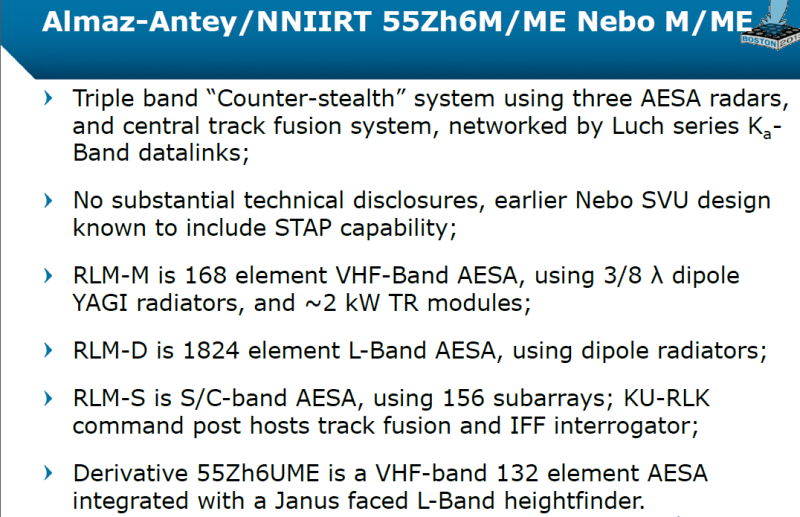
The fact its still in production wherein GaN radars are being increasingly hawked – the Giraffe as you mention, comes to mind as an ITAR free option, indicates that it is all said and done a capable system. Not as much so as the S-400 with all options (eg the VHF/L-Band AESAs for multi-band tracking)
I don’t think India (yet) faces true wideband stealth opposition – I’d rate even the JSF higher than the J-20 in that, because shaping apart, the US has a decades ++ lead over the ROW in VLO/LO development & the funding & MIC to deliver on that. There is stuff the US knows, which the rest of the world is still developing.
For true VLO threats, I think the only options (for a simpler fix) are either to dramatically increase power/range in the low bands (L/VHF/UHF), i.e. GaN. Or better still develop some sort of multi-static system. One emitter & multiple receivers, coupled with the above.
Can the MRSAM deliver against a LO threat like the J-20? I do suspect the IAF would not have agreed to the program unless it was future capable (to a degree), using for instance feeds from multiple radars (not true multi-static as mentioned above) but somewhat of an approximation. The missiles would have to be guided in to a higher degree by the C3I van than a regular target.
So not true fire & forget.
TeerWell the whole question is what is each radar developers secret sauce so to speak. We might well see GaN based S-Band multi function radars out perform earlier gen L-Band search units or other higher units thanks to the improved power aperture performance + processing improvements. However, what goes into the S-Band ELTA EL/M-2084 is still interesting. Similarly specific tweaks to a S-Band current AESA system and not one of the newer GaN ones entering, might place it equivalent to a notionally better system which has a higher band of ops until and unless the other system is from an equally capable manufacturer. So many factors to look at. I presume though Elta’s experience in the area is substantial so its systems will be fairly capable.
Canada seems to have purchased it, as has Singapore.
The MF claim comes from the range of functions it can (theoretically) perform depending on customer requirements.
https://www.youtube.com/watch?v=O5NKjwloJuk
About range, a similar MPR for the IAF has a range of 160km for 0.2 Sq mtr target, based on which the EL/M-2084 should be able to perform equally or even better. And hence, coupled with TBD (if it does have it), will be able to detect most Low RCS targets the IAF is up against.
TeerIts not merely range, band and power aperture functions though, but also algorithms & also receiver performance and also the design of the waveform itself.
Elta might have had breakthroughs there in terms of detecting low RCS targets and then deploying that on various radars.
http://www.freerepublic.com/focus/f-news/1970095/posts
The CAEW is believed to be the first radar to use a technology known as “track before detect” (TBD). Discussed since the 1970s, TBD improves the ability of a radar to detect small targets. To eliminate false alarms, conventional radars have to set a clutter and noise threshold below which radar returns are ignored. In TBD, those returns are assembled into the equivalent of a God’s-eye picture and scanned for patterns that resemble target tracks.
CAEW uses TBD to improve detection of small targets and reduce false alarms, without a large antenna or high power levels. The technique is also valuable in helping an AESA detect and track stealthy targets. Once TBD has indicated the location of a possible target, the AESA focuses more power on that area.


 Sign In







