 Teer
TeerNice visual depiction of what 5% difference in the L1 means, despite claims of marginal etc.
http://rafalenews.blogspot.com/2011/11/mmrca-is-5-price-difference-irrelevant.html
Also does EADS have a 40% stake in Dassault, thanks to taking over Aerospatiale? If so, it may be a win win for EADS one way or the other.
TeerThere is also an issue of cost per flighthour and airframe life. If you are retiring some planes anyhow and ample spares are available, no issues in using them up to begin with!!
TeerSo what do you think is going to happen now ? These 60 Rafales are more important for Dassault then 126 for India since all the UAE fighters will be manufactured in Merignac ,no licence production in customers country !
Like I have mentioned before, its entirely possible that 60 of those planes come with all their parts from Dassault out of a 189 plane order, for quick induction. SKD and then CKD, and 18 will anyway be from the manufacturer. 120 planes made and assembled in India + spares is still ok for Indian aerospace and HAL.
TeerTeer, I’m actually talking about stand off ATGMs if you take a quick scan of my posts.
The A-5s are very fast, down low, particularly. Faster than a lot of CAS platforms out there. Their downside is poor fuel economy, but as you said, a quick pass and not for deep strike but “near CAS” would negate that.
Point is the PAF is not the USSR or PRC. There are limited funds to spare amongst limited airframes. Can PAF afford another specialized type? I think not. Its better off with its existing fighters and adding these PGMs to those planes, rather than making a plane which relies on low level attacks.
What I meant is you try to stay out of the AD bubble and if you do have to go low, make a single pass and scamper. The A-5 will lack the sensors and the efficiency to operate effectively in this manner.
TeerI wonder what they are doing for the ARM requirement? Presumably both have offered to integrate HARM (don’t know whether ALARM is still in production) which is why Raytheon is happy. It sort of knew whosoever won (apart from the MiG-35) there was a good chance its weapons packages would fly on the winner.
But it does seem more and more that the EF team is really taking this entire competition as seriously as anybody possibly could. They seem to have answers for pretty much all the IAF requirements, and will (if we go by unit costs) be very competitive in terms of offsets and TOT as well.
I wonder what all they have included in terms of radar and EW proposals.
Teertalking about it, might be “funny”, if india chooses one, the pakistains take the other…
Who’ll pay for it? France didn’t want to offer liberal terms to finance the JF-17 upgrade per statements on this forum. Instead opted for a better Mirage 2000 upgrade deal with India (money back guaranteed). Lets face it, Pakistan is not going to be able to afford either aircraft even in UAE level quantities (60 planes), let alone at the level the IAF is looking at (126-189 planes to begin with).
TeerEven the recent NATO mission in Libya has reports hitting that a simple aircraft would have served just as good – http://defensetech.org/2011/11/11/did-libya-show-the-need-for-light-attack-planes/
Would help the PAF against its own Pakistani Taliban campaign, and conserve flight hours on its F-16s which are apparently being used heavily. As the opposition, the Taliban, don’t have dedicated anti-aircraft units of the sophisticated kind. But not in a conventional war with AAA units every where!
TeerThe PGM (and stand-off PGM like the LS-6) carrying capability of the JF-17 is a multiplier that cannot be ignored.
Problem is LS-6 is totally dependent on GPS/INS which makes it ok for point targets, or predefined ones. Its not good enough to target moving ones as it has no seeker. With a range of 60 km from high-medium alt, as is usual for these types (eg KAB-500 has ranges of upto 80 km), it will still be unable to outreach some of the longer SAMs coming into theater with ranges of 70-120 km (MR/LR-SAM – variants of Barak-8).
Basically, to combat fast moving targets like tanks, you need either munitions like Brimstone or smart cluster munitions, eg the SFW. These can be deployed by fast movers in a single pass and then leave, while their escorts try to hold off enemy A2A opposition.
With AWACS on either side, its all about large force packages, unless its a fight in the mountains where terrain masking still permits low flying helicopters etc to be used to effect. Even there, the defense and offense both get some advantages, cleverly sited AAA/SAMs can be very dangerous to low flying units.
Teerhmmm…
Its for CAS and to be deployed by say, the Pakistan Army Aviation with large armored formations in big plains and deserts against large(er) Indian formations…
in comparison with attack helicopters and not in comparison with strike aircraft…
Easy targets for the Indian Army’s Corps of Air Defence & Artillery, with its SA-6/Akash regiments, its Tunguska and SA-8 units, not to mention its upgraded Zsu Schilkas.
What Pakistan needs versus the IA battle groups are fast movers with Brimstone type missiles, one pass and clear out. Even that will not be easy, because the Indian AF will be doing its utmost to achieve localized air superiority over the TBA with Flankers, MiG-29s etc.
Putting slow moving A-5s into the battle field, that cannot even make use of terrain the way helicopters can, that will be a recipe for disaster.
The IA is currently equipped with batteries (organized into regiments/groups) of SA-6, SA-8, Tunguska, Schilka, and twin barrel Zsu (which are on flatbed trucks). Mechanized infantry and other units also have Iglas.
The Army has also ordered and is receiving two regiments of Akash and substantial numbers of SpyDer. These will replace the oldest SA-6 and SA-8 units. It also has a tender out for more MR-SAMs for which Hawk, SLAMRAAM, Russian SAMs are competing. New RFIs are also being put out for new generation guns & MANPADS.
The Army has also ordered many DRDO 3D TCRs and 2D gapfillers.
The ADC&RS (Air Defence Control & Reporting System), the CADAs C3I software is also being deployed.
Against this sort of network, putting an A-5, however modified, into the air, will be nothing short of disastrous.
The only solution is to engage from medium-high alt, and that too is contingent upon getting windows of superiority open against the IAF. In an era of AWACS, thats easier said than done.
Helicopters using terrain masking are still a better idea in some areas (J&K for example).
TeerBharat Karnad in a recent speech mentioned, that India will have upto 3 Arihant class SSBN (these can carry 4 K4 or 16 of the smaller K15) and upto six more improved Arihants variants (these will probably be much larger and carry a 12 pack of the K4 and variants).
Also, India will be receiving 2 Akulas from Russia, w/o any nuclear weapons but which will probably be used by Navy to safeguard above assets.
TeerKb, here is the data from Sandeep Unnithans article on the SLBM. Note, while the article did bring in some confusion regarding the K series as a rival to Agni etc (they arent, both programs are proceeding in parallel) and also that thereafter, the Shourya cleared another trial and was cleared for production. This happened just recently
http://www.thehindu.com/sci-tech/science/article2482010.ece?homepage=true
Mr. Avinash Chander said it was “an entirely atmospheric flight” at a height of 40 km. Since this was the third successful flight in a row, “the development phase is over and we are going in for production of this missile.”
and on K4
With Shourya ready for production and its under-water cousin, K-15, already under production, the DRDO’s sights are set on K-4 missile, which will be launched from a submarine. After K-4 is launched under water, it will knife up to the surface and can target places 3,000 km away. “Various systems of K-4 are under development,” a DRDO official said.
Anyways, from the 2010 article we have:
Shaurya/K-15 /B-05
Range 750 km
Weight of missile 10 tonnes
Warhead 1 tonne
length 10 m
Status K-15/B-05 in series production. Land-based missile awaiting clearance
K-4 Ballistic Missile
Range 3,500 km
Weight of missile 20 tonnes
Warhead 1 tonne
length 10 m
Status Second test by January 2011. At least six more tests before induction by 2017. Future variants for larger nuclear submarines to be 2 m taller and have 5,000-km range.
Air-Launched Missile
Range 200 km
Weight of missile 2 tonne
Warhead 500 kg
length 4 m
Status Hypersonic missile project called the Air Launched Article. Designed to fit under the belly of a Su-30MKI. First prototype by 2012.
This plus the Nirbhay and the LFRJ comprise the Indian complements to the Brahmos JV’s ALCM which is beign acquired as well.
IAF will have around 3-4 ALCM types each of which can used for specific missions.
TeerRegarding this L-band array…
Mr. Fomin kindly released the latest Take-Off magazine in english on his website , and re: T-50 avionics, at pages 27-28 it’s written something like( resume) Tikhomirov-NIIP displayed at MAKS-2011 the second AESA (N-036, my note) prototype featuring a number of emprovements etc. In adition the developer exhibited a full size TRM ( for N-036, my note), and an L-band AESA to be housed in the wing leading edge.
Several lines down it says State Ryazan Instrument Plant ( GRPZ) displayed N-036EVS computer etc etc, and other novelties from GRPZ at MAKS 2011 were the 4283E AESA two-band digital IFF interrogator and 4280MSE multifunction integrated IFF responder.
Now to me the writing seems to suggest that the Tikhomirov-NIIP L-band AESA, and the Ryazan 4283E are two different things …am i wrong here ?:confused:
Ryazan makes NIIP products. Its NIIPs chosen manufacturer.
So those products displayed are those developed by NIIP, with Ryazan assistance (in terms of checking suitability for manufacturing) and made at Ryazan.
In short, Flateric is right.
TeerToss bombing is no longer a preferred means of nuclear payload delivery.
Break through AD, have a sufficient force protection package, and there is nothing wrong with toss bombing.
If you simply must have an air launched capability – a nuclear tipped Brahmos launched from the Su-30MKI still remains the only option for the foreseeable future.
No, it doesn’t. Per public reports – there are upto 3 programs* that will offer this capability apart from Brahmos, which will end up as just one of the several options.
*of which at least 2 are fairly serious statements of intent and being funded with a direct requirement from GOI, per all public reports so far.
TeerThe Liquid Ramjet Missile program
This is an example of another low key program, (as in low publicity but well planned out, high impact program) to develop India’s own liquid fuelled ramjet. Even if Brahmos does one day get its engines are made in India, the country clearly wants its own proprietary tech to leverage as it sees fit.
http://livefist.blogspot.com/2010/09/first-look-indias-long-range-cruise.html
The images while marked Livefist (typical) are actually DRDO’s presented at an industry seminar.
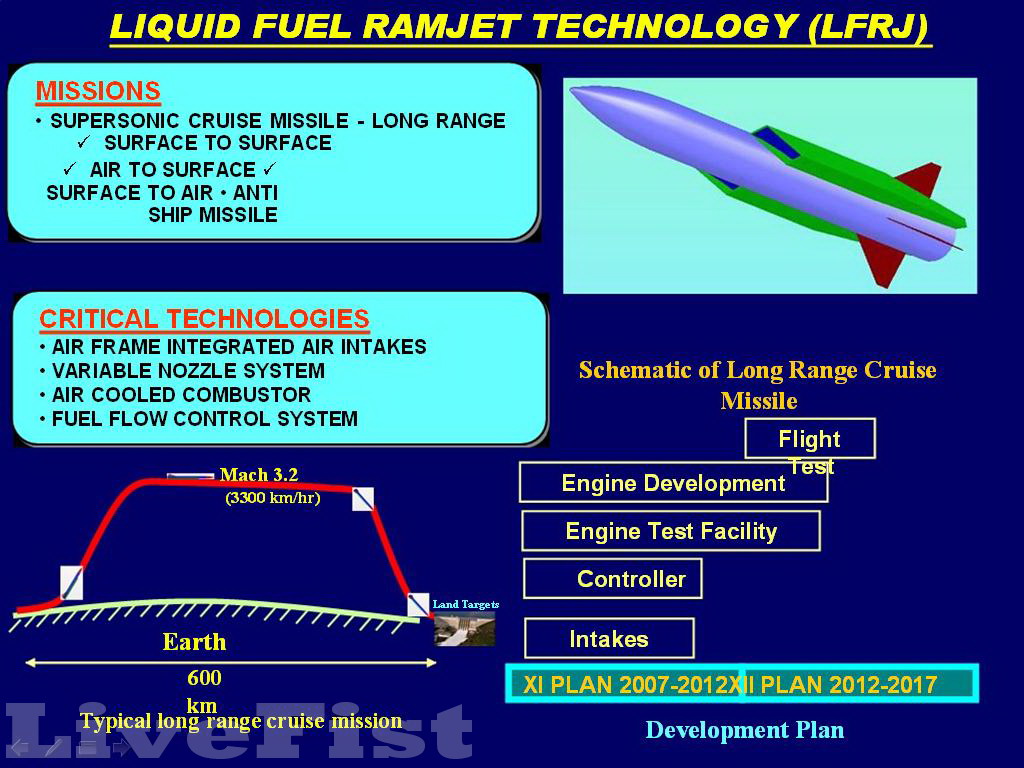
AWST also mentioned DRDL is working on Ramjets for both A2A and ASM applications. Basically, they’d mature the tech to be used for separate programs as need be.
Lets take a look at Astra; ballistic flights completed, carriage flights on MKI done; controlled flights with seeker/control systems underway. The program is now at a decent stage! Within the 2012-17 plan, the missile will be made ready in my reckoning and ordered in number. What is interesting is that while its being developed, the technologies needed to improve it even further (its decent at 40-80 km, height effect on range when compared to India’s RVV-AEs and the rival SD-10A) but then look at the LRSAM program.
Here, India is the one developing the dual thrust motor for the LRSAM/MRSAM (Barak8) programs. Another DRDO slide – ignoring the self promoting livefist

The seekers and radar will both be made in India as well if my memory serves me right.
The systems, including the motor have clear applications for AAMS as well.
It is even possible the same missiles may be adapted for A2A functions as well or even their subsystems (seekers, motors, datalinks etc) as add ons to the Astra or the next versions.
Point is, the number of programs India is working on and productionizing one by one, offer significant scale for product introductions across the spectrum.
The Astra could be improved further using tech from MRSAM/LRSAM, already benefiting from tech developed for IGMP.
It could be configured into a lightweight GBADS with local radars, sort of India’s SLAMRAAM.
In a decade or thereabouts from now, India’s imports of PGM systems from the west will increasingly shift to niche systems which offer very specific capabilities. The others will be available from local sources, either via local R&D or JVs.
The IGMP successfully managed the transition to the complex large systems, now a bunch of programs are continuing that for tactical systems. Its just a matter of time.
TeerThis is the Agni-2 Prime I mentioned earlier.
Expect 2 more tests for verification then mass production. Many new technologies used.
http://www.thehindu.com/news/national/article2630898.ece
Indigenous technologies played a big role
In the successful flight of Agni-IV on Tuesday, what stands out is the flawless performance of a range of new indigenous technologies developed by the Defence Research and Development Organisation (DRDO), and according to technologists in the organisation, they represent a quantum jump in the nation’s missile technology prowess.The triumph caps three successful flights of Shourya, Prithvi and Agni-II missiles conducted in September last week and has boosted the DRDO’s confidence to go in for the Agni-V’s maiden flight in a couple of months
The spectrum of new technologies incorporated in the Agni-IV mission included fibre reinforced plastic (FRP) or composite casing for the second stage, ring-laser gyros for inertial navigation system (RINS), micro-navigation system (MINGS) as redundancy to improve the vehicle’s reliability, a powerful onboard computer system, a multi-channel communication system and advanced avionics. The FRP reduced the missile’s weight, enabling it to carry more propellants and to have a better range than Agni-II’s 2,000 km.
“Today, we have a missile which is lighter in weight, highly accelerating, manoeuvrable and unmatched. This missile incorporated the type of redundancies seen in manned missions, providing for robustness and reliability,” Dr. Saraswat said.
The other important technologies that contributed to the Agni-IV’s success were better stage separation systems, efficient propulsion, high-energy solid propellants and powerful batteries.
Avinash Chander, Chief Controller (Missiles and Strategic Systems), DRDO, and V.G. Sekaran, Director, Advanced Systems Laboratory, Hyderabad, were sure that the new technologies contributed to the Agni-IV’s triumph. The missile was road-mobile (it can be launched from a specially designed truck), “which is state-of-the-art for this class of missile,” they said.
Mr. Reddy said the indigenous RINS and MINGS, complementing each other in a redundant mode, were proven in this flight. “We used a powerful onboard computer system with distributed avionics structure and a multi-channel, highly reliable communication system, which controlled and guided the missile accurately to the target.”
Read the entire article for the missing bits.


 Sign In







