 Teer
TeerWell the EL/M-2084 is fairly powerful.
http://www.janes.com/article/59418/singapore-confirms-e-lm-2084-radar-is-in-rsaf-service
A 256nm range is quoted.
Depends on what the range vs RCS performance is.
It does claim, to be able to “Furthermore, it can detect and track low radar cross-section (RCS) targets. “
http://www.globes.co.il/en/article-canada-buys-iron-dome-radar-technology-from-israel-1001056948
TeerUpto 4 NG ARMs mentioned per Su-30 – wing stations.
TeerDRDO has put out a tender for its partners to modify the Su-30 for its NGARM (Anti Radiation Missile) and Astra simultaneously!
Indian Defence Sentinel quoted on the net..
Integration of NGARM Missile with Second Su-30MKI
DRDO on June 30, 2016 invited tenders for integrating its NGARM missile on a second Su-30MKI aircraft.The vendor will assess the feasibility of integration of the missile to the allotted Su-30MKI and prepare an integration scheme. DRDO will then allot the Su-30MKI to HAL (ND) to embody the missile integration modifications. DRDL will certify the modifications.
For software and hardware modification of Radar Computer, Mission Computer, Display Processor, DRDL Hyderabad to take assistance from SDI & ASTE AF, Bangalore.
NGARM integration is being dovetailed with Astra integration on the second Su-30MKI.
Also:
Helicopter Nag getting a new seeker – 640x512px versus the earlier 128x128px FPA.
IMHO, now that India has access to these high quality FPAs via import, a WVR missile is just a matter of time. The overall missile being designed and built in India even with an imported FPA would still represent a significant saving in expenditure and also give proprietary control over upgrades.
http://timesofindia.indiatimes.com/india/HeliNa-set-for-september-showdown/articleshow/52942240.cms
TeerIs the Multi-Function Radar still the Israeli S-Band ESA?
EL/M-2084.
https://en.wikipedia.org/wiki/EL/M-2084
Teerhttp://ajaishukla.blogspot.in/2016/06/after-long-development-path-brahmos.html
Last Saturday, India test-flew a potent, new version of the BrahMos — a lightened missile that can be carried on, and fired from, the Sukhoi-30MKI fighter that is the backbone of the Indian Air Force (IAF) fleet. Transported on the Su-30MKI to the vicinity of the target, this overcomes the BrahMos’ one drawback — a short range of just 295 kilometres.
This range restriction was imposed on the Indo-Russian missile by the provisions of the Missile Technology Control Regime (MTCR), which prevents member countries from transferring missiles, including unmanned aerial vehicles, which can carry a 500-kilogramme payload to a distance of 300 kilometres.
Russia is an MTCR member-partner; and India, which became a member-partner on Monday, has voluntarily adhered to MTCR guidelines since September 2008. While this imposed a 300-kilometre limit on the BrahMos’ range, there are no technological difficulties in increasing it. Both countries wave away enquiries about plans to do so.
Quickly realising its potential as an anti-ship missile, the Indian Navy offered two frontline destroyers, INS Rajput and Ranvir, to be fitted with the BrahMos. The admirals insisted it be capable of evading enemy missiles through complex manoeuvres, including right angle turns at supersonic speed. Later, the navy demanded a “salvo capability”, in which warships carrying the BrahMos can fire eight missiles at an enemy flotilla, two seconds apart, each targeting a different enemy warship.
The army too came aboard, given its need for precision firepower in implementing its new “Cold Start” doctrine, also referred to as “proactive strategy”. Given the differences in targeting, range and flight path, the army version of the BrahMos required a different configuration and software. A more precise guidance system was included in a new BrahMos series called Block II. The army then asked for a “steep dive” version for mountains, in which the BrahMos, after flying over a high ridgeline, could dive steeply to strike a target in the valley several thousand feet below. The complex changes needed in guidance software have been implemented in the Block III version. A satisfied army has ordered three regiments of BrahMos.
Following the navy and army lead, the IAF has asked for two BrahMos versions. One is a surface-to-surface version for striking ground targets that are important for the air battle — enemy radar and communications networks, and forward air bases. A second, lighter version of the BrahMos, its weight pared to 2.5 tonnes, will be carried on the Sukhoi-30MKI for deeper-lying targets. This involved strengthening the fighter’s airframe to allow it to carry a 2.5 tonne payload, and to ensure the missile does not impeded the flow of vast quantities of air needed to keep the fighter’s Saturn-Lyulka AL-31FP engines going.
TeerLook at the range <300 km
TeerAustin, do you remember whether it was a “can be done” or has been done sort of statement from VK Saraswat?
In the same presentation, there was this slide. So am not sure whether he was speaking of a possibility or stating the reality.

TeerVery inappropriate…
Hey hey hey, everyone knows it should be the Hindis… :p
TeerIndian MOD release.
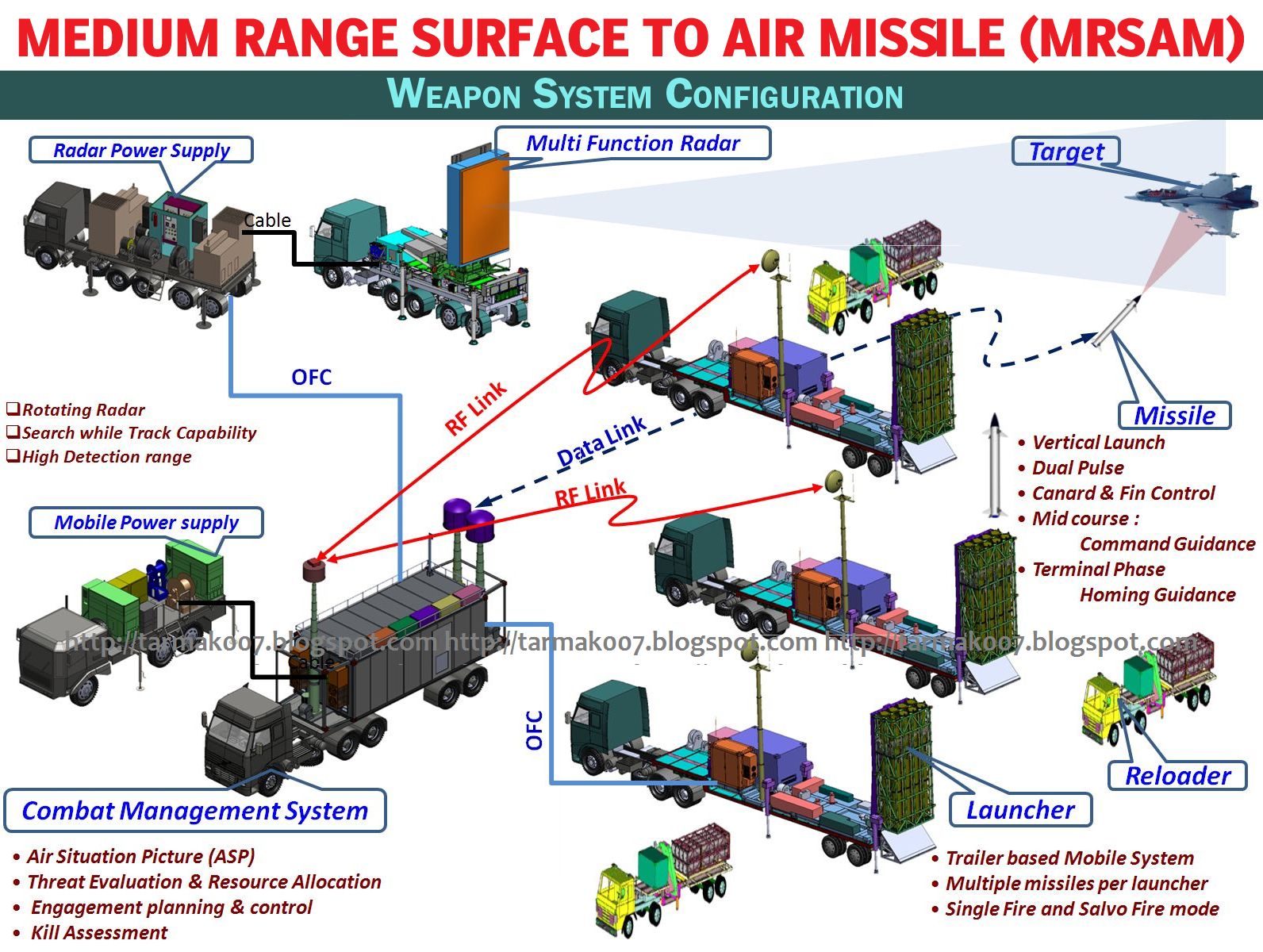
MRSAM details
http://defense-update.com/20160329_mrsam-2.html
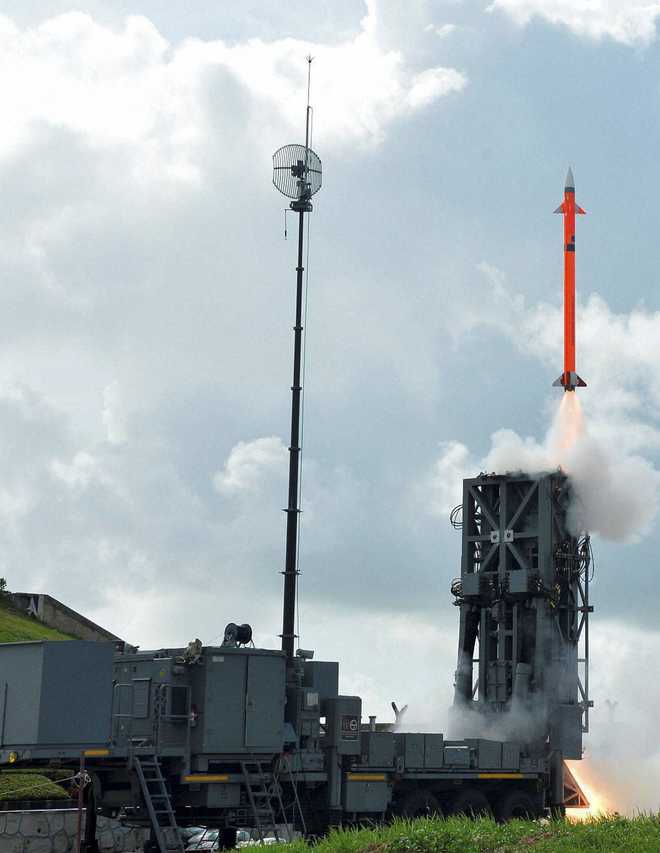
The Indian Defense Research & Development Organization (DRDO) unveiled at Defexpo 2016 the fire unit of Medium Range Surface-to-Air (MRSAM) missile system, developed and manufactured for the Indian Air Force and Army. The development of this system, a land-based version of the Long-Range SAM (LRSAM) Barak-8 naval area defense system, was designed and developed by the DRDO and will be produced competitively by Larsen &Turbo and Tata Power SED, both private sector enterprises. The missiles, developed by Israel’s IAI and Rafael will be produced in India by Bharat Dynamics (BDL).
Three fire units will comprise a battery, self supported with target acquisition and communications. The fire unit comprises two stacks of four Barak-8 missiles, for a total of eight launch tubes. Stacks are reloaded separately, for rapid replenishment. The IAF plans to buy 60 fire units, with the Army buying additional lots to fulfill its requirement for medium range air defense.
Missiles have the propulsion from India & seeker/guidance from IAI.
The C3I is from DRDO/Indian industry
TeerSome more positive news for the IAF.
IAF has 9 squadrons and 18 batteries of MRSAM on order.
http://www.odishanewsinsight.com/odisha/third-launch-of-medium-range-surface-to-air-missile-mrsam-successful/
Should be active instead of armoured.
Third launch of Medium Range Surface to Air Missile (MRSAM) successful
Surface-to-Air-Missile-‘Barak-8’
[b]With a third consecutive successful test-fired on Friday, the Medium Range Surface to Air Missile (MRSAM) air defence system has achieved a Hat-Trick. The missile was launched at 1020 hrs from the test range of ITR at Chandipur. The objective of today’s mission was for maximum range and high maneuvering target.[b] The missile guided by armoured seeker system hit the last minute maneuvering target.
With this launch, MRSAM system has proved the air defence capability for three different boundary envelopes of the target. The Defence Minister Shri Manohar Parrikar congratulated the team DRDO, Air Force, IAI, Israel and associated Industries for the hat-trick success of MRSAM weapon system
TeerSAAB has surprisingly removed the BOQ-X300 from its website.
This is on offer for the LCA along with a SAAB GaN based radar as a counteroffer to the Israeli EL/M-2052.
Teer5 LRSAM FUs are none other than the S-400
Interesting programs, confirmed by the MOD which are contracted for are:
Litening 4
http://aviationweek.com/defense/rafaels-litening-aircraft-upgrading
Some more confirmation.
https://www.flightglobal.com/news/articles/india-acquires-litening-targeting-pod-426811/
India acquires Litening targeting pod
29 June, 2016 BY: Arie Egozi Tel Aviv
Rafael will supply 164 examples of its Litening targeting pod to the Indian air force, for use on four types of combat aircraft including New Delhi’s Sukhoi Su-30 fighters.
Guy Oren, director of Rafael’s electro-optical systems unit, says the pods will be delivered in the next couple of years.
An advanced version of the Litening 4 – the Litening 4 I – will be supplied. The improved system has been equipped with upgraded infrared cameras and a charge-coupled device colour camera to help identify targets on the ground, particularly dense areas, Rafael says.
The company adds that the new version doubles up as a surveillance and reconnaissance system in addition to being a targeting pod.
Big step forward for the IAF’s precision strike capabilities.
In 1999, IAF used Litening with 1000kg/250kg regular bombs for multiple successful strikes against the Pak Army.
The ability to have these systems double as ISR units is another plus.
TeerRii, FBW
If you understand Hindi, see this one as well.
https://www.youtube.com/watch?v=sPOwFr0Dy_M
TeerWhich begs the obvious question, “why select a foreign fighter at all if Tejas is so capable”? No offense, but thank goodness fo India’s government-MoD bungling. Makes people living in the US look a bit more fondly upon our own disfunctuonal DoD, Congress.
Watch the entire interview before going into the overwrought statements Toan was picking up.
[youtube]pvqC4cbTgkk[/youtube]
https://www.youtube.com/watch?v=pvqC4cbTgkk
General GOI aims from 3:00
MOD state of affairs, 8:48, fear to inaction on allegations of corruption
At 12:26 he mentions Tejas – Light combat aircaft. NOte what he says about its capabilities, accurate but not one whiff of jingoism.
At 19:32 – see more. And compare his nuance versus the stuff posted here.
TeerWith all these “deals” going around, kickbacks to politicians, brass and bureaucrats must be at an all-time high.
Rii, actually its not that. In fact, its the “avoid corruption” angle which makes things even more complex.
Hence, the Rafale deal got recast as well. The DM Parrikar’s stated aim when he took office was to clean up the dross.
So he cancelled a bunch of deals which were so old that they didn’t make sense and fast tracked another bunch which were based on operational necessity. The former outweighs the latter.
There were 291 schemes planned under 12th plan. 60 schemes were added during the
review (recast) of 12th plan. Out of the total 351 schemes, 36 have been contracted, 124 have
been deleted and 191 schemes are ongoing/under progress. Out of these 191 schemes,
Acceptance of Necessity (AoN) have been granted to 78 schemes.
If they were corrupt, they would be happily adding away and not deleting obsolete requirements. Also note they are methodically working the deals, not fast tracking them (though I’d argue some do need to be fast tracked- for instance:http://pib.nic.in/newsite/PrintRelease.aspx?relid=113227).
The PM Modi’s stated aim is to stop central Govt corruption.
See:
http://indiatoday.intoday.in/story/transfer-posting-raj-ends/1/531599.html
While it can’t be completely wiped out, it can be minimized by making things more transparent and the current PMO is indeed very powerful.
Even so, Modi’s big challenge is India’s bureaucracy.
http://www.firstpost.com/india/pm-modi-is-getting-restless-with-the-bureaucracys-stalling-tactics-2602444.html
http://timesofindia.indiatimes.com/city/hyderabad/Defence-deals-procurement-do-not-happen-overnight-Parrikar/articleshow/52810610.cms
The process is simply cumbersome
“To place a defence order, it takes a hell lot of time. With every Tom, Dick and Harry sitting in the department … those who do not understand anything about actual product asking some vague questions, sometimes funny questions, also sometimes relevant questions. After he satisfies himself he gets transferred and somebody else comes in and raises different kind of queries again … it takes lot of time,” Parrikar said.
Also, Modi needs to balance the exchequer with the MOD requirement, but he has been pretty successful on balancing the subsidy (moving a chunk to the real folks who need it) & some loss making PSUs arena (Air India being the biggest example, benefiting in part from favorable worldwide economic headwinds like oil prices but there are many more which need to turn the corner and its early days yet to say all of these are ok)
So there is some breathing room for defence, with the aim being to build the services up into an actual warfighting force, serviceability wise.
IMHO, that’s the biggest thing Modi/Parrikar can do. The Rafale stuff is just icing, if the Su-30 fleet achieves Parrikars stated aim of 75% serviceability from 55%, that’s 50 airframes on a 272 strong Su-30 fleet. Plus the committed 4 more squadrons of Tejas, 80 more airframes (as versus the original 40 alone). Together, that takes the bite off of the MMRCA (for now) being 36 planned as versus 126.
If the economy picks up then IMHO the pace of acquisitions might accelerate but the bureaucracy has to deliver too.
SO far the two steps Parrikar has taken, one on the Tejas and the other on Su-30 serviceability have the potential to be game changing.
The Tejas is sufficient against PAF freeing up Su-30s against PLAAF and the serviceability angle literally adds airframes to the fleet.


 Sign In







