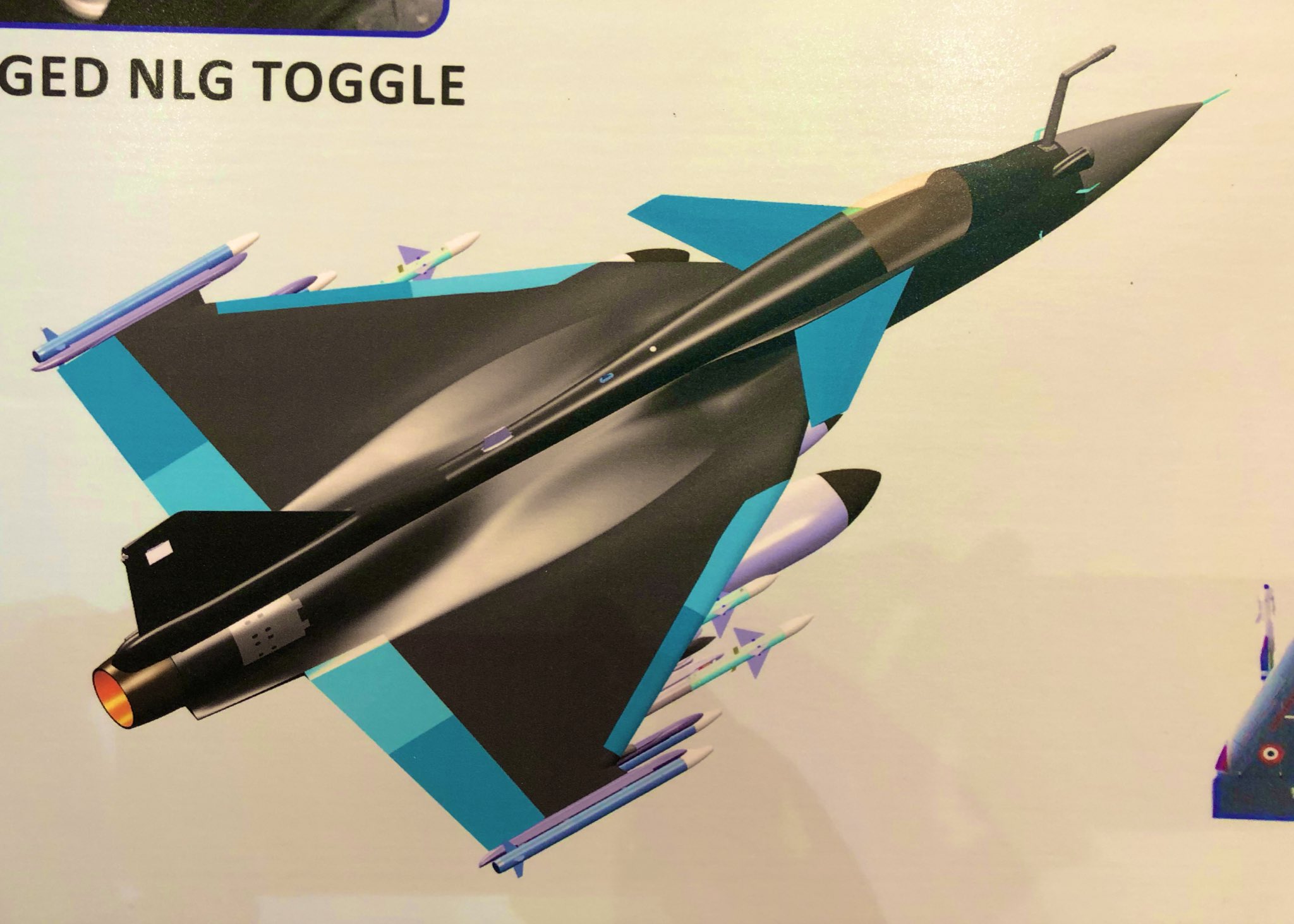
Tejas Mk2 Medium Weight Fighter (MWF) prototype metal cutting to begin in February 2020. All designs and drawings have been frozen.
Metal cutting, the first step in the start of commercial production, of the of indigenously made single-engine fighter plane Tejas (Mk-II) is scheduled for February 2020, according to Dr Girsh S Deodhare, director of the Aeronautical Development Agency (ADA) and head of the Tejas programme.
The Mk-II will have more advanced sensors including a powerful radar, empowering the fighter for operations beyond the visual range, and improved avionics. The fighter will be able to fly with more weapons and fuel than its predecessors Mk-1 and Mk-1A.
The IAF is buying 123 Mk-1 and Mk-II fighters. The Tejas Mk-II will be several tons heavier and is designed to fit into the medium weight categories of fighters.
Recently the IAF told the government that it is ready to buy more indigenous fighters to replace its aging fighter fleet.
The Tejas (Mk-II) are slated to replace the existing French-made Mirage -2000 and Russian -made MiG-29 class of fighters.
“The detailed designing stage is over; drawings are frozen,” Dr Deodhare said.
Both the Indian Air Force (IAF) and the Defence Research and Development Organisation (DRDO) are looking at the Tejas as a replacement for the the French-made Mirage-2000 class of fighters, around a dozen of which were pressed into action on February 26 to bomb a Jaish-e-Mohammed terrorist camp in Balakot, Pakistan, in reprisal for the February 14 terrorist attack in Pulwama that killed 40 Central Reserve Police Force (CRPF) troopers.
The prototype of the Tejas (Mk-II) is expected to be flying in about two years. The metal cutting will take about a year to 18 months. Tejas Mk -II, which will be fitted with a GE-414 engine, is scheduled to make its first flight in 2024.
The DRDO has been criticized and even ridiculed for slow progress made in key military programmes, especially the Tejas light combat aircraft (LCA) programme, which has taken about a decade-and-a-half to mature. Nonetheless, the Tejas has the unique distinction of not being involved in a single crash or accident till date despite hundreds of hours of flying.
Using learnings from the past and in an effort to shorten the manufacturing and maintenance process, the DRDO has decided to build the Tejas (Mk-II) in a modular fashion and plans to lean on the private sector more than it did in the past.
Modular construction, where components like the fuselage, wings and landing gear area built separately but are put together in the final assembly line, increases the speed of construction and shortens delivery time. Modular construction requires detail exacting design of each component and allows more than on unit to be involved in the production process. It also helps maintenance and reduces time between sorties. Components can be changed easily by replacing a module making the fighter easily serviceable. A major complaint against the initial batch of Tejas fighters was that they weren’t designed in a modular fashion increasing maintenance and turn-around time.
Interestingly, the DRDO is also working on an “optimally manned” cockpit technology for the LCA and the next-generation Advanced Medium Combat Aircraft (AMCA).
The cockpit technology will help regain control of the aircraft in case the pilot loses consciousness or is incapacitated. A helmet-mounted sensor will alert ground control, which will be able to take over the aircraft’s controls to safely land the aircraft. “It is an artificial intelligence-based application. Till now we were following (the west), now we want to take the lead, “ Dr Deodhare said.
..


 Sign In