BlackArcherRedux
There are 3 separate teams in the ADA that work on the Air Force Tejas, Naval LCA and the AMCA. The Naval LCA team will continue to work on the twin engine DBF. The Navy has its officers as part of the team, so they’ll be working closely with the Navy, based on the Navy’s requirements. Even earlier, the single engine Naval LCA Mk2 was being designed simultaneously with the Air Force Tejas Mk2 MWF.
Target timeline for first flight of the twin engine DBF is 2026, a full 3-4 years after the Air Force Tejas Mk2 MWF is supposed to fly for the first time. For the better part of this decade, the Navy’s needs are to be met with the MiG-29K only.
BlackArcherReduxIAF will overhaul its 3 Mi-26 helicopters to keep them flying for another 10-15 years. The ‘Featherweights’ squadron will then be flying both Mi-26 and Chinook heavy lift helicopters
[url=https://theprint.in/defence/iaf-mi-26-choppers-to-russia-overhaul/30093… Mi-26 choppers to be sent to Russia for overhaul[/ur]
New Delhi: The first of the Indian Air Force’s three iconic Mi-26 heavy-lift helicopters known as Halo, is set to fly to Russia in about six months to undergo extensive overhaul and repairs that is expected to extend its life by another 10-15 years, ThePrint has learnt.
The move will enable the IAF to operate the Russian-made world’s largest heavy-lift helicopters together with the American Chinook choppers that are being currently inducted, giving it an unprecedented tactical lift capability.
Once the process is complete, India will become the first country to have a simultaneous inventory of both Mi-26s and Chinooks.
Speaking to ThePrint, senior government officials said the Ministry of Defence finally cleared the file for the overhauling of the three Mi-26 helicopters in August.
To be serviced in rotation, sources said, the choppers are now being readied so that they are in a condition to fly to Russia.
Servicing each Mi-26 helicopter is likely to take anywhere between a year and a year-and-a-half. The second chopper would fly to Russia for the overhaul once the first one is back. Subsequently, the third one would be sent, said an official who did not wish to be named.
It would take each chopper about three weeks to reach Russia.
BlackArcherReduxIAF’s Rudra ALH-Mk4 details. The Rudra is especially popular in the Indian Army.

BlackArcherRedux
Don’t know why the edit option is not present for existing posts..
BlackArcherReduxSorry that image did not load. A smaller version of it is here
BlackArcherReduxThe LCA Navy Mk1 is already ready to be tested off IN’s aircraft carrier. trust me, ADA has learnt a lot of the lessons it needed to learn from the LCA Navy Mk1. The single engine LCA Navy Mk2 design itself implemented a host of changes to address issues that were found with the Air Force design that was modified to create the Navy design. They made a lot of changes to the Mk2 only for the naval requirements, but now that the Navy has made it clear that it only wants a twin engine design, ADA has begun the preliminary design of the twin engine Deck Based Fighter.

This was the last LCA Navy Mk1 fighter design- the LEVCONs have been dropped in favor of small stabilators. Most likely, the twin engine DBF will be a modified version of this design itself.
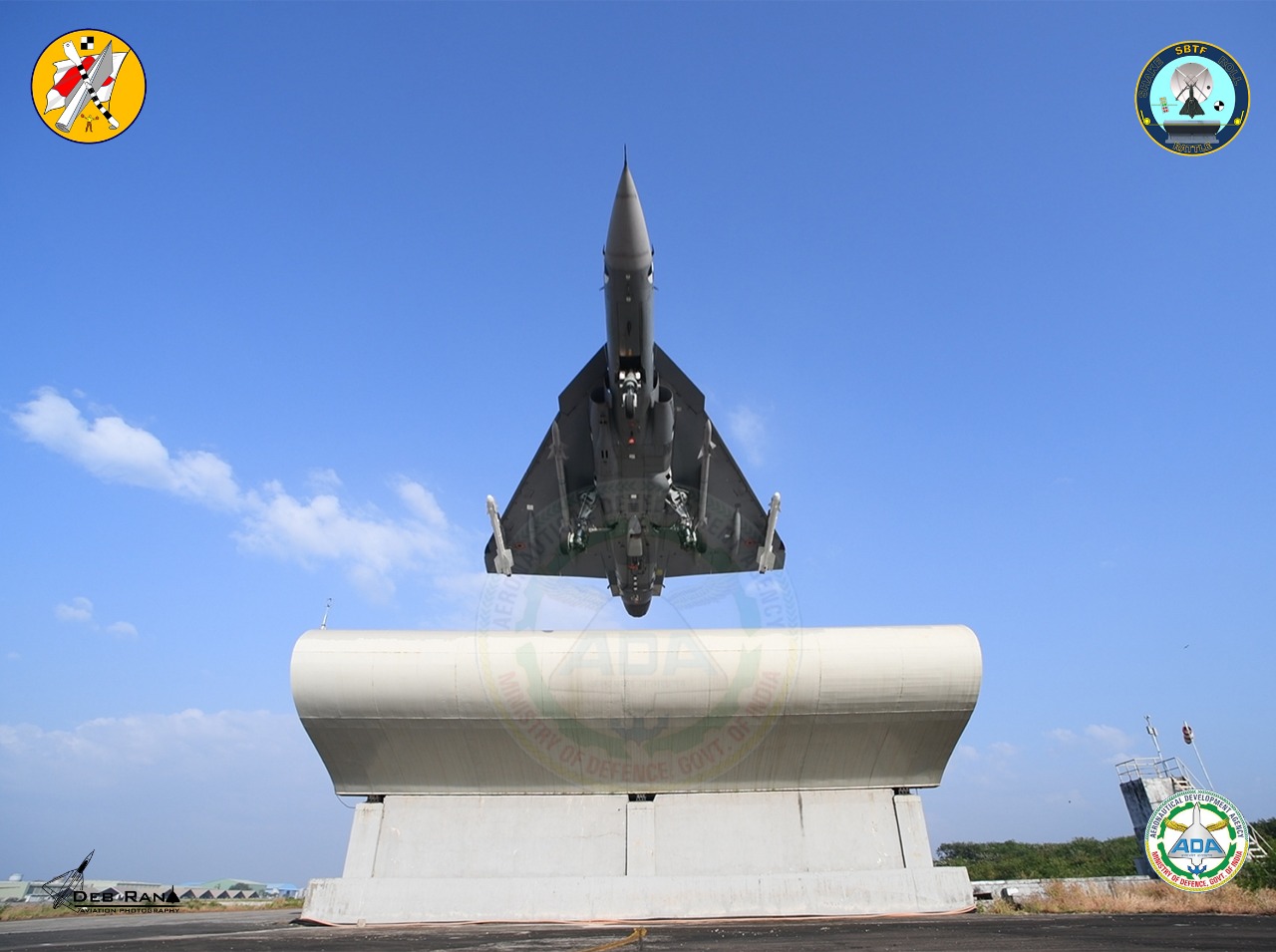
BlackArcherReduxLCA Navy Mk1 with 2 R-73 WVRAAMs and 2 Derby BVRAAMs taking off from the ski jump ramp at SBTF, Goa.
BlackArcherReduxAnd Tomcat VIP, that is the Tejas Mk1 on the chart that I posted. It is the Elta 2032/MMR that is shown there. That is a mechanically scanned array radar, not a PESA.
Mk1A will include the Elta 2052 or (unlikely it seems) the indigenous Uttam AESA radar.
BlackArcherReduxHere is the original DelhiDefenceReview article on the Tejas Mk1 and Mk1A updates. Better to read it there than the regurgitator that is IDRW.
Recent developments with respect to the Tejas Mk1’s capability development
Lack of inert ammunition had kept gun-firing trials for the Tejas Mk1 in abeyance even though the corresponding software ‘patch’ had been ready for a while. Having received the said ammunition recently, the Aeronautical Development Agency (ADA) will begin firing trials early next year. Though, ADA says ‘air to air’ gun firing against a moving target is a challenging task, it does not foresee any great hurdles in completing this test point given the availability of experienced pilots overseeing the process at the National Flight Test Centre (NFTC),
Meanwhile, the design of dual carriage pylons for carrying missiles as well as a jammer pod on a single underwing station is complete. Also, a fully capable flight simulator is being built at SAFS and will become operational in 12 months’ time, thereby remedying one of the gaps pointed out in a Comptroller and Auditor General (CAG) report on the LCA program. Pilots entering 45 Squadron currently train at a simulator at located at ADA, Bengaluru. As such, with squadron service generating high sortie rates, valuable feedback from the IAF is helping fix teething issues in design and manufacturing.
…
For example, apart from structural changes, the HAL Tejas Mark 1A, for which an order of 83 units is soon expected from India’s Ministry of Defence, will feature changes derived from the AMCA and MWF programs. The Tejas Mk-1A will for instance feature a revamped Digital Flight Control Computer (DFCC) besides incorporating various new Line Replaceable Units (LRUs). While the earlier DFCC was based on the 386 series processor, the new DFCC will feature PowerPC based computing architecture. This dramatically improves computing performance. While the MkI required 24 physical connectors, the newer version would be a press-fit mechanism drastically reducing maintenance overhead.
From what I know, the Gsh-23 gun trials were supposed to be done in-flight for FOC initially. They were already done on the ground, to measure vibrations. No major issues were found, as per my interaction with a HAL engineer at Aero India 2015.
Then, for reasons that were never explained, it was mentioned that the in-flight gun trials were de-linked from FOC and it would be done after FOC was granted. Now as to what exactly led to a lack of inert ammo which should’ve been an easy thing to procure from Russia, I have no idea. The links below show Tejas prototypes firing the Gsh-23 gun on the ground
BlackArcherReduxMiG-27 and all MiG-21 squadrons except MiG-21 Bison squadrons, will be retired by 2019 as per what earlier reports had indicated.
For sure there won’t be any more MiG-21bis, MF or M in IAF service soon. Bisons will continue till 2025 as per what ACM Dhanoa (retd.) had stated in an interview before his retirement.
One request- please don’t quote IDRW articles here. It’s just a website that regurgitates original content that others created. They don’t even give credit to them and just shamelessly lift stuff posted on other forums and pretend that it is their original content.
BlackArcherReduxThe image below shows the list of private companies that are building the various modules of the Tejas as of now

BlackArcherReduxLike I said earlier, HAL has given a figure of 24 units per year as possible, since it has outsourced the manufacture of the fuselage and wings to private companies and only acts as the final integrator. Private companies will only be happy to increase production rates as long as its economically feasible and the order size is big enough.
HAL Nashik will get a new Tejas production line as the Su-30MKI production winds down after the new 18 unit order is delivered. With the MRCA likely to go to a private company based on the Strategic Partner (SP) model that the GoI wants to implement, HAL has only got the Tejas, MWF and after that the twin engine deck based fighter for the Navy. AMCA will go into production in the 2030s. More incentive for HAL to focus on how to maximize its revenues with these jets it’ll build.
BlackArcherReduxThe fact is that the new Air Chief Marshal is a former LCA test pilot and a very respected officer who will drive the IAF towards indigenisation. He recently flew in the HAL HTT-40 basic trainer, becoming the first IAF ACM to fly a prototype. And it is clear that the HTT-40 is going to join service, and there’ll be no more Pilatus PC-7 Mk2 bought.
The commitment to the Medium Weight Fighter Tejas Mk2 is real and ADA already has begun metal cutting on a prototype that is supposed to fly in 2021-22. If the project is managed properly, we could see it being inducted in 2026-27, given the Tejas Mk1 experience. Much earlier than then, the production at HAL should be humming (as it is now with ALH which is churned out pretty fast), giving the IAF the fastest and most economical way to achieve squadron numbers.
The 114 MRCA hasn’t even been accorded an Acceptance of Necessity, which would lead to an RFP in 6 months, so I would say that is still some ways away.
BlackArcherReduxthe Tejas Mk1A order is to be signed before March 2020. No way a new Rafale order will emerge anytime soon because of any delays to this Mk1A contract.
As it is the IAF’s new Air Chief Marshal RKS Bhadauria stated that no follow-on off the shelf order for more Rafale fighters was being discussed. the IAF is hoping to see movement on the 114 MRCA deal, and has orders for 18 Su-30MKI and possibly 22 MiG-29s to add 2 more squadrons.


 Sign In