BlackArcherRedux
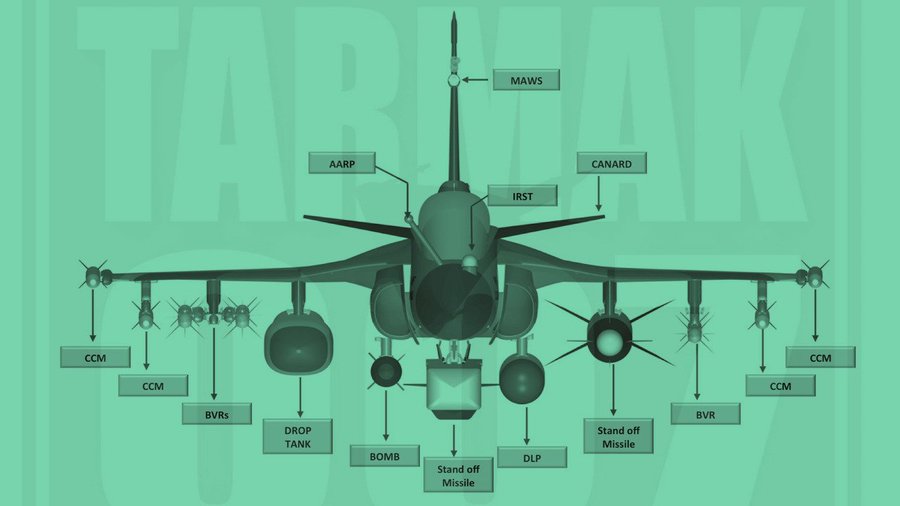
MWF loadout drawing
Designed to carry upto 8 BVRAAMs + 4 CCMs
Centerline hardpoint will be designed to carry upto 1800 kg payload. A new heavy stand-off precision weapon named Rudram-3 is in development and MWF will need to be able to carry it.
Rudram-1 is an anti-radiation weapon
Rudram-2 is another stand-off weapon
BlackArcherReduxMWF loadout drawing
Designed to carry upto 8 BVRAAMs + 4 CCMs
Centerline hardpoint will be designed to carry upto 1800 kg payload. A new heavy stand-off precision weapon named Rudram-3 is in development and MWF will need to be able to carry it.
Rudram-1 is an anti-radiation weapon
Rudram-2 is another stand-off weapon
BlackArcherReduxHAL signs contract with IAI for 54 Elta 2052 AESA radars for Jaguar DARIN III upgrade. Includes ToT
JUST IN! HAL signs contract with IAI ELTA for AESA Radar: The Avionics Division, Hyd has entered into a contract with IAI ELTA, Israel for manufacture/supply of AESA Radar (total of 54) for Jaguar DARIN III upgrade aircraft under the Transfer of Technology.
As part of TOT, HAL will manufacture Gallium Arsenide-based Trans Receiver (T/R) Elements of Radar Antenna. Also, Transfer of Design Tech like Antenna with different configurations, development of Radar Processor application software/Low Voltage Current Source are also ensured
BlackArcherReduxIndia’s next fighter- the single F-414-INS6 powered Medium Weight Fighter (MWF) is to go into Detail Design from next month onwards.
-First prototype rollout targeted for August 2022
-First flight targeted for Sept 2023
-12 squadrons = 12 X 18 = 216 jets
Although these images show fixed probe, a retractable probe is being planned to reduce drag. Also DSI is being considered based on AMCA experience.


Lucknow: The Medium Weight Fighter (MWF), the gen-next variant of Light Combat Aircraft (LCA) Tejas – LCA MK-II, will enter the Detail Design phase next month.
The configuration for this advanced single-engine fighter has been frozen along with sub-system level Preliminary Design Reviews (PDRs).
It is now confirmed that the most-critical ‘aircraft-level PDRs’ will be held at the end of this month.
And, the detail design and tool design activities will start from next month.
Sources confirmed to Onmanorama that the all-important metal cutting for MWF is scheduled to start from April 2021. Sources claim that the Indian Air Force (IAF) has indicated to induct about 12 squadrons of MWF.
Long lead activities like procurement of raw material for metal cutting have already been commenced.
“We have frozen the design configuration,” says an official.
..
The mockup, an engineering cockpit simulator, is embedded with large area display (LAD), sleek Head-Up Display (HUD) and side stick, or control stick on pilot’s side console.
..
In addition to improved range and endurance, the MWF has a maximum all-up weight of 17,500 kg with increase in weapon carrying capacity. Among the key features are:
• Active Electronically Scanned Array (AESA) radar in place of Multi-Mission Radar (MMR)
• Internal electronic warfare (EW) suite with jammer
• Integration of latest sensors like Infra Red Search and Track (IRST) and Missile Approach Warning System (MAWS)
• Multi sensor data fusion
• NCW (Network Centric Warfare) capabilities
• Close Coupled Canard
• Improvements in maintainability
• Increased internal fuel
• OBOGS (On Board Oxygen Generating System)
..
Supersonic drops tanks, retractable air-to-air refueling (AAR) probe, quick turnaroundrole change and fly-by-wire flight controls with upgraded Digital Flight Control Computer (DFCC) are some of the other features of the MWF.
To be powered by GE-F414-INS6 engine, the MWF has a service ceiling of 50,000 feet.
It is 14.6 m in length, has 8.50 m wingspan and stands at 4.56 m height. It is capable of touching up to +9/-3.2 ‘g’ limits and can fly at maximum speeds of 1.8 Mach.
..
Target 2023
The first prototype of MWF ‘roll out’ is scheduled for August 2022 with its first flight expected in September 2023. A total of four prototypes are being planned initially.
Not wanting to repeat the missed lessons in Tejas MK1 project, the IAF is involved actively in every step right from the beginning of MWF. The Project Monitoring Team (PMT) from IAF is a part of all activities providing necessary inputs to the designers. Periodic reviews are also conducted by Air HQ.
Similar to the Tejas MK-1, HAL is fully involved from the beginning as the principal partner mandated to produce all prototypes.
BlackArcherReduxStill waiting for the source of this claim that HAL used Rafale offsets with Messier Bugatti to optimize the LCA Navy landing gear. Never heard of it before.
And HAL had several years ago spoken of changes being made to reduce the landing gear weight. Well before the Rafale deal was even signed.
BlackArcherReduxI don’t know what you’re talking about..redesigned landing gear designed with the help of Rafale offset contract? Says who? HAL designed the original overweight landing gear and then had to re-design it as well. No foreign help was sought, as far as I know.
BlackArcherReduxNaval LCA NP-2 on board INS Vikramaditya

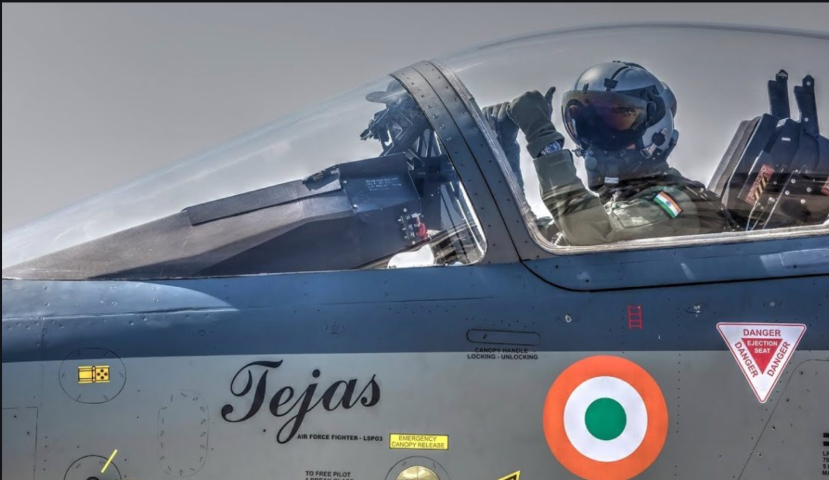
BlackArcherReduxA great interview with Grp Cpt Rajeev Joshi, Tejas test pilot on flying and fighting in the Tejas Mk1
Flying and fighting in HAL Tejas- interview with test pilot Rajeev Joshi
….
What is the best thing about it?
“The small size and the good sensor package. The ability of the avionics design to absorb changes and upgrades seamlessly is a positive advantage. The biggest strength of the programme comes from the fact that the design and integration is indigenous. This gives the aircraft the ability to match the best in terms of features, utilities and modes. Small size and low (radar) signature, coupled with a good sensor package, puts the Tejas in a good advantageous spot with respect to bigger birds. The typical ‘first look, first kill’ works very well for the Tejas in a fight, both in the beyond visual and the visual realms. The Helmet Mounted Display System works well in a snap engagement and the coupled missile ‘line of sight’ (LOS) modes allow the first shot to be good. The HMDS is a very versatile piece of equipment for a number of tasks. The handling of the flight control system is fabulous and is being refined continuously. Based on the operational feedback from the fleet, the build up of rates is being refined to make it crisper and yet more responsive. In this area too, the 100% indigenous flight control system is a winner. It’s ours, and can be tweaked continuously. The process is very robust and the feedback about handling and what would ‘feel’ better is addressed very quickly. The full authority Auto Low Speed Recovery makes the aircraft truly carefree, more so than any other fighter in the world. This may be contested, but I’m willing to defend this position in a debate! The ALSR and other higher control law modes put this a notch higher. Throw it around as much as you can — when she says ‘no’, she will take over and recover the situation for you. The control and handling in high gain tasks like aerial refuelling is superb. It will beat contemporaries or older birds in this area. It really makes you feel like a great pilot!”
…and the worst?
“Ironically, the size! It invariably tends to get compared to its bigger cousins in the business. The size essentially limits internal fuel and hence the shorter legs as compared to others. However, if the focus is kept on the fact that it was intended as a light fighter, the fuel fraction is reasonable. The ‘404 and aircraft combo is frugal, and with external tanks and a high flow-rate aerial refuelling system, it’s ok…..”
How would your rate Tejas in the following categories:
A. Instantaneous turn
“Snaps into it! However, the traditional drag of the delta platform does start showing after a while.”B. Sustained turn
“Mid mach numbers and mid altitudes, good. Like an aircraft of its size, affected by stores carried.”C. Acceleration
“Climbs well, and the acceleration is good. The continuing refinement in the drag department is an ongoing process which aims to make this better still. With every drag count being ‘counted’ with a fine tooth comb, it will only get better”D. Climb rate
“Reasonable and meets the specs laid out.”E. High alpha performance
“Fabulous! Difficult to enter a difficult situation with respect to this… a very robust control law makes the Tejas a winner here. Do remember though, that comparisons with its thrust-vector control- equipped Russian cousins would be unfair here. The nose holds up well in low speed fight, and the ALSR makes you trust the aircraft. High angles of attack manoeuvres and reversals are comfortable, albeit with a little ‘barrellish tendency’. Though like any flight control system controlled fighter, the rate of roll and pitch rate does go down with high AoA and/or high pitch angles.”…..
How does it compare with other fast jets you have flown? Which aircraft has most similar flight characteristics?
“A lot of inspiration for the Tejas came from the Mirage 2000. Of course, the Mirage was a worthy template to look up to, and hence it is quite like it. Flight characteristics-wise? Closest to the Mirage 2000. Lovely similarities in feel and handling.
….
BlackArcherReduxIAF Rafale jets in France. Intense work up period for the training of the first sets of IAF crews
pic credit in the image itself
RB003


RB004


RB005


RB006 at Bordeaux Mérignac

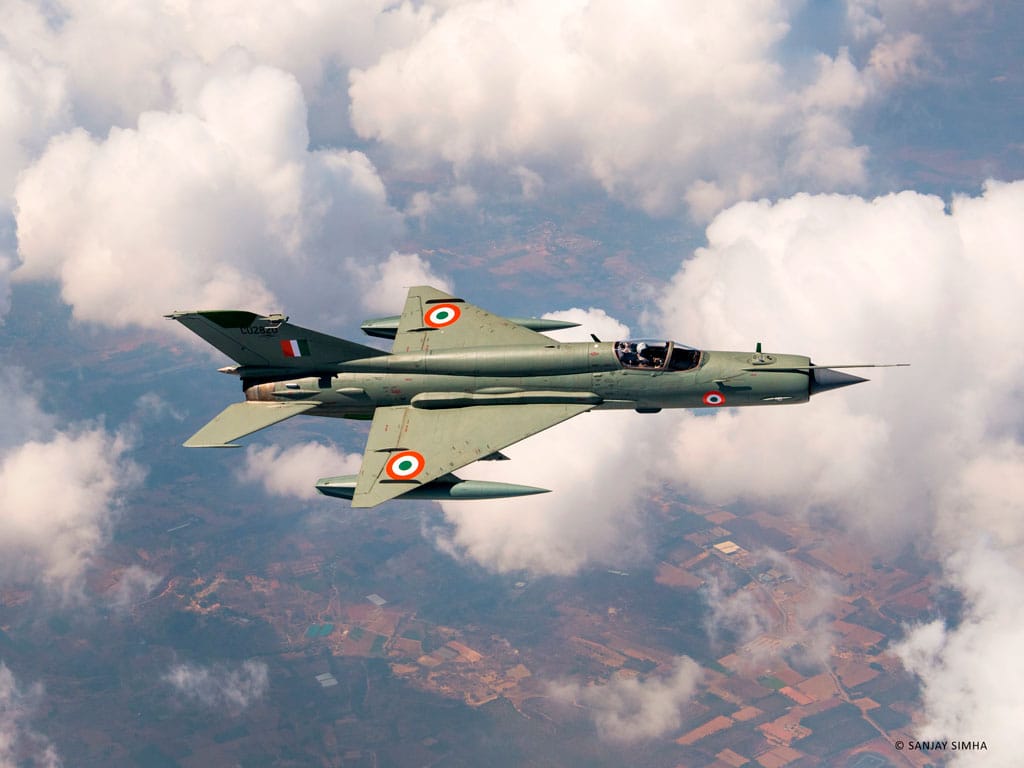
BlackArcherReduxA lovely aerial shot of a MiG-21 Bison of the IAF


 Sign In