BlackArcherRedux
LOL. How much thrust do you think 2 X F-125IN produce? 40 kN in afterburner! So with 2 X F-125IN it’ll produce even less thrust than the existing F-404-IN20. Adour is no better, and heavier than the F-125IN. If anything, the IAF is VERY happy with the F-404 engine. In multiple interviews this has been mentioned. the previous Air Chief Marshal in an interview mentioned that the F-404 consumed less fuel at 7,000 ft-10,000 ft than a MiG-21 consumed at 33,000 ft. Even earlier, it has been said that the F-404 is a “fuel sipper” of an engine. Plus it’s reliable.
And I don’t understand what you even mean by “cannot afford”. The Indian Navy is serious about going with a twin engine Deck Based Fighter and the LCA Navy Mk1 acts a technology demonstrator for that.
Your opinion is your opinion but India is now serious about indigenisation and not throwing billions of $ on imports. There most likely won’t be any imported MRCBF. There will be a MiG-29K MLU possibly and there will be a Tejas Mk2 MWF.
Nobody in the forces nor in the Govt. shares your viewpoint, but you’re entitled to it, so I’ll let it be. Anyway this forum has people who think they know better about how to run India’s procurement and development programs with a lot of condescending BS, without knowing even ABCD about it, but that’s not going to change.
Watch from 17:40 onwards. the former ACM BS Dhanoa, who has flown the Tejas talks about it. “It has got a fantastic engine, very good radar, very good man-machine interface and the Mk1A which comes in with AESA radar and other things has even better performance…”. He accepts that the program is behind schedule but that HAL is doing something about it so that production goes up to 16 aircraft per year, so that one squadron is added per year.
But no one in the IAF or GoI believes that dumping it and going for foreign imports will work. In fact, it’ll be the stupidest thing possible.
The current ACM is even on record in a very recent interview stating that it was easier to get contracts done through the indigenous route, apart from all the other benefits such as continuous upgrades and new weapons integration.
The 114 MRCA is very likely the last foreign fighter import, with a very remote possibility of some off-the-shelf Su-57E bought in 2030s if AMCA deadlines slide.
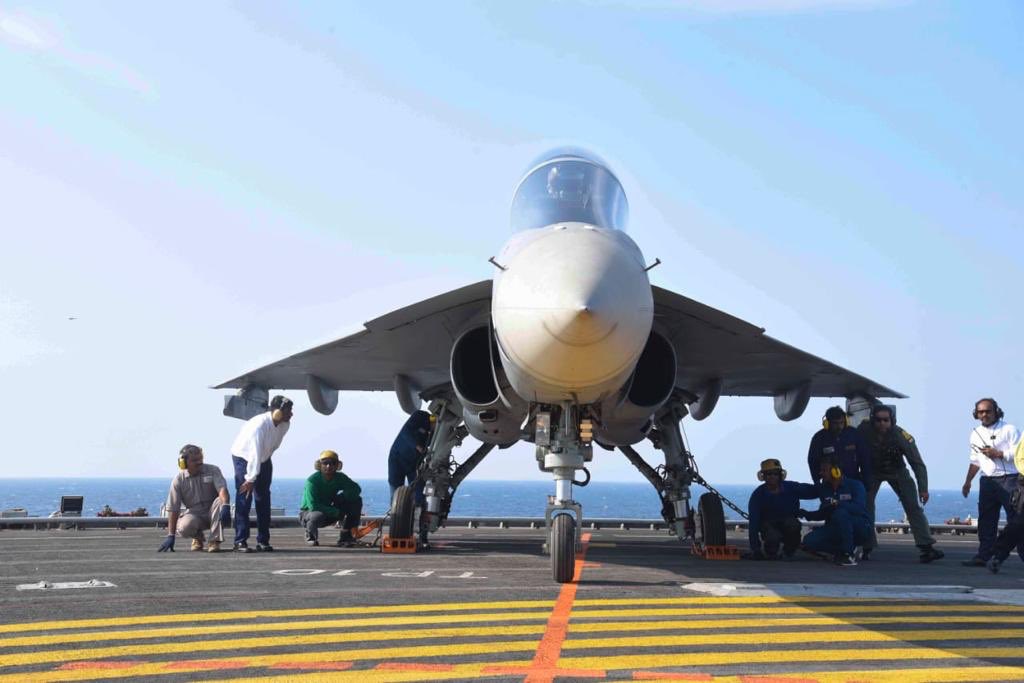
BlackArcherReduxMore images
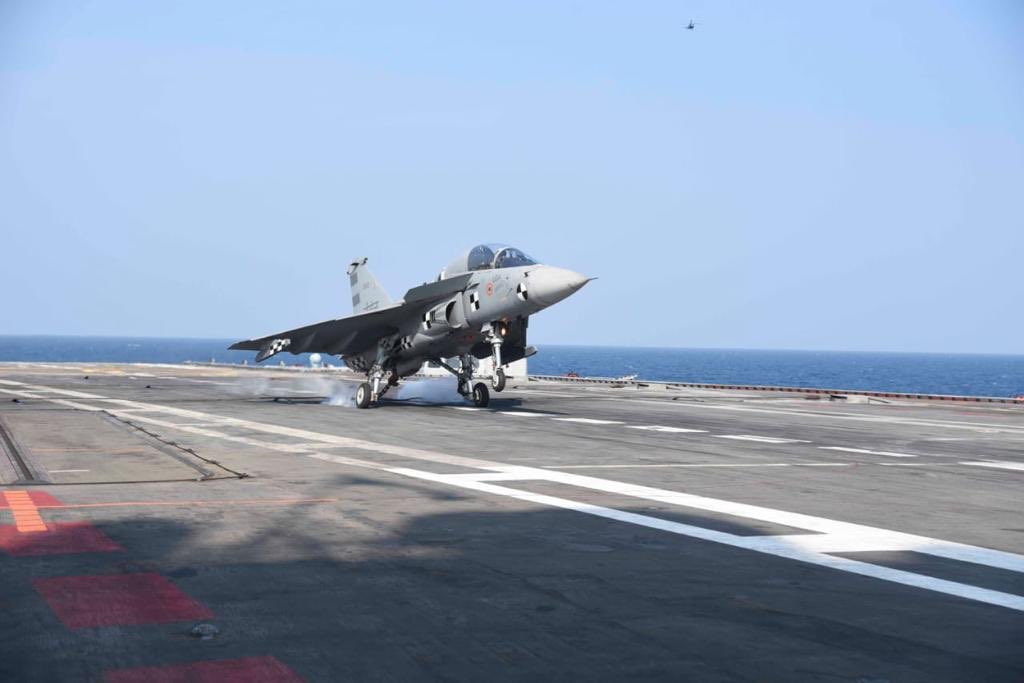
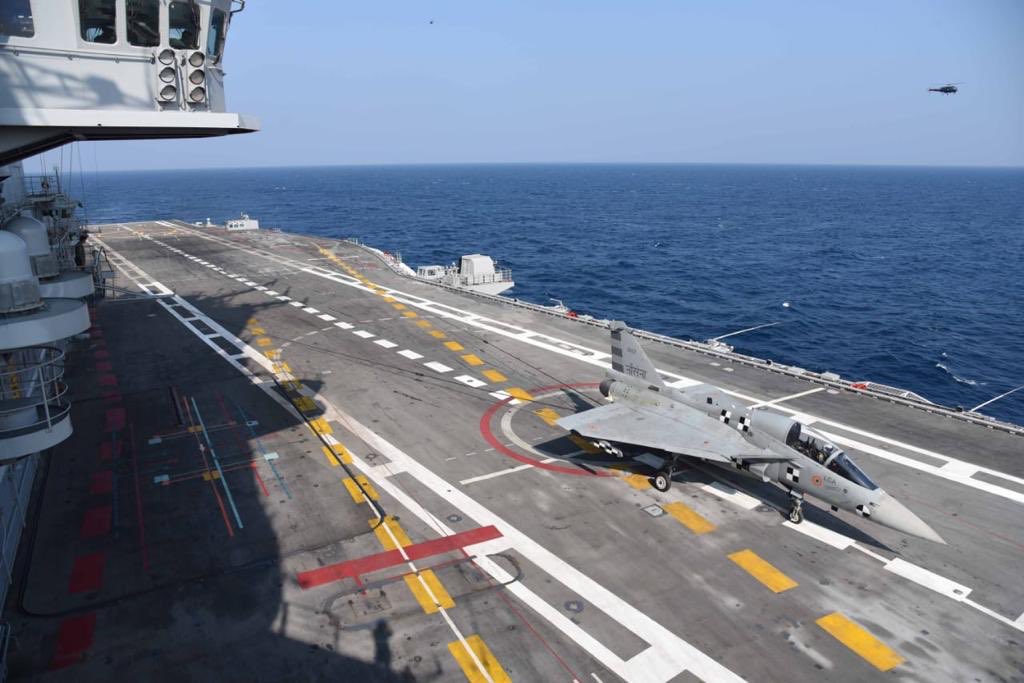
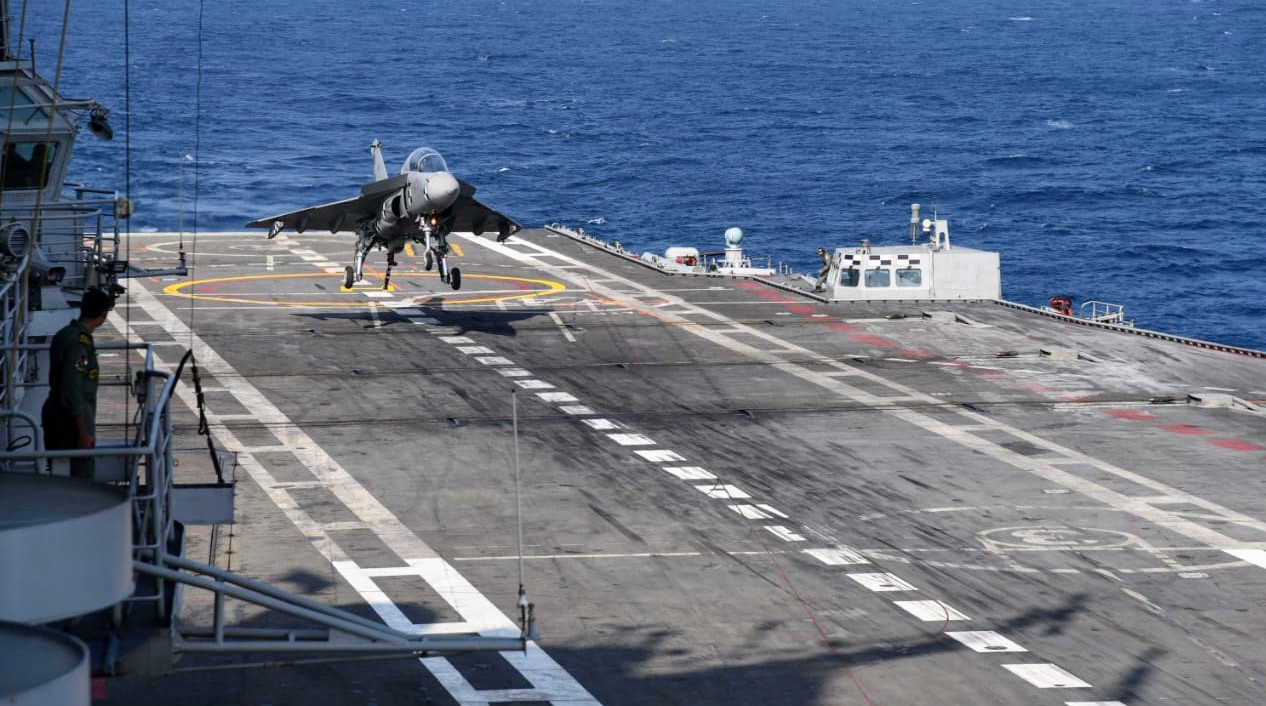
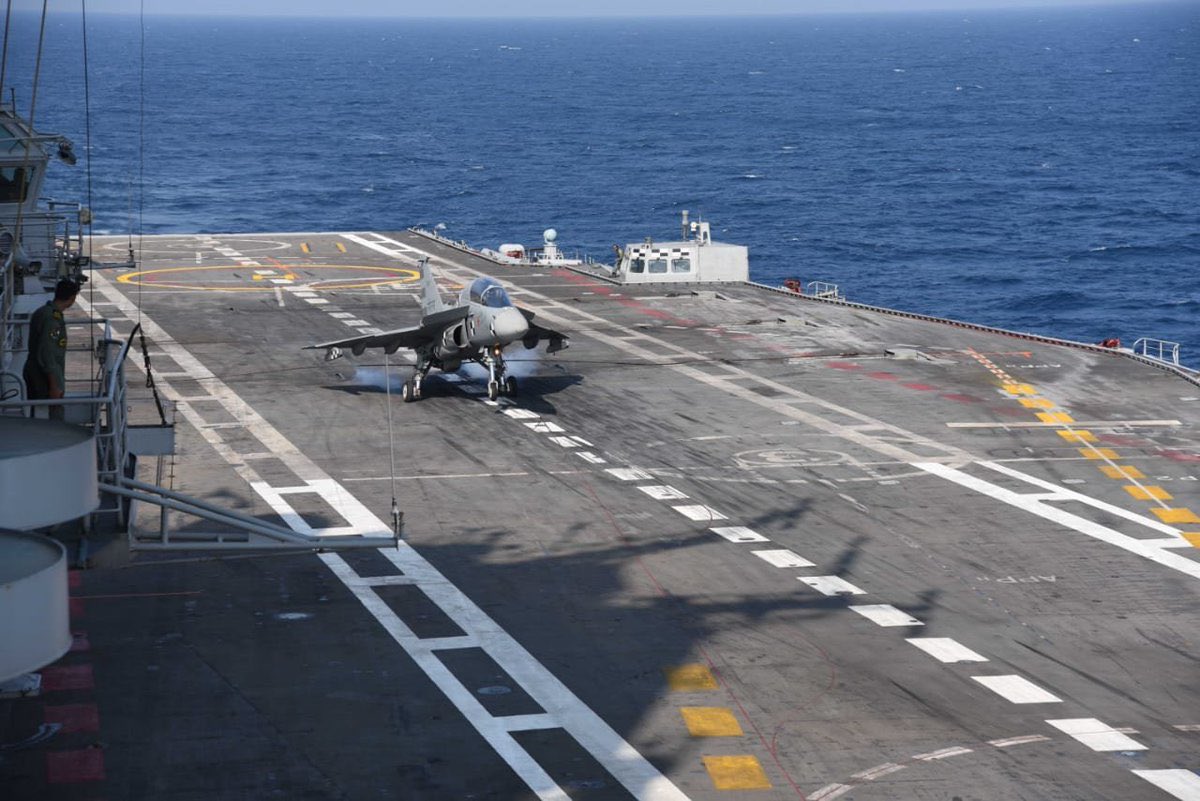
BlackArcherReduxAnother image of Naval LCA just moments before landing and snagging the 3rd arresting wire
BlackArcherReduxVideo of Naval LCA prototype NP2 landing on INS Vikramadityahttps://www.youtube.com/watch?v=XU7L_6xPTgw
BlackArcherReduxFrom Vishnu Som’s Twitter feed
1. Exclusive details on today’s LCA Navy prototype landing on the deck of the aircraft carrier, INS Vikramaditya. The LCA N, piloted by Commodore Jaideep Maolankar, snagged the third wire on the deck of the ship. The target was the second wire.
2. The first take-offs happen tomorrow off the INS Vikramaditya’s ski jump.
3. The twin seat Tejas N prototype makes its landing tomorrow flown by Captain Dahiya, the second test Tejas N test pilot.
4. There will be more than 20 tests of the Tejas N off the Vikramaditya. Extensive ten day intensive flying campaign underway.
5. There was 23 knots of wind at the time of approach today … Touchdown was at a comfortable 128 knots relative to the speed of the carrier.
6. The aircraft tested today was in a clean configuration.
7. The landing has been described to me as being an anti-climax given the extensive preparations ahead of the sortie today.
8. A process of extensive documentation preceded the actual first landing today – key to officially validating a lot of the technologies being tested.
9. The preparation for the sortie was very thorough – enough fuel was carried to ensure a return to Goa in the event of the aircraft being unable to snag an arresting wire using its arrestor hook.
10. The aircraft tested today had max fuel on board and no dummy weapons.
11. The learning curve has proven to be massive – someone associated with the project told me “How little we knew in September.”
12. Lots of tests can now be done based on the usage data generated through multiple sorties which are being flown over the next few days.
BlackArcherReduxBlackArcherReduxFirst images of Naval LCA prototype NP-2 landing on INS Vikramaditya. A historic maiden landing of an indigenously designed and developed Indian fighter on a carrier

BlackArcherReduxHistory made as India’s Naval LCA makes 1st arrested landing on Aircraft Carrier
Making it the first homegrown aircraft to land on an aircraft carrier deck, a prototype of the naval Light Combat Aircraft (LCA) ‘trapped’ on the Indian Navy’s sole aircraft carrier INS Vikramaditya today out in the Arabian Sea. Hailed as a major milestone, the Indian Navy has declared, ‘With this feat, the indigenously developed niche technologies specific to deck based fighter operations have been proven, which will now pave the way to develop and manufacture the Twin Engine Deck Based Fighter for the Indian Navy.’
The historic sortie was commanded by Commodore Jaideep Maolankar, who heads the N-LCA flight test. The flight marks a milestone in a journey that has been beset with odds at virtually every level.
The debut arrested landing on INS Vikramaditya’s deck took place during a pre-scheduled operational deployment of the aircraft carrier group in the Arabian Sea, and comes four months after the N-LCA test team conducted a first full launch and recovery from the shore-based ski jump test facility at the INS Hansa air station in Goa. Arrested night landings were conducted in September last year, with the the test team quickly becoming focused on achieving a deck landing before long. That it took four months to get there will be a huge confidence boost to a team that, ironically, faces giving up the N-LCA platform entirely.
..
BlackArcherReduxFor the Tejas Mk2 MWF production to start in 2028, the first prototype must roll out on time in late 2022 or early 2023 and the MWF must at least attain IOC level capabilities to start production. The fact that it builds on the existing Tejas Mk1 experience in systems, FCS, avionics and flight testing is a big factor in the compressed schedule for the MWF induction.
Also, by the time MWF gets ready for production, all the hiccups and production scale up issues that were seen for the Tejas Mk1 production line would have been dealt with.
If things go according to plan, then close to 80-100 Tejas Mk2 MWF should be in service by the time the ORCA/TEDBF is ready for production.
BlackArcherReduxhi Blitzo,
Between March 2020- March 2021, HAL will deliver 12 Tejas Mk1 FOC fighters to the IAF. With that done, 32 Tejas Mk1 single seat fighters would’ve been delivered by March 2021.
That’ll leave 8 Tejas Mk1 trainers, which will be delivered in the period between March 2021- March 2022.
In addition, the 83 Tejas Mk1A order includes 10 Tejas Mk1 trainers and 73 Mk1A single seaters. Those 10 Tejas Mk1 trainers will be built BEFORE the Mk1A single seaters, so they’ll also be delivered between March 2021-March 2022. All Mk1A deliveries to be over by March 2028, as per current estimates.
The delivery schedule may look like this, if HAL doesn’t go beyond 16 units per year. With all forward, aft and rear fuselage modules being built by private sector suppliers now and Su-30MKI production to stop next year, they could possibly scale up to 24 with another line being set up at HAL in Nashik, but that isn’t for sure as of now.
Delivery Schedule if numbers don’t go beyond 16 per year:
March 2018-March 2019 – 8 Tejas Mk1 IOC single seat fighters delivered to the IAF
March 2019-March 2020 – 4 Tejas Mk1 FOC single seat fighters to be delivered since FOC was granted only in February 2019
March 2020-March 2021 – 12 Tejas Mk1 FOC single seat fighters to be delivered so the second squadron is equipped
March 2021-March 2022 – 8 Tejas Mk1 FOC trainers from the first 40 batch and 8 Tejas Mk1 FOC trainers from the 83 Mk1A batch to be delivered. Total 16 trainers
March 2022-March 2023 – 2 Tejas Mk1 FOC trainers and 14 Tejas Mk1A single seat fighters
March 2023-March 2024 – 16 Tejas Mk1A single seat fighters
March 2025-March 2026 – 16 Tejas Mk1A single seat fighters
March 2026-March 2027 – 16 Tejas Mk1A single seat fighters
March 2027-March 2028 – 11 Tejas Mk1A single seat fighters and 5 Tejas Mk2 MWF single seat fighters
BlackArcherReduxHi Quantum. Yes the single F-414 powered Naval LCA Mk2 design with the stabilators has been abandoned. the Indian Navy finally made it official to ADA that it would not acquire single engine carrier fighters and that left ADA with no option but to begin the process for the design of a new twin engine TEDBF design, powered by 2 F-414 engines.
As of now, what we know is that target MTOW is 24 tonnes, which is in the same range as the MiG-29K and Rafale M, but the thrust is significantly more than the M-88 on the Rafale M. 2 X 98 kN F-414 engines will give it nearly 196 kN of total thrust, to allow for STOBAR ops off of IN’s 2 STOBAR carriers with lower payload limitations in hot and humid conditions. It is targeted as a replacement for the IN’s MiG-29K fleet.
Rafale M is great for CATOBAR ops, but for STOBAR ops, it will have payload limitations, especially in the hot and humid Arabian Sea and Bay of Bengal environs.
BlackArcherRedux40 Tejas Mk1 1 x GE F404-IN20
83 Tejas Mk1A 1 x GE F404-IN20
200 MWF 1 x GE F414-INS6 (MTOW of 17,500 kgs). The first prototype is to fly by 2023 and metal cutting on that prototype is to start next month. The IAF has expressed a firm commitment to acquire the type once it enters production in 2028 to replace the Mirage-2000, MiG-29 and Jaguar fighters
XXX numbers of ORCA 2 x GE F414 – This is almost certainly going to be an IAF variant of the TEDBF fighter that’ll be designed for the Indian Navy. No indication that the IAF asked for this but it will certainly be of interest to the IAF given that the ORCA is an indigenous equivalent to the MRCA of its choice, the Rafale
60-70 TEDBF 2 x GE F414 – Will replace the 45 MiG-29K/KUBs and possibly add a third squadron to allow for 1 squadron to be deployed aboard each carrier in rotation. Supposed to enter service in 2032-33 when the MiG-29Ks will be retired.
?? AMCA 2 x GE F414 – Phase 1 AMCA fighters will be equipped with the F-414 generating 98 kN thrust. Not exactly sure how many that means. The Phase 2 would be a turbofan capable of producing 110 kN of thrust.
It’s a huge windfall for GE. Between 200 MWF, 60-70 TEDBF and possibly another 100 ORCA and 100 AMCA, that’s 770 engines! This is where the penny wise pound foolish nature of Indian procurement makes itself evident. They won’t spend $500 million to develop the Indo-French Kaveri JV turbofan saying it’s too expensive. But they’ll end up spending several billions of $ buying (with some local assembly) hundreds of GE turbofans.
This turbofan area is where something needs to be done. It simply doesn’t make sense to not have an indigenous turbofan when several hundred indigenous fighters are to be built over the next couple of decades.
BlackArcherReduxI remember how you were scoffing at the position of the canards on the CFD model of Tejas Mk2 saying that it couldn’t be positioned there. Even back then I had told you that the canards would be able to move within the range of motion planned given that it was part of CFD studies, but you were insistent that it couldn’t be done. Obviously, the angles at which you look at them doesn’t reveal all the details that a CAD model does to whoever is making them.
While this is very preliminary, rest assured that there are smart guys who’re doing this and will account for such details that will obviously make a big difference to a design, such as where MLG will be placed and what it’s kinematics will be like.
See the first rendering of the TEDBF on a deck. There’s MLG. Those weapons that are hung off are purely representational and don’t mean as much as to where the hardpoints and pylons will be eventually – what is being done with this model is to aid in studies for sizing the eventual design. Length, wing span, etc.
There will be considerable refinements required to the wing-body blending on the underside and more details will be designed then. I even feel that the shape of the canopy and the region just aft of the canopy is different than on the MWF – which I would expect to remain the same on ORCA/TEDBF thanks to the fact that it took a lot of optimization studies to arrive at the new shape to improve the area ruling.
As Deino pointed out- if those are F-414s as TEDBF was supposed to have, then the nozzle size is off in relation to the length of the fighter. It is more like the M-88s on the Rafale.
So, just preliminary renderings and not too much should be read into it, other than the fact that there is some work going on for a twin engine 4.5 gen Tejas derivative fighter that will likely be a canard delta.


 Sign In