 Wanshan
Gulf deployment of navy’s laser weapon – with video
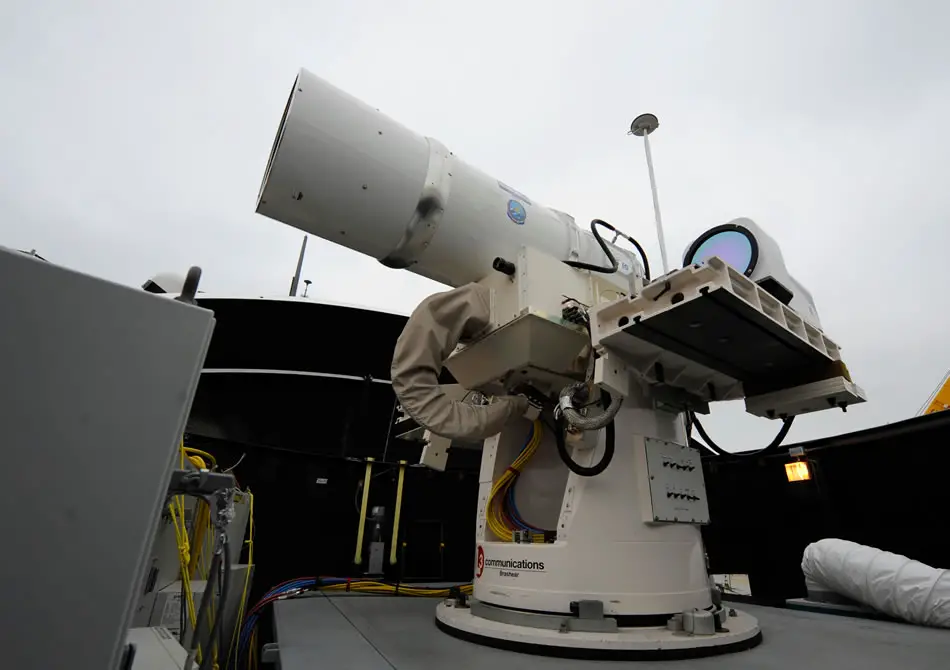
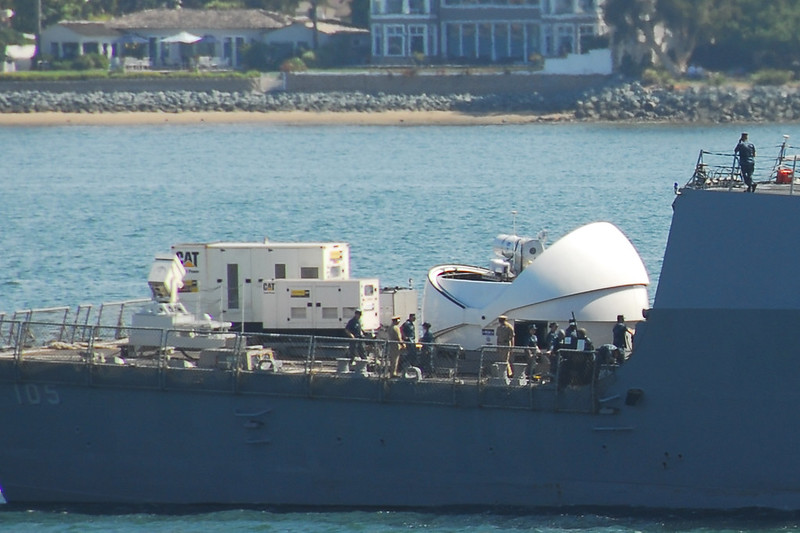


See also http://www.dailytech.com/Navy+Develops+New+AntiUAV+Lasers+for+Humvees/article30233.htm
Wanshan@wilk: 45 posts in 4 years?
WanshanSmaller, lighter, cheaper airframes with longer range and greater endurance. So we can cram more airframes on the deck and each can do its business further away from the ship.
> UCAVs therefor?
A genuine counter to wake homers, putting a Frigate in the way is expensive and wasteful
Well, hardening the ship will end you up with a 200k vessel, apparently. So, either and effective decoy or some hardkill method needed.
WanshanNope. I think Photobucket must be shrinking them down automatically. 🙁
Are you able to upload them here as attachments?
Try opening each link in a new tab once, close that tab, then repeat the process (the second time around I get just the jpg displayed, not the photobucket page with it)
WanshanWanshanWanshanBut certainly the 44/1 and 33/1 kill ratios with Fiat G.50 and Buffaloes were due to the fact that opponent were flying I-16s and I-15 ( and Chaikas etc ) etc with very little experience.
The I-16 was slightly more maneuverable than the early Bf 109s and could fight the Messerschmitt Bf 109E [Emil] on equal terms in turns. Skilled Soviet pilots took advantage of Polikarpov’s superior horizontal maneuverability and liked it enough to resist the switch to more modern fighters. The German aircraft, however, outclassed its Russian opponent in service ceiling, rate of climb, acceleration and, crucially, in horizontal and diving speed, due to better aerodynamics and a more powerful engine.
Finnish pilots preferred the Hurricane, the French Morane-Saulnier M.S.406 and even the Brewster Buffalo to the G.50…
WanshanEverything is relative.
Yes, the plane is a complex and fly it was not easy. Three engines, each failure leads to an accident. It can not be compared. But I would not call it a “coffin”, 8 persons 231 aircraft = 3.5%.
On the conclusion of acceptance trials for the initial Yak-36Ms in August 1976 (Kiev was underway in the Atlantic at this point), the aircraft was formally accepted by the AV-MF in October, under the new designation Yak-38. Towards the middle of the 1980s, the Yak-38 was removed from front line service and transferred to land-based operations. In 1991, the type was retired from the Soviet Navy, and transferred to storage.
8 pilots in 15 years of service of 231 aircraft…
WanshanThis is curious..FAF scored 33/1 kill ratio with Brewsters and even made a wooden copy of it; http://fi.wikipedia.org/wiki/VL_Humu
Several nations, including Finland, Belgium, Britain and the Netherlands, ordered the Buffalo. Of all the users, only the Finns seemed to find their Buffalos effective, flying them in combat against early Soviet fighters with excellent results,[2] as opposed to the far more advanced Japanese fighters that the other nations faced.
During the Continuation War of 1941–1944, the B-239’s (a de-navalized F2A-1) operated by the Finnish Air Force proved capable of engaging and destroying most types of Soviet fighter aircraft operating against Finland at that time, achieving, in the first phase of that conflict, a kill-ratio of 32:1 (32 Soviet aircraft shot down for every B-239 lost)[3] and producing 36 Buffalo “aces”.[4]
When World War II began in the Pacific[5] in December 1941, Buffalos operated by both British Commonwealth (B-339E) and Dutch (B-339D) air forces in South East Asia suffered severe losses in combat against the Japanese Navy’s Mitsubishi A6M Zero and the Japanese Army’s Nakajima Ki-43 “Oscar”. The British attempted to lighten their Buffalos by removing ammunition and fuel and installing lighter guns to increase performance, but it made little difference.[5]
The Buffalo was built in three variants for the U.S. Navy, the F2A-1, F2A-2 and F2A-3. (In foreign service, with lower horsepower engines, these types were designated B-239, B-339, and B-339-23 respectively.) The F2A-3 variant saw action with United States Marine Corps (USMC) squadrons at the Battle of Midway. Shown by the experience of Midway to be no match for the Zero,[1] the F2A-3 was derided by USMC pilots as a “flying coffin.”[6] The F2A-3, however, was significantly inferior to the F2A-2 variant used by the Navy before the outbreak of the war.
WanshanThanks for these interesting documents. The PDF works fine, but I can’t seem to get full resolution versions of the images; the low resolution versions are ofc. unreadable. Could be I’m missing something, but maybe not. 😮
http://i21.photobucket.com/albums/b291/barquitos/P-Files/Ultracarrier1.jpg
http://i21.photobucket.com/albums/b291/barquitos/P-Files/Ultracarrier2.jpg
http://i21.photobucket.com/albums/b291/barquitos/P-Files/Ultracarrier3.jpg
http://i21.photobucket.com/albums/b291/barquitos/P-Files/Ultracarrier4.jpg
http://i21.photobucket.com/albums/b291/barquitos/P-Files/Ultracarrier5.jpg
Better?
The Ultracarrier: A 400m Post-Nimitz Concept ship proposed by Donald Fort in the December 1978 issue of Naval Proceedings. The ship would have had a loaded displacement roughly five times that of a Nimitz class carrier.
http://www.shapeways.com/model/323382/ultracarrier-1-3000-x1.html
WanshanCUrrent hull designs of the large carriers provides adequate side torpedo protection through appropriate structural and internal design. Adequate bottom protection against underkeel torpedoes has been inhibited thusfar by the combination of harbor depth restrictions on ship draft and availability of inside volume.Permanently shaps bottom protective structures can be built; they would increase the displacement of the ship and require special measures like dredging to enable harbor entry. One preliminary ship design with enhanced all around torpedo protection, and also allowing for aircraft growth, has led to a ship designed to have about a 215,000 ton displacement, 1500 ft length and 49 ft draft
Naval Studies Board
Commission on Physical Sciences, Mathematics, and Applications
National Research Council
Carrier 21. Future Aircraft Carrier Technology. Volume 1: Overview
National Academy Press, 1991
p87
😮
Discusses 4 different carrier alternatives p 105 and on:
Advanced Nimitz type
New large monohull (100000+ to 200000+ tons, dpending on design)
Large semisubmersible ship (325000 empty, 660000 tons full load)
LHA/LHD sized carrier with 30 F/A-18 class STOVL a/c (contingent on development of new aircraft)
Also considers ‘Large Seabased Platforms’
Floating Island ($4 billion for a 9000x900ft floating airfield)
Semisubmersible ship (2000ft SWATH)
WanshanThe interesting question is, why these Lockheed designs have e.g. Harpoon and VLS launchers, whereas the LCS have nothing like that – except of the RAM launcher there is no missile system available at all.
These, you mean?
http://www.lockheedmartin.com/content/dam/lockheed/data/ms2/documents/SCS_Bifold.pdf
from http://www.lockheedmartin.com/us/products/multi-mission-combat-ship.html
Incidentally, GD/Austal also offer a multi mission combatant, with 2*4 Harpoon and (it seems like several … 2×2 … 8-cell modules) Mk41.

32 missile Vertical Launch System (if at the expense of hangar no. 2)
1 medium caliber gun (Forward)
8 Harpoon missiles
2 Close-in Weapons Systems
6 ASW Torpedos
http://www.austal.com/Resources/PromotionSlides/dd47585d-170b-4e43-a80c-2d849e065b2d/mm-brochure-horiz2011.pdf
from http://www.austal.com/en/products-and-services/new-concepts.aspx
Ain’t nothing wrong with the 57mm. Like the 76mm before it, it is primarily for close-in AAA and ASuW. Not shore bombardment. A great many navies use this, even on frigate sized ships (CPF/Halifax e.g.)
@Al.
Comparing these mmc’s, I’m afraid the answer to your question whether it is beyond the realms of possibility that the Mickey Mouse gun and views are but placeholders until they actually get the weapons which USN plans to fit is: NO.
WanshanIt seems that F-104 STARFIGHTER was also a Flying Coffin; http://aircraft.wikia.com/wiki/F-104_Starfighter
In West Germany it came to be nicknamed Witwenmacher (‘The Widowmaker’). The real Widowmaker was of course the Martin B-26 Marauder. Other colorful nicknames included “Martin Murderer”, “Flying Coffin”, “B-Dash-Crash”, “Flying Prostitute” (so-named because it was so fast and had “no visible means of support,” referring to its small wings) and “Baltimore Whore” (a reference to the city where Martin was based)
http://en.wikipedia.org/wiki/Martin_B-26_Marauder
Flying Coffin was also used by ATC crews for the Curtiss C-46 Commando. The men who flew them also referred to it as “The Whale,” the “Curtiss Calamity,” and the “plumber’s nightmare”.
http://en.wikipedia.org/wiki/Curtiss_C-46_Commando
Other aircraft that got referred to as flying coffin were:
Airco DH.6 (a.k.a. Dung Hunter,, crab, clockwork mouse)
Georges Levy G.L.40
Potez 540 (Spanish: Ataúd Volante)
Caproni Ca.313
Brewster F2A-3 Buffalo
Consolidated B-24 Liberator
Boulton Paul P.120 was called Black Widowmaker
WanshanOne question answered…..cap doffed Wan!
u r welcome
WanshanSo why not opt for six 200,000t carriers instead? :rolleyes:
Dec. 1978 U. S. Naval Institute Proceedings contain a 5-page article on the proposed “ultra-carrier” of some 500,000 t. full load.
James L. George (1992) The U.S. Navy in the 1990s: Alternatives for Action contains reference to a CNA study of proposed carrier alternatives, which includes a 200,000 ton super Nimitz, the Ultra Large STOAL CVX.
The 16th edition of Norman Polmars’ Ships and Aircraft of the US Fleet (pp89-90) also mentions a number of unusual carrier proposals considered by the bottom up review at the time of publishing (1997).
http://www.dtic.mil/dtic/tr/fulltext/u2/a328353.pdf
Ultracarrier files:
http://s21.photobucket.com/albums/b291/barquitos/P-Files/?action=view¤t=Ultracarrier1.jpg
http://s21.photobucket.com/albums/b291/barquitos/P-Files/?action=view¤t=Ultracarrier2.jpg
http://s21.photobucket.com/albums/b291/barquitos/P-Files/?action=view¤t=Ultracarrier3.jpg
http://s21.photobucket.com/albums/b291/barquitos/P-Files/?action=view¤t=Ultracarrier4.jpg
http://s21.photobucket.com/albums/b291/barquitos/P-Files/?action=view¤t=Ultracarrier5.jpg
Consider the ramifications of passing through Suez and Panama canals, using port facilities (where can you park VLCC – ULCC sized carriers?)… and how to attain sufficient speeds with these large vessels?


 Sign In








