 Wanshan
It all comes down to capability over cost!
Sure an Osprey costs the same as a JHerk, but can the JHerk become an organic AEW to a LPH/CVL group?As for Badgers comment- made me laugh a little too- well done mate
It would appear that NH-90 has a better ceiling than EH-101 and e.g. S-92 (6000m versus around 4575m) though it obviously has less internal volume, payload, range and endurance. However, an Erieye-like solution could be adopted with downlink data via an associated datalink subsystem to a ground-based air defence network to lesser the internal volume/payload capacity needed.
According to Boeing, V-22 has a service ceiling 25,000 ft (7,620m)
WanshanNew dutch NH-90 Helicopter Still Too Heavy
State Secretary of Defence Jack de Vries on Wednesday had “bad news” for the House of Commons, he said. The NH-90 helicopter ordered by the Ministry of Defence is still heavier than planned.
NH Industries had announced to measures to reduce the helicopter’s weight, but these have not had the desired result. The weight of the aircraft has been a problem for years. This is important because the additional weight makes them too heavy to land on the Dutch navy frigates for which they are intended.
The Netherlands decided in 1991 to participate in the NH-90 program, and ordered twenty [of the NFH-90 naval variant] which should have replaced the current Lynx ship-borne helicopters beginning in 2007.
However, because of the recurring weight issue, that date has been moved back several times. The latest date for their initial delivery has now been pushed back to 2011, de Vries said.
It is not possible to rule out further delays, nor to say what extra costs will arise from the delays, he added.defense-aerospace.com
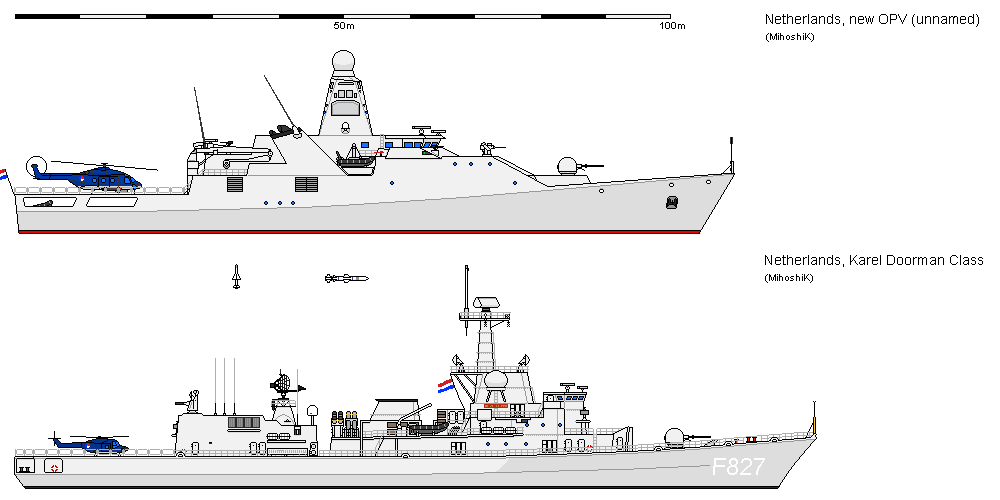
Too heavy for the 4 LCFs (Zeven Provinciën class) or for the remaining 2 Ms (Doorman class) or for the 4 new patrol ships (Holland class)?

WanshanRoyal Malaysian Navy News:
Malaysia co-opts container ship for anti-piracy role
The container ship Bunga Mas Lima was operationalised as a Royal Malaysian Navy (RMN) auxiliary vessel on 1 June following modification for counter-piracy escort duties off Somalia. Owned by Malaysia International Shipping Corporation (MISC), the 699 TEU container ship has been fitted with a helicopter deck, small-boat facilities, light weapon mounts, military-standard communication systems and a medical centre …
Monday, June 1, 2009
Launch Of A New Kind Of Naval Shipit has now been confirmed that the Royal Malaysian Navy will now operate a new class of ship, the naval auxiliary ship. The latest news announced today regarding Ops Fajar is that MISC Ship Bunga Mas Lima has been launched as a naval auxiliary ship after modifications in Malaysia Marine and Heavy Engineering Sdn Bhd (MMHE), a subsidiary of MISC, MMHE shipyard, Pasir Gudang, today. Despite my earlier speculation, the ship is actually a 699 TEU container ship and has been renamed as Naval Auxiliary Ship TLDM BM5 and will be now tasked for escort missions in the Gulf of Aden. As a result the KD Inderapura now operating in the Gulf will return home as scheduled this month.
To be crewed by a mix of MISC seamen, navy men and Paskal special forces, the MISC seamen has been absorbed as Malaysian Navy reserves and has had basic military training. They will be responsible for the navigation and maintenance of the ship while the naval men is charge of the security arrangements. As for the ship itself, she operates under international law as a naval auxiliary under military control and enjoys sovereign immunity privileges.
For MISC, the delivery of the ship is a sign of their commitment to the safety of their shipping operations and crew especially in the pirate infested Gulf of Aden. For the RMN, the operation of the ship embodies the realization of a very component of the concept of Total Defence stated in the National Defence Policy.
source: http://securemalaysia.blogspot.com/ (includes images)
additional images: http://hullconstruction.blogspot.com/2009/05/bunga-mas-lima.html
WanshanLet’s not forget the ex-Gorshkov is a “conversion” of a Helicopter Carrying Missile Cruiser.
Tyazholyi Avianesushyi Kreyser [TAKR/TAVKR] = heavy aircraft-carrying cruiser (includes STOVL Yakovlev Yak-38 ‘Forger’)
The Baku/Gorshkov was considered a different class because of a number of differences with the previous three 1143s, including a a 5m longer flight deck.
WanshanSome photos of HMS Daring (type 45):
http://www.modellmarine.de/index.php?option=com_content&view=article&id=2048:lenkwaffenzerstoerer-hms-daring-typ-45&catid=271:aktive-schiffe
http://www.modellmarine.de/index.php?option=com_imagebrowser&folder=daring-portsmouth&Itemid=55
Nice find, thanks for posting.
WanshanWell, most agree that China’s Carrier will be a STOBAR Type. Yet, we have heard some talk about Catapults of late………..Then let’s not forget the recent news that Brazil in going to help China with its Carrier Development.
In short the odds support the former but who knows…………Only time will tell.:cool:
IIRC the news was that Chinese navy personnel would be training on board Brazilian vessels, including Sao Paolo. That’s quite a bit of a difference from ‘carrier development’, with which Brazil has little to no experience since it has always worked with used carriers obtained from other navies. Nothing specific about whether the training of navy personnel was purely sailor training or whether it (also) included aviator training.
WanshanFrom: http://www.amiinter.com/nspd_sample.html
Naval Systems Projections Database
The Naval Systems Projections Database (herein after referred to as NSPD) was developed by AMI International to serve as a means of assisting clients in entered orders forecasting, future market potential analysis, and future competitive market share analysis.Ship Types
Vessel type categories were developed to describe the worldwide market with the degree of fidelity necessary to be accurate and meaningful for business development and strategic marketing purposes. The vessel type definitions are provided at the end of this document as well as via a link on our homepage.NSPD Field Definitions
General Program Data Fields
Vessel Types
AMI categorizes vessel types on the basis of ship function, size, speed, armament, and overall sensor/combat system capability. The detail characteristics of different vessel types is described at the end of this document.This field serves as a means to categorize the various vessel types into general segments in order that this field can serve the need of quickly sorting the entire ship naval future market into discernable segments. This should be meaningful for business development and strategic marketing purposes.
Vessel Type Definitions
Frigates (FF or FFG)
A frigate is a medium-sized surface combatant (between 2,000 and 5,000 tons) that is either suited for one specific role (anti-submarine warfare or anti-air warfare), or has lesser all-around capabilities than a destroyer. A frigate may be less capable than a destroyer, but is still a relatively sophisticated and expensive (averaging around US$325 million apiece) platform. A frigate is generally the smallest surface combatant that can conduct extended blue-water missions in a high-threat environment.
Corvettes (FS)
Corvettes are fast (around 25 knots or better), well-armed ships that displace between 700 and 2000 tons. A corvette is generally not intended for extended ocean-going operations, and is best suited for regional operations. Corvettes are generally the smallest platforms capable of accommodating the sensors, weapons, and combat systems needed to operate in a medium threat environment. Corvettes are sometimes referred to as light frigates (FFLs). It can be assumed that the hull design for a corvette and that of an offshore patrol vessel are very similar. The differences will be in propulsion and outfitting. Corvettes will have higher speed and therefore less endurance and range than OPV, much greater armament, and less space for provisions and habitability.
Fast Attack Craft (FAC, also referred to as PTGs or PCGs)
FACs are small (under 700 tons), fast (over 25 knots) vessels that are intended for quick, hit-and-run strike operations within 100 miles of the coast. FACs are primarily armed for a limited anti-surface warfare (ASUW) mission. They may bristle with a number of guns, torpedoes, and surface-to-surface missiles (SSMs) and thus present a credible threat to surface ships. However, a FAC lacks the range, seakeeping qualities and defensive systems needed to operate independently for any extended length of time in a high or medium-threat environment. FACs are generally employed by nations that plan to operate them close to shore, or in the shelter of archipelagoes (e.g. the Aegean, Norwegian fjords, or the South China Sea). Generally, FAC hulls are thin and made of aluminum or steel. Because of their thin hulls, modifications are more difficult to make and life expectancy is reduced.
Offshore Patrol Vessels (OPV)
In response to a number of environmental and economic concerns, world navies and/or coast guards developed a type of patrol vessel, the OPV, which is capable of patrolling the waters of an Exclusive Economic Zone (EEZ) for extended lengths of time. By virtue of its mission, an OPV must be relatively large (generally over 700 tons) to possess the necessary range and seakeeping characteristics needed for extended offshore patrols. The higher in latitude a Navy operates (North or South of the Equator), the larger the wave heights and therefore the larger an OPV will be. For example India operates in waters that are known for very rough conditions. Some Indian OPVs are beyond 2,000 tons displacement. An OPV is often built to commercial standards and is slower (generally around 20 knots) than its corvette and frigate cousins. However, some nations will build OPVs with space and weight margins for future weapons upgrades. These types of OPVs will generally be built to naval standards including hull and equipment shock requirements. An OPV is generally lightly armed (a medium-sized gun), but is sometimes fitted to carry surface-to-surface missiles (SSMs) or ASW equipment in wartime. Most new construction OPVs are also equipped with a helicopter deck and hangar to enhance its patrol capabilities. It can be assumed that the hull design for a corvette and that of an offshore patrol vessel are very similar. The differences will be in propulsion and outfitting for each application. Offshore patrol vessels will have slower speed, less armament, and greater space for provisions and habitability thereby allowing for greater endurance and range.
Patrol Vessels
This vessel type category will include the following patrol vessel types:
Patrol Boat (PBs) – Patrol Boats are smaller than OPVs and larger than PCs, thus filling the range between 100 and 700 tons. A PB is designed for multi-day patrol operations (anti-smuggling, search and rescue, coastal security, etc.) in coastal waters. A PB is often armed with a small to medium caliber gun (typically a 76mm and/or 40mm gun) and machine guns. It may also be fitted for, but not with, surface-to-surface missiles (SSMs).
Patrol Craft (PC) – Patrol craft are small (under 100 tons) and are intended to conduct short patrols (anti-smuggling, search and rescue, harbor security, etc.) in relatively sheltered coastal waters, harbors, or rivers. Patrol craft are lightly armed (usually machine guns) and have limited range.
WanshanFrom http://www.csis.org/media/csis/pubs/me_mb_ai.pdf (2004)
page 22:
“Israel has 18 additional missile craft – including seven Sa’ar 4.5 (Hetz)-class ships with eight Harpoons and six Gabriels each. It has two Sa’ar 4.5 (Aliya)-class ships with 4 Harpoons and 4 Gabriels. It retains two Sa’ar 4 (Reshef) class missile patrol boats for spaces. The Sa’ar 4.5s have been extensively modernized under the Nirit (4.5)-class upgrade program which incorporates a “modernization by cannibalization” approach, scrapping much of
the material from the Sa’ar 4s while outfitting the vessels with new hulls, low-radar-signature masts, new firecontrol detectors, updated sensors, and four eight-cell launchers for Barak point-defense missiles. All Sa’ar 2s and 3s have been retired.(38)”page 83:
(38) Jane’s Fighting Ships, various editions; IISS, Military Balance, various editions.
From http://www.seawaves.com/newsletters/TDIH/july/17Jul.txt
2006 – The Israel Navy began evaluating the possibility that guided missile vessels could be deployed around Haifa Bay to provide a defensive shield against rockets fired by Hezbollah in Lebanon. The vessels would be equipped with the Barak anti-missile system normally carried by ships such as the Saar-5 and Saar-4.5 class corvettes. The Navy’s department for armaments and the Defense Ministry’s Weapons Development Authority are responsible for the evaluation
From http://www.jewishvirtuallibrary.org/jsource/Society_&_Culture/barak.html
Barak Missiles
——————————————————————————–The development of the Barak missile by the Israel industry and the Navy began approximately eleven years ago. The Barak missile can destroy attacking missiles, and can target and attack various airborne targets such as aircraft, unmanned aircraft and various bombs. It can also damage enemy ships.
The Barak missile is fired from a vertical launcher, which saves valuable space on the ship deck and enables 360 degree range around the ship. According to plans, 64 missiles will be placed on Saar 5 missile boats and 32 on Nirit class Saar 4.5 missile boats.
——————————————————————————–
Source: Israel Defense Forces.
From http://www.janes.com/extracts/extract/jsws/jsws0168.html
Title
Barak/ADAMS/’Relampago’/Defender (Israel)Section
Defensive weaponsAppearing in
Jane’s Strategic Weapon SystemsPublication date
Jan 02, 2009Type
Short-range, ground- and ship-based, solid propellant, theatre defence missile.Development
Studies for the development of a small and lightweight vertically launched surface-to-air missile started in Israel in 1979. The Barak 1 ship-based system, designed and developed jointly by IAI and Rafael, was first seen at the 1983 Paris Air Show. Vertical launch trials started in 1984, and the first trials engagement of a simulated sea-skimming missile was successfully completed in 1986. Sea trials began in 1989. Barak 1 is fitted to Hetz-class fast attack craft (FAC) (Saar 4.5) with 16 or 32 cell vertical launchers, and to Eilat-class corvettes (Saar 5) with two 32 cell vertical launchers for the Israeli Navy. The missile is also being fitted to Prat (ex-UK County)-class destroyers with two octuple launchers for the Chilean Navy, and Singapore is adding two octuple Barak launchers to its Victory-class corvettes. A scaled-up version of the Barak missiles, designated AB-10 was proposed as a short range ATBM in 1987, but this programme was terminated in 1989. A ground-based version, known as ADAMS (Air Defence Anti-Missile System), was reported to be in development in 1991, with up to 12 vertically launched missiles carried on an 8 × 8 wheeled vehicle together with the tracking radar and an electro-optical sensor for use in heavy ECM environments. Hughes Missile Systems (now Raytheon Missile Systems) proposed the ADAMS missile combined with the Phalanx gun as the HVSD/ADAMS for the US DoD high value site defence system. In 1994, a ground-based Barak system was again offered for export, this time called ‘Relampago’ and mounted
WanshanQuite amazing how you get your info wrong so often.
Yes, see your own post 19, about Iraqi FACs having 76mm guns etc
The Saar 4.5 is ‘fitted for but not with’ the Barak system. Don’t be deceived by all the armaments shown on websites for Saar class. They can’t carry them all at once without severe sacrifice in seakeeping ability.
“The Hetz class missile craft is equipped with three types of missile systems: Barak, Harpoon, and Gabriel II.”
http://www.globalsecurity.org/military/world/israel/hetz.htm
The Naval Institute Guide to Combat Fleets of the World by Eric Wertheim (p333)
Lists as part of armement of the Nirit class: “4 8-round Barak point-defence SAM vertical launch groups”.
In the discussion of its combat systems, it is stated: “The four Barak vertical launch groups are recessed into the after deck. The radar directors are mounted on platforms abreastr the tower mast….. Herev as completed was equipped with dual davids for RIB combat swimmer craft: the craft lacked gun and missile f.c. radars and probably does not have Barak missile facilities”
See also this link (different edition)
“Israel’s Ministry of Defence has approved the continuation of theNirit (Saar 4.5) class upgrade programme with two existing vesselsin line for hybrid work.The Nirit-class fast attack craft (FAC) is a ‘modernisation bycannibalisation’ programme. The upgraded Nirit is described as ahybrid descendant of the smaller Saar 4-class vessel, butincorporates a new hull with a low-radar-signature mast, new fire-control detectors, updated sensors and four eight-cell launchers forBarak point-defence missiles. … The Nirit combat system comprises a foredeck Vulcan Phalanx close-in weapon system, a 76mm OTO Melara compact aftdeck gun mount withIsrael Aircraft Industries Mabat Gabriel middle-range surface-to-surface missile (SSM) launchers, eight Boeing long-range Harpoon SSMlaunchers and 32 Barak anti-missile vertical launchers.”
http://www.janes.com/articles/Janes-Defence-Weekly-98/ISRAELI-SAAR-PROJECT-TO-GO-AHEAD.html
“Outstanding features of this class of missile boats include very high survivability, extensive power and weapon systems designed for the naval arena. Advanced weapon systems include improved Gabriel missiles, Harpoon missiles, Barak anti-missile missiles, 76 mm guns, anti-aircraft guns, innovative night vision equipment, electronic warfare systems developed in Israel, a new radar system and a command & control system.”
http://www.jewishvirtuallibrary.org/jsource/Society_&_Culture/saar1.html
Oh, what’s that behind those Gabriel launch boxes?


http://kr.blog.yahoo.com/shinecommerce/3701.html?p=1&t=2
http://kr.blog.yahoo.com/shinecommerce/8823.html?p=1&t=3
Most Sa’ar boats operate with a reduced weapon payload during peace-time (including Saar 5, which incidentally no longer uses its rear VLUs for Barak, not Gabriels, due to top weight and stability problems. Funny how that had to happen with Israels biggest ships …) It has been israeli practise even with earlier Saar ships to mix and match armament according to mission and threat (e.g. Gabriels with either 2 76mm or 1 76mm + 1 40mm, or no Gabriels but 3 40mm on Saar 2/3)
WanshanIf you don’t realise it by now, the article pointed out the weaknesses of the FAC which highlight why they are not effective combatants.
The fact that a certain type of ship has weaknesses doesn’t make it ineffective. That is (also) a matter of circumstances under which it is employed and operational doctrine. Every type of ship has strengths and weaknesses.
Did you deliberately not read all the other sections I have posted? Why do you think replacements for FACs are moving upwards in size and displacement?
I’ve read the full articles. Increases in length and displacements do not mean the larger ships aren’t still FACs (even if ‘on steroids’) and employed as such.
You fail to acknowledge even the possibility that to the extent that navies shift from FACs to other larger classes of ships this is the result of a shift in a) (perceived) threat, and b) what the navy is expected to do. If the neighboring country is making territorial claims in mid-ocean and starts building modern large frigates to back up those claims, for example, building more coastal craft is not going to help is it? But does this mean the existing coastal craft have not fullfulled their role? Obvously not. Likewise, is your natoin has committed itself to international phumanitarian and peacekeeing organisations – as many more nations have in the past 10 years than say 30 years ago – then you are going to get suitable assets for your nay (e.g. LPD). However, navies never have unlimited resources (particularly smaller ones, which tend to have FACs), so often times the implication is that if you want one capability you cannot also have the other. The dutch navy wanted top of the line LCF and 2 LPDs. The sacrifice it had to make was a reduction in fleet size, the sale of most smaller frigates many of which had not even reached midlife.
That seems to be a specific opinion towards the Osa, and no mention about which specifc group having that (correct) opinion.
Oh, so now its not your guy who’s talking? Somehow he is not representative of naval experts opinion?
However, given that many navies tried to build FACs with hard kill self defenses, certainly that wasn’t a shared view towards all FACs. The limitations of the FACs simply weren’t as apparent and widely perceived then. Until the Battle of Bubiyan, of course. Nothing hits home like a massacre”.
Your author has this as a general view towards German Schnellboote (S-Boats), the American PT-Boats and the British Motor Torpedo Boats (MTBs) as well. Your authos also states:
“Of course, it must be noted that the Iraqi Navy was up against a vastly superior opponent in an exposed environment not particularly favoured for FAC operations.”
and
“Nevertheless, these events showed that the day of the rudimentary FAC was over and marked the end of an era that began with the sinking of the Eilat.”
An OSA is a rudimentary FAC (from its inception 4 decades earlier), various Lurssen derived boats aren’t designed 2-3 decades later aren’t. Note, incidentally, that you author doesn’t mention the captured Kuweiti missile boats, which you claim the Iraqi’s so fully mastered.
Look at the specs again. No Gabriels.
The second six vessels are configured for anti-surface warfare. They were to be fitted with the Gabriel II short to medium range anti-ship missile supplied by IAI, but this project has been abandoned. Gabriel II uses dual mode semi-active and active radar homing and is armed with a 100kg warhead. The range is from 6 to 36km and the missile velocity is 0.6 Mach.
http://www.naval-technology.com/projects/fearless/
According to The Naval Institute Guide to Combat Fleets of the World by Eric Wertheim, Gabriel II was to be carried in the second group en lieu of the anti submarine torpedo tubes. They were not fitted as such, but the design could clearly handle that load without further changes, effectively allowing a Sea Wolf replacement. Even if not installed, it does show RSN what roles considered.
No, it’s because RSN tried to give it a comprehensive anti-air self defense capability, and the sensors had to be placed high on the mast since they required height for optimal performance. And instability resulted. Trying to attribute it away to being just a ‘characteristic of this class’ is ridiculous. If this was just a characteristic, why couldn’t they have done away with it? Clearly, the mast was required, for the purposes I stated.
“The corvettes are noted for their tall mast, making them top-heavy compared to ships of similar class.”
http://en.wikipedia.org/wiki/Republic_of_Singapore_Navy#Corvettes
“Suffer from topweight problems due to huge mast housing EW gear.”
http://www.hazegray.org/worldnav/asiapac/singap.htm#4
The (smaller) Saar 4.5, Hetz class has the same AAW missile suite with associated sensors. Unlike the Victory class, the Hetz class does not suffer top weight and stability problems however. Nor do the Aspide equipped Ecuadorian Esmeralda class and the Malaysian Laksamana Class. Nor does the Crotale equipped UAE Murray Jip class.
And how do you explain the increase in size of their surface combatants, from Saar 4, to 4.5 then to 5, and now the LCS? The LCS just happens to come with that speed, considering it has a semi-planing hull and the power in it. And on that, the question is whether that speed has brought too much of a sacrifice in other areas.
There is no such linear progressiopn. Actually, the Saar 4.5 has 2 subclasses (Aliya and Hetz). The first 2 boats (Aliya su class) date predate Saar5 but are hybrid boats (they were given rather chunky helicopter facilities, the use of which informed the Saar 5 design). The Hetz-sub class remained a true FAC and it partly coincides and partially even postdates the Saar 5. They are new hulls that were fitted to a large extent with equippement from retired Saar 4s due to budget constraints.
While wapedia mentions that there has been talk of 9 LCS-1 mods and 3 LCS-2 mods as replacement for the Saar 4/4.5 this obviously is not the present state of affairs. Given LCS unit cost and past funding levels for ISC (it could barely pay Saar 5 and had to scrape to get Saar 4.5), this is not going to happen. To date, Lockheed Martin received an initial contract from the Israeli Navy in February 2006 to perform a feasibility study for a multi-mission LCS variant. The study, successfully completed in April 2007, resulted in the Israeli Defense Forces’ (IDF) decision to approve initial funding for two multi- mission ships currently based on an LCS-I design that would include anti-air, anti-submarine, anti-surface and anti-missile warfare missions, as well as special operations. (http://defense-update.com/newscast/1107/news/141107_lcsi.htm) Now, that’s a package of tasks far more comprehensive than most navies would have their FACs perform. Perhaps the Israeli needs are somewhat different and go beyond that for a ‘pure’ FAC for sea denial. Certainly, they face different naval threats than 30 years ago.
If a navy calls a 6,000 ton warship a FAC, does that mean what I said still applies? Please apply common sense to what I’m saying. Around 57m and lower designs suffer severely from the problems I listed. 62 m are pretty much borderline cases in terms of acceptability.
Have a look at this list of corvette classes. You claim 62m/600 tons as corvette. However in most cases, there is a clear break somewhere between 500-1000 ton 1000-2000 ton or under/over 750 tons. All are labelled corvette, but those under 750-1000 are rather typically craft with a hull built for speed rather than seakeeping and endurance. They are in fact FAC’s on steroids. Those 62m 500-600 tons ‘corvettes’ are much much closer to what is traditional termed FAC then they are to corvettes.
Can you explain why e.g. the Saar 4.5 is classified as FAC and the Victory class as corvette? The Hellenic Navy currently operates the Super Vita-class ships, which are 580 tons[vague] full load. The Hellenic Navy has categorised the class as fast attack missile craft. A similar vessel is the Kilic-class fast attack missile craft of the Turkish Navy, which is classified as a corvette by Lürssen Werft, the German designer of the ship. Is Visby really anything other but a very large FAC and if yes, then what makes specifically it a corvette?
The Hayabusa was evolved out of lessons learned from the 1999 Noto Peninsula incident, when 2 intruder vessel of suspected North Korean origin was able to escape its Japanese trackers at 30 knots. That accounts for its high speed. Generally, it seems to embody the lessons of the Battle of Bubiyan as well, in a similar fashion to that of the 022 FAC. Little hard kill defenses (due to their ineffectiveness because of all the problems I listed earlier), relying more on stealth for survival.
So, there was no step up in armament from a 20mm gatling on the PG 1-go patrol hydrofoil to a 76mm in the Haybusa? Or a step up in tonnage from 50 to 200 (and thus in seakeeping and endurance)? Or in terms of sensors? In fact, you have no evidence to the effect that armament choices for these ships have anything to do with the (perceived) (in)effectiveness of hardkill measures on small boats. That’s just your interpetation. Incidentally, in Italian service that same dinky 50 ton hydrofoil carriers a 76mm with no problems.
WanshanSorry, FACs like the Sea Wolfs were supposed to be able to handle surface warships. That was their primary mission.
And where exactly in the article does it say the Sea Wolfs can’t? The only example of FAC failure given are in reference to Iraqi OSAs in the 1990, which were mauled by BOTH US A-6Es and the Sea Skua armed British Lynx Helicopters. And what does the article say about the OSAs at the time of their first instroduction (1950s):
“In the late 1950s, the (then) Soviet Union took a step ahead to piece together a fleet of crude missile armed boats, which NATO codenamed, Komar and Osa. They were fitted with tactical SSMs onboard – the P-15, better known as the SS-N-2A or B Styx (The later P-20 and P-21 were jointly coded SS-N-2C Styx). As they were considered highly vulnerable to air attack, little note was made of their existence. Such craft made up the Soviet defence fabric. They were nonetheless supplied to the (then) Soviet Allies and other client states, including Egypt.”
Even in the 1950s they were considered vulnerable to air attack. So, how come them being swatted in the 1990s by modern air power is somehow a surprise or a proof of anything that we didn’t already know?
As far as RSN user experience goes, why don’t you look at what the RSN officer said? Do you think he would have said that if what he said runs counter to his experience?
“The addition of varieties of shipboard systems draws us inevitably to the question of space. The larger build of the corvette comes along with the advantages of longer range and better seakeeping. This extra range is a consideration in view of the tighter defence budgets with the recent economic downturn. The new corvette would be expected to fulfil a multi-role function that goes beyond her current� limit for strike operations.
..The increased stability of the platform is crucial as the shock of high speeds creates undesirable operation conditions for weapon systems.
…The first notable effect of a smaller hull is seakeeping. Much of the miniaturised electronics is placed in a cramped CIC. Already, there are problems placing new additions to technology because of the space limited by small hulls. To compound matters, all these get much harder in a rolling and pitching CIC. Crew fatigue occurs more quickly. Rough weather also reduces the effectiveness of sensors.
These problems provide reason for the FACs continual increase in size.
…
“
How then do you explain the 500 ton, Gabriel, Mistral and torpedo armed Fearless Class Patrol Vessels (commissioned 1996-1998)? Sure they don’t do 40 knots, but they are FACs in every other respect. For this class the limitations like avialable space, vibration, mast height somehow don’t exist? What did RSN have in mind?
Exactly. You said it yourself, the comprehensiveness of the fit needed to make it combat capable made it unstable. A high mast was required to give the sensors the optimal location, and even on a 62m corvette that made the ship unstable. Guess what happens on a smaller FAC?
No, its mast made it unstable. Not the fit of Barak in the hull rear or the fit of ASW torpedos on the main deck. And as you might note, not all similarly sized and armed ships (e.g. Laksamana class) have similar stability problems. Why do not all similarly sized ships have such a tall mast? Because it is characteristic of this particular class.
The article describes the Kilic-class of ‘mini-corvettes’ as being 1,300 to 1,400 tonnes in size with a full surface-to-surface armament (either Harpoons or Penguins), anti-air warfare capability for self-defence (Point defence or CIWS) and a limited Anti-submarine Warfare (ASW) capability. In reality, they are under 550 tons with no CIWS or PDMS or ASW. So much for accuracy…
Tell us why did they not acquire more FACs to replace the aging FACs? Given how much of a supporter the Israeli navy has been in the past of FACs, and how they expected FACs to be able to handle surface threats, the fact that the Israeli Navy abandoned FACs serves as a severe indictment of the FACs. The threat is still the same – surface, sub surface and airborne threats. Sure the opposition benefits from increased technology, but any FAC replacement can also have the same technology. Unless, perhaps, the inherent disadvantages of the FAC simply don’t allow it to go up against larger vessels effectively, and the Israelis have finally realised that, along with the RSN?
Told you already. There is no rule that says that in the face of changed circumstances you need to deploy the same type/size of ship. The Israeli Sea Corps has abandoned nothing: there are no 9 LCS’ ordered and the main force remains FAC. However, even if LCS were acquired in such number, the choice of LCS indicates not abandoning the fast attack element but rather a further embrace of fast attack (what other 3500 ton ship is that fast?)
Sorry, you’d find that the KILIC class is 62m, and actually qualify as corvettes. Corvettes are borderline acceptable. Same for the Hellenic navy, with their Roussen class also a 62m design. Look at their older FACs, and see the trend? Upwards. Why? Think.
Sorry but all those ships – whether they are labelled corvette or not – are essentially hulls designed for high speed (Fast), carry an primary armament of antiship missiles (Attack) and are of relatively small displacement (Craft). The main point about corvette though is sea keeping. Many FAC got labelled corvette for the same reason some nations call they dinky 2500 ton frigates ‘destroyers’. A true corvettes (which since ww2 has been an ocean sea going convoy escort / basic ASW unit) is more the likes of e.g. the Italian Minerva class or the german K130 Braunschweig or the French A69 or the MEKO 140 : a hull designed for sea keeping rather than speed. Why do you deny that the manufacturer of the Roussen class labels it a FAC? (I suspect Lurssen to have appropriate the term corvette for purposes of marketing in the Gulf) The Kilic class has none of the elements which the RSN officer is his article lists as characteristic of corvettes:
Developments to the FAC since 1991 had discernible changes. Such craft can take on at least an ASM-armed helicopter at standoff ranges up to 13km. The type, termed the corvette, is generally defined as a heavily-armed small surface combatant measuring 60 to 95 metres in length and displacing up to 500 to 2,000 tonnes. A distinguishing feature of the corvette is her capability for limited independent deployment, typically between 10 to 20 days, and usually equipped with self-defence capability against air and submarine threats. It is often also helicopter-capable – sometimes even affording her own hangar. The result can be seen, for instance, in Vosper Thornycroft’s 83-metre corvette design, of which two have been sold to Oman. Besides the eight Exocet MM-40s and the ubiquitous 76mm main gun, these vessels carry, inter alia, an octuple Thomson-CSF Crotale SAM launcher able to tackle air threats, including sea-skimming missiles. The attractiveness of the heavily-armed corvette has sparked numerous replacement programs for FACs.
I supposed the JMSDFs PG Hayabusa Class is BS too? If so, why would Japan bother with it?
WanshanIf FACs were capable why did they not replace Sea Wolfs with similar FACs? The experiences of the RSN have given it a through understanding of the limitations of small vessels. Instability has been a problem which even the Victory class corvettes face. Even the SLEP upgrades for the Victory corvettes are necessarily limited to comms upgrades – nothing major can go in without taking something out anymore. Look at the article written by the RSN officer. FACs are no longer regarded as viable for the main arm of a fleet. Their limitations are clear to the RSN and the Israelis, who were once a staunch supporter of the FACs. Notice the trend towards larger vessels even in Sweden. And what are the Israelis looking for to replace their older Saar FACs? See the displacement of LCS-I? Look at the increasing displacements of the vessels replacing the FACs in just about all cases. Replacements for FACs are becoming bigger, evolving pretty much to corvettes. Ever wondered why? FACs are a passe idea, their limited utility for their cost apparent. Except in forums, perhaps.
For starters, the mission perception of the RSN today is different and far more comprehensive than say 35 years ago. If you want to do different things, then you are going to need and get different ships. Also, the threat has completely changed (note e.g. developments in PLAAF and PLAN). Those are two very good reasons for not replacing the old Seawolf class with similar sized and similar armed ships, even if the boats served to full satisfaction.
Instability has been a problem especiallyfor the Victory class, which has a quite distinctive tall mast. Given the comprehensiveness of its weapons fit, I’m not suprised something has to come out before something else can be put in. Isn’t that the essence of RE-fitting?
It is rather ludicrous to consider both LCS versions as replacements for the earlier FACs. Fact of life is that the FACs are aging and will have to be retired. In considering new ships, Israel will look at the threat, in the present and foreseeable future. The threat has clearly evolved from 20-30 years ago. Just compare the middle eastern navies of 30 years ago with those of today. So why would they necessarily need to get the same type of ship? That does not mean there is something wrong with the type of ship being paid off, however.
Indeed, considering the Med, have you noticed that nearby Turkey has steadily continued to build FACs through 2007 (8x 436 ton DOĞAN, 2x 433 ton YILDIZ and 7x 552 ton KILIÇ classes, all with similar displacement, sensors and armament of 1x76mm, 1×35/2 or 40/2, and 8 Harpoon). And I don’t think the Hellenic navy is moving away from FACs either (Combattante IIa and III and more recently Super Vita classes. Ever wonder why these navies continue to see a usefull role for the FAC?
Don’t confuse a changes in aspiration levels / navy missions / real and perceived threats with design failure!
WanshanTo whom understand french.
The proof that there is something strange.
The same source report 2 differents price for the Horizon:Here is 2.7 bilions € for 2 Horizons:
En définitive, le coût des deux frégates françaises, les Forbin et Chevalier Paul, atteint 1.9 milliard d’euros, auquel il faut ajouter le coût du système d’armes. La Marine nationale estimant le budget total à 2.7 milliards d’euros, le prix de ce dernier serait donc d’environ 800 millions d’euroshttp://www.meretmarine.com/article.cfm?id=105325
Here is 1.6 bilion €. There’s written 800 milion € at unit:
La commande de la troisième Horizon était d’ailleurs prévue dans la loi de programmation 2003-2008. Le coût très élevé de ces navires (800 millions d’euros pièce) est la raison principale de cet abandon.
http://www.meretmarine.com/article.cfm?id=144
Tmor, could u help us to translate from french to english?
Thanks.
😉
Ultimately, the cost of the two French frigates, Forbin and Chevalier Paul, reached 1.9 billion d’ euros, for which it is necessary to add the cost of the weapon system(s). National marine estimating the total budget at 2.7 billion euros, the price of this last would be thus approximately 800 million; euros
2 ships at 1.9 billion > 950 million apiece plus the cost of weaponry.
cost of weaponry: 800 million for 2 ships.
total per ship: 1.35 million
The ordering of the third Horizon was d’ elsewhere envisaged in the law of programming 2003-2008. The very high cost of these ships (800 d’ million; euros part) is the primary reason of this abandonment
this would be in line with the 950 million excl weapons (when you build more units, the price per unit comes down e.g. because development costs can bespread out over more units).
You also need to factor in whether or not the amount is monetary units of a particular year (compare ‘constant dollar’): to get the same value as 1 dollar in year X, one might have to spend 1,1 dollar om year Y=X+1). Your first article is from 2007 and your second from 2005 > some effects of e.g. inflation?
WanshanWill ex-Gorshkov keep the SS-N-12 missile launchers, and if so, will there still be room for reloads.
No and no.
Wanshan2 good articles. Note the first is by an officer from the RSN, which discarded FACs for frigates. It also refers to Israeli officers who have once advocated FACs in the past, and how their navy is now realising that they were wrong. Incidentally, the RSN was based on the Israeli navy in its formative years. Both have come to the same conclusion about FACs. Note how even FAC users like Sweden have moved out of FACs towards larger corvettes, in spite of an operating environment conducive for FACs.
I don’t know where you get the notion that RSN discarted FACs for frigates. In reality, the RSN has consistently gone for building up both its naval and shipbuilding capability by adding new, larger classes of ships as well as a submarine arm, MCM and amphibious ships.
The now retired Sea Wolf class 270 ton missile gunboats, based on the TNC 45 design from Lürssen, were acquired in way back in 1968 and were commissioned 1975-1976. As new technology became available, these gunboats underwent a number of upgrading programmes in the 1980s and 1990s to increase their strike capability and sophistication. On 13 May 2008, all six gunboats were retired at a sunset decommissioning ceremony held at Changi Naval Base following 33 years of service. In 1983, the RSN ordered six 600 ton Victory class ‘corvettes’ from Lürssen. These were the first class of ships in the RSN to have an anti-submarine capability. Nonetheless, they clearly represent the principle of the fast attack missile craft. The six boats of this class commissioned 1990-1991 and remain in service. The 3,200 ton Formidable class multi-role stealth frigates are the latest platforms to enter into service with the RSN. The class commissioned 2007-2009.
As for the Israeli Sea Corps, last time I checked, it operated three submarines, three 1,000 ton corvettes as well as eight 500 ton Sa’ar 4.5 missile boats (Hetz class) and two 450 ton Sa’ar 4 class missile boats. I.e. two thirds of their main combattants are FACs. Hardly a testiment against the FAC.
The major surface combattants of Sweden are 9 ‘corvettes’: two 380 ton Stockholm class (1984-1985), two 425 ton Göteborg class (1990-1993) and five 650 ton Visby class (2000-2006) . The first four really are FACs for all intents en purposes and my comment for the Visby’s is essentially the same as that for the RSN Victory class. What the Swedes and the others abandoned is the idea of single purpose ships, but not the principles behind the FAC-M.


 Sign In







