 Wanshan
Very nice! Thanks
WanshanUnited Defense Mk 45 Mod 2 gun
WanshanIts the trade off their navy made with their DoD for getting 5 large new surface ships. I think the subs will be or have already been sold.
WanshanKey Enabler of Sea Power 21 vision – DD(X) will be a multi-mission
surface combatant tailored to bring offensive, distributed, and precision firepower at long range in support of forces ashore. DD(X) is the centerpiece of a Family of Ships that will be acquired within a future Surface Combatant Navy construct to deliver a broad range of combat capabilities to the Fleet.
http://peoships.crane.navy.mil/ddx/

Like me, you could have googled this ….
WanshanEx-RN Type 22 F46 got MM40 instead of MM38

WanshanAnd your point is?
Wanshankewl!
WanshanWanshan,
It would be nice if you gave the source of the text you posted – or even better just provided a link:
Actually, I copied a post out of the LCIG forum on ACIG.org because I recognized the TEL as the one I had seen in pictures there. Is there a problem with that?
WanshanAssuming it is launcher by the TEL in the background, I would say SSC-1A ‘Shaddock’ / SSC-1B ‘Sepal’


Type: Land-attack/coastal defense missile
Soviet designation: ?/Redut, 4K44 Utes
Missile designation: FKR-2, P-5S Pityorka/P-35, P-35B, 3M44 Progress
Designer: Chelomey
Lenght: 11.75/10.2 m
Diameter: 0.975 m
Span: 2.6 m
Weight: 4,500 kg
Range: 745/25-460 km
Speed: Mach 1.4
Propulsion: Two solid-propellant rocket boosters + KRD-26 turbojet sustainer
Guidance: Inertial/command + active radar terminal homing
Warhead: 513 kg HE or 350 kT nuclear (only nuclear for A)
Operational: Entered service in ?/1966
Launch site equipment: Three launch vehicles/Three SPU-35B launch vehicles, 4R45 Skala radar vehicle
Launch Vehicle
Designation: ZIL-135K (BAZ-135MB)
Length: 13.5 (11.5) m
Width: 2.86 (2.8) m
Height: 3.53 (3.0) m
Weight: 21,000 (18,000) kg
Road Speed: 40 km/h
Road Radius: 500 km
Engine: Two 180 hp ZiL-375Ya diesel/300 hp YaMZ-238N diesel
The development of the SSC-1A began in 1954. The SSC-1B was developed in the early 1960s with the first test firing in September 1963. The P-5S (SSC-1A) is based on the submarine-launched P-5K (SS-N-3C) land-attack cruise missile whereas the SSC-1B is based on the ship-launched P-35 (SS-N-3B) anti-ship missile. The P-5S cruises at a high altitude whereas the cruise altitude of the P-35 can be set as 400, 4,000 or 7,000 meters. The P-35 is tracked in flight by radar and guidance commands are sent to the missile based on the radar image it transmits to the ground station via a video data link. In 1982 the improved P-35B (3M44) missile that can use targeting data from Tu-95RTs or Tu-16D aircraft or a Ka-25Ts helicopter was introduced.
Both missiles are transported in and launched from a long cylindrical container mounted on a ZIL-135K or a later BAZ-135MB 8×8 wheeled chassis. Crew consists of 5 men and time into action is about 30 minutes. Before launching four hydraulic stabilization jacks are lowered, the hemispherical end covers of the launch tube are removed to top-mounted tables and the container is elevated to an angle of 20 degrees. The P-5S version of the transporter-launcher vehicle can be distinguished by a longer driver’s cab. A Redut (SSC-1B) brigade consists of three battalions, each with five to six batteries. In 1988 there were 6 Redut battalions in the Soviet Baltic Fleet, 3 battalions in the Northern Fleet, 5 battalions in the Black Sea Fleet and 5 battalions in the Pacific Fleet. The Redut system has been exported to Angola, Bulgaria, Syria and Yugoslavia.
The 4K44 Utes fixed system was developed on the basis of the Redut as a replacement for the fixed Sopka (SSC-2B) batteries. The first test launch was conducted in May 1971 and the system entered service in April 1973. The firing battery consists of MRSTs-1 Uspekh-U, 4R46 Mys radar with Parol IFF, command center and trainable twin tube launchers. Two Utes batteries were constructed: Object 100 near Sevastopol and Object 101 on the island of Kildin in the Kola peninsula. The latter has now been partially disbanded.
See also:
http://www.globalsecurity.org/military/world/russia/ss-n-3.htm
http://www.new-factoria.ru/missile/wobb/redut/redut.shtml
Wanshan“Now, the Mig29K is about half the size and weight of the Su27K/33 which suggests 12+32=44 Su27K/33. ‘
Did you mean 12+8 Su33’s ? 44 Su33s look pretty scary to me.
Oh, darn, calculated it the wrong way around. Have to redo that, going for an all Mig29 load out, using 2 mig29 for 1 Su27/33 and.
(2×12)+16=40
40+8=48 MIG29 (= 24 SU27)
WanshanDidno’t the russians or someone recently make a film about murmansk convoy PQ17?
WanshanAyalaBotto beat me to the USS Thomaston (LSD 28) … rats …. so I’ve got to give a different one:
The first ship is RFA SIR GALAHAD (L3005), of the SIR BEDIVERE CLASS. She was built in 1988 as replacement for the previous LSL by that name, which was lost during the Falklands conflict.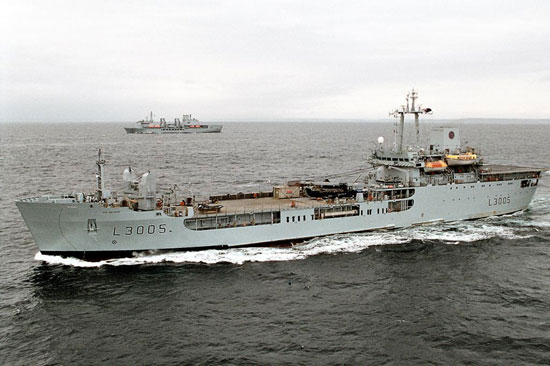
Number 2 may be a RN Landing Craft Utility (LCU) Mk 9
WanshanMaybe they just gave her a lick of paint so that she wouldnt rust away totally, or as part of becoming a tourist attraction? What I mean to say is that we don’t really have a clue what’s happened or happening on board this baby. It is all conjecture at this point.
The original mix of aircraft for Kuznetsov was intended to be 12 Su-27K and 16 MIG-29K or same amount of Yak-141(the MIG-29 and Yak-141 have similar exterior dimensions). Helicopters would be four Kamov Ka-31 (AEW), 18 Ka-27/28 (ASW), and two Ka-32 (Utility).
Now, the Mig29K is about half the size and weight of the Su27K/33 which suggests 12+32=44 Su27K/33. The 4 AEW KA-31s would have to be kept as well as at least 6 ASW KA-27/28s and 2 Ka-32s. But up to 12 Ka-27/28 could be replaced with jets. The footprint of a Kamov heli is yet smaller than a Mig29K, lets say about 3 heli’s for 2 Migs. So, that’s room for 8 additional Mig29Ks or 4 addition SU27K/33, making for a total of 48. I think it would be very hard to put more than 50 Flankers on board Varyag.
Let’s keep watching that waterline because without the installation of engines, this baby will be going nowhere (unless under tow). Only if she’s can move under her own power will she ever be able to launch aircraft.
WanshanProject 1241 = Molniya = Tarantul
sub-types:
Rocket Cutter (RKA, Raketnyy Kater)
project 1241R and 1241RE = Mołniya (NATO: Tarantul I, INDIA: VEER).
project 1241.1M and 1241.1ME = Mołniya (NATO:Tarantul II).
project 1241.1MP = Mołniya (NATO:Tarantul III).
project 1241.7 = Mołniya (NATO: Tarantul IV).
KGB Guardship (PSKR, Pogranichniy Storoshevoy Korabl’ a.k.a. Border Patrol Ship)
project 1241.2 = Mołniya-2 (NATO: Pauk I).
project 1241P and 1241PE = Mołniya-2 (NATO: Pauk II).
project 1242.1 = Molniya-M (a.k.a. Molniya)
This missile boat is a further development of the original Molniya (Lightning) family boats, developed for export. It differs from its predecessors in that the outdated P-20 missile system [SS-N-2 Styx] has been replaced by the Moskit-E ( SS-N-22 Sunburn) missile system which fires supersonic antiship missiles, and that the new Garpun-Bal multirole radar system has been installed.
project 1241.8 / 1241.8E = Molniya-M (a.k.a. Molnya, India: modified Veer)
The missile boat of Project 1241.8 has been developed on the same basic platform as the Project 1242.1 boat. It differs from the predecessors by the missile armament only: it carries 16 Kh-35 [SSN-X-25 Switchblade] missiles of the Uran-E system instead of 4 missiles of the Moskit-E (SS-N-22 Sunburn) system.
“In 1999 Russia delivered to Vietnam 2 missile boats “Tarantul-2” of project 1241RE. Also, in 1999 Severnoye Design Bureau finished developing the PS-500 missile ship (construction completed in 2001) and a corvette of project 2100 (construction of 10-14 units proposed). Under a contract from 2001, the Almaz shipbuilding company constructed two patrol boats “Svetlyak” of project 10412 for 40 mln USD. The ships were delivered at the end of 2002. According to a 2003 contract worth 120 mln USD, Russia will transfer to Vietnam 2 large missile boats “Molniya” of project 1241.8 and 8 more will be locally assembled under license using Russian components (Vietnamese designation Ho-A Class).“
source
PS-500 is based on the project 1241 hull and more stealthy compared to the original. Come to think of it, this may be the ship designated 1241T. It has 2×4 Uran.
WanshanI really do not understand the Nato interoperability thing. What specific things prevent an Su-25 from participating in a Nato mission, and why can’t those specific things be addressed to make the plane Nato-compatible instead of having to discard the whole plane?
Compatible are weapons (similar capabilities or not?) and electronics (e.g.g. IFF equipment, radios, mission planning gadgets)? It may be more expensive to have to rework a plane then to discard and obtain another, expecially if the new plane is used and/or provided at at a NATO equivalent of Chinese ‘friendship prices’. And I should add, it may also be smarter from a logistics point of few (shared maintenance facilities, for example)


 Sign In








