 Wanshan
PNS Alamgir set sail for Pakistan (see other thread for link and details)
WanshanThat’s also where the Harpoon launchers go on the Flight IIAs.
So where do they have Nulka launchers (if any)?
WanshanSo far as I understand it the F-15E is not currently scheduled to be replaced in USAF service by the F-35A, which begs the question of what it will eventually be replaced by. As I see it the plausible possibilities are these:
1. More F-35s
2. Evolved F-35 (ala F-16 > F-16XL)
3. F/A-XX/NGAD
4. UCAVsThoughts? My instinct is that they’ll hang around till F/A-XX/NGAD. Funding for a clean sheet aircraft will likely be tight, but faced with a requirement to replace three platforms (F-15E, F/A-18E/F, F-22A) I can see a JSF-esque program emerging. Minus STOVL tagging along to spoil the party. :rolleyes:
They can stretch a bit with an evolved F-15 (based on Silent Eagle, which is to only have the level of stealth allowed for export by the US government, implying that they can take this idea further still)
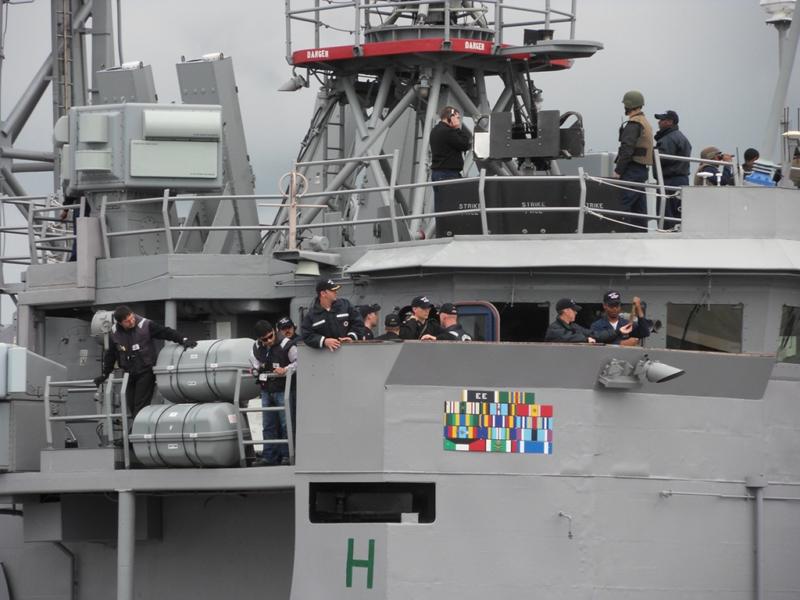
WanshanInside the red square you have the Kingposts for high line transfer and the Nulka launchers.
Exactly :rolleyes:
Nulka launchers: Interesting that USN chose to mount them on top of the superstructure on its Perry’s while Australians mounted then amongside the superstructure on their Adelaide’s.
WanshanI suspect it is the launchers for the BAE Systems (Aussie origin) the Mk 53 DLS NULKA active missile decoy, currently used aboard the U.S. Navy’s FFG 7, DDG 51, CG 47 and LPD 17.
http://www.flickr.com/photos/baeinfo/3466187224/
http://www.baesystems.com/BAEProd/groups/public/documents/bae_publication/bae_pdf_nulka_fact_sheet.pdf
Nulka
Decoy SystemDescription: Nulka is an active, off-board, ship-launched decoy being developed in cooperation with Australia to counter a wide spectrum of present and future radar-guided anti-ship cruise missiles (ASCMs) assessed to have passive rejection capabilities. The Nulka decoy employs a broadband radio frequency repeater mounted atop a hovering rocket platform. After launch, the Nulka decoy radiates a large, ship-like radar cross-section while flying a trajectory that seduces and decoys incoming ASCMs away from their intended targets. Australia is developing the hovering rocket, launcher, and launcher interface unit. The Navy is upgrading Nulka with an improved payload to reduce cost and modifications to the fire control system to reduce the system’s overall weight. The existing Mk 36 Decoy Launching System is being modified to support Nulka decoys.
Program Status: Development is scheduled to proceed through Milestone III for Full-Rate Production in FY 1999; installation on most U.S. and Australian surface warships and amphibious ships is to begin in late FY 1999.
Developer/Manufacturer: AWA, Australia; and Sippican, Marion, Massachusetts.
http://www.navy.mil/navydata/policy/vision/vis99/v99-ch3d.html


WanshanThe vertical raillike structure is for RAS. Behind it, 1 deck level up (where the ladder leads to) are decoy launchers. They are present on some OHP class frigate too (behind the bridge, WM25 dome and SLQ-32) e.g. VandeGrift, Taylor and Ford (048, 052 and 054)

http://www.defence.pk/forums/naval-forces/48324-oliver-hazard-class-frigate-acquisition-pakistan-42.html#post1306782
http://www.naval.com.br/blog/?s=ffg
WanshanAnd WAAY more capable. But what Im really looking for, is just how much this fiasco will cost the Indian Navy once/if it is finaly delivered.
The only thing so far you can conclude is that cost went up. There is nothing else to base the conclusion of ‘fiasco’ on, not in a practical operational sense. You’ld have to wait and see how she does when actially in service.
Let’s not forget CdG has not exactly been without problems ….
– The ship was launched in May 1994 and commissioned in September 2000, following sea trials which began in January 1999. As a result of trials the landing deck has been lengthened by 4.4m to enable the E-2C to land and clear the deck quickly.The 5 million francs for the extension was 0.025% of the total budget for Charles de Gaulle project.
– On 28 February 2000, a nuclear reactor trial triggered the combustion of additional isolation elements, producing a smoke incident.
– During the night of 9 November 2000, in the Western Atlantic while en route toward Norfolk, Virginia, the port propeller broke and the ship had to return to Toulon to replace the faulty unit. The investigations that followed showed similar structural faults in the other propeller and in the spare propellers: bubbles in the one-piece copper-aluminium alloy propellers near the centre. The fault was blamed on the supplier, Atlantic Industries, which had already gone bankrupt. To make matters worse, all documents relating to the design and fabrication of the propellers had been lost in a fire. As a temporary solution, the less advanced spare propellers of Clemenceau and Foch were used, limiting the maximum speed to 24 knots (44 km/h) instead of the contractual 27 knots (50 km/h).
– The carrier was due to enter service in December 2000, but, following the breakage of a propeller blade during long-distance trials, this was delayed to April 2001. Charles de Gaulle went back to sea with two older propellers and sailed 25.2 knots (47 km/h) on her trials.
– Between July and October, Charles de Gaulle had to be refitted once more due to abnormal noises, as loud as 100 dB, near the starboard propeller, which had rendered the aft part of the ship uninhabitable.
– In September 2007, Charles de Gaulle began a refit which included overhaul and refuelling of the nuclear propulsion system and installing a new SYTEX command and control system with Syracuse III satellite communications system. The refit was completed and the carrier returned to the French Navy in December 2008.
WanshanNow if we also had a good indication of what funding the Chinese have poured into Varyag and what the Russian paid to build (and maybe also to repair/refit) Gorshkov and Kuznetsov, repectively, we’ld have an interesting comparison.
WanshanRMK30 on Mureana (similar solution to SLAM, but with gun instead of missiles)


WanshanThe French state has a majority stake in DCNS, though this is set to be reduced if Thales (with sub-majority state share) takes DCNS over. I don`t see a problem here.
And DCNS is the only business involved in the Mistral deal ?
WanshanLots of trouble stirring in Yemen.
Plenty of US airfields and aircraft in Europe and the US also appears to want Europeans to have a bigger role.
– Italian carrier Garibaldi is on Libyan ops.
Plus, they can always overfly Egypt to reach Libya if necessary.
The Europeans want Arab and Muslim countries to have a bigger role.
WanshanSo this blowpipe system and others like it were obviously intended to protect the sub when on, or near the surface, when at there most threatened. So anyone what to discuss why the german navy see the need to have a surface to air missile(with limited surface attack threat) that is fired from a subs torpedo tube, and therefore usable when the vessel is at its most hidden?
German navy operates subs often/mainly in the confined, shallow waters of the Baltic (as opposed to e.g. the deep open North Atlantic). Hence the use on Type 212A of non-magnetic steel and regular seel on Type 214. I.e. the sub is more likely to not have anywhere to go to avoid detection. Hence, an option that gives it a fighting chance makes good sense.
Also as the blowpipe system doesn’t seem to have been utilized, what other protection do subs have when in such vunerable positions? Is it just a case of grap a GMPG from the weapons locker? Or even a stinger/javelin depending on the threat? Do subs carry these kind of weapons? I’m talking, as earlier on transit of shallow passage-suez/panama canals etc
You don’t want to have to surface. Schnorkling at speed (on air breathing diesels) while having capability to fend of heli’s or MPA’s…
I.e. this is for SSKs not for SSNs (which can run sustained high speed underwater)
WanshanI do not believe they have any kind of air search radar.
I think sonar can pick up airborne noise through water plus airborne threats may be dropping sonar buoys (splashes) or employ active dipping sonars (pinging). You might also have a mast mounted passive (IR/TI) detection device like ADAD.
WanshanGerman-designed, British-builr subs, said to have SLAM – a British short-range SAM system using the Blowpipe missile. But I’m not sure it was ever confirmed it was fitted.
i.e. Israeli submarine type 540 Gal class 😉
Key question for effectiveness would be: can sub detect heli/mpa with sufficient accuracy to move to periscope depth, raise the SLAM mast and engage (considering effective range of Blowpipe being 3,5 km, not a riskless venture …)
WanshanAnti-Air missile (“Blowpipe” or SLAM) system on Aeneas (the ‘SSG’) in the mid-70s.


In view of the threat by ASW helicopters and -airplanes faced, at the beginning of the 70’s the Vickers Shipbuilding Group developed the submarine launched anti-air missile system. It employed the Blowpipe missile in a launch canister and a launcher for employment from submarines. In November 1972 tests were successfully completed, on board the HMS Aneas. The SLAM system consisted of a waterproof GRP cylinder, in which the sixfold Blowpipe starter for the underwater travel was protected sunk. If the submarine emerged, be away-folded and the starters driven out hydraulically to the cover, in the tower of the submarine the accommodated, GRP receiver (max. pressure load 7,000 kg/m ²) had to be fired. The firing and the steering of the missiles happened from board of the submarine: The contactors the goal would have selected over the periscope, with which the Blowpipe launcher (the launcher swivelled with the periscope in firing direction) was connected, and over a television screen would have pursued. If one would have shot a fiber plastic, would be the connection between launcher and search periscope separated and those the fiber plastic would be by means of thumb-joystick, steered on board accommodated control system, while one would have pursued the goal on the screen. Like Blowpipe, also SLAM would have been against aircraft applicable, ships, in particular probably smaller patrol boats or did not only arm clearing-up ships insufficiently, have been likewise attacked could. SLAM was operational up to a swell around strength 4 and a temperature range from 0°C to 55°C. Beside the test ship, which was HMS Aneas, the only well-known user system the Israeli navy, which had equipped with it their three, meanwhile except service placed, submarines of the French Agosta class.
(machine translated from German: http://www.whq-forum.de/cms/39.0.html)
HMS Aeneas (P427), named after the hero Aeneas from Greek mythology, was an Amphion-class submarine of the Royal Navy, built by Cammell Laird and launched 9 October 1945.[1]
In 1972 Aeneas was hired by Vickers for use in what proved to be successful trials of the Submarine-Launched Airflight Missile (SLAM) system, an anti aircraft system using a cluster of four Shorts Blowpipe missiles on an extendable mast, allowing attacks against low flying aircraft while the submarine was at periscope depth.
Aeneas was broken up in 1974.


 Sign In







