 Snow Monkey
@halloweene: AFAIK, Elettronica was/is the foreign vendor working on the EW suite for the MiG-29 upgrade.
Why is it so often touted that Finmeccanica will be blacklisted?
Didn’t India JUST ANNOUNCE that they will no longer blacklist foreign firms?
If there is a specific source of info that blacklisting will be return to being legally sanctioned, please cite it.
Snow MonkeyRussian researchers reveal wind tunnel model for undisclosed Embraer transport
The TSaGI Central Aerohydrodynamics Institute says that data from windtunnel tests on the new wing in December and January is now being analysed by a joint team of Russian and Embraer engineers.
I wouldn’t say this is exactly proof that Embraer is planning on working with UAC for a JV plane, the Russian engineers could plausibly just be the staff of Tsagi contracted to assist the wind-tunnel tests… But I would say that outcome seems pretty reasonable given Embraer’s limited resources and increasing competition.
Snow MonkeyHere is that chart again that Austin first posted…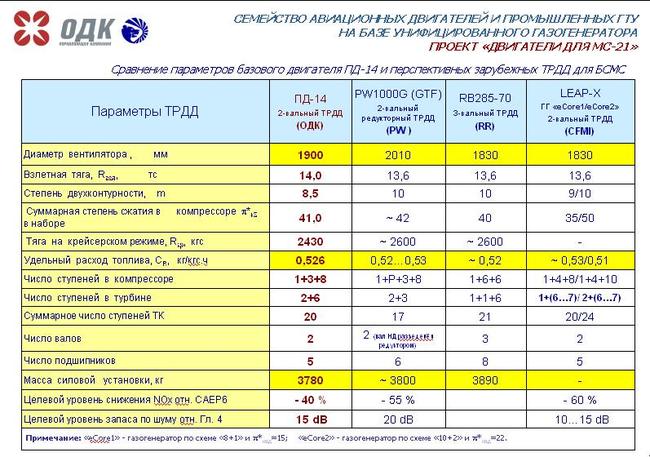
The Yellow parameter column, from top to bottom:
Fan diameter
Takeoff thrust
Bypass Ratio
Total Compression Level
Thrust @ Cruise
Specific Fuel Consumption
Number of compressor stages
Number of staged in Turbine
Total number of stages
Number of shafts
????
Engine Weight
And the last two are emission reduction and noise levels.
Snow MonkeyI had the impression it’s performance (SFC) was on par with the other two. The image/table posted here a while back seemed to confirm that…
I had actually thought it was MORE expensive than the other two (upfront),
no doubt because the other two have much greater scale of production (+more titanium in PD-14? at least vs. LEAP)
It will be interesting to see what PD-18 turns out like as well… I think the next MAKS is set to announce new developments for widebody/’Ekojet’, so clarification on the power plant end could also be forthcoming.
Pratt is also proposing a GTF for the 777X, although RR and GE are seemingly not.
Snow MonkeyPiaggio Reveals Unmanned Avanti
Named P.1HH Hammerhead, the new variant of the Avanti has been extensively modified for its UAS role. According to Piaggio the new version will be capable of 16 hours of operation carrying a range of payloads including Sigint and Elint packages as well as being able to conduct border and maritime surveillance and electronic warfare. Weapons and other external stores could also be fitted to pylons attached to the forward fuselage. The aircraft has been developed to capture part of the medium altitude, long endurance (MALE) market against aircraft such as the MQ-9 Reaper or BAE Systems Mantis.
…This is the third special mission variant of the Avanti. At the 2012 Farnborough Air Show, Abu Dhabi Autonomous System Investments (ADASI) revealed plans to develop a maritime patrol variant of the P.180, and Rockwell Collins has been selected to provide a new avionics suite for the MPA variant. First flight of that version is expected in 2014. There is also a ‘flight checker’ version of the P.180 for flight inspection duties.
I love this plane, but 16 hours endurance does not seem much for a UAV, certainly not of this size… I don’t know if this platform really is competitive vs. optimized UAVs such as Predator or the mentioned still-in-development Mantis. Mantis is supposed to have have up to 30 hrs endurance AFAIK.
Perhaps the enlarged wings could be used for the MPA variant though…? In fact, the sensors themselves, as well as weapons pylons, could also be applied to the MPA version. I really don’t see this platform as a direct competitor to Predator or Mantis, but it does seem possible as a UAV successor to Sentinel, or more specifically the Beechcraft Shadow/Super King Air, with more sensor payload than would fit on a Predator-sized UAV…? The duration could also be extended if it could manage to pull of mid-air refueling.
Snow Monkeythis is really huge, if only because automated systems are less likely to fail carrier landings. if that proves to be true, how long before they install such systems on manned aircraft? it would seem absurd and outdated to risk human error on something like a $150 million F-35
certainly if it can land a UAV it can land a manned jet. if that’s workable, it saves alot of CTOL training.
Snow MonkeyAh, yes, I would expect certainly all external panels to be coated as designed for, although they could be using some non-RAM ‘filler’ temporarily. If anything else, just aerodynamics would be an issue if they wanted to increase the external volume by 30mm thick. I don’t see any reason to believe there is some deficiency that would require substantial RAM changes to the design though (beyond what is planned for, even if RAM isn’t flying yet).
Snow MonkeyNot really. It is possible to replace a Destroyer with a Cruiser…
Sure, and like Scooter I won’t complain if you call them cruisers.
I was just hypothesizing that if USN saw them as replacing destroyers, they are likely to also call them destroyers.
Obviously that doesn’t discount the travesty against naming conventions, but that is WHY it probably occurred IMHO.
If they were meant to replace a cruiser, they would have been much more likely to also be named a cruiser.
Snow MonkeyNICE! How many SSJs have been delivered to date by the way? …While it isn’t a block buster and, with GTF-powered competitors looming, unlikely to become one, it’s still a respectable achievement by international standards and a resounding success in Russian terms.
It still remains to be seen what happens with the new 130 seater (engine-wise, as well as airframe, along with partners for both), but it seems plausible that a new engine for SSJ could be shared/derived from that for the 130-seater, and possibly also an updated wing/tail design. That should more than keep Superjet competitive with GTF re-engined E-Jets circa 2020. That may be a somewhat short lifespan for the original specs, but the project was clearly a learning project, and such a re-fit would seem to keep it more than competitive for a normal commercial duration.
One factor for that is the contract with Safran/SaM, what guarantees they have… On the other hand, they could be willing to participate in a new engine themselves. With the engine competition being Pratt’s GTF, it seems reasonable Safran would be willing to contribute newer designs, especially if at that point the commercial prospects for SSJ would seem good (having been proven in service in the initial config by then, and competitive (re-engined) with Embraer’s updated offerings), and Russia’s own capabilities on the engine would have much improved since the beginning of SaM 146, so contributions derived from PD-14 or even PS-30 could well find there way into future SSJ-130/ SSJ-100NG… ???
Snow MonkeyI think you already answered your own question ;), but I believe that originally the USN planned to procure many more DDG-1000. Due to costs, they can’t do that, and instead will procure more upgraded existing designs… in other words DDG-1000 was meant to replace existing designs, even if in the end it is auxilliary to them. Hope that makes sense (of sorts).
Snow MonkeyNot a single panel would fit after the application of the coating.
Is this really a problem for a new platform all of whose panels are being designed from scratch to work with the planned coatings? I don’t really think the exterior will be coated 30mm thick, but the issue of panel fit doesn’t seem relevant here, panels fit as they are designed to, if a thick coating is planned, that is part of the design.
I thought I would go into the ‘flat bottom’ topic that supposedly distinguishes PAK FA stealth from the F-22.
The F-22 belly isn’t even fully flat, probably 40% of it in the aft portion resolves into a ‘valley’ between the engine nacelles. So certainly this portion of it is more or less equivalent to the current PAK FA design there. More forward, the PAK FA intakes clearly have intentional faceting, so the difference there is not total, not to mention the intake/fuselage interface for F-22 is more complcated than PAKFA, whose ‘flat belly’ extends all the way under the cockpit.
But my main point was that the F-22 belly is not completely flat (presumably for aerodynamic reasons), and so lack of completely flat belly is something shared by both F-22 and PAKFA. On top of the fact that PAK FA has the opportunity to integrate much more advanced RAM into it’s design (not just RAM refits as compatible w/ existing design specs, as F35 RAM applications to F-22 are). I don’t see any clear-cut RCS discrepancy to the extent that some seem to claim (I don’t necessarily think PAK FA RCS will exactly equal F-22, but I don’t see grounds for claiming some insurmountable extreme discrepancy, and it could even be better in certain sectors… some sectors are certainly more important than others, f.e. rearward RCS matters much less for a high speed platform like PAKFA with good situational awareness). The L-band arrays also allow PAKFA to detect and directionalize emitters in that band, at minimum enabling maneuvering to avoid that source or orient to minimize RCS.
Snow MonkeyI got excited when I thought it was Il-476 for a moment…
Snow MonkeyIAF thinks HTT-40 sucks don’t want it. Thinks HJT-36 also sucks because of its Russian Engine
can’t they re-engine it with a French alternative?
F124/125 would seem to make sense, given it will also be re-engining Jaguars.
Whenever Jaguars are retired, all the engine and spares could be transferred to the HJT fleet at no cost.
Snow MonkeyRight, and how old is the F-22 now?, with Pak-Fa design still being refined, and having a solid plan for further upgrades once in service. USAF doesn’t have any replacement for F-22 in the near term, so Pak-Fa should certainly be able to be ‘broadly comparable’ with F-22, perhaps with strengths and weaknesses.
I honestly see mostly strengths, with it’s ‘Block 2’ or further upgrades meant to keep it competitive with the future NGAD. Aero/kinematically, it has a great base to build on, and given the better-than-required performance of the ‘introductory’ engine, that makes me suspect that the bar will just be raised further for the ‘new’ engine. Areas of potential weakness mostly seem to be in countermeasures and so on, which have the least public info to make any informed judgment on. (and if the comparison there is the 90’s tech F-22, I don’t think the question is if it meets that bar, but at how much it surpasses it, the comparison would be more to the newer F-35, a platform that is otherwise blown out of the water by PAKFA)
The US has used it’s stealth expertise on the B-2, which Russia doesn’t directly compete with for now, and the F-35 program, whose performance and costs are hardly world beating vs. new programs. Realistically, Russia has recovered well from the lost decade, with renovations and incremental development to the previous gen (SM, 30, 34, 35) as well as a ‘5th gen’ project which seems promising. The US is certain to eventually put NGAD into production, along with some stealth bomber… What Russia does in the future with upgrades to PAKFA, along with potential new bomber programs or even ‘light/mid fighter’ programs (akin to F-35 or AMCA) remains to be seen… But I don’t see any reason why to expect a divergence from the noted historical norm, if anything we can see that the opportunity is always taken to learn from other’s mistakes and select design criteria that are synergistic and not self defeating.
Snow MonkeyThe title and first two sentences?
It will be interesting to see if the contract ends up so Dassault (/Thales/Safran) isn’t liable if HAL screws up.
Of course that wouldn’t apply if they are at fault, and presumably they would need some sort of arbitration clause to resolve contentious cases.
At the least, it seems reasonable for the portion of the contract value covered by HAL/Dassault (as opposed to the Reliance JV and other supplied subsystems) to be held jointly liable by both Dassault and HAL as the owners of the JV for IAF Rafale assembly, etc.


 Sign In







