 topolo
There is a set of diagram issued by a US A/C manufacturer that compare M2K, F-20A and F-16/79 for the Australian contest (won by the F-18), this include EM diagram at FL150 and combat conf, where it can be seen that the M2K has a better sustained turn rate than the 2 others on the complete speed range (M0.2 to 1.6), this does not say its a better plane… but it say at least that it turns better at this level.
Ther is also an accelration chart in the same conditions, and the M2K accelerate also faster that the 2 others.
topoloThe first HUD picture is taken from a rafale and the second one from a Mirage 2000-5.
No, the one i posted is from a M2000-5, and the gun kill has been confirm at debriefing.
I had a long discussion with the pilot about speed/AoA/Ng conditions that show that the kill occured few time after the merge and not after a long DGFT (the GW of the M2000 is still very high).
But, I do agree with what have been said, this deos NOT demonstrate any superiority of the M2k over the Gripen.
topoloI can confirm it’s a Gripen in a M2000-5F HUD, the gun kill has been confirm in debriefing, but as you say, it means nothing. We surely can find the opposite picture taken the same day… (my source have only one side, of course)
topoloHello, I found this picture in my home forum :
I know it is not a definitive answer to the topic question, but, as you can guess, the HUD is a M2k one, and a Gripen can be seen in the middle.
topoloTopolo, the Kfir and Cheetah have a dogtooth with outer wing leading edge extensions. The Mirage III does not.
All these devices are there to increase the lifting area (and so the lift) and to move forward the CoL tor educe the nose-heavy feeling, they also have been (partially) adopted by the Mirage-III NG (where stability is enforced by FBW).
Increasing the lift area provide better maneuvrability (more Load factor at same speed), moving forward the CoL increase the pich-rate (nose authority), these improvments have been made by many M-III users, but their are always limited by the natural stability of the auto-stable wing profile and its not-so-high (not to say poort) CLmax.
With a more classic wing profile and slats (in M2k), “aigrettes” are enough to provide the best instantanous turn rate of its generation (30 d/s +) and a nose authority that can not be compared to any one else (for what I know at least)
topoloWhat you say is very wrong. The CoG has to be ahead of the CoL on a conventional (non-FBW) aircraft or else it would have dangerously unstable stall characteristics. .
This is only true when you have a tail to produce an opposite torque (by positive or negative lift applied far after the CoG), if you have no tail, and if there is a distance between CoL and CoG, there is a pitch torque, that then a pitch rate… FbW has noting to do with that, I guess aircraft design is not your job…
Concerning forward canard of the Kfir, yes they add a positive impact on medium AoA Drag, but this much less significant tahn on the M2k, because the wing profile of the Kfir (the same as the original M-III) is auto-stable (CL increasing with AoA), so you can re-enerigize the flow, it’s not enough to reverse the CL increase.
topoloThis picture show that R-60 (stricly) has no head on capability, bu the R-60MK has some (limited compared to AIM-9L, but existing)
topoloThe reason for the Mirage 3/5/50’s poor maneuvering performance is entirely due to it being a non-FBW tailess deltawing. The CoG is well ahead of the CoL of the wing, so pulling hard on the elevators does nothing but create a large amount of drag in a turn causing enormous loss of speed.
Sorry, but what you said deeply hurt my own logic…. (and not only mine I suppose, every one invloved in his professionl life in delta airframe design would have the same I guess)
In a tailess Delta (such as MIII), the GoC and the CoL are exactly at the same location, all along stabilized flight, if not, you will have a Pich torque, and so a pitch rate….
BTW, the instantaneous maneuvering performance of M-III, are far better than the Mirage-F1’s one, and comparable to Mig-21MF if not better.
The main problems with Mirage-III family are the limited amount of internal fuel (so poor range or endurance), the impossibility to have slats (nor obviously flaps) that drive to high-speed high-Aoa alnding condition, not compatible with Carrier neither not-prepared-landing strops as required by NATAo in the 70’s (leading the the swept wing with large slats and flaps of the F1).
With FbW, the wing of the M2k can adopt a non “auto-stable” profile, got upfront vertice generator (aigrettes) and got slats, that allow to increase lift and pitch rate (and make the M2k even more agile than the M-III, and may be the more agile A/c of its generation), but also to significantly reduce medium AoA drag, giving the the M2K much better sustained capability (even without the benrfit of the better Th/W ratio provided by the M-53 comapred to the ATAR)
topoloThanks a lot (the last one is the most accurate I ever seen, even if it does not give me the MIG-21MF zero fuel weight it is an astonishing document) !
topoloHello,
I’m looking for any reliable data (extracted from original Flight Manual if possible) on MIG-21MF (iz.96F) weight and balance.
Here are the data I already have on close/similar version.
A – MIG-21M iz.96
1 – Extracted from MIG-21M iz.96A L-15 Yougoslavian Flight Manual
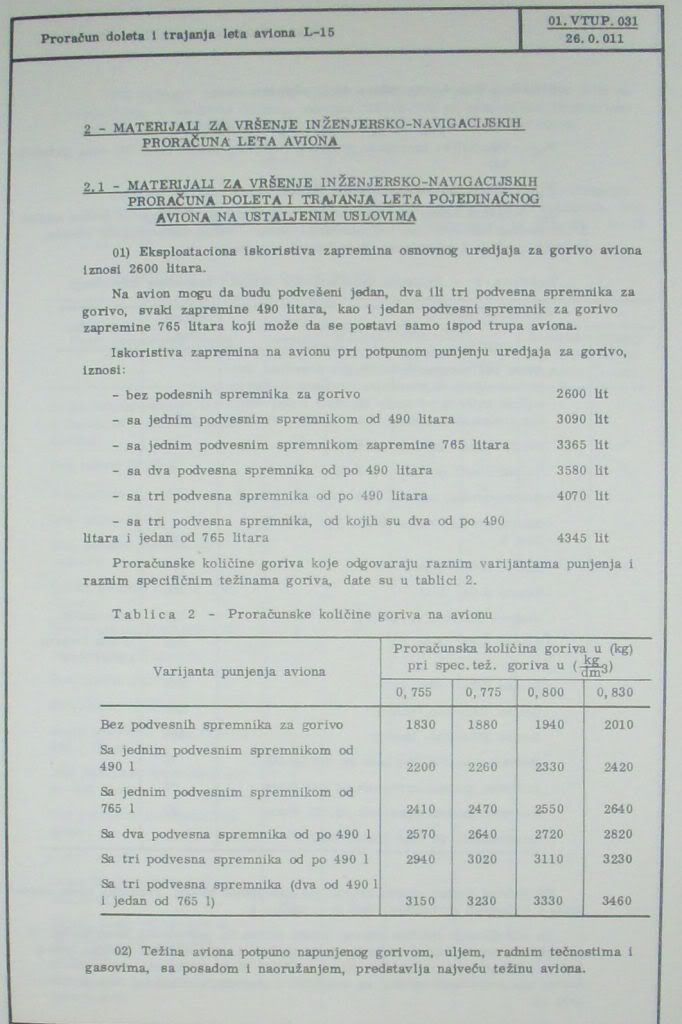
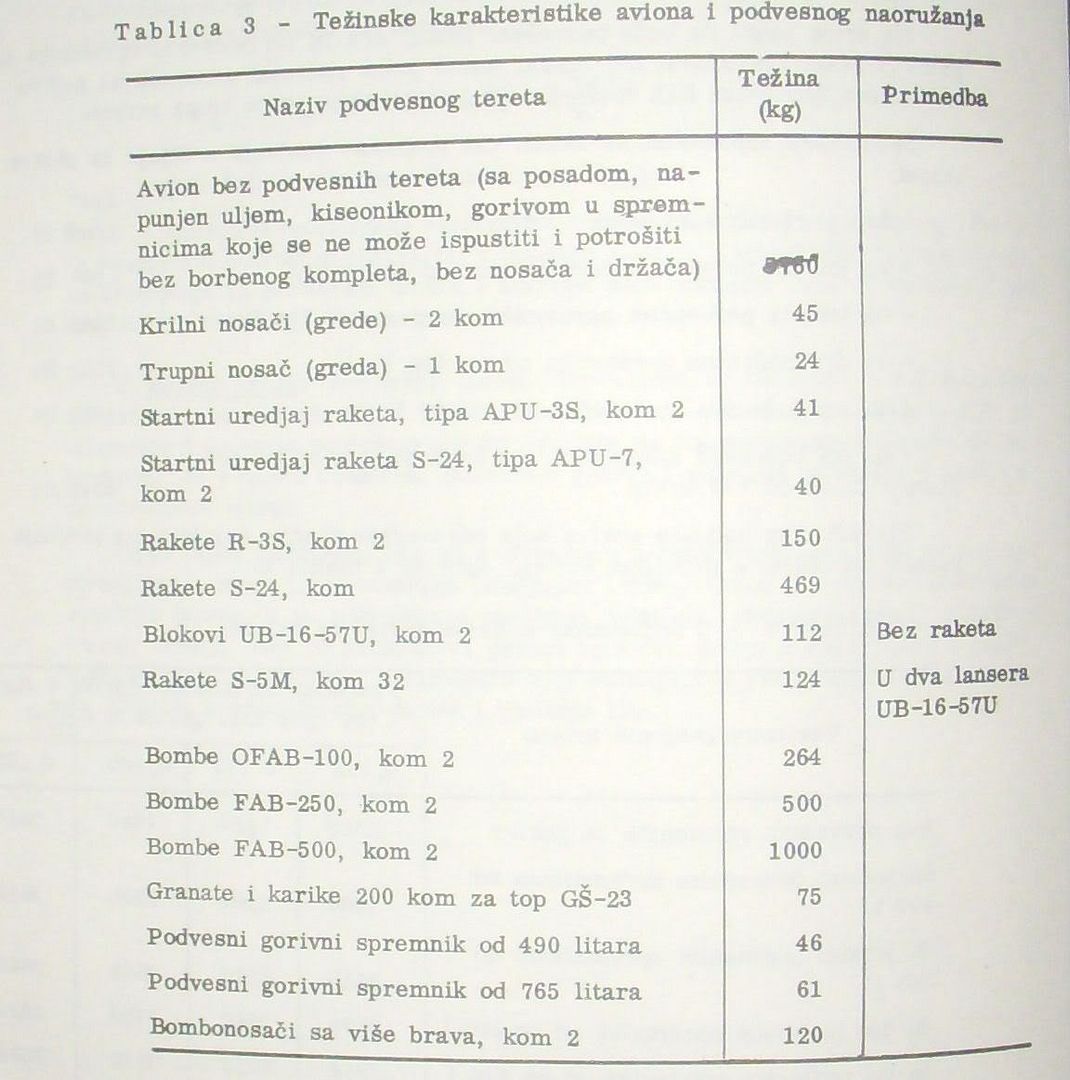
Clean Aircraft with pilot : 5,760 kg (including non usable fuel)
2 x Underwing pylons (for R-3S) : 45 kg
1 x Centerline pylons : 24 kg
2 x launch rail (for R-3S) : 41 kg
2 x R-3S : 150 kg
200 round for GSh-23 : 75 kg
Zero fuel weight : 6,095 kg
Internal usable fuel (@0.8kg/l) : 1,940 kg (from 2,600l total capacity, 2,425 l usable, 175l dead)
Take-off weight (2 R-3S, no Ext Tank) : 8,035 kg
2 – Extracted from “MIKOYAN MIG-21” by Yefim Gordon, Keith DEXTER and Dimitri KOMISSAROV
Page 149
Internal fuel capacity : 2,650 l
Empty weight : 5,350 kg
Normal take off weight : 8,840 kg (not mentionned by supposed with external tank)
Page 151
Take off weight 2xR-3S : 8,212 kg
Take off weight 4xR-3S : 8,451 kg
Fuel load : 2,210 kg (2,650l @ 0.83 g/cm3)
Page 447
Normal take off weight : 8,200 kg
2 – Extracted from “MIG-21 Fishbed: The World’s Most Widely Used Supersonic Fighter” by Yefim Gordon and Bill Gunston
Page 96 MIG-21 TECHNICAL DATA Table
Empty weight : 5,950 kg
Normal take off weight : 8,950 kg
B – MIG-21MF iz.96F
1 – Extracted from “MIKOYAN MIG-21” by Yefim Gordon, Keith DEXTER and Dimitri KOMISSAROV
Page 447
Empty weight : 5,350 kg
Normal take off weight : 8,200 kg
2 – Extracted from “MIG-21 Fishbed: The World’s Most Widely Used Supersonic Fighter” by Yefim Gordon and Bill Gunston
Page 96 MIG-21 TECHNICAL DATA Table
Empty weight : 5,350 kg
Normal take off weight : 8,200 kg
DATA INTERPRETATION
My first interpretation, based on “MIG-21 Fishbed: The World’s Most Widely Used Supersonic Fighter”, was that the MIG-21MF/iz-96F was an evolution of the MIG-21M/iz-96A not only in replacing the Tumanskiy R-11F2SK-300 by the R-13-300, but also reducing Empty weight of about 600kg (whatever means: part airframe weight reduction by swap for steel to titanuim, equipement reduction…)
My second interpretation is now that the Empty weight of 5,960kg at page 96 of “MIG-21 Fishbed: The World’s Most Widely Used Supersonic Fighter”is only a typo error (a strange one, because the weight in lbs is coherent with 5,950kg, so if it is a typo error, it’s one in the author’s data tabel and not only in the book).
Consequently, I now suppose that MIG-21MF/iz-96F and MIG-21M/iz-96A have very close Empty weight.
MY REQUEST
So, I’m looking for help in solving my doubt…
The best way should be to provide a scan of the Weight and balance page of a MIG-21MF flight manual (like in section A-1)
I’m mostly interseted in
– Egyptian Mig-21MF left by Russian in early 70’s
– Ethiopian Mig-21MF delivered in 77-78
– Iraqi Mig-21MF delivered in 73
Thanks in advance….
topolo@Martinez, thanks a lot for your scans
topoloIt seems that “MiG-21M (izd. 96)” (so later than Tip94), whan it is called L-15 is limited to 7G for mach number 0.8 and 6G over M0.8 (may be due to its higher gross weight) ?
topoloThanks a lot…
Is there somewhere a fitting table between Tip number and “commercial” version identifier ?
topolo@Martinez:
I have real concern abount this picture: being related to Mig-21MF… as far as I know Ng max of 8.5 is only for Mig-21bis (with structural improvment such as Tip75)… are you sure ?


 Sign In







