 Impi
ImpiGet this: There is China and China have a province
known as Taiwan and it’s known “simply as Taiwan” and not
as Red Taiwan or Blue Taiwan or even White Taiwan..
Taiwan is not merely a province of China, it is an independent country. Nevertheless, your mention of Taiwan as a mere province of China is rather indicative of where your sympathies lie.
“Red China” was not created as a perjorative term, it was created as shorthand for “Communist China” without having to use the military’s “ChiCom” shorthand. There’s no need to say “Red Cuba” because there aren’t two Cubas. Yet both Taiwan and China are called “China” (ie the People’s Republic of China and the Republic of China”), hence the need for differentiation. There is absolutely no racist overtone to this term whatsoever, and I would suggest that you stop with your Quixotic attacking of things that don’t exist before you make yourself look even more foolish.
In any case, I am led to believe that the colour red is considered a particularly auspicious colour in Chinese mythology, where it has come to symbolise prosperity and good fortune. Considering the very obvious Chinese preference for the colour red, do you really think they’re offended at being called “Red China”?
ImpiHey, it was in a movie, so it must be true. Hollywood never lies, does it? 😛
ImpiIf, after all this time and evidence, there are people who still refuse to believe that the US landed men on the moon, then I am afraid they are so far gone down the rabbit-hole of irrationality that they cannot be helped.
It is simply not possible to deny the landings without abandoning all pretence to logical thought, while inventing ever more improbable scenarios to try explain why the simple and logical one can’t be true. Occam’s Razor, anyone?
Every claim made by the “moon-hoax” committees has either been easily disproved, or betrays an ignorance about the technical aspects of the mission (or indeed cameras). Furthermore, the Soviet Union had the technical ability to, like the US, track the progress of a spacecraft from earth’s orbit to the moon, and to determine whether signals received from the moon were indeed coming from there. This is in addition to the KGB’s successful penetration of NASA. Now is it really possible that at the height of the space race the USSR would not have exposed the US if the moon landings were faked? Of course not.
That the United States landed men on the moon is a fact, and one that is really indisputable. To argue further on the issue is a waste of everybody’s time.
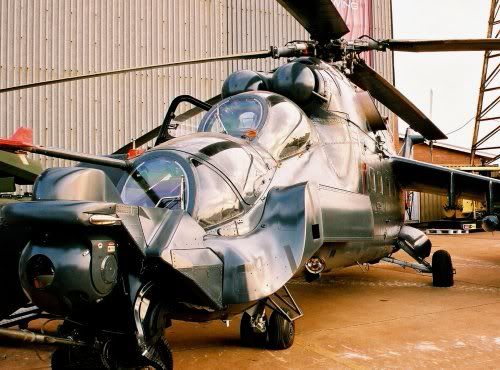
ImpiYeah, Algeria operates between 30 and 40 SuperHind MkIII helicopters, with Ingwe ATGMs, a new 20mm cannon, and a nose-mounted FLIR, Laser designator and long-range TV turret.
ImpiYeah, I agree with the advice given here, contact the publisher and author. Having the original digital photos should be enough to stand up in court as evidence that the photos are yours, because neither the author nor publisher will (for obvious reasons) be able to produce such originals.
The fact that you did not have copyright information on the images might be tricky (I’m not familiar with the legal system there), but so far as I know the copyright on images is assumed unless you state otherwise. After all, if a photographer gave an exhibition in which he didn’t have copyright info on every single image (as they don’t), that doesn’t mean that every attendee is free to copy the image for profit.
I’ve also had photographs of mine stolen and used on other websites, including once by a certain arms manufacturer, so I know the indignation that comes with it (even though it’s never worth calling the lawyers for). I imagine it’s even worse to know that somebody is profiting from your images, and not giving you due credit and compensation. So, good luck, and I hope you get them to comply without much fuss. Usually, they will. Publishers don’t like being seen as copyright violators.
ImpiMalaysia is like Homer Simpson, eyes bigger than his stomach, they want all the good things but don’t have the money for them and South Africa won’t do bater deals for military equipment, this is where the whole deal fell through.
Turkey is a tricky situation, they have the money, they are willing to buy, but they don’t really no what they want. Bell won the first comp but then Turkey changed the deal, a new comp ensures forcing Bell to sue and they won that deal and the US declined to bid again, this forced the Russians to win, then Turkey fell out with Russia on details again. The Third comp which is now starting has seen little bidding from anyone because they are affraid of being mucked arround just like the Americans and Russians, they’d be better off building their own helos so then they could change their minds as many times as they want and have no one effected by it.
With Brazil, they are having a hard time at the moment, too many programs, far too many items to upgrade and never enough money to do it all. IF any attack helo is bought by the FAB, then they would only be in small numbers and I don’t think that Denel would survive on just a small order of say 12 for the FAB, they would rather not bid on a small order and save the time and money, usually wasted on promotion, for their own business!
Good points, and I agree with most of them. I’ve always believed it would be immensely tricky if not impossible to sell the Rooivalk, mainly for political reasons. The problem with the Rooivalk is though it is immensely capable, coming very close to the Apache in terms of its capability, it is also fairly expensive as a result of that. So immediately you’re limited in who you can sell to, because only very few nations have the large defence budgets necessary to buy significant numbers of aircraft this expensive. But now there’s an additional dilemma: Those who can afford to buy it will be extremely skeptical of making any such purchase from South Africa, considering SA’s somewhat erratic foreign policy and doubts over the long-term viability of Denel. After all, an attack helicopter needs support and upgrades over a 20-30 year lifespan. Bell, Boeing and Eurocopter can offer this. Can Denel?
The Rooivalk in sum has suffered the same fate as many projects that emerged during the dying days of the Cold War. Had it emerged earlier, when South Africa was still engaged in the Border War in Angola, the SAAF may indeed have purchased a fair number. As it was, it emerged in the 1990s, at a time of severe budget cutbacks and a seemingly more peaceful world. It’s only recently that defence budgets have started to pick up again slightly, but in the meantime Rooivalk development has stagnated more than was necessary.
Though that said, Brazil, Turkey and Malaysia are still possible buyers, even if a purchase is currently unlikely. Turkey apparently wanted the Rooivalk from the beginning, even before the deal with Bell, but that was scuppered by the South African government of the time’s refusal to sell anything to Turkey as a result of its treatment of the Kurds. The relationship has changed somewhat now, and in recent weeks Turkey has been making overtures to the SA govt about relaunching the Rooivalk program with some Turkish defence industry involvement, and a Turkish purchase. Perhaps, as with the Bell and Russian deals, this may lead to nothing but frustration, but things are at least moving forward.
As for Brazil and Malaysia, even small purchases would provide a nice boost for Denel’s revenues. After all, the development costs have now essentially been covered by the South African government, coupled to a R2bn package to completely restructure and consolidate the company. Any Rooivalk production from now would be essentially pure profit, and the price may even decrease now that there isn’t the massive development cost to recoup. So yeah, while any additional purchase is unlikely, it’s not entirely impossible.
Well the Rooivalk did stem for those years of conflict and as such came away with those requirements. Anything else would be an upgrade to the original platform and thus decrease the “Growth Potential” of the helo, this is a serious marketing flaw IMHO. Sure there is a commonality with Eurocopter products (bearing the modernday name in mind), but why have a mut if you can afford a pedigree? The cost of the Rooivalk (being the Mut coming from many Eurocopter parts), is almost the same as some of it’s competitors (being the pedigree’s, like A-129I, Tiger, perhaps even the AH-1W/Z).
I’m not sure the Rooivalk design is really that much of a compromise. It is, in essence, a slightly cheaper and less capable but far more rugged competitor to the Apache. Aside from the Longbow radar (though a similar system could be fitted), it does pretty much everything the Apache can do, with the added benefit of extra range, minimal maintenance, low support requirements and being better designed for hot and sandy conditions. After all, the Apache was designed for the battlefields of Western Europe, not the deserts of Arabia, whereas the Rooivalk was designed to operate in desert-like conditions from the outset. It’s also more capable than the A-129 and Tigre, and probably the AH-1Z as well.
However, your point about the “mutt vs the pedigree” is well-made, and similar to the point I made above. It makes far more sense for most buyers to get something from the US or Europe than it does for them to get something for a similar price from South Africa. It’s unfortunate, but that’s the way the world works I guess.
ImpiYeah, much as I’d love to see the Rooivalk in Swedish colours, I must admit that the WAH-64 is probably a better buy for them, as it has been optimised for cold-weather conditions.
Where the Rooivalk excels is in the environment it was designed for: Hot and dusty (an environment the Apache really struggles with). So though the Rooivalk is designed for operations up to around -35C, it’s not quite my first choice for cold weather ops.
Having said that, Denel does have experience with converting the Oryx to M2 standard, which involved upgrading two examples with the required cold weather protection and equipment to operate safely in Antarctica. As the Oryx has essentially similar dynamic components as the Rooivalk, it would not appear to be too hard to perform the same upgrade on it with minimum fuss.
But I still put my money on the WAH-64 for Sweden’s choice.
sealordlawrence, I believe that even though it’s listed as an “option”, the pulse-doppler radar being referred to may be the standard velocity sensor that’s fitted to every aircraft. In fact, most if not all of those options are already on the SAAF models. Denel does however have a MMW radar under development for the Rooivalk, though the current lack of funding has prevented it from being installed. I’d expect that it will be fitted to any export Rooivalks that may or may not be purchased.
ImpiThe small turret/radome above the nose is the FLIR sensor for the pilot, while the WSO uses the sensors in the turret under the nose. I’m not entirely sure about the cheek sponsons, though it’s a fair bet that they may hold both ammo and extra avionics. I’ll try find out more about that.
As for it’s commercial flop, you’ve got to remember that there’s a whole lot more to buying weapons systems than just buying a couple off the shelf. Not only do politics pay a huge role, but economic offsets and investment also play a major role. SA just cannot compete with Europe or even Russia in terms of the additional side-benefits that go with many deals. And of course the Rooivalk isn’t exactly cheap, and while it is light years more capable than a Hind, many countries don’t want to pay that much to get the extra capability.
Yet that said, the Rooivalk’s future isn’t that dark. Malaysia is still showing interest, Brazil is very keen, and Turkey is seriously considering it as well. There’s also talk (albeit exceedingly speculative) that if these purchases go through the SAAF may consider purchasing some additional Rooivalks in a few years time.
As for the Mokopa, it does currently have a longer range than the Hellfire, at around 10 000m (while the Hellfire peaks out at around 8 500m). It is at least as accurate as the Ingwe, which means a CEP of less than 300mm at max range, and it has a tandem shaped-charge HEAT warhead capable of penetrating through 1 350mm of armour and defeating any current Explosive Reactive Armour (ERA). The version currently fielded by the SAAF has a semi-active laser guidance seeker, though a MMW or IR seeker is also available. All feature Lock-On Before Launch (LOBL) and Lock-On After Launch (LOAL) capability.
Incidentally, the recent Exercise Indlovu demonstrated the long-range capability of the aircraft. Two Rooivalks flew 600km from their home base in Bloemfontein to a tactical air base in Upington, where they refuelled and were armed. From there, they flew 360km to a forward refuelling point at Springbok, where they refuelled from 200 litre drums (the Rooivalk has a gravity refuelling system that allows refuelling from drums). They then took off and flew 100km through instrument conditions to rendezvous with an SA Navy task force off the coast of Port Nolloth, where they met up with two Oryx helicopters from the SAS Drakensberg and escorted them and the troops they carried in a simulated assault on the port. They then returned to Springbok, refuelling from drums once more, before flying the 360km back to a range near Upington, where they carried out an air defence suppression strike against “enemy” radar. They then refuelled and returned to Bloemfontein.
All in all, not bad. As was said elsewhere: To sum up: they self-deployed over nearly 1 000km to a forward refuelling point, flew 100km to support a landing operation, and then launched an attack against a target 360km away from the refuelling point. All with no more than a small support team at the tactical air base, and a few truckloads of fuel drums, and with no need for a runway.
The Rooivalk/Oryx combo is ideally suited, and is going to serve SA well in coming years.


 Sign In







