 LMFS
LMFSBefore starting to build a new carrier, the Russian Navy needs to determine the design features which allows the carrier air wing to operate in a pre-planned manner – e.g. sortie rates, aircraft types/size/weight/launchspeed/landing speed, fuel/sensor/weapons loadouts, mission planning/intelligence/networking/communication, and subsurface/surface/air/space defenses. Which means the Russian Navy has already developed a CONOP for the new carrier and its air wing.
True, there has been a LOT of discussion (and probably will be still a lot) but if they have settled for a concrete path they should have taken a lot of important decisions. Having a clear strategy is no small thing.
I doubt the new carrier will be a modernized Kuznetsov, because the K was designed to provide a screen of A2A missile-armed fighters in support of massive AShM attacks against NATO convoys and largely ignored operations against shore targets. Soviet naval aircraft of that era couldn’t launch with heavy weights of bombs and fuel. This was verified during recent operations against Syria rebels where only a small load of bombs were carried, even with the Kuznetsov parked just off the Syrian coast.
I don’t think land strike will be the main role of the carrier’s air wing. They are making their naval fighters multirole, true, but I think the main job is still defence of the fleet. RuN has no use and no numbers in foreseeable future to replicate USN approach of massive strikes against land targets.
Regarding TO weights of the naval fighters: springboard can launch fighters at full or almost full weight, see here:
http://cppcms.com/files/skijump/
This claim that STOBAR carriers are not effective holds not much merit from what I have seen and seems rather an axiom that journos repeat without much thought. Besides, newer planes with higher TWR and better low speed characteristics only improve the situation. And in the end you will need full fuel frequently, but how often will you need full weapons payload? Full A2A load is quite light for modern carrying capacities. A massive A2G load with i.e. 4 x 1500 kg bombs (don’t even know if the pylons of any plane stand that) is still “only” 6 tons. In the Russian case it is even better, since their heavy fighters don’t normally operate with EFTs, so a very big part of the most common external load in Western fighters is simply not there. I see more use in capability to carry oversized, long range AShM. For that use, a big and heavy airframe is needed, but the load is not going to be above 2-3 tons.
As for Syria, I have seen really few aircraft operating there with big ordnance loads. It does not seem like they needed them primarily but rather good target intelligence and bombing precision. The concept of limited intervention leaves the heavy lifting to the local ground troops while the Russian air power just takes care of high value or very specific targets. It is much better so than having to flatten a country with the use of air power.
It will be interesting to see how the new carrier design develops. As a contrast, USN as defined “sea control” as the CVN’s primary mission. CVNs will not be used to support strikes against inland targets because doing so is too risky. So the CVNs will not approach the enemy coast until USAF has neutralized the air/surface/space threat.
That must be new, do you have a link?
Probably they can this time ask the Chinese for help? :angel:
Given this timeline and surely including additional delays, the PLAN is surely close to launch their 004 carrier by that time.
If the Chinese have a good shipbuilding industry that is great for them, but how does that help rebuilding the Russian one? That is the final goal, not to give workload and know-how to foreign shipyards. And these are extremely sensitive technologies and designs, so this is a no go IMO. A floating dock can be ordered abroad, a carrier, never. Besides, let’s not forget that both China and India are still using soviet carriers either directly or as base design, so Russians still should think they have an edge in terms of design, materials and so on. What could make sense would be the cooperation to design EMALS, ideally between Russia / India / China, but maybe this is asking too much of the relationship between the later. That thing will be expensive for any single user to develop and it may be good to find partners.
LMFSThe USAF is standing up an Aggressor Unit manned with 11x F-35s. They will arrive in 2022 at Nellis AFB (Hello Red Flag).
Any idea what systems will work on board of these planes? Should be a good indication of what level of avionics development they expect from their potential rivals
LMFSWhat costly retrofits are you referring to?
Concurrency costs. Since they are a burden, you go for them if the other alternative (not having the planes in the air force or having to refurbish 4G ones) is worse. I was just meaning that this early production did not come for free either, since the planes were not 100% combat ready. Who says PAK-FA could not have been produced in such conditions since two or three years?
LMFSI would say there are two valid complaints that are hard to dispute in regard to the Pak-Fa program:
1. Far too rosy pronouncements from gov officials with unrealistic timeline.
2. No reason Izd. 30 shouldn’t have entered development and testing concurrent with the award of the Pak-Fa development to Sukhoi.
Could partially agree on the first one, even when overoptimistic officials is hardly an exclusive characteristic of the program. What is not clear to me is what has been done roughly from 2015 to our days in terms of modifications of the plane. I am not aware of any important rework but rather refinement and further maturing of the platform and systems. In JSF program we have access to detailed data and can ascertain what systems and features are ready and which ones not, when they will be and what is the roadmap in the end. For Su-57 we don’t have that granularity and judge the system as a whole as mature or not, without understanding what is really ready and what is not. Then the plane is suddenly sent to Syria with all systems working and it is claimed it was a combat deployment, catching everyone by surprise. It is difficult to know if the plane with 1st stage engine and a basic functionality could not have been produced already in 2016 as planed, in case it had been deemed necessary. In the case of JSF as a reference, the plane was brought into operation as fast as possible as delays accumulated in the project created a need for fresh airframes for the services. In Russian case the Su-35S and 30SM were there, so this need was not felt so acutely. What is the better option? Only time will tell, but unsurprisingly I prefer the second approach as I deem it safer from a risk management perspective.
The second claim is not so clear to me, especially because 1st stage engine was considered “5G-level” in terms of technology by its developers and claimed to be ok to cover MoD’s requirements. We don’t know what the 2nd stage is capable of, but developer claims it is “5G+”, with higher specific thrust than any comparable engine and the TSFC of the relatively high-BPR AL-31F. So they changed from a modern AL-31F based, relatively-high BPR engine, to a supercruising engine. Was it possible for them to reliably calculate the risk of developing the izd. 30 before developing the 117? Would have it been a wise decision to shortcut that step altogether? I doubt it. Actually the way I see it is that the successful implementation of risk management measures (Su-35S and 1st stage engine) allowed MoD to delay the mass manufacturing of the Su-57 until a supercruising engine could be developed. We still don’t know to what extent this will result in key capabilities of the plane being enabled. But if the plane ends up having a VCE with the supercruise ability of a F119 and subsonic fuel economy of AL-31F, it would be difficult to criticise the decision to delay production in order to get what IMHO would be the first 5G supercruising fighter in the full meaning of the concept.
LMFS[USER=”40269″]FBW[/USER]
Not that this discussion serves the Su-57 thread in any way, but I have to raise the flag when you try to compare the merge & renaming of programs that led to JSF with the clean slate PAK-FA design from Sukhoi, as if it had originated in the MFI /Su-47. Of curse a company will use what they have learned previously in other programs, but MFI’s effort was the Su-47 and PAK-FA is the Su-57. Trying to relate both is too much of a stretch not to be called out, since approach, parameters and requirements of both planes are worlds apart. And worse, this stunt only serves to justify the point that PAK-FA has been poorly led and bears no fruit while JSF already can boast of some hundreds of planes, despite them needing costly retrofits and management efforts. So, nothing but a childish discussion, again, which is more about emotions than substance. Can we go back to facts please?
LMFSDeputy Prime Minister Borisov has confirmed plans to create a new aircraft carrier in Russia
However, he did not specify when the new aircraft carrier can be launched
MOSCOW, may 9. /TASS/. Russia plans to build a new aircraft carrier for their Navy. This was reported to journalists after the Victory parade on red square, the Deputy Chairman of the government of the Russian Federation on issues of defence, Yuri Borisov.
“It has long been in the plans”, – Borisov said in response to the question from the TASS correspondent, whether in Russia decided to create a new carrier.
To clarify, when it can be launched, the Deputy Prime Minister did not.
https://z5h64q92x9.net/proxy_u/ru-en.en/https/tass.ru/armiya-i-opk/6416226
LMFSRussia plans to manufacture 12 upgraded Project 22350M frigates – source
According to the source, a project plan for a vessel with a displacement of 7,000 tons and a capability of carrying up to 48 Kalibr, Oniks and Tsirkon cruise missiles will be finalized by the yearend
Russia plans to manufacture 12 upgraded Project 22350M frigates capable of carrying each up to 48 Kalibr, Oniks and Tsirkon cruise missiles, a source in the shipbuilding industry told TASS on Thursday. “The lead vessel in this series is planned to be commissioned to the Navy in 2027,” the source said.
According to the source, “a project plan for a vessel with a displacement of 7,000 tons and a capability of carrying up to 48 Kalibr, Oniks and Tsirkon cruise missiles will be finalized by the yearend.”
“In all, 12 frigates of this class are planned to be manufactured, with 11 out of them to be commissioned to the customer within the frames of the new state arms procurement program,” the source added.
TASS does not yet have an official confirmation of this information.
LMFSAs said above, if the decision that was expected regarding the way forward with the carriers has indeed been taken, then we should notice it in the following months because official news will probably be published. This should also unleash a series of associated decisions, like the path forward with naval fighters / PAK-KA / STOVL, AWACS / AEW, UCAV, EMALS / springboard, carrier vs. LHDs and all other related issues, from which we will also get a trace. So we just have to wait a little and see, such a program will give many hints before it actually materializes or fails completely.
IMO all this criticism does not come from deep and detailed study of Russian military budget but purely from personal beliefs. When the costs of a carrier, as reported by design bureaus, are used and spread along the years needed to develop such a project, the impact on the Russian budget does not look too big. And is important to remember that most of the modernization of the armed forces has been already completed, so there are both money freed and MIC companies needing workload. The need to develop the navy is as an obvious need for Russia as it is for any other power, so in reality there is only one way forward and it was outlined in the naval development strategy, regardless of how difficult or how many delays. Such strategic documents are the obvious base to analyse the development of VMF and cannot be simply dismissed since they lay down the roadmap that MoD must implement.
What would make sense, as far as I can see? 2-3 new carriers as the ones described in the article, with newer Krylov hull and only a springboard, at least in the beginning. 3-4LHDs. For the naval fighter Russia has an obvious choice which is the Su-57, essentially providing VMF the kind of platform NGAD is trying to produce for USN but with many years of advantage. AWACS/AEW role could be covered in the beginning by networking of existing aerial assets. But in the future a specific plane could be developed. Contrary to popular belief, Yak-44 could be operated from a springboard, so it is not 100% mandatory to need EMALS, at least until tankers become a central element of the naval aviation.
STOVL would be good for the LHDs but a solo development for a low amount of planes does not look feasible. Besides, high speed helos could cover part of the roles of a STOVL. One possible approach would be the development with China, which also seeks to develop their expeditionary forces. The other, to develop a light fighter in the following versions:
1. UCAV, CTOL for the VKS and export
2. CTOL, manned. For export and maybe VKS
3. Unmanned STOVL, with lifting fan in the place of cockpit. This would eliminate most of the layout problems and limitations of current STOVL designs, where the position of the lifting devices after the cockpit eliminates dorsal tank, central weapons bay & centerline pylon and forces the main engine forward, reducing internal volume and worsening aero. This would be a real improvement for STOVL performance IMO.
LMFSActually, I suspect that the most important “technology demonstrator” for the PAKFA project was probably the Su-37 in the 1990s – certainly with regard to the fly-by-wire flight control systems and TVC. Come to think of it, the Su-35S could also be considered a tech demonstrator as well?
Of course, the famous “evolutionary” development model. In every step of the development there was a B plan in place, like Su-35 and 1st stage engine. There are lots of risk management measures all over the program, as it should be.
EDIT: To be clearer, the technology demonstrator is just a risk management measure. It is not mandatory to have one specific design for that purpose in the program if the risks inherent to the involved technologies can be addressed on already existing planes or in other other ways. No use in always trying to find the equivalents to the typical US categories in the Russian development model.
[USER=”77826″]XB-70[/USER]
Considering the sourcing volumes for Russian aircraft we see normally (both in units per year and in total number of ordered units per contract), I don’t know exactly what weight the economies of scale would have here. I haven’t seen serious deviations in contract prices from one batch to another in planes like Su-35S or 30SM, but the official announcements also don’t provide a lot of detail. In any case I don’t expect them to buy more than the customary 8-14 units per year at any time of the program and I doubt they are holding production due mainly to economy.
As to the training and infrastructure costs to operate the planes, they are really spreading those along many years since only 15 units are foreseen by now, which would be one squadron plus training planes. On the other hand I would expect VKS putting a lot of focus in avoiding Su-57 being a hangar queen, which Russian military does not need at all and has no capacity to handle. For instance the technology to detect cracks in the composites that they built in the airframe instead of needing specialised equipment shows a clear effort to transition to the newer technologies without imposing a big burden on the operation of the plane. But of course much of the technology in the plane is completely new in the RuAF so it is true a lot of training and testing of operational procedures will be needed. That is IMO one of the reasons they are not hurrying buying big amounts by now.
LMFSRegarding the new carriers:
> A decision regarding further steps in this regard was expected for this Spring, so combined with the fact that the “leak” was disclosed by TASS it may indicate the decision has indeed been taken. I think it is possible that we have an official communication still this year.
> 70 kT would follow previous reports about VMF wanting a bigger carrier than the Kuznetsov. I suppose the air wing the ship can carry has limitations and therefore they would like to go for something a bit bigger. The size is not a super carrier (Nimitz is >40% bigger) but if combined with the new hull by Krylov could maybe carry a three fighter-squadron air wing, maybe even more.
> Personally I think the decision is totally correct, both in regards of the size and of the propulsion. Details about the air wing, hull layout, installation of VLS and presence of catapults or not are further interesting details we hopefully will learn in the future.
LMFSRussian upgraded Su-25 attack aircraft to get sighting system with artificial intelligence

© Yuri Smityuk/TASS
MOSCOW, May 8. /TASS/. Russia’s upgraded Su-25SM3 attack aircraft will get an onboard target acquisition and sighting system with artificial intelligence elements to allow pilots to strike designated targets actually without their participation, a source in the defense industry told TASS on Wednesday.
“As part of further upgrade of attack aircraft, the latest Su-25SM3 versions will be furnished with a new sighting system. It will be fully automated and a pilot will only have to select a target on the screen and all the rest will be done by artificial intelligence,” the source said.
The target acquisition system with artificial intelligence will be able to independently identify hostile targets, keep them in sight and guide missiles. The new technology has been integrated into the unified troop command and control system, which allows mapping an optimal route towards the target and the trajectory of using weapons. Upgraded attack aircraft will also be able to receive data on targets from external sources through the command and control system.
A source in the aircraft-building industry earlier told TASS that the upgraded Mi-28NM attack helicopter would get a similar system with artificial intelligence.
As Editor-in-Chief of the Arsenal of the Fatherland journal Viktor Murakhovsky told TASS, the new system is capable of accomplishing a whole range of tasks. “This includes re-targeting during a flight, the issuance of new flight assignments and integration into the battlefield reconnaissance and information space,” he said.
The new target acquisition system really features artificial intelligence elements, the chief editor said. “When picking a target, the aircraft’s onboard information and control system automatically maps the most optimal route towards this target in compliance with the selected tactics… The system can also offer options for employing the weapon payload against such a target, the variants of tactical and air maneuvers with regard to this target,” the expert explained.
Besides, the attack aircraft equipped with this system can guide weapons using target acquisition from external sources, the expert said.
“It can get target acquisition from ground-based hardware, for example, from the Strelets reconnaissance, control and communications system [part of the Ratnik soldier combat gear],” the expert concluded.
The Su-25SM3 is a modernized version of the Su-25 attack aircraft. The plane is capable of destroying small-size ground installations and air targets at any time of day or night. The attack aircraft’s combat efficiency has increased threefold compared to other modifications. As distinct from its predecessors, the upgraded aircraft is equipped with the Glonass satellite navigation system that offers a possibility of programming a final point on the map with an accuracy of up to 10 meters while the cockpit has a digital display with an option of projecting the ground and air situation.
LMFS| class: mainnews | ||||
|---|---|---|---|---|
| [TR] | ||||
| [TD=”class: mainnewshead”]
[/TD] |
||||
| [/TR] | ||||
| [TR] | ||||
| [TD=”class: mainnewsdate”][/TD] | ||||
| [/TR] | ||||
| [TR] | ||||
[TD=”class: mainnewstd”] 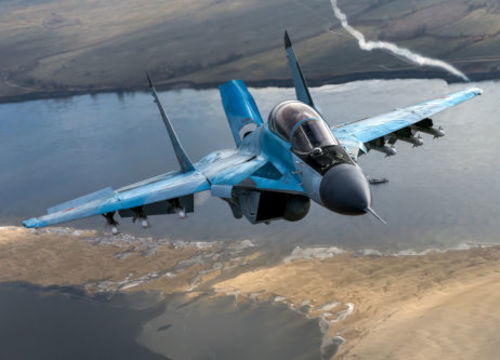 |
||||
|
Moscow. May 8. INTERFAX-AVN – the Russian defense Ministry, is expected to receive six MiG-35 every year, reported “Interfax” an informed source. |
||||
|
“It is planned to sign contract to the Russian Air and space forces had at least six cars a year” |
– said the Agency interlocutor on the prospects of the MiG-35. | |||
| He noted that the military has already received the first two MiG-35 contract for six cars signed at the forum “Army-2018”. “Already delivered two aircraft | and another four cars will go to the end of the year | ” the source said. | ||
| In December 2018 | the defense Ministry said that the Corporation “MiG” has completed the final Assembly of the first batch of aircraft for the delivery of videoconferencing and preparing to conduct their acceptance testing. However | to date | officially on the transfer of military first MiG-35 was not reported. | |
| Then | the Ministry stated that the crews of the State flight test centre (glits) | the defense Ministry has launched an intensive flying experimental vehicles to test their maneuvering characteristics | and aerodynamic stability. In addition | military pilots have already begun to experience aircraft armament of the MiG-35 class “air-air” and “air-surface”. |
| 22 August 2018 on the forum “Army-2018” the KLA and the defense Ministry signed a contract for delivery of six light fighter MiG-35 until 2023. Machines will be supplied in single and double (combat training) versions of the MiG – 35S and MiG-35УБ. | ||||
| The President of UAC Yury Slyusar announced in an interview to “Interfax” that the delivery of these six cars will be completed in 2019 | and the mass production of fighters to begin after 2020. | |||
|
https://z5h64q92x9.net/proxy_u/ru-en.en/https/www.militarynews.ru/story.asp?rid=0&nid=507725&lang=RU[/TD] |
||||
| [/TR] |
LMFSyou also have to look at this in the light of concurrency. The slow start might help save money further down the road, unlike F-35 where they just pump out several scores of jet from the first years, only to have the jets semi functional due to changes when the 3rd or 4th year comes around, by then having already spent Billions on jets that would not go to the Frontline or require massive upgrades again..
A slow start might give KnAAZ the time and chance to make any last effort changes if need be, without the need to spend money on fixing the prior jets.
True, especially considering the 2nd stage engine is apparently going to be retrofitted in the serial units that are produced prior to its availability. That should be 15 units, at least that is what sources report as being foreseen in the state armament program.
On the other hand, I assume KnAAZ will take care of readying the production line rather than making adjustments the to plane. This is the reason for the pilot series of any product.
[USER=”29017″]ActionJackson[/USER]
IIRC 510 and 511 were already representative of the final status of the plane. No HW redesign is expected before 2nd stage engine from what I have read.
[USER=”1416″]Scooter[/USER]
Prototypes: sourced and produced on a unit base, by hand or with general purpose tooling.
Series: produced in a purpose-built line with specific tooling and processes and sourced as a batch.
Anyone with experience in the industry can tell you all this difference implies. I understand what you mean and agree the sense of the serial production is to handle bigger numbers in a reliable and economical way, but in the end the volume output of the line does not determine if the production is serial or not, the processes do. And again a serial production contract in Russian jet fighter industry is hardly going to mean more than 10-14 units per year with production lines that are going to be kept open for decades, so quite differently to US case. In US the goal seems to be to use economies of scale with a production as brief and intense as possible, in Russia the goal is to spread the workload to avoid peaks and hence keep the staffing and production capabilities stable for many years. They use very different approaches from which different results can be expected.
LMFSPumping out 1 aircraft per year is kind of serial production in name only. It will be interesting to see if Russia tries to pick up the pace now that oil and gas prices are bringing a lot more money in. An interesting tidbit on that article on the Su-57 planned contract is that it suggests the new engine will be available in 2023…pretty close to what I had been thinking earlier and a more reasonable estimate for flight trials. Maybe that designer who was interviewed earlier considers that to be ‘mid 20s’.
This is the pilot series, so it is not specially out of normal for Russian standards that the run is small and produced slowly.
Regarding the availabililty of money, Russia is not running deficits or for that matter the purchasing of a plane in the price range that has been hinted for the Su-57 should pose a significant strain for the budget, much less in the amount of units per year that Russia normally buys for their main types. Other hardware is way more expensive even despite the lower numbers, for instance Tu-160, transport planes, AWACS etc.
Regarding the testing of the 2nd stage engine, it was originally mentioned that it would take roughly 5 years after the start of the flights, so 2023 was always the goal. Of course things could go worse than expected and besides when the serial production of the new engine can be organized is still an unknown, it may well be that no serial Su-57s with izd. 30 are produced before 2025.
LMFSContracted to create a super-heavy transport to replace the An-124 “Ruslan” report “Ilyushin”
07.05.2019 12:00:01
Moscow. May 7. INTERFAX – Signed a contract to develop a super-heavy transport aircraft to replace the Ukrainian An-124 “Ruslan”, the annual report of JSC “Il”.
“In the framework of development of works on creation of superheavy military transport aircraft (STWD) completed the pre-contract phase of work concluded the state contract on performance of 3-5 stages of the ROC “STTS”, – stated in the document, published Tuesday in the Center of corporate disclosure.
According to the report, in 2018 the company “Ilyushin” was also conducted preliminary work for implementation of scientific-research work “Research of ways of creation of a perspective aviation complex of the military transport aviation (NIR PAK VTA)”.
In addition, Il continues work on modernization and restoration of health and life extension of aircraft type An-124 with engines D-18T.
In August 2018, the UAC President Yury Slyusar told Interfax that the possible shape of the perspective plane of the military transport aviation PAK VTA discussed with the defense Ministry. “We are now discussing with the Ministry of defence, the possible appearance of this aircraft, what characteristics he must possess, and so on. There are developments in this direction. But to proceed directly to the creation of a new car, we can only after all these issues with the customer,” – said Yu. Slyusar.
Earlier, Deputy Prime Minister Yuri Borisov said that Russia will start research work (SRW) to create a new super-heavy transport to replace the “Ruslan” after 2025. “They Kirovskom plan at the end of the GPV (state armaments program for 2018 – 2027 years – Interfax)”, – said Yuri Borisov to journalists, answering a question about plans to develop a new heavy aircraft to replace the An-124.
In Russia the production of the An-124 ceased in 2003, but continues deep modernization and maintenance of airworthiness of the aircraft. During the period of existence of the Ulyanovsk aviation complex made 36 units An-124.
https://z5h64q92x9.net/proxy_u/ru-en.en/https/www.militarynews.ru/story.asp?rid=1&nid=507664&lang=RU


 Sign In







