Schorsch
Rumors surfaced that there will be a substantial delay to the B787-3, the designated short range variant. It is supposed to get a smaller wing. It is said that Boeing wants to focus its resources on the B787-9, which is the most popular variant, while the -3 (due to be delivered nearly at the same time) has only two customers. If the project is killed or only delayed is unclear, if the two customers change their orders it is likely that the -3 will be delayed by quite a while.
SchorschSince SOC closed the old one, here’s the new version for youse guys to play with as Jay would put it.
Be afraid, US CBG, be very afraid.
Discuss…
I generally think that we (=the Forumers) have the ability to overestimate. But apart the bovine merde ping pong match between some posters the thread contains some very useful information, especially from Jonesy and some others.
SchorschThe best solution for the USAF is the KC-30.
The best solution for US industry and US workers is the KC-767.
The best solution for the US taxpayer is too close to call, and to an extent, depends where he lives!
It would seem that the best compromise might be a split buy.
I would not criticise the USA if it were to select the more ‘protectionist’ option, as long as there is openness that this is what it is doing.
A split buy is the worst solution. Either one offering is OK, but half of both would be a nightmare. If they sit together and all “evaluation parameters” are equal, they still can flip a coin.
If you have two options for one task, which are equally good, you will not take both.
SchorschI think it is more that Leahy thinks Singapore needs more A380, not that they actually asked for it. Time will tell. How many B747-400 does Singapore have?
SchorschIt looks like a useful aircraft when some requirements are taken from the list. Performance-wise it has to suffer from high wing loading. Remember, we still have the F-16A’s wing (F-16A had 7.5t OEW and 15.7t MTOW) carrying basically a 10 to 11t aircraft. In the shown config with a drag index somewhere close to 200 and more than 5t external load (not including CFT), it has a static TWR of something like .55, which equals that of a Tornado IDS. It may have serious problems getting of the ground under hot weather conditions.
Still, it makes a useful fighter-bomber, and without CFT and when tanks are dropped, it is a very dangerous opponent in BVR and WVR.
If I was India, I would definitely consider it.
SchorschIf you have ever heard an aircraft whose blade tips are supersonic you will know what it sounds like… the Huey is one and that trainer aircraft.. Harvard is it? is another. The blade tips on the Bear never become supersonic… it has a constant speed variable pitch propellers. It uses a very coarse pitch for normal forward high speed flight but doesn’t suffer from having supersonic blade tips which create drag rather than pushing force. The result is that the Bear is about 100km/h faster than the west had first estimated it to be.
…learned that in AFM or AirInt.
The Bear normally cruises at a speed substantially below its VMO/MMO, normally at M0.7. There it had for its time unmatched range and endurance (today’s turbofan jets are of course much better). To reach the top cruise speed of M0.82ish it is equipped with highly swept wings. At such speeds the prop efficiency goes down the sewer. That is the difference between a Bear and a jet: the jet normally cruises quite efficient just short of its MMO, while the Bear has to stay lower to prevent the loss of prop efficiency. If it had a simple prop, it would not reach M0.8 at all.
In the end the Bear is a design compromise caused by the existing circumstances at that time. With the arrival of fairly efficient jet engines (1960ish with JT8D=TF33) it was an outdated concept.
SchorschThe A400M is starting to look a lot less like a paper plane now.
http://www.airbusmilitary.com/images/1sta400m2.jpg
Maybe its a photo perspective thing, but it looks about 10-15% smaller than somehow I had anticipated
They mixed up meters and yards.
SchorschIt’s only a matter of time before the suits at Qantas pressure Airbus for an increased MTOW
Currently 8000nm or 14800km are available. We all know that these are best case figures and do not include strong headwinds or operational fuel reserves above the required reserves.
The A380 has plenty of growth potential. If market demand is sufficient, a weight variant with 580t should be possible. Just as every aircraft type things have to establish, experience must grow. Airlines need to figure out what kind of tool they bought and what they can do about it. I keep on saying that the A380 is not just another aircraft, but it is a game changer (maybe comparable to the B767).
SchorschEven assuming you are correct and the Il-76 is out of service in that period of time (which is ridiculous in my opinion) the Russians will need something to replace it and I doubt it will cost anywhere near what a C-17 costs.
You are making the basic mistake of assuming that Russian developed aircraft are always cheap. What is your reason for that? OK, the labor costs are lower, but how much do the labor costs influence the price of development? We haven’t seen any figures on development costs for Russian aircraft (while all American&European programs have numbers on the table), during Soviet times the programs at OKB MiG for example all were a mild catastrophe.
Besides that, most of the Russian aviation industry is state owned.
If they are leasing then support for the engines is not the countries problem. If they buy the planes they could simply ask for western engines to be fitted. No big deal.
The RERP for the C-5 (equipping them with new engines) costs several billions. Engines are not a plug’n play thing, they are an essential part of the aircraft. Replacing them is costly.
Yes… imagine buying something that can do the job but getting it so cheap because the development costs have already been paid. What a mistake it would be to save money buying a plane that can do the job when you could build your own plane with lower performance figures that costs more…
It is not the NIH syndrome it is jobs for the boys syndrome. I wonder if the Ukraine entering NATO and the EU might have made the An-70 more attractive. It would be a good way to pump money and jobs into a new member state while getting something worthwhile from it.
The A400M doesn’t have lower performance, it has tailormade performance. Second, it doesn’t cost more money over lifetime.
Third, subsidizing the former SU industry is not exactly what the Western European taxpayer has in mind. They got enough money for free.
SchorschIt was after SIN-SYD had flown for a couple of months that SQ announced Trent 900 burns several % less fuel than Airbus had promised. 380-861 has not entered service. Will it be no better than Airbus promised, or a few % better like -841, or even better than -841? The range depends on that.
I heard fuel burn is 20% better than on the B747-400 (which actually was the A380 design goal), and actual fuel burn is even a tiny bit better than Airbus promised. Now, consider it to be 1 or 2%. Actually, a real useful average fuel burn can be established after a dozen and more are in service (although the A380 airframe has exceptionel manufacturing quality).
How many 707-s or DC-8s replaced the 747-100 that was 21 hours late on its entry into service? And 747-200 and 747SP could not be replaced because nothing had their range. Nor can A340-500 or 777-200LR. Thai has 1 sole A340-500HGW and 3 A340-500 non-HGW. The SQ and EK A340-500 fleets also are small… And one time of day is often the only time of day that schedules and timezones make sense, so any extra flights would have to fly at about the same time.
How does the cost per seat compare between an 181 seat A340-500 or a 238 seat B777-200LR and an A380-800?
Still doesn’t make sense. First application is on race tracks between congested hubs. JFK, Heathrow, Frankfurt, Hong Kong and Singapoor. Any excess A380 will be available to airlines earliest in 2011.
Schorschthe 787 is going to sell almost 800 before first flight! that’s unprecedented!
Ah, that’s the reason they haven’t flown yet. They want to break the 800 mark. 😀
SchorschStill roughly comparable with the YC-14 using a normal takeoff.
Bending reality can be so entertaining!
SchorschIn an interview with Steven Udvar-Hazy of ILFC by “The Flightblogger”, Mr Udvar-Hazy said he doubts that the B787-10 will be launched in the near future. Weight issues close the window of opportunity and would demand significant re-design of wing and landing gears. The thrust demand is beyond the original design scope of the engines.
My comment:
The B787-8 is currently 7 tons overweight compared to original specifications from 2004. That is approximately 6%, or three times as much as the A380 had as penalty when starting service. I guess the performance guaranties (in terms of range) of the -9 already put the aircraft quite on the edge.
SchorschWrong about the engines. The Il-76MF has the new PS90A engines that are more powerful and more fuel efficient that the engines previously used. They also meet new European noise emission requirements.
No, not wrong. I know they use the PS90 today.
But even the PS90A are old engines by today’s standards. Everybody who buys such an aircraft has to hope and pray that Russia still uses its own Il-76MF (of which they own … zero) in 30 years. If not, there is hardly any reason to continue support for these engines (the few Il-86/96 will be gone by 2020 latest). For external customers without industrial control over the parts of an aircraft or at least sufficient market power, such a detail can be a serious show stopper. Also consider that you are in a standing dependency to Russia, which is less desirable than being in a standing dependency on 5 European nations with constantly changing governments.
Here is a BLOG I think might be related to this thread (Sorry about its length):
I don’t dispute that Russian transports are very cheap to lease. Why is it so? Because the highest share of costs for a military transport is its purchase price financed over x amount of years. This purchase price includes development. For the Russian leasing company this cost item is somewhere close to zero. It doesn’t prove at all that the lifetime costs of Russian hardware when procured in a Western way does save a single USD. That is why Germany was right in rejecting the An-70 and Canada is right in saying it ain’t a long term solution.
In 10-15 years there will be only few Il-76 out for lease. Rest is grounded or scrapped.
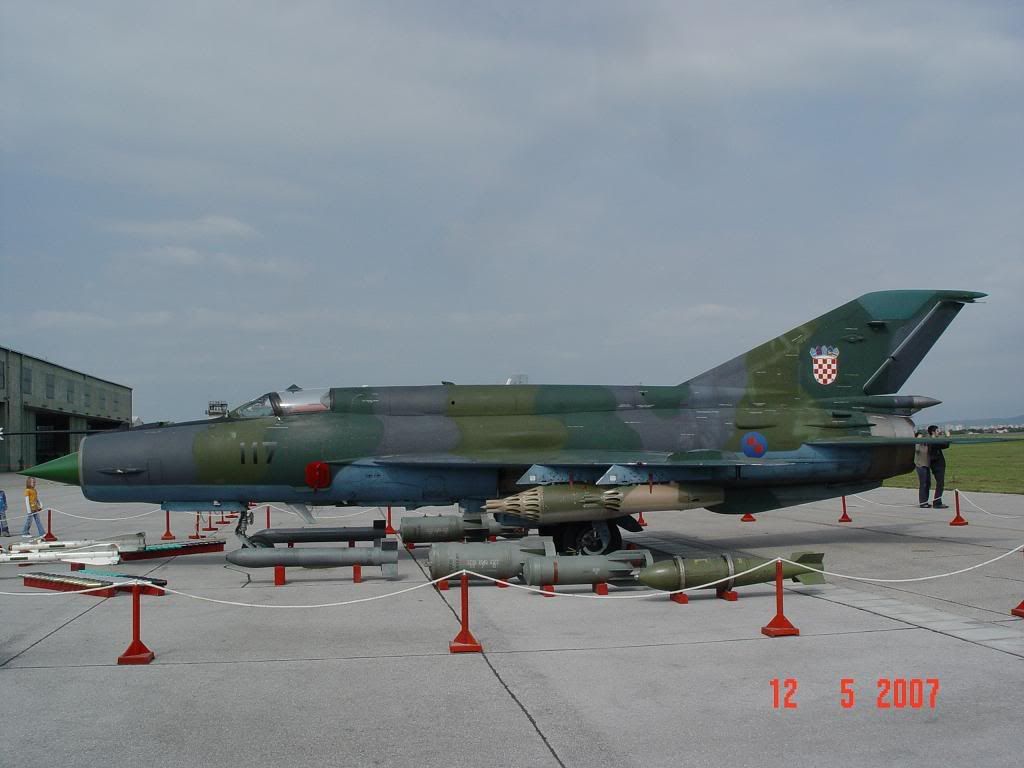
SchorschReminds me of a Museum visit.
Considering the dumbness of the bomb and the lack of any computer targeting equipment and the well-known payload-range characteristics of the MiG-21, the attack of a 4-ship (do they have so much) MiG-21 strike must be … a joke.
Sad we don’t have F-104G to spare any more, it would considerably increase the punch of the CAF.


 Sign In