I thought that the Sokol was the one with the “tail” wheel midway along the fuselage ie a reverse-tricycle undercarraige.
It’s my age, someone help me!
Roger Smith.
Thanks again.
Am going to try Coventry City Libraries’ microfiched local newspapers one evening next week.
Roger Smith.
Pity more countries don’t adopt the Belgian (and French?) scheme of fitting brightly painted balls on those cables near airfields.
When I was touring the continent (by road) many years ago they were highly visible – and helped us locate the airfields too!
Bit off topic but do many other countries use them?
Good wishes to the two ladies.
Roger Smith.
Great news about the continuing restoration and donation/addition of cameras – keep up the good work
Roger Smith.
Thanks to respondees.
RE8 A3772 was one of a batch of 150 built by Siddeley Deasey (forerunner of AWA) in Coventry. If I do discover any more I will post.
Roger Smith.
Aah…if only it was that simple 😉
State of the art CAD wouldn’t save that much time or money when it comes to ‘reverse engineering’ from an existing airframe, as the big cost/time is in the human element of dismantling to each individual component and taking precise measurements etc.
Mark12’s £10m figure for a control surface is probably pretty accurate 🙂And ‘blue prints’ wouldn’t be the end result from a state-of-the-art CAD system either 😉 …… they disappeared well over 40 years ago 😀
Surely there are laser measuring devices nowadays that measure and input data into a computer as the object is rotated?
Roger Smith.
It’s a Dunlop unit – “AC….” is a Dunlop main assembly number (along with AH….) ACO…. and AHO…. are sub-assembly numbers.
Roger Smith.
So as not to confuse the matter Graf Spee was scuttled in 1939 – Nermal
Whoops – I dropped another one there my maths failed on me. 17th December, 1940 could not have been in the First year of the war could it!!
Roger Smith.
The pub G-ORDY refers to is the building on the extreme left about a third up the page and is The Baginton Oak or The Oak (the ancient tree it is named after is just out of shot) and was used as a mess by the RAF during WW2.
The old control tower is almost slap-bang in the centre.
The “X” on the end of the runway and the lighter colour at the far end suggest it is still under construction – this is the end of a runway that appears in one of the pics on the other thread.
The two linked nissen huts just to the right of the pub are the postwar home of Coventry Aeroplane Club.
The “lake” is what we referred to as The Sandpits and as a boy I used to fish there. It was later closed and became a council rubbish tip to fill it in and is now “dead” land.
Just above the sandpits, going left to right and slightly up is Rowley Road. This road was built in the 1930s to replace the road that ran through the land that became the airport. Notice it converges on the runway but it stops where it meets the A45 (London – Birmingham trunk road). The constant problem with air displays at Coventry is that the far end of Rowley Road offered a good vantage point without paying to go in and hundreds used to line the fence there!
Just above the three hangar bases/to the right of the sandpit is the old scrapping area. Many is the aircraft that met it’s end there including Ace Freighter Connies.
Above that the white roof was part of the sewage system at Baginton. That building was by the above ground holding tanks and to the right of the far end of the runway (seen in one of the other photos) were the circular filter beds – the “cleansed” sewage exiting into the River Avon that runs very closeby.
The Midland Air Museum is now just beyond that white roofed building.
Roger Smith.
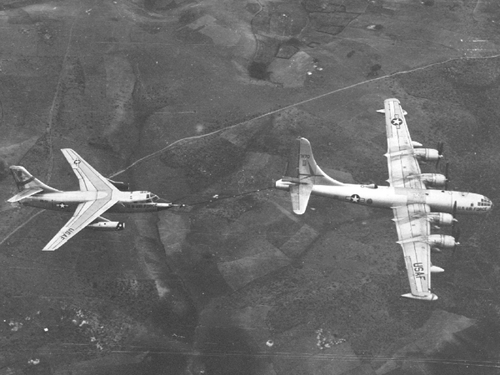
Boeing KB50 leading and Douglas RB66.
Found the following at http://www.sculthorpe.org/html/other.html
Now can you see it’s not a B-24 Moggy! 🙂
Roger Smith.
Coming back into Baginton?
Yep, thats the sewage works in the near background (and the AWA works beyond that).
Incidentally, going off topic, the replacement for this sewage works (Baginton had large, above ground sewage holding tanks on the north side as well) were ginormous underground pipes to nearby Finham. These had just been installed and were used in the making of the (original) “Italian Job” film driving the Mini Coopers through them.
Roger Smith.
Just had a butchas at the plates. They are indeed labelled “Coventry” so you’re right. I’ll have a look at the originals to see if I can see the Red Lion at Hunningham.
Ahhh sigh, the Red Lion at Hunningham. Took a young lady on a first date there many years ago – and she lived right next to the airport!
Roger Smith.
Sorry if I have missed something, Meteors are not my speciality, but what happened to EE531? I am assuming that it is no longer at Pebble Mill. Did EE531 have a wartime career?
Firstly my apologies – I made a mistake. We moved EE531 from Lasham to Meteor Ford Ltd in Birmingham first for temporary exhibition then on to Weston Park.
Now, DaveR – EE531 is the Meteor F.4 owned by and on display at the Midland Air Museum. The Midland Aircraft Preservation Society purchased it for £175 in 1972 and we had heck of a job to raise that amount. Some of it was by loans from members but most of it from Meteor Ford in exchange for displaying it at their showrooms. Can’t remember offhand when it was delivered to the R.A.F. but think it was after end of the war. It spent most of it’s service life in experimental work ending up with the R.A.E. at Lasham being used for radio aerial trials. It’s official history (Form ?) says it was used for folding wing trials but we could never find any evidence of the engineering that would have had to have been carried out for such trials.
Roger Smith.
I photographed the first Argosy G-AOZZ at the Yankee Air Museum, Willow Run, Michigan three years ago. I’d post a photo but have never learned how (yet)!
I was intrigued to find it named “City of Leamington Spa”
For those of you whose geography is lacking Leamington Spa is in Warwickshire about 5 miles from Baginton where the main AWA factory was situated and ‘OZZ was built.
However Leamington Spa is a town not a city! Is it just a case of “you say either, I’ll say either”?
Roger Smith.

The photographer was very fortunate – it used to be a running joke that this regular feature in the programme was rarely seen by the audience as the USAF failed to find the aerodrome (admittedly no concrete runway then) most years. When they did they were sometimes at such altitude as to make identification difficult.
Roger Smith.