 fantasma_337
1. There are 4 EMB-145 AEW’s on order, There are no options. Two ERJ-135 VIP transports were also included in the offsets.
2. As Arthur said, it was the only Corsair base left when Souda switched to the Brick, ehh, Block 52+’s 😉
3. No AGM-130’s have been ordered, and probably none will… That’s why SCALP-EG was ordered for the -5’s and the JDAM/Longshot order was processed…
4. Officially, 2010, realistically 2007-8, and depending from the date of the 4th Gen a/c delivery dates, maybe much sooner than that…
5. Some MIM-14 systems are still active at Skyros, and will be until the end of 2004.
6. The Orions are sheduled to upgrade their electronics. As Arthur said 2 C-130’s are used for that role as well…
7. There are other priorities.
Speaking of CL-425 MP’s : http://www.airliners.net/open.file/529605/M
fantasma_337Hello Rush, ehh I mean Distiller 😉
What makes you think Greece will buy new jets at all?
Good point! The conventional wisdom says that delaying such a decision until the F-35 becomes available, would be the way to go (especially with a few mofe F-16’s as an interim solution)… Yes you guessed it, the US Embassy is lobbying hard for this course of action… If the Cyprus problem is solved and relations with Turkey improved, then maybe it will be postponed yet again, its very possible…
They have not the economical power and not the money. Almost all the money the could have spent on jets would have come from the EU. Greece decided for hosting Olympic Games (again, to a good deal financed with EU money), and against jets.
No, the money for the Games comes mainly from the Greek Economy, while most general infastructure works are financed also by the EU programs. But the whole idea behind the Typhoon is that with its purchase, not only we cover the planned withdrawal of Corsairs ( 90+ a/c) and non upgraded Phantoms ( 50+), but by choosing an EU fighter we can get a good value for money, not only financially but also politically ( in the EU Council), and maybe even an amount of tech transfer or even a production line…
And Greece would be the first country reaping a profit from such games.
That remains to be seen and most people here are not that optimistic…
140 jets are on their way out and their mainetance starts to cost so much that even if they have flight hours left in them, its not wise to keep using them, so they’ll be gone until 2008-9 maximum, although this may be done much sooner than anyone thinks…
The main drawback for the F-35 imho is that its mainly a bomber. What we need is a dogfighter…
Again the deal mainly depends on politics and economics…
fantasma_337Puffy….
Dassault planes are very popular with HAF pilots, and the PA-AMD relationship has been close, and productive. Just remember who essentialy improved the ICMS EW suite… 😉
Also the New Democracy party MP’s have been lobbied by Dassault for years, and the French offered a cheaper contract for the Rafale btw… Take a look here (link supplied by Icarus):
http://www.lesechos.fr/lettrespro/aerogb/aerogb_42/42/AE0420102.htm
and to the complete thread here:
http://forum.airforces.info/showthread.php?s=&threadid=1932&highlight=Rafale+Greece
The new Greek MoD Spilios SPiliotopoulos, a former PA F-104G/F-4E pilot, has mentioned that he is FOR a 4th Gen fighter, but did NOT mention either the Typhoon or the Rafale…
For those reading Greek take a look here:
“…Óôçí Áåñïðïñßá èá ðñïóðáèÞóïõìå íá åðéôá÷ýíïõìå ôçí Ýîïäï áðü ôçí õðçñåóßá ôùí Á-7Ç/Å Corsair êáé ôùí åíáðïìåéíÜíôùí Ñ-4Å SRA êáé íá ðñï÷ùñÞóïõìå ôç äéáäéêáóßá ãéá ôï ìá÷çôéêü áåñïóêÜöïò ôÝôáñôçò ãåíéÜò…”
“…In the Air Force we’ll try to expediate the withdrawal of the A-7H/E Corsairs and the F-4E SRA’s and move on the acquisition of a 4th generation fighter(*)
(*) He did NOT mention “Typhoon”…
http://www.e-spilios.gr/1/iframe.scr?category_id=7113
Interview to F.Karaiosifidis and P.Zorzovilis from Ptisi Magazine ( in Greek).
fantasma_337…Viper? Nahh
…T-Rex? Not another Dynosaur,pleazzz
…Swordfish? Too naval, the AF will not allow it 😉
…Piston? David Stern will not allow it 😉
…Corsair III? Hmmmm…
…Hellcat II? Deja vu all over again…?
I hope its something original that does not bring to mind Disney pictures 😉
How’bout F-35 Ca$h Eater? Typhoon/Rafale/Hornet Slayer? GAO Nightmare? Pretzel…? GW will love this one :D.
fantasma_337Good Job Rush…. eehhhh I mean Distiller 😉
Keep’em coming… 😀
fantasma_337fantasma_337-6- & -8-
Note: Information on this page comes from a Convair report detailing the development of the nose section of the aircraft from mock-up to installation.
The NB-36H (originally designated XB-36H) was used in the studies and testing of an airborne nuclear reactor. The reactor to be carried aloft was not to be used for aircraft propulsion but primarily for determining many unknown factors pertaining to the effects of nuclear reaction. The NB-36H, named The Crusader, flew 47 times during the mid-1950s.Project MX-1589 was carried under two Air Force contracts, one pertaining to research and development of an airframe and one for the construction of what became the Nuclear Aircraft Research Facility operated by Convair-Fort Worth for the Air Force.
The project was classified until late 1955 when the Department of Defense revealed the existance of the B-36 testbed for an airborne atomic reactor. The nose section of the aircraft had to be completely redesigned and resulted in one of the first uses of a full-scale working mock-up. The nose section mock-up included a hydraulic design feature providing simulation of aircraft take-off position, and detail design of the crew compartment interior duplicating actual aircraft conditions of ventilation, color scheming, and other crew comfort and safety factors never before involved in airframe construction.
The XB-36H carried a crew of five: pilot, copilot, flight engineer, and two nuclear engineers. All crew members were located in the forward section of the aircraft while the atomic reactor was located aft. The greenhouse nose of a production B-36H was replaced by a more conventional cockpit arrangement. The new nose section was slightly shorter than the original and the nose landing gear was moved 6 inches forward to allow for a crew entrance/escape hatch just behind the nose landing gear.
(6–>) On Labor Day, 1952, (1 September) Carswell Air Force Base was struck by a tornado and several aircraft were damaged. These aircraft were returned to Convair for major repairs. In the group was airplane #242 (S/N 51-5172) which had lost the nose section of the fuselage. Convair proposed that this airplane be used for the nuclear program, with the damaged nose section forward of Station 5 to be replaced with the nose section and crew compartment then being designed as a mock-up. The proposal was agreed to by the Air Force.
The size of the crew compartment was determined by the total allowable weight of the nose section of a B-36H airplane. In order to lessen the indoctrination which would otherwise be necessary, the pilot’s and co-pilot’s stations were held as closely as possible to the arrangement of the standard B-36. The nuclear engineer’s stations were designed to incorporate the necessary instrumentation for the reactor operation. Engine scanning normally performed by crew members from the rear of the conventional B-36, had to be taken over by television cameras in the test aircraft. The placement of the television set presented another problem. The set had to be located where the flight engineer could readily see it. Although space was not available at the flight engineer’s station, there was room in the overhead area between the nuclear engineers’ stations within easy viewing distance of the flight engineer.
The color treatment and lighting arrangement of the interior surfaces were designed to help eliminate as much eye fatigue as possible. A gray color scheme used in the nuclear and flight engineers’ compartments, proved unfavorable for the pilot and co-pilot’s stations. Exterior light passing through the yellow windshield turned the light gray into an unfavorable color. By using lavender, in the pilot’s and co-pilot’s compartment, and illusion of gray is achieved.
TYPE
NB-36HNumber Built/Converted
1 (cv)Remarks
Airborne testbed for a nuclear reactorNotes:
Serial number: 51-5172 (originally B-36H-20-CF)
SPECIFICATIONS
Span: 230 ft. 0 in.
Length: 162 ft. 1 in. (as B-36H, the NB-36H was slightly shorter)
Height: 46 ft. 8 in.
Weight: 357,500 lbs. (max. gross weight)
Armament: None
Engines: Six Pratt & Whitney R-4360-53 radials of 3,800 hp. each (takeoff power) and four General Electric J47-GE-19 turbojets of 5,200 lbs. thrust each
Crew: 5 (pilot, copilot, flight engineer and two nuclear engineers)
PERFORMANCE
Maximum speed: Approximately 420 mph at 47,000 ft.
Cruising speed: 235 mph.
Service Ceiling: Approximately 47,000 ft.http://www.wpafb.af.mil/museum/research/bombers/b3-84.htm
First flight September 1955, last flight March 1957(?).
fantasma_337fantasma_337Starfighter hands down!!!
If you have heard an F-104, there is NOTHING that can come even close to it… Yes there are many noisy jets, and the Thundering of a Phantom comes to mind here, BUT none can come close to the strong and “racy howl” sound of a J-79 engined manned missile…
Especially if it passes at 10m altitude, 10m away… 😉
fantasma_337Those interested in a more detailed look at the IRIAF & IDF/AF strikes in Iraqi nuclear installations, should take a look at the March-April issue of Air Enthusiast.
fantasma_337Distiller’s avatar
That’s Rush Limbaugh ( outspoken GoP supporter, radio host/journalist/writer), after a considerable weight loss…
fantasma_337Yes, they ‘re still in Tanagra, waiting to see what will happen to them…
fantasma_337Garry, you forgot the link:
AIR FORCE JETS – CLOSE CALL!
Close Call.
This one was really close. Big post flight hose-down.
Check out the speed brakes fully deployed on the F-16 on the left!
These guys are better than this, but close calls do happen. Obviously
the timing was off in this maneuver. In a crossover, both planes try to
cross each other at the same altitude going different directions. The lead
plane flies a constant airspeed, and the second plane adjusts his airspeed
(relative motion) to stay as close possible without having a mid-air.
In the photo, the second plane was going too fast and pulled his speed
brakes (panels sticking out on tail) and idled his engine (decreased
contrail).
He also was changing his altitude, base on the aeronautical law that states
that two planes cannot occupy the same airspace at the same time. The
altitude change was what saved his butt. I still can’t believe they
didn’t swap paint.
…….I Guess This is why people like air shows…………………..
SUBMITTED BY PAUL S.
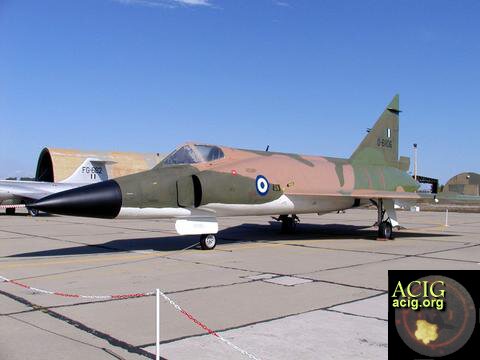
fantasma_337And this is the 4th thread about the F-102 started by PhantomII…
http://forum.airforces.info/showthread.php?s=&threadid=12044&highlight=F102
http://forum.airforces.info/showthread.php?s=&threadid=4260&highlight=F102
http://forum.airforces.info/showthread.php?s=&threadid=5904&highlight=F102
http://koti.welho.com/msolanak/vint_f102.html
http://www.airliners.net/open.file/379791/M/
fantasma_3371 (91-0021) – 1 (116)
In the late 60’s the F.1 was under development. It started to be produced in 1973-74. The Greek F.1CG’s logged no less but 160.000+ flying hours, which means 5500-6000 per airframe – and many of these – over 3.500+ hours – in “live” interceptions over the Aegean Sea, under combat-similar conditions.
http://www.acig.org/artman/publish/article_140.shtml



 Sign In








