Many thanks to Mick at Hawker Hunter Aviation – three beautiful cartridges and canisters dropped through my letterbox this afternoon!
I’ll post some photos when I’ve refurbished WT660’s starter panel…
Many thanks to Mick at Hawker Hunter Aviation – three beautiful cartridges and canisters dropped through my letterbox this afternoon!
I’ll post some photos when I’ve refurbished WT660’s starter panel…
At 4.00pm the police advised that the device was believed to be a naval shell…
http://harrogate-news.co.uk/2012/01/09/hull-road-york-unexploded-device/
At 4.00pm the police advised that the device was believed to be a naval shell…
http://harrogate-news.co.uk/2012/01/09/hull-road-york-unexploded-device/
Moderators have opinions too, and can (and do!) voice them on threads, but abusing their role just because they disagree with the path the discussion is taking is simply childish, assuming the forum rules are still being upheld throughout…
The correct colours for the Hunter topsides would be, as Bruce says, British Standard BS381C gloss Dark Sea Grey 638, and gloss Dark Green 641 (new 241).
The undersides up to around 1966 were Aluminium (often called ‘High Speed Silver’) which doesn’t have a BS381C equivalent. After 1966 the undersides became BS381C gloss Light Aircraft Grey 627, because the metallic Aluminium was no longer available when the paint type was switched from cellulose to polyurethane.
Thanks to other forum members, I can now vouch that Ford Moondust Silver (with a coat of clear lacquer) is a good modern substitute for the old cellulose gloss ‘Aluminium’.
From around 1970 the Hunter paint scheme slowly changed from gloss to matt, and white was dropped from the roundels and fin flash.
Another point to note that, say, gloss Dark Sea Grey, isn’t the same shade as matt Dark Sea Grey which has had a coat of gloss lacquer!
The correct colours for the Hunter topsides would be, as Bruce says, British Standard BS381C gloss Dark Sea Grey 638, and gloss Dark Green 641 (new 241).
The undersides up to around 1966 were Aluminium (often called ‘High Speed Silver’) which doesn’t have a BS381C equivalent. After 1966 the undersides became BS381C gloss Light Aircraft Grey 627, because the metallic Aluminium was no longer available when the paint type was switched from cellulose to polyurethane.
Thanks to other forum members, I can now vouch that Ford Moondust Silver (with a coat of clear lacquer) is a good modern substitute for the old cellulose gloss ‘Aluminium’.
From around 1970 the Hunter paint scheme slowly changed from gloss to matt, and white was dropped from the roundels and fin flash.
Another point to note that, say, gloss Dark Sea Grey, isn’t the same shade as matt Dark Sea Grey which has had a coat of gloss lacquer!
Nice round figure…
Nice round figure…
…Does anyone know how the eject warning triangles would be applied to my D.H. Vampire T.11 ? ( mine have been hand painted and don’t look right(!))
Vinyl in this case might be the answer?
Baz
In a 1950s RAF AP sheet I have for the Hunter ‘stencils’, the ejection seat triangle also looks like it would have been a water-slide transfer, labelled ‘P&S STD.1932.38’ which probably means it could have simply selected from stores using that ID.
Looking at the ‘Engine Starter’ photo below, you can see ‘STD.1932/79’ in the bottom right of the transfer – just as it is described in the AP stencil sheet.
…were printed decals that were applied to the aircraft then covered with some dope to keep them on. Which explains why in all the colour pics the area around the image is darker than the rest of the OD…
I’ve noticed that with WT660’s original decals, the area of the water-slide transfers is easily discernable from the aluminium paint underneath. I presumed that age had discoloured the shellac or whatever they were made from, having gone a darker golden colour, but I seem to remember Airfix kit transfers in the 1960s were similarly discoloured from new!
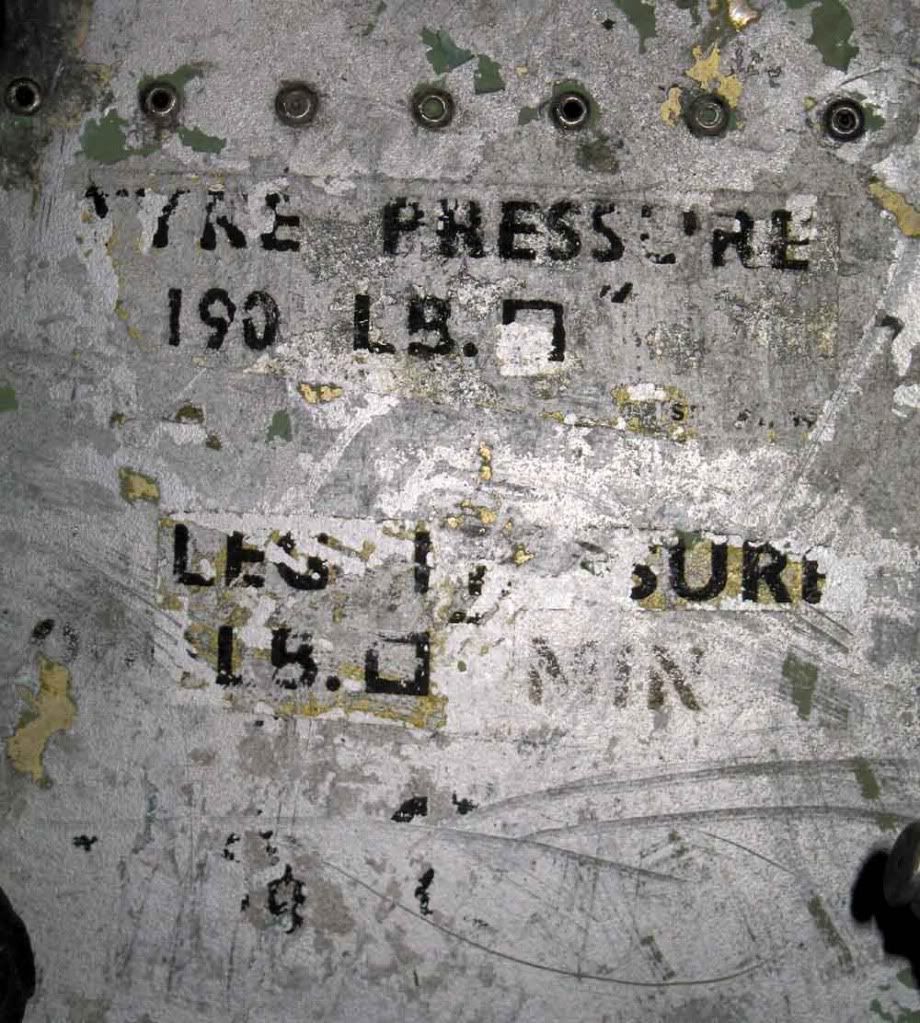
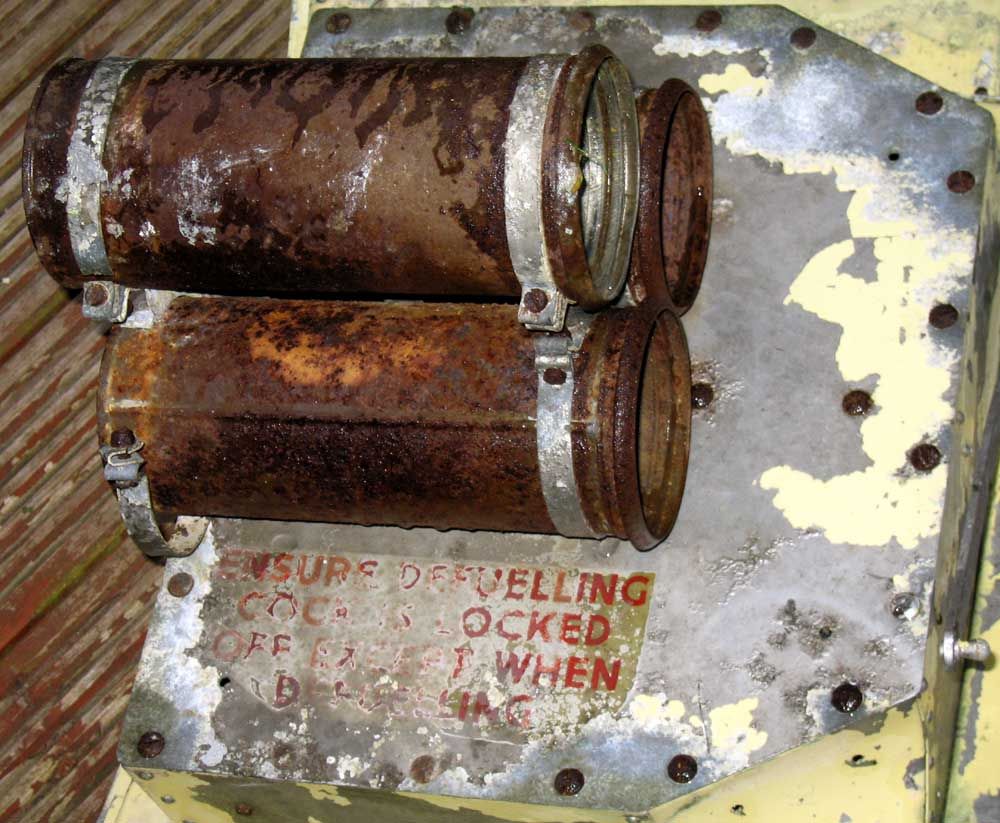
Here are some more of WT660’s transfers:-
Inside the main undercarriage doors…
The engine starter fuselage panel…
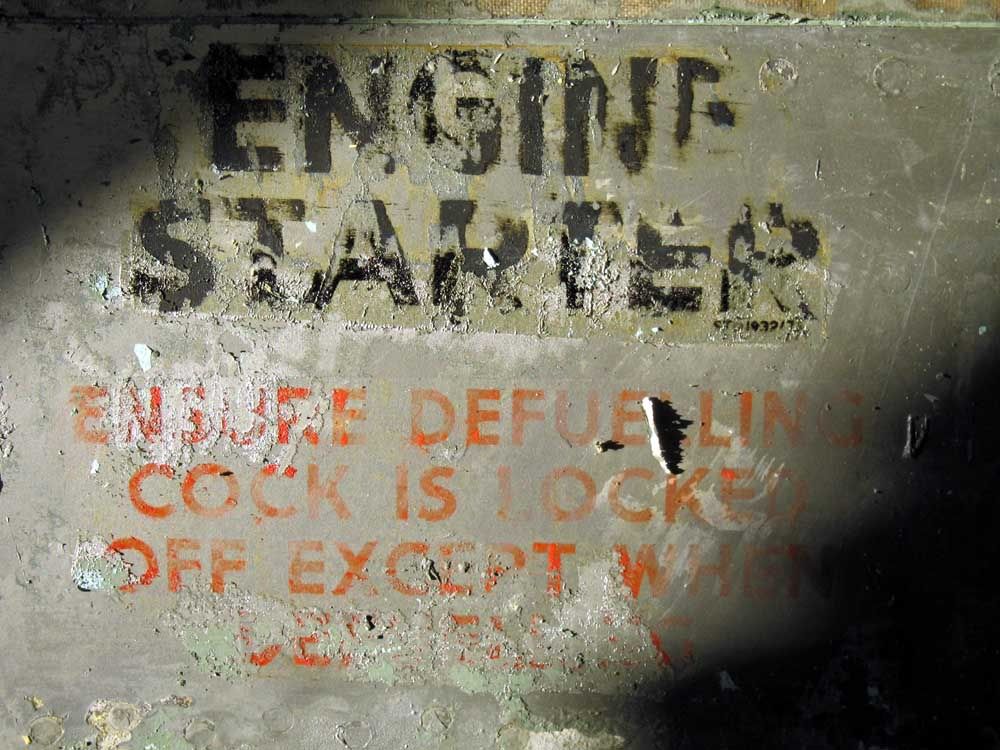
and inside the engine starter panel.
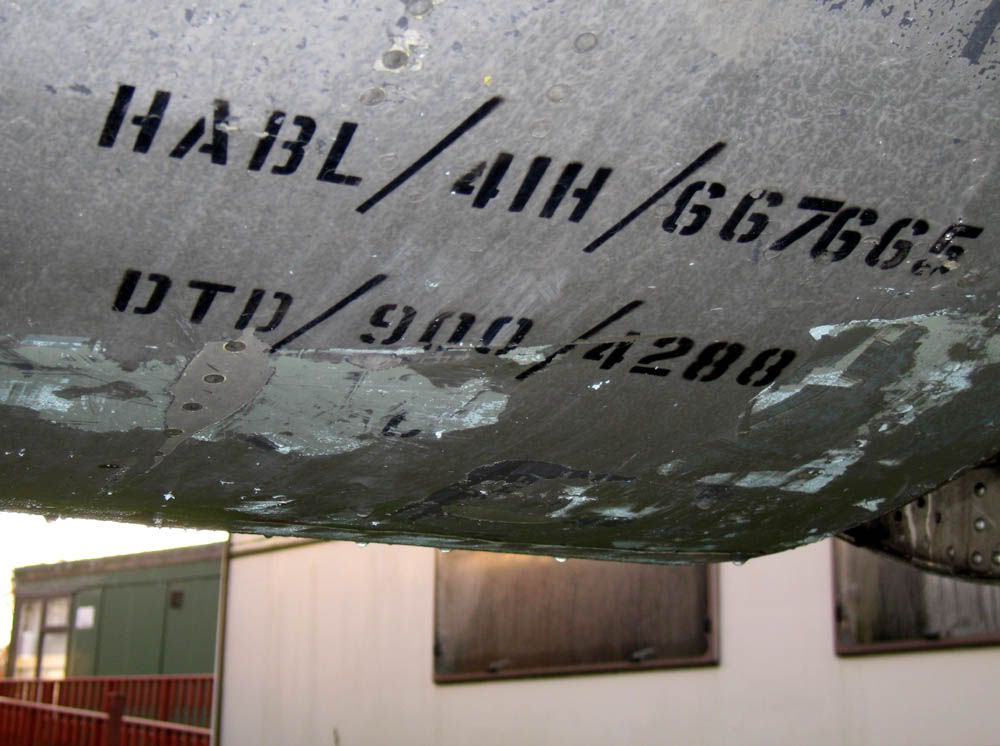
The only actual stencilling I’ve found so far has been under the starboard Sabrina. It’s a bit confusing though, as I presume ‘HABL’ to be Hawker Aircraft Blackpool (WT660 was built at Kingston), and 41H/667665′ isn’t a Hunter construction number as far as I can tell – WT660 is 41H/665495…
…Does anyone know how the eject warning triangles would be applied to my D.H. Vampire T.11 ? ( mine have been hand painted and don’t look right(!))
Vinyl in this case might be the answer?
Baz
In a 1950s RAF AP sheet I have for the Hunter ‘stencils’, the ejection seat triangle also looks like it would have been a water-slide transfer, labelled ‘P&S STD.1932.38’ which probably means it could have simply selected from stores using that ID.
Looking at the ‘Engine Starter’ photo below, you can see ‘STD.1932/79’ in the bottom right of the transfer – just as it is described in the AP stencil sheet.
…were printed decals that were applied to the aircraft then covered with some dope to keep them on. Which explains why in all the colour pics the area around the image is darker than the rest of the OD…
I’ve noticed that with WT660’s original decals, the area of the water-slide transfers is easily discernable from the aluminium paint underneath. I presumed that age had discoloured the shellac or whatever they were made from, having gone a darker golden colour, but I seem to remember Airfix kit transfers in the 1960s were similarly discoloured from new!
Here are some more of WT660’s transfers:-
Inside the main undercarriage doors…
The engine starter fuselage panel…
and inside the engine starter panel.
The only actual stencilling I’ve found so far has been under the starboard Sabrina. It’s a bit confusing though, as I presume ‘HABL’ to be Hawker Aircraft Blackpool (WT660 was built at Kingston), and 41H/667665′ isn’t a Hunter construction number as far as I can tell – WT660 is 41H/665495…

Over the last 30 years or so the UK MoD has squandered billions on escalated or cancelled projects, fatally flawed designs, and politics-based procurement. Lately it has looked like the MoD and BAE shouldn’t be trusted to even put a battery in a torch.
Yet, the governments still send the armed forces to many far-flung bits of the planet to act like global enforcers, while at the same time cutting their budgets and assets. This is where most of the budget goes, instead of actually protecting this maritime nation and its surrounding seas.
For all the huge amounts of money spent, in a war of attrition the UK’s days would be numbered in weeks, if not days. An awful lot of hope seems to be pinned on those 11 subs…