BarnesW
http://www.thedailybeast.com/articles/2015/09/30/did-russia-send-an-anti-u-s-force-to-syria.html
I noticed this article today that would prompt a question.
Does the United states even remotely have the fire power or assets to remove the Russians? In the event of an international shooting incident, do we even have enough F-22s? Discuss.
I think if it comes to US vs RU it isn’t going to be conventional, so it’s noughts and crosses all over, everyone loses.
BarnesWhttp://www.thedailybeast.com/articles/2015/09/30/did-russia-send-an-anti-u-s-force-to-syria.html
I noticed this article today that would prompt a question.
Does the United states even remotely have the fire power or assets to remove the Russians? In the event of an international shooting incident, do we even have enough F-22s? Discuss.
I think if it comes to US vs RU it isn’t going to be conventional, so it’s noughts and crosses all over, everyone loses.
BarnesWWith any luck they’ll find a large terrorist camp out in the countryside and FOAB it.
BarnesWhttp://breakingdefense.com/2015/09/russians-in-syria-building-a2ad-bubble-over-region-breedlove/
WASHINGTON: In keeping with its increasingly aggressive behavior over the past two years, Russia is deploying lethal and long-ranged anti-aircraft defenses to keep Western forces out of three key regions: the Baltics, the Black Sea, and, now, the Levant. From where NATO’s top commander Gen. Philip Breedlove sits, the Russian forces flowing into Syria don’t look like counter-terrorists out to stop the Islamic State, which Vladimir Putin has said is his highest priority. They look like the first pieces of a layered “anti-access/area denial” system that could complicate US and allied operations in Syria and well beyond.
BarnesWWell this is new territory for everyone.
A question for you all:
Are we going to read about more civilian deaths at the hands of the Russians because its the Western media or because they aren’t that careful about where the bombs are being dropped?
I suppose anything is precise compared to a Barrel Bomb.
When nobody except the Syrian government forces are in uniform, how do you determine who the civilians are?
BarnesWBypass ratio is .56 from P&W product card, by comparison the latest F100 is .36 bpr
Okay, then Key Pubs was wrong in what it said.
BarnesWYou mean 0.57? The Al-31 series has 0.59 and it includes supercruise variants (117/117S)
I’m not so sure that 0.57 was correctly derived. The only official information I’ve read says that 57% of the air goes through the bypass stream (KeyPubs F-35 Special 2014, page 34). Now that equates to a BPR of 57/43 not 0.57.
BarnesWAgreed that they were in a frozen state under the Ottoman Empire, but I feel it needs to be pointed out that while Turkey was (eventually, having fought it out) allowed to pursue it’s own course, Britain and France not only carved up the rest of it to suit their interests creating borders which for the most part never really existed before (and thus new nations), but also facilitated the creation of a permanent destabilizing factor in their midst (Israel) which not only put the surrounding region in a continuing state of war and arms race (the Cold War didn’t help here), but also destabilized the secular Arab (first pan-Arab, then nationalist) regimes (or practically dictatorships) as they proved incompetent to solve the Palestinian problem (among many other issues) thus giving an extra spur to the rise of the Islamist parties.
But, this is a very complex topic and would be an endless debate and OT so perhaps we keep it at that; I just thought your post lacked this historical perspective regarding some of the causes of today’s mess since you’ve said that they should be left alone to sort it all out, but they never got that chance due to various strategic interests in the region by some Western powers.
1. Britain didn’t want to create Israel where it currently is. Why? Well it just seemed stupid placing it where they’d be continually surrounded by enemies.
2. They were continually at war even before Britain and France carved them up.
BarnesWSo now how does this work in Syria?
Factions on the ground:
Assad government
Anti-assad moderate rebels (supported by the West/Arabs)
IsisUs coalition strikes
IsisRussian coalition strikes
Anti assad rebels
IsisBy the way how can they discriminate which is Isis, and which are the anti assad rebels (which itself has many2 groups)
It’s more like:
Assad government
Moderate Rebels
Terrorist Faction 1
.
.
.
.
Terrorist Faction 99
ISIS
BarnesWBarnesW, this forum has no appetite for your racist reviewing of modern civilizations. Thx in advance to keep the focus on the topic of this thread.
Statistics do not discriminate, they just are how they are.
BarnesWIts interesting why this very same logic does not apply when we are talking about internal bay and F-22’s kinematics. Su-27 has 47% more fuel than F-15C. Granted its climb and acceleration is not as good at most parts of flight envelope, but I don’t think anyone would call it less lethal due to its kinematics.
Well the Su-27 is almost a decade removed from the F-15 for a start but the empty TWR did take a hit due to the extra internal fuel. However Russia has to cover a vast amount of airspace with relatively few planes, so range is a strong driver there.
You can say Su-27 is bigger than F-15 (21% by weight 10% by planform area), but F-22 is way bigger than Su-27 (21% by weight 26% by Planform Area) and carries 1 ton less fuel than Su-27.
But theoretically, you could put extra fuel in the weapons bay, that’s what you’re missing. The F-22 is larger because it carries 8 AAMs plus attachments internally and the means to launch them under high g or upside-down. TVC also adds a little weight over the original Su-27. You can’t carry weapons and more fuel internally and add TVC and still be as light, obviously you can’t, unless the gap in technology is exponential. Does the Su-27 have built-in jamming?
F-22 has no role in that scenario anyway. You are talking all-around technological and numerical superiority againist your enemy. I don’t like running such scenarios but; on a more equivalent adversary like Russia, A patrol of MiG-31 will easily neutralize cruise missiles (this is its purpose anyway), and Su-27S doing CAPs and MiG-29s doing GAI will neutralize SEAD aircraft.
Some yes, all no. The Su-27s will be shot down by F-22s and the MiG-29s have proved no match even for F-15s thus far. Even on a 1vs1 basis.
At the same time, Russian SRBMs and cruise missiles will target your deep targets, and their Su-27/30/35 will try to achieve air superiority. In the end USAF F-22s will find themselves engaging RuAF Su-27/35, no doubt F-22 will have an edge, but it doesn’t help if it has 1/2 to 2/3 combat persistance of Su-27/35.
The SRBMs have a range of 480km. They can be targeted by a variety of cruise missile from surface or air. They can also be shot down by several US and European systems – Patriot, THAAD, SM-3, SM-2 Dual Capability, Aster 30 etc. What usually happens is fierce fighting for the first night and then the enemy get demoralised by being shot down BVR by an enemy they can’t see and give up. Combat persistence of a dead aircraft is zero.
BarnesWNot really, we just like to pretend they are for political motives. Netanyahu pretty much levelled the whole of Gaza and I don’t see any US-led vote being held at the UN on that. The problem with international law is that it doesn’t actually exist in a set-in-stone way like national law (even though that can be pretty flexible at times too). Whether something is deemed a crime under international law depends on what’s in it for how many people and, as such, it’s a farce. When protesters start shooting, police will start shooting back, which can hardly be seen in the same light as shooting a person in the back at a time when there isn’t a protest and then planting your taser on them. If we don’t like the regime, we report that the government opened fire first, if we do like them, then the protesters are terrorists and they opened fire first.
My own personal perspective on it is that western civilisation endured tens of millions of deaths to reach the point of being a semi-rational, secular democracy. It wasn’t achieved by people emigrating and it wasn’t achieved by foreign intervention, it was simply achieved by people dying for what they believed in for several centuries. Is that acceptable in the 21st century? No, but the Middle East is not in the 21st century and there are several billion too many people in the world, so they should be left to negotiate their own way from the 14th century to the 21st century. And before you get too compassionate, let’s look at the statistics and understand why they are where they are:
23 Jul 2014
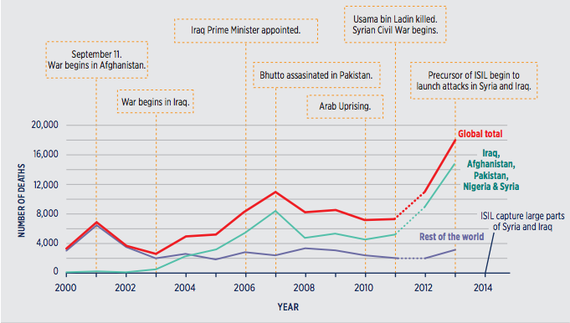
Pointing to a geographic imbalance, the report by the nonprofit Institute for Economics and Peace said five countries — Afghanistan, Iraq, Nigeria, Pakistan and Syria — accounted for four-fifths of the almost 18,000 fatalities attributed to terrorism last year. Iraq had the bloodiest record of all, with more than 6,300 fatalities.
NOV. 18, 2014
Terrorist related deaths have leaped by almost one third in the last 12 months as the world enters a deadly new phase in the cycle of violence
According to the dashboard, Iraq has endured the highest number of attacks in the last year with 3,158 incidents, while terrorism in Nigeria is the world’s deadliest, recording the highest number of deaths per attack, with an average of 24.
The MTSD classifies 12 countries as “extreme risk”, including Iraq at the top as most at risk, as well as Afghanistan, Pakistan, Somalia, Yemen, Syria, Lebanon and Libya. It also includes the growth economies of Nigeria, the Philippines, Colombia and Kenya.
Iraq, rated as the highest risk country, recorded more than three times as many acts of terrorism as Pakistan with 3,158 attacks resulting in 5,929 deaths – an increase of 2,188 on the previous year.
And in Nigeria, the campaign of violence by Islamic militant group Boko Haram saw the country record the highest number of fatalities per attack, with Maplecroft’s figures recording 146 reported attacks between July 1 last year and June 30 this year, resulting in 3,477 killed – an average of 24 people killed per attack, compared to two deaths per attack in Iraq.
http://www.theatlantic.com/international/archive/2014/11/the-geography-of-terrorism/382915/
NOV 18, 2014
The Geography of Terrorism
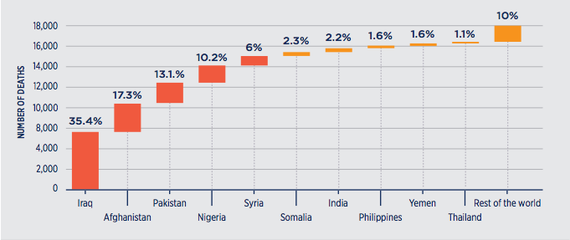
Of the 17,958 people who died in terrorist attacks in 2013, 82 percent were in one of five countries: Iraq, Afghanistan, Pakistan, Nigeria, and Syria. That’s one finding from this year’s Global Terrorism Index report, published by the Institute for Economics and Peace. The report is based on data from the University of Maryland’s Global Terrorism Database, which has information on more than 125,000 terrorist attacks between 1970 and 2013.
The report found a 61-percent jump in terrorism fatalities between 2012 and 2013. “Over the same period,” the authors wrote, “the number of countries that experienced more than 50 [terrorism-related] deaths rose from 15 to 24″—an indication that the problem of terrorism was getting both more fatal and more widespread a year before ISIS declared a new caliphate.
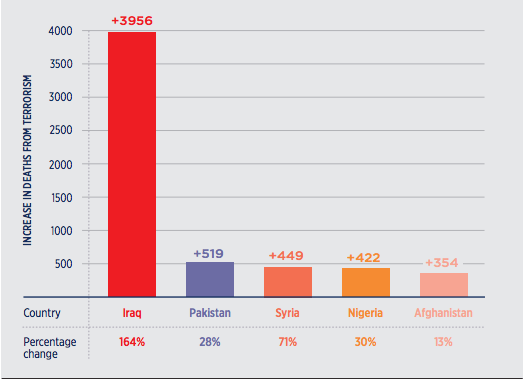
But it’s also striking where terrorism didn’t occur. Much of the increase in terrorism-related fatalities in 2013 took place in Iraq, where terrorists claimed nearly 4,000 lives—a 168-percent increase over 2012. Worldwide, Iraq was the worst-affected country, accounting for 34 percent of terrorism-related fatalities in 2013, with Afghanistan ranked next with 17.3 percent. Meanwhile, between 2000 and 2013, the report found, around 5 percent of terrorism-related fatalities occurred in the 34 wealthy countries of the OECD. In 2013 specifically, there were 113 terrorism-related deaths in OECD countries—0.6 percent of the worldwide total. Six of these took place in the United States.
Deaths From Terrorism, 2000-2013
Percentage of Global Terrorism-Related Deaths, 2013
Biggest Increases in Terrorism-Related Deaths, 2012-2013
^That was even before ISIS.
http://csis.org/files/publication/150618_Patterns_in_Global_Terrorism_in_2014.pdf
BROAD PATTERNS IN GLOBAL TERRORISM IN 2014
Anthony H. Cordesman
June 19, 2015The State Department reports that there were a total of 13,463 terrorist attacks worldwide
in 2014, resulting in more than 32,700 deaths and more than 34,700 injuries. In addition,
more than 9,400 people were kidnapped or taken hostage. This meant the number of
terrorist attacks in 2014 increased 35% and total fatalities increased 81% compared to
2013.Looking back at previous editions and other data one sees the following patterns:
• The Middle East, North Africa, and South Asia continue to dominate world
terrorism. They had a total of roughly 9,600 terrorist incidents in 2013 – the vast
majority of which were carried, out by Islamic extremist or Jihadist groups.• No other region had more than 1,000.
The State Department data also decisively show that terrorism is not a clash between
civilizations, but a clash within one. So do Rand studies that reflect:• A 58-percent increase in the number of Salafi-jihadist groups from 2010 to 2013.
Cordesman: State Department Report on Patterns in Terrorism in 2014 6/19/2015• Estimates that the number of Salafi jihadists more than doubled from 2010 to 2013,
according to both RAND’s low and high estimates.• Approximately 99 percent of the attacks by movements like al Qa’ida 2013 were
against “near enemy” targets in North Africa, the Middle East, and South Asia.
BarnesWTVC affects fuel economy at all speeds. As for nozzle efficiency, there is no evidence of that. The af mil site also says the B-1B can do Mach 1.2 at sea level. If you ask me, 18,000lbs sounds like a rounded figure and 18,448lbs sounds like an accurate figure.
When considering operational deployment you have the false conception of flying a first day mission deep into a peer adversary’s territory with fuel bags. Never going to happen unless you enjoy heavy losses, the progress will be far slower and shorter in radius that that. Deeper targets will be hit with cruise missiles but the focus from an aircraft PoV will be SEADing back their IADS and knocking planes out of the air. After that, you either have the choice of using that region for IFR, or mounting a ground offensive in that region and capturing airbases.
Add internal fuel and you increase the size and weight of the aircraft, increasing drag and reducing performance. As an air superiority fighter, the aim was to remain lethal in air combat, rather than extend range.
BarnesWGetting back to assumptions, if people thinks F-22’s L/D ratio is better, then F-22 would need 7,4% better cruise L/D ratio only to match F-15’s internal fuel range.
In operations L/D would be much better because it carries no pylons or external armaments. Ferry range is unimportant because IFR is available. You’re also neglecting the affect of TVC on trim drag (~5-7%). And you should note that the petal-free nozzles on the F-15 add 3% to its drag. And the internal capacity of the F-22 is 18,448lbs, which is ~8,400kg (page 10-7 http://www.academia.edu/9336427/F-35_Weapon_Systems_Overview).

BarnesWConfirmed.
http://www.nytimes.com/2014/06/30/world/middleeast/iraq.html?_r=0
On the geo political theme, Assad must go. He is a murderer and this has been notified by the UN on a legal basis (vote).
A leader in the Middle East is a murderer?? Shocker! How could such a terrible crime ever have found its way into such a peaceful, stable, rational little region? How many people in that ‘vote’ were democratically elected?


 Sign In