LmRaptor
The French are due to bring the Rafale/Super Etendart(d) to test their aircraft on our ranges. Where? When?
LmRaptorSorry man, you are talking about tail slide all the time (at least that is what i think you mean by “hover” maneuver).
What that has to do with sustained level flight at high AoA? By that definition ordinary Su-27 and Mig-29 can sustain 90° AoA.
Give me some video that can prove that F-22 can sustain 70° in level flight without height drop or 90° AoA.I am not sure what are you trying to prove?
I gave you examples of planes sustaining level flight at 70° AoA or more. You can consider what ever you like, but if the plane flies for prolonged time at high AoA without height drop and in perfect control that is what is called sustained level flight. Is it important if the flight is done almost wholly supported by the engine thrust with 3D TVC nozzles or by any other means?
No I don’t mean a tail slide. I mean the ‘hover’ maneuver, which often becomes a tail slide. I really don’t have to give you any videos, you are free to believe what you want (and this is all in the public domain). The F-22 can sustain 70°+ AoA and roll there.
Falcon, you gave me no examples of sustaining 70° in level flight, and while no doubt the aircraft you refer to can, they were in fact performing instantaneous maneuvers/demonstrations. A sustained maneuver is not defined as:” but if the plane flies for prolonged time at high AoA without height drop and in perfect control that is what is called sustained level flight.”
As to your last question. Of course it is – because it is exactly the same thing as losing altitude while performing a sustained high AoA ‘maneuver’ – except it’s much slower. It’s just a different aircraft orientation. The F-22 can do this easily, while sustaining 70°+ AoA or even 90°+ AoA (depending on how slow you want to go) — but like an Su, it wouldn’t be sustaining any appreciable forward velocity.
Also, I don’t see what you are trying to say when you compare the F-22 departure test video to an Su airshow video. ANY of these jets will depart flight in those test conditions. When they go below a particular velocity threshold and roll, it will result in the aircraft tumbling, even at really high angle of attack (providing the aircraft isn’t sitting on its own thrust as I refer to above). A Su-XXXXX would experience exactly the same thing – because 3D TVC doesn’t have close to enough thrust to over come the inertia of a tumbling aircraft. It might well recover quicker… but it would tumble none-the-less.
LmRaptorI can’t watch the videos you have provided because my internet connection is currently too slow, while at work I will have similar problems for different reasons.
What I will say is that I have seen the F-22s departure testing videos and they have no bearing on whether it can roll at extreme AoA. It can, while maintaining controlled flight at. It just won’t be doing it at close to the rate a 3D TVC equipped fighter.
LmRaptorF-22 can sustain 90° AoA for very short period of time when performing a tail slide. At 90° AoA he is standing still and he can control only pitch angle. Stronger crosswind could cause sideslip and F-22 doesn`t have means to control sideslip angle at 0 speed, only planes with 3D tvc can do that. In other words F-22 can`t sustain 90° AoA. Only when he starts to fall (he starts to build up speed) he can use elevators for directional control.
This is what happens when F-22 starts to roll at high/critical AoA http://www.youtube.com/watch?v=VOro3MDF_sI . He goes to spin.
And this is what happens when Su-35S starts to roll at high AoA http://www.youtube.com/watch?v=oTypIHLqG2I at 10:40 sec. He uses directional TVC control to finish high AoA 360° roll without any problem.
The F-22 can sustain what is effectively 90 deg AoA, irrespective of sideslip while lacking 3D TVC. A skilled pilot in the ‘hover’ maneuver can use pitch vectoring to generate a forward force while maintaining the same altitude by using throttle modulation and variable stick inputs. This would be a sustained maneuver by the definition you have been using.
In practical terms I would consider these types of maneuvers to be instantaneous or perhaps transient. This is because the aircraft’s mass is almost wholly supported by the engine thrust, resulting in extremely (and I stress extremely) low speed maneuvers.
LmRaptorOk, then on that basis the F-22 routinely sustains 90 degree AoA maneuvers at airshows. Whenever the F-22 performs the ‘hover’ maneuver with its nose pointed vertically, any lateral movement would count as a 90 deg AoA.
All that is happening is careful throttle modulation as you kindly pointed out. But again the critical thing is the bulk of the aircrafts mass is being ‘lifted’ by the engines. That is the same with all of the sustained ultra high AoA maneuvers (except for when the aircraft is virtually falling) I have seen at airshows
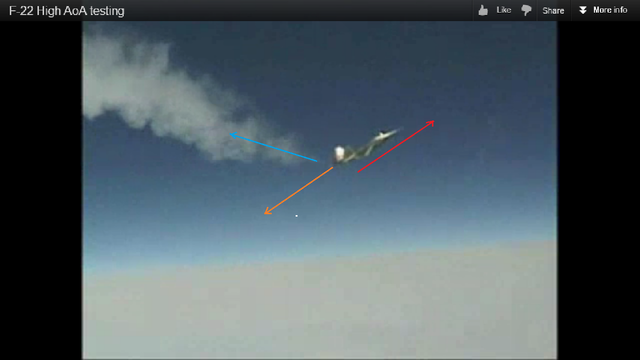
LmRaptorI asked because direction of the exhaust condensation looked deflected to me.
But when I looked closer I saw that F-22 is actually sinking (probably in every single instance) so maybe direction of the “wind” can cause exhaust condensation to look deflected. Any way, maybe you are right regarding TVC and I do agree with everything else you just said.
At air show F-22 is not going over 40° at level flight when we look at Slow Speed Pass Parameters.
In contrast to that Su-30MKI is doing ~70° AoA in level flight at air shows.
http://www.youtube.com/watch?v=VAfXdQSomIk
2:34 sec of the video.
While admittedly impressive, the Su-30MKI is not actually sustaining that maneuver. It is using a combination of thrust vectoring and canards to balance the aircraft in a position where its thrust is used to maintain altitude. The forward motion of the aircraft is actually coming from its initial momentum, and when that is bled off it is forced to roll or climb out. It is therefore an instantaneous maneuver, which is prolonged by the relatively low drag force at 70 km/h.
LmRaptorAll high AoA testing above 20-30 degrees is technically a controlled stall TooCool_12. A Cobra or a Kulbit are both examples of instantaneous controlled stalls. The nose down pitching moment during the recovery from one of these manoeuvres is the result of aerodynamic hysteresis. Its magnitude can give you a clue as to how refined the aircraft’s aerodynamic design is, and how effective its control authority is.
A stalled wing still provides lift however. The lift generated in this post-stall environment can be mathematically modelled as a dynamical system which sometimes composes of Hopf Bifurcations and their associated limit cycles.
The limit cycles define the coefficient of lift in stalled air flow. This means for a given AoA, Reynolds Number, Mach No, Altitude etc… the coefficient of lift is time dependent. The coefficient of lift at a given point in time has a potential maxima and minima, which is bounded by the limit cycle. The coefficient of lift could also be anywhere in between these maxima and minima at any point in time
Aerodynamicists are mainly interested in the potential maxima and minima of stalled flow coefficient of lits .
LmRaptori.e. straight and level flight assuming the chord line is in line with the horizon
LmRaptorhaavarla, Fornoff was talking about the F-22s sustained turn rate rather than its AoA.
The F-22 has actually been tested at over 70 deg of sustained and controllable AoA.
mack8, 360 deg AoA is geometrically impossible.
LmRaptorI think its a fair bet that the FA18E with the EPE will get above mach 1.6 with BVR missiles. Or what do you think? 20% extra thrust gives over 2% extra speed? http://www.boeing.com/AeroIndia2011/pdf/Aero_India_Super_Hornet_Briefing.pdf
@LmRaptor: We can argue forever on the topic. But if the EWS is up to date then its near impossible to get a BVR kill. WVR or short range missile kills will always be tricky to evade and thats where kills will continue to dominate.
Thats fine Tu22m. I will simply disagree with you on the basis that there is no difference between WVR/BVR as far as the missile is concerned. The only discriminator here is the capabilities of the weapons themselves. If a BVRAAM is more capable than a WVRAAM when comparing them in their respective domains… it will score more kills by virtue of being more capable and by being fired first.
The line “short range missile kills will always be tricky to evade and thats where kills will continue to dominate” doesn’t mean anything… because you are basing that on historical evidence rather than current and more importantly future missile capability (reflecting the heavy BVR emphasis in current AtA planning).
It just so happens that for technological and historic reasons – WVRAAMs have generally been guided by IR based sensors as opposed to RF sensors – making them effectively unbeatable by current conventional soft kill techniques (Lasers will start to change this). This gives them impression that WVR as a doctrine is superior to BVR, whereas the truth is the concepts are exactly the same; but its the relative capability of the missiles in each domain, which changes the outcome of what philosophy is more successful at any point in time.
LmRaptorYou are welcome to believe what you like. I was very skeptical myself.
LmRaptor@ Sintra it depends on who you ask. Some people I have spoken to claim the technology freeze for the METEOR has effectively put the missile in the stone age with regard to ‘software related bits’. It will be interesting to see how well the METEOR tests in the comings years.
@ Sens you sometimes talk utter nonsense mate. I think the evolution of SAR modes found in AN/APG-77 or AN/APG-81 are a clear indication of whats been happening in providing a ‘true’ look down shoot down capability.
@ Tu22a I agree that countermeasures evolve as rapidly as the threat. The difference today is that missiles are not necessarily the main form of end game guidance anymore. The concept of net-centric warfare in theory allows for numerous datalinked sensors to provide guidance right up to the end game. As a result, ECM, Chaff, Towed Decoy etc can be completely overwhelmed. So ECM vs. ECCM etc might be a cat and mouse game with one side having a temporary advantage. But the shift in AtA philosophy and the introduction of the datalinked ‘Gods Eye’ supported by numerous aassets (using RF/IR/UV/ESM/HOJ) – provides a seriously difficult challenge to even the most advanced enemies. See what the Typhoon chaps said about F-22 BVR – and as far as I know they had full DASS by then. For me the major challenge to BVR missiles is the end game kinematics against F-22/Typhoon type targets i.e. targets with good supersonic manoeuvrability and acceleration.
LmRaptorTu22m I agree the missile has been the weak link by far in bvr combat. The thing about the missile is its now supplemented by third party targeting, 2 way data links, lock on after launch, HOJ, improved ‘silent’ tactics and a much more comprehensive networked environment. With dual mode or evn tri mode seekers in the works, the pks of these systems are more likely to be increase relative to the combat results demonstrated. Seeker and guidance technology is only just coming out of its infancy.. and if you keep it cool, the reliability of the weapon increases significantly.
LmRaptorPeregrinefalcon, what you say is true in general, but the reality is the F-22A has a marginal range advantage when compared to the Typhoon. This relates to both jets flying without external fuel tanks or stores, in ideal cruising conditions, utilising a step climb procedure to ensure max L/D as aircraft mass drops due to fuel consumption. I don’t care what anecdotal evidence is out there that says otherwise.
LmRaptorAre you still working for LM djcross?
And if so are you working as part of LM Aeronautics?


 Sign In