LmRaptor
Satorian, like you I also would not be suprised if the 22 can Supercruise at those lofty heights – what exact Mach No’s it does it at? Classified.
Apparently according to the latest AFM the F-22 can SC at Mach 1.82 now. With a top end speed of Mach 2.25 and sea level speed of Mach 1.4.
________
Sucks ****
LmRaptorOh come on flex – calling VLO/LO a useful feature as opposed to a major technical breakthrough is just ignorance.
@ppp – The F-22/B-2 have been tested against more than just X-band radars mate, many SAMs don’t operate in X-band.
Long wave radars are nothing more than early warning systems – they don’t have the ability to track a target like the F-22/B-2 for a firing solution. They are generally imobile and massive. Quite easy targets on the first day of war.
Short wave radars simply don’t have the power by quite a margin. Even if employed in enough numbers to make a full umbrella against F-22/B-2 – they are vulnerable to DEAD/SEAD where they will be attacked at the edges and eroded.
Optical systems have major issues such as range finding – volume/area search just to mention two – a cloudy day? Against a supercruising F-22 at 65 000 ft launching 8 SDBs from 113 km away?
The JSF will have bigger problems.
________
Cheap utg universal horizontal shoulder woodland
LmRaptorJack keep the faith :). While some people are still desperately arrogant in their desire to hear what they want – there still are people who greatly appreciate you giving us ‘tidbits’ of valuable information.
LmRaptorAnyway, it was apparently stealthier than the F-22, and significantly faster. Rumor has it that supercruise speed of the GE F120-powered example was right about Mach 2, with maximum theoretical speed being significantly higher than the airframe’s redline speed. The F-23 could’ve been the world’s first Mach 2 fighter to not have afterburners! I’ve said before that the GE-powered YF-23 is probably the single most advanced fighter aircraft ever flown.
Many of that is very debatable, from the F120 up.
Anyway as to my opinion – I believe the biggest watershed in fighter technology was the invention of the Radar and Jet engine. I’d say guided munitions and stealth resulted from these two inventions and hence were only slightly less ground breaking.
Potentially for me there is little doubt that the synery combination of the F-22 gives it the mantle of the most revolutional air-air fighter out there. For the first time in we have radar/guided munition systems working as advertised and the F-22 gives the pilot a suprise advantage not seen since WW1/11 – while it combines the performance of the lastest fighters into the package aswell. With a whole host of yet ‘untapped’ capabilities. With a small production run and a current change in the type of warfare being fought will it ever live up to that potential and show it in combat? I can’t claim to know.
So in reality what has revolutionised aircombat the most. F-117/B-29 nuke/WWII strategic bombers/P-51 Mustang/F-4 multirole capability.
________
Bad_Bald_Kitty
LmRaptorWhat! Have you not seen:
The Tuskegee Airmen
Firefox
The Sum Of All Fears (the BACKFIRE strike scene)
Thirteen Days
I mean a blockbuster film dedicated to aircraft like Top Gun.
________
Side Effects From Prilosec
LmRaptorThen why fly towards Reading to start with, thus getting mixed up with Heathrow traffic, then turn back? It initially approached from the direction of Yeovilton.
It’s a rarity seeing any military aircraft overhead here, except for a week once every two years. I’ve always assumed that they’re deliberately routed away from the area, because of commercial traffic. Apart from Heathrow traffic, we get low-flying light aircraft, police helicopters, etc.
Sorry I didn’t read the first paragraph of your previous post.
LmRaptorDo you guys across the pond send up Typhoons/Tornados in case some little Cessna gets lost keeps overflying a nuke station, wont land or answer the radio?
Well I guess my question is, are Typhoons on QRA yet? I thought I had read they were, maybe thats a possibility.
Oh and the nuke powerplant incident? Happened here in the states, it was nighttime and the guy was drunk, kept flyin around at low level, they finally got him to land somehow. Idiot.
The tiffies in the south I think have overtaken the tornados in QRA but im not sure.
LmRaptorCould you elaborate?
Sure – wing fences effectively channel spanwise airflow (airflow moving along the wing) into chordwise airflow (flow that moves from the front to the back of the wing) – the process that generates lift. If wings had an infinite span this would not be an issue, but in practice they don’t 🙂 obviously. Remember the spanwise flow gets greater along the wing – resulting in the outer wing section stalling – so as an engineer one doesn’t want this. So instead of using larger, draggier, more radar relective and less efficient lift generating surface the modern day engineer uses a notch in the leading edge section of the wing to eliminate or at least offset the effect of this spanwise flow.
________
LovelyWendie99
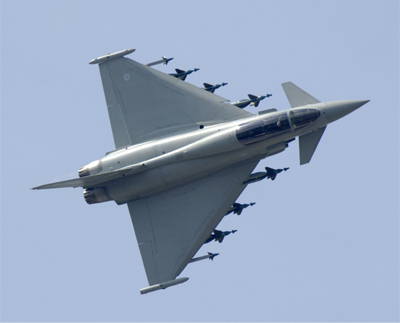
LmRaptorGiven that Farnborough’s over, can anyone suggest why a solitary Typhoon would fly low & slow over Reading ten minutes ago (i.e. 14.30 BST). Approached from the SW, then applied more thrust (clearly audible), turned, & flew off to the West. First one I’ve seen here.
For those who don’t know the local geography, Farnborough is to the SE. We rarely see military aircraft here. We’re directly under the flightpath for transatlantic flights to & from Heathrow, & not terribly far away. I can now hear the usual low rumble of airliners overhead – ah, a big twin descending (A330 or 777, can’t tell from here, & this angle – went directly overhead) towards Heathrow.
Perhaps it was heading to Yeovilton?
LmRaptorThe SR-71 for me was amazing becaue of the time scale it was built in more than anything else. 8 months from the drawing board to flying prototype if I remember correctly. I agree with Jack that the F-22 and the F-117 were perhaps more challenging than the F-35 in many areas. ATF developed the F119/120 – the basis for F135/136. The 77 is the basis for the 81 and MLD was the basis for DAS. Sniper pod was the basis for EOTS and AN/ALR-94 is reportedly more advanced than the EW suite on the F-35 – or it has at least much more potential in follow on upgrades. The lift system on the F-35 is interesting, but lets be honest, it’s a niche capability. Is STOVL really needed? Most studies I have seen show it’s not as big a game changer as the public have been lead to believe. The F-35 first needs to overcome its STOVL problems before we can judge it – while it will be the least capable of all 3 variants.
Read this piece by Bill Sweetman over at Ares – regarding JSF development.
With Farnborough coming up, we’re no doubt going to hear a lot from Lockheed Martin about how well the F-35 program is going. With that in mind – and given that there won’t be time next week to look at history – it’s a good opportunity to compare progress with the closest historical parallel, the F-22.
The F-35A made its first flight in December 2006, so we are now about 19 months into the test program. The F-22 flew in September 1997. What had been accomplished in April 1999, 19 months after that event?
In both programs, two airplanes were flying at the 19-month mark. but the second F-22 flew at the nine-month point and moved immediately to Edwards AFB to join the combined test force. Both F-35s are still flying from Fort Worth. At the 11-month point, in August 1998, the F-22 performed a full inflight refuelling, allowing test sorties to be extended.
With that accomplished and two aircraft flying, the F-22 hit a Congress-mandated target of 183 flight-test hours by late November 1998, less than 15 months after first flight. By the end of 1999 the total was 500 hours, so by April the F-22 force was probably well past the 250-hour point. The 100-sortie mark was passed in May 1999.At 19 months the F-35 has notched up 45 flights on two aircraft. The STOVL F-35B has performed two of those. Dry refuelling tests were completed in March but no fuel has been transferred, and despite the F-35’s large internal fuel capacity the average sortie has been around an hour. (That also suggests that the jet is flying at take-off weights under 45,000 pounds, versus its 70,000 pound maximum – no wonder it outruns the F-16 chase.) At this point, therefore, the F-22 had flown more than twice as many sorties and the F-35, and four to five times more hours.
The F-22 went supersonic in October 1998, which the F-35 has yet to do. By this point, too, the Boeing 757 flying test bed had flown with mission avionics on board – that won’t happen in the F-35 program until year-end.
By the two-year mark (September 1999, corresponding to December 2008 for the F-35) the F-22 had supercruised and reached a 60-degree angle of attack.There are real reasons for the difference. The longer delay between the first and second F-35s reflects the fact that BF-1 incorporates the major redesign carried out in 2004-2005 to fight weight gain. The first aircraft was grounded for a time because of problems with the flight control actuators last year.
But still this underlines how much work has to be done to meet the stated initial operating capability dates for JSF: mid-2012 for the Marines (four years from now), a year later for the USAF. In April 1999, the F-22 was still five and a half years from IOC.
To put it another way: JSF plans some 66 months from first flight to IOC. One third of those months will be behind us in October and fewer than one per cent of the planned test hours have been accomplished. Now, we all know that flight testing accelerates geometrically as more airplanes join the force and as they get more reliable, but there’s still some hard work ahead of the JSF program.
By the way, the F-22 is making its international air show debut in the UK this weekend, with two days at the Royal International Air Tattoo and a one-day-only appearance at Farnborough on Monday. A gutsy decision, guys – it will be sad if the cloudbase is at 300 feet and it’s raining, and as a Hampshire kid I will tell you that’s a distinct possibility.
Postscript: An email jogged my memory, reminding me that at least two 1950s fighters – the McDonnell F-101 Voodoo and the Chance Vought XF8U-1 Crusader (the latter designed not far from Fort Worth) – went supersonic on their first flights. The XF8U-1 now belongs to the National Air & Space Museum and is being restored by the Museum of Flight in Seattle.
LmRaptorIsn’t the notch in the L/E of the English Electric Lightning wing there for the same purpose ??
Ken
Yes.
________
Arizona dispensary
LmRaptorEven modern Gulfstreams employ wing fences – but they are by no means the most efficient way of preventing in simple terms: spanwise airflow (airflow inbetween root and tip – which stalls the wing preventing chordwise airflow from front to back).
________
VAPORIZERS
LmRaptorNever saw that movie, dont pay a lot of attention on these figther-movies, but never underestimate the craptastic holywood powers 😉
The best movie involving fighters was the “flight of the dark angel”…or something like that, no cheesie “young ameicans cool pilots on their uber fighters”, no “evil commies, muslims, ruskis”, was about an excelent american pilot, but depressed to madness, his kfir and a nuke ;), and his instructor that thought he knew all about him, never liked the plot turn in which he kills all his family, the story would have been more interesting
Anyway..expect another generation of OMG! this XY plane is the best uber crap ever! 😉
I watched that a long time ago. Brings back memories :).
________
MAINE DISPENSARIES
LmRaptorAre the RJs 18/19/20 not RC-135Ws as opposed to Vs?
________
Cheap Airsoft Powered Guns


 Sign In