 Stonewall
Original URL: http://www.theregister.co.uk/2009/12/02/type_45_viper_paams_fail/
Navy’s £1bn+ destroyers set to remain unarmed for years
Ex-British miracle missiles in new test FAIL
By Lewis Page
Posted in Science, 2nd December 2009 14:46 GMT
Free whitepaper – A Closer Look at WS_FTP Server
The “Sea Viper” missile system for the Royal Navy’s new Type 45 destroyers looks set to suffer further setbacks following a reported failure during test firings. The weapons are already so late that the first £1bn+ Type 45 has been in naval service for nearly a year – almost completely unarmed.
HMS Daring during sea trials
Might as well park her up for a bit, lads. You’re wasting your time
News of the test failure comes courtesy of the Ares blog, reporting remarks by Andrew Tyler of the UK Defence Equipment and Support (DE&S) organisation.
“[The test failure] has been a setback,” says the MoD mandarin.
“We are working extremely hard with the other partner nations and the company to resolve what the problems were with the final firing … [It is] too early to come up with the diagnosis.”
Sea Viper is the Royal Navy’s name for its version of the Principal Anti Air Missile System (PAAMS), European industry’s answer to the highly successful American Aegis/Standard, which has nowadays developed to the point of being able to shoot down satellites in low orbit (http://www.theregister.co.uk/2008/02/21/spy_sat_shoot_hit_secrets_safe/). Sea Viper/PAAMS is largely French and Italian in origin, but includes some British technology too.
The system’s promised special sauce is that it is supposed to be able to knock down supersonic sea-skimming antiship missiles, a thing that even the latest Standard SM-2s may be unable to do. Such missiles are a terrible threat to surface ships without air cover, as they will only be seen by a mast-mounted radar as they emerge above the horizon during the final minute of their flight. Sea Viper/PAAMS is supposed to be able to detect a hostile shipkiller the second it appears, fire an Aster countermissile almost instantly, tip the Aster over from its vertical launch and fly it to intercept the shipkiller head-on at a closing speed in excess of Mach 5.
There has always been some doubt as to whether this is worth doing – it would be cheaper and simpler to deliver maritime air cover from carriers than provide every convoy or task group with a screen of £1bn+ destroyers. Airborne radar can cover vast areas of ocean, tracking sea-skimmers over their entire flight, and patrolling jets would have a much easier task taking down the shipkillers with time in hand from behind – or, even easier, attacking the plane or ship carrying them.
HMS Daring will probably be on her third captain by the time she’s actually armed
Now it seems possible that the miracle destroyers can’t actually be built anyway, or certainly not yet by the PAAMS coalition. Ares reports (http://www.aviationweek.com/aw/blogs/defense/index.jsp?plckController=Blog&plckScript=blogScript&plckElementId=blogDest&plckBlogPage=BlogViewPost&plckPostId=Blog%3a27ec4a53-dcc8-42d0-bd3a-01329aef79a7Post%3afe9f8c24-186a-4a57-83c5-ef292ba7fe73) that the final test was “the most stressing of the test firing program”. Shooting down multiple supersonic sea-skimmers is the most difficult thing that Sea Viper would ever be tasked to do – so we can take it that it can’t in fact do what it says on the tin.
This is embarrassing on many fronts for the MoD. Firstly, the Ministry deliberately chose to continue with PAAMS when the multinational Euro-warship project foundered and Blighty went on alone with the Type 45 – even though an Aegis system in a British hull would have been far cheaper and more capable (http://www.theregister.co.uk/2009/06/23/type_45_cpac_slammage/page2.html).
Secondly, the only real reason this was done was in order to preserve British jobs and tech expertise. This too has been a failure as BAE Systems – the UK part of PAAMS – has already fired those workers anyway (http://business.timesonline.co.uk/tol/business/industry_sectors/engineering/article6934053.ece), before the system is even in service. The weapons are no longer even partly British.
Thirdly, Sea Viper/PAAMS is about the only reason for having a Type 45 destroyer. Space has been included in the ships’ design for Tomahawk cruise missiles, but none have been bought and there is no sign that any will be. We already have the ships, but in the absence of Sea Viper they are embarrassing, expensive white elephants.
HMS Daring, first of the Type 45s, will have been in Navy hands for a year in eight days’ time. She is armed with nothing but a 4.5-inch “Kryten” gun turret and a pair of light 30mm cannon, suitable for shooting up pirate dhows and the like. This is an utterly pathetic amount of punch for a £1.1bn (at the latest estimate) warship with a crew of 200. Her first captain has already been and gone; the second, it now seems certain, will also depart before the ship is capable of achieving anything even vaguely in proportion to her cost or even vaguely worth his time commanding her. It won’t be at all surprising if the same thing happens with the second Type 45, Dauntless, which has just arrived (http://www.google.com/hostednews/ukpress/article/ALeqM5h_0eRNsFUCRFvXETb7Uq0ITqf9JA) in Portsmouth ahead of handover to the Navy tomorrow.
The whole saga is made even more depressing by the fact that it is very largely the vast expense of the Type 45s which has led to the swingeing cuts to the rest of the British fleet seen in recent years, and which is imperilling the future of the new carriers which would be so much more useful.
We’ve asked the MoD for more details on the test failure, but as of publication hadn’t heard back. We’ll update this as soon as we hear. ®
Stonewall
A Russian Ka-52 attack helicopter maneuvers on the deck of the French Navy amphibious ship Mistral in Saint Petersburg. (French Navy photo)
French Ship Mistral Hosts Russian Naval Aviation
(Source: French Navy; issued Nov. 30, 2009)
(Issued in French only; unofficial translation by defense-aerospace.com)
“This day will mark history.” These are the words uttered on November 27, 2009 by the Director General and Chief Designer of the Kamov firm, Mr Sergei Viktorovich Mikheyev, at the first landing of the Russian Ka-52 combat helicopter aboard a helicopter carrier. In this case, the ship was the French Navy’s Bâtiment de Projection et Commandement (BPC) Mistral.
Having barely sailed out of the Neva, in the heart of St. Petersburg, where the Mistral made a four-day visit, the ship made a “cross deck” landing exercise with Russian Navy helicopters. For over an hour, several deck landings were made by a Ka-27 (Helix anti submarine warfare helicopter), a Ka-29 (assault transport helicopter) and the impressive Ka-52, which also simulated a refueling on the flight deck of the Mistral.
The Ka-52 is Russia’s latest combat helicopter, and like other helicopters designed by the Kamov design bureau is fitted with coaxial main rotors. Thanks to the absence of anti-torque tail rotor, they offer stability and exceptional agility. Another originality of the Ka-52 is its ejector seats, which allow its two pilots, installed side by side, to be extracted from the aircraft after the blades are blown off in less than 6 seconds.
The Ka-52, which has not yet entered active service, thus made its first deck landings on the Mistral, whose choice is a strong symbol of the friendship between Russia and France.
Further evidence of the close Franco-Russian relationship was given by the participation of a French officer to the KA-29’s deck landings. Ensign Rémi Wasseln, helicopter flight deck officer on the Mistral, made several landings in the Mistral aboard the Ka-29. It is with ill-concealed joy that he commented on these bilateral exercises: “It’s a rare moment that I experienced, and I will have fond memories of being able to fly over the Mistral in the Ka-29 while a Ka-52 was in the landing circuit. The crew of the Ka-29 was very friendly, and showed great kindness to me. I look forward to working again with the Russian navy, maybe with the Ka-52,” he said.
In unison, General Nikolai Victirivitch Kuklev, acting commander of the Russian Naval Air Arm, M. Mikheev and Captain Didier Piaton, commander of the Mistral, welcomed the ease with which these exercises were smoothly conducted. Adapting protocols, acclimatizing to new operational cultures, and communicating when not speaking the same language are not easy accomplishments. These difficulties have been overcome by the common desire of the Russian naval aviation and the French navy to mark this day in history by allowing the Ka-52 Russian made its first deck landings on the French Mistral.
(EDITOR’S NOTE: The Russian government has shown interest in purchasing one or more Mistral-class amphibious ships from France, and the visit to St. Petersburg was an initial demonstration of its capabilities.
-ends-
Stonewallsounds very much like a wish list. I would have expected contracts more than just ‘we want this fleet’. Sounds a little fanboyish no gov info just the name of a government program. I would have expected quote from a Def, Min to be talking about this and i don’t see it on either of the links and their would be much more info on all the various forgine desgines.
The link at the bottom is far more modest a replacement of the Vosper Frigates with a Hobart class as a possibility. My cynicism means i can’t take it seriously as their has been no evidence of Brazil spending such a huge amount on defense. If the Junta was in charge I might have believed it but a left wing ex trade unionist not so much.I have a feeling the link isn’t genuine
I already asked a Brazilian guy for an official link of that list, if and when I get it I will post it here.
ps- Don’t forget the findings of vast oil fields on the brazilian coast, plus the reactivation of the 4th fleet, among other things…
also the construciton of a new naval base in the North (Maranhão) seems almost certain…
meanwhile here is a link form the OFFICIAL SITE OF THE BRAZILIAN NAVY
http://www.mar.mil.br/peamb.html
(It does not go into much detail as the “wish list” (as you put it) but it shares some light on the subject
Stonewalltaken from another forum (google translation)
a summary of the current Renovation Program of the Navy, current PEAMB, to run until the year 2030.Foram excluded from the modernization programs. The total planned investment and $ 95 billion (including the upgrades in progress).
FLEET (except Naval Aviation), and DHN Forces District:
15 submarines, diesel-electric (4 contractors);
06 nuclear propulsion submarines (1 contract);
02 aircraft carriers (similar to Charles De Gaulle with conventional propulsion);
04 multiple-purpose ships (these ships will be the Mistral class);
30 escort ships;
04 ships carrying aid;
05 vessels logistical support;
01 submarine rescue ship;
12 ocean patrol vessels of 1,800 tons;
27 patrol vessels of 500 tons (6 contractors / construction);
04 patrol vessels of 200 tons;
14 river patrol boats;
05 ships of hospital care;
08 tankers and support river;
08 sweepers;
08 minesweepers;
12 tugs of the high seas;
01 ship Oceanographical;
04 ships activities;
01 research vessels, and
01 polar ship (class icebreakers).Naval Aviation:
48 aircraft for high-performance air defense;
08 AEW & C aircraft / CDO / tankers;
16 ASW helicopters / ASuW (4 SH70 acquired);
66 medium helicopters overall employment (16 engaged EC725);
60 light helicopters for general use, and
30 light helicopters instruction.Corps:
78 cars caterpillar amphibians;
26 tanks;
42 armored personnel carriers (Piranha IIIC);
36 shells campaign;
06 rocket launchers;
02 air defense systems, and
02 electronic warfare systems.Weapon Systems:
Heavyweight torpedo;
Lightweight torpedoes;
Minas contact and influence;
Surface-surface missiles;
Surface-to-air missiles;
Sub-surface missiles;
Air-ground rockets;
Anti-tank missiles;
Rocket missile decoys;
Rocket torpedo decoys;
Pumps depth;
Smart bombs;
Explosives;
Naval ammunition;
Ammunition light weapons;
Artillery ammunition, and
Fireworks in general.
also:
In recent months, after the Navy of Brazil will create programs for future escorts ocean patrol vessels, ship logistics and carrier, shipyards, several countries began to present their proposals, they say, would have full support their respective governments. As for aircraft carriers, it should be noted that the Navy of Brazil intends to operate a multi-purpose vessel, which may be one LHA or LHD (similar concept to the Spanish project for Australia and other, more conventional, to replace the São Paulo Carrier .
continues(in portuguese)
>>> http://pbrasil.wordpress.com/2009/07/15/especial-prm-reaparelhamento-da-marinha-do-brasil-candidatos-e-previsoes/
Stonewall
Royal Navy aircraft carrier may be sold to India
Government considering sale one of two £2bn machines as part of strategic defence review
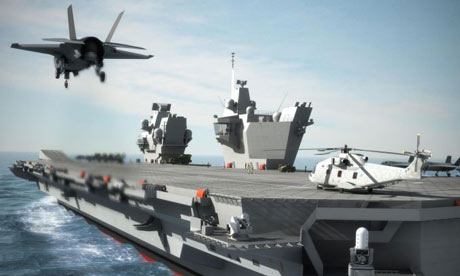
Computer generated image issued by the MoD of an aircraft carrier that is due to be built in Britain. Photograph: MoD/Crown Copyright/PA Wire
One of the Royal Navy’s new £2bn aircraft carriers could be sold off under government cost-cutting plans, the Guardian has learned.
It is understood that India has recently lodged a firm expression of interest to buy one of the two state-of-the-art 65,000 tonne carriers, which are still being built by BAE Systems in the UK.
Any sale of the long-delayed carriers would be highly controversial and would leave the Royal Navy with just one carrier. It could also force Britain to borrow from the French navy, which itself only has one carrier and is reluctant to build any more.
Last summer French president Nicolas Sarkozy proposed to Gordon Brown that the two navies co-ordinate the maintenance and retrofitting of their carriers, so that at least one of them is at sea at any time.
The government has accepted it would cost more to cancel the contract for one of the carriers than it would to carry on building. BAE Systems is also keen to increase its arms exports and would welcome the sale of such a flagship piece of hardware to a country such as India, which is keen to upgrade its military, particularly its air force.
According to senior defence sources, Whitehall officials are examining the feasibility of selling one of the carriers. It is understood they are planning to put forward the option as part of the government’s strategic defence review, which will start early next year. The review will publish its conclusions after the general election. Whichever party wins the election, the review is expected to result in savage cuts to the UK’s military budget.
“Selling a carrier is one very serious option,” a defence source said this weekend, although the government is a long way from committing to any sale. It could take between six and 12 months to reach a decision, he added.
The £4bn aircraft carrier programme has been dogged by controversy and has become a totemic in the issue over how public spending – and in particular the military budget – should be cut. The programme has already been delayed by two years to push back spending commitments, which will end up costing the taxpayer more in the long run. Construction finally began in July on HMS Queen Elizabeth, which is due to come into service in 2016. Preparatory work on the HMS Prince of Wales, due for launch in 2018, has also started. The two carriers will replace the ageing Invincible class carrier fleet, and are three times the size.
Military chief and the companies involved in building the carriers had feared the government could scrap one of the carriers altogether to save money. But it is understood that the financial penalties the government would be required to pay to BAE Systems, the company building the ships, would be prohibitive. The company is currently drawing up a formal estimate of the cost the government would incur from cancelling the order.
About 10,000 jobs in Portsmouth, Barrow-in-Furness, Fife and Glasgow depend on the work. Now that construction of both carriers will almost certainly go ahead, the government is desperate to find other ways to cut costs.
Another option under consideration is to only equip one of the carriers with aircraft, leaving the other to only operate with helicopters, which could save more than £3bn. Alternatively, the two carriers could share one complement of planes. The original plan envisaged equipping each carrier with 75 new US-made Joint Strike Fighter planes, but the cost has soared from the original price tag of £18m each.
Asked about the plan for a sale of the one of the carriers, a spokeswoman for the Ministry of Defence said lots of options for the carriers were being considered, but stressed that no decision had been taken. “We have got the strategic defence review coming up, so all options are on the table,” she said.
The debate over whether British soldiers fighting in Afghanistan have the equipment they need – most notably enough helicopters to enable them to avoid heavily mined roads – has brought the issue of military spending to the fore. Military analysts say that the navy’s budget, such as that earmarked for the carriers under review, is most vulnerable to cuts, compared to that of the army and air force.
http://www.guardian.co.uk/business/2009/nov/16/royal-navy-aircraft-carrier-sale
Stonewallagain talks about the PLAN training on the São Paulo:
Monday, November 16, 2009
An update on the training of PLAN officers in Brazil.
Six month ago, it was reported that China and Brazil had reached an agreement to train PLA Naval personnel in Brazil on aircraft carrier operations. The recently reached “five-point consensus” agreement during the Brazilian Defense Minister Nelson Jobim’s visit to China seems to add credence to the earlier report.China, Brazil reach five-point consensus to strengthen military exchanges
http://news.xinhuanet.com/english/2009-11/17/content_12471017.htm
http://www.chinaview.cn 2009-11-17 00:13:38
Chinese Defense Minister Liang Guanglie (L) and visiting Brazilian Defense Minister Nelson Jobim inspect the guard of honour in Beijing, China, Nov. 16, 2009. (Xinhua/Liu Jiansheng)
BEIJING, Nov. 16 (Xinhua) — China and Brazil here on Monday reached the five-point consensus to strengthen bilateral military exchanges during talks between their senior military officers.
Chinese Defense Minister Liang Guanglie held talks with visiting Brazilian Defense Minister Nelson Jobim Monday afternoon.
The two sides have decided to increase group visits and strengthen young and middle-aged military officer exchanges. They would also seek to expand cooperation on military and personnel training and conduct exchanges and coordination in peacekeeping actions.
China and Brazil would enhance cooperation on military industry and science and technology. And a joint commission of the defense ministries of the two countries would be established for further exchanges and cooperation.
During the talks, Liang said China-Brazil relations have entered a new phase of comprehensive development since Chinese President Hu Jintao and Brazilian President Luiz Inacio Lula visited each other’s country in 2004.
The pragmatic cooperation in various areas between the two countries has been continuously enhanced and their strategic partnership has been increasingly deepened, Liang said, adding that their military ties have developed smoothly with frequent high-level visits and increased pragmatic exchanges and cooperation.
Liang said, the two armed forces are expected to explore new areas of cooperation and further their friendly cooperation.
Nelson Jobim said Brazil hoped to continuously deepen its pragmatic military cooperation with the Chinese armed forces within the framework of their strategic partnership.
Editor: YanHere is a good review from the “China Brief” back in June 12 on the training program.
http://www.jamestown.org/single/?no_cache=1&tx_ttnews[tt_news]=35116&tx_ttnews[backPid]=13&cHash=f072084889Publication: China Brief Volume: 9 Issue: 12
June 12, 2009 08:14 AM Age: 157 days
Category: China Brief, In a Fortnight, Military/Security, China and the Asia-Pacific, Latin America
By: Russell HsiaoNAe Sao Paulo
In a May 9 interview with Brazilian defense, strategy and intelligence news website Defasanet, Brazilian Defense Minister Nelson Jobim stated that Brazil and China had reached an agreement to train personnel from the People’s Liberation Army Navy (PLAN) in Brazil. In the interview (available in Portuguese), Jobim announced that the two sides reached a training agreement to stage PLAN officers aboard the NAe Sao Paulo, Brazil’s Clemenceau-class aircraft carrier (Defesanet, May 13). There has been no reported official confirmation from the Chinese government concerning this agreement, however, on May 19 the official Xinhua News Agency released a news report in its Spanish portal (no equivalent has been found in the news agency’s Chinese or English portal), which cites remarks that Jobim made to the media about the nature of the plan in question. The Xinhua report cited Jobim as saying that the agreement was reached in April during Navy Admiral Carlos Soares de Moura Neto’s official visit to Qingdao to attend the PLAN’s 60th Anniversary Naval Review (Xinhua News Agency [Spanish], May 20). The defense minister noted that the Chinese wanted aircraft carriers for power projection, and that he hopes naval cooperation between Brazil and China can serve as the gateway for defense cooperation in other areas (Defesanet, May 13, Xinhua News Agency [Spanish], May 20). Jobim is planning a visit to China in September or October, which analysts say is likely to finalize the training agreement.
Although the details of this alleged agreement are still unknown, given the chronic lack of funding for the NAe Sao Paulo within Brazil’s national budget, some observers speculate that a part of the deal may involve the Chinese paying for some of the restoration of the aircraft carrier in return for some real on-deck operational experience for its carrier officers. An article that appeared in a Chinese naval university’s website, “Why did China Choose Brazil to Train it Carrier Pilots?” referenced an unspecified source as saying that the Chinese will provide technical support to Brazil for constructing its nuclear submarines (Haijun.xaut.edu.cn, June 1). Western and Chinese analysts believe that at a minimum this agreement will allow the Chinese access to Brazilian naval aviation expertise in addition to the carrier itself. In any event, training of PLAN officers on NAe Sao Paulo would accelerate the development of Chinese capacity in naval aviation, which has been a major weakness in China’s efforts to operationalize an aircraft carrier.
There are currently nine navies with aircraft carriers in active service, and the United States, France, Russia and Brazil are the only four naval forces that have operational aircraft carriers capable of launching and recovering conventional aircraft. Reports that appeared in the Chinese press in the past have suggested that the PLAN is planning to employ the CATOBAR (Catapult Assisted Take Off But Arrested Recovery) launch and recovery system for its carriers. This may explain why Chinese leaders have selected the NAe Sao Paulo as the operational carrier for training its future star carrier officers. Moreover, France is restricted from participating in any technical training that may lead to a possible transfer of sensitive technology to China due to the current EU embargo on China. On the other hand, Russian—and the British navy, which will launch its Queen Elizabeth class carriers from 2014 to 2018—operates STOVL (Short Take-Off and Vertical Landing) system, thus Brazil appears to be the only viable candidate for the PLAN if they intend to adopt the CATOBAR system. In addition, China’s turn to Brazil may be the result of the standstill in Sino-Russian defense cooperation, Russia recently suspended negotiations to sell China—its number one client—the Su-33 fighter jet due to allegations that the Chinese are illegally copying the Su-27SK and other Russian military hardware and technology (Defense News, May 4; Haijun.xaut.edu.cn, June 1).
StonewallThere are rumours about a conventionally powered version of the Charles de Gaulle
StonewallIs the Kirov on the background the Lazarev or the Nakimov?

also, is this confirmed?:
Admiral Nakhimov December 30, 1988 Undergoing overhaul at Sevmash since 1999. To rejoin the navy by 2010
http://en.wikipedia.org/wiki/Soviet_battlecruiser_Dzerzhinsky
StonewallAny updates on the Portuguese plans to build an Enforcer 12000??
The latest rumours are that possibly a smaller version of the Mistral might be choosen for the “Portuguese-same-day-to-be-built?” LPD>>>>
August 29, 2009 by worldef
French DCNS (Direction des Constructions Navales Services, http://www.dcnsgroup.com) with its MISTRAL 140 multi-purpose vessel will be one of the contenders for the Portuguese Navy NPL (Navio Polivalente Logístico) construction programme. The company already delivered two 21.300 Tonnes vessels to the French Navy, L9013 Mistral and L9014 Tonnere. A third vessel is under construction by French shipbuilder STX Europe AS (http://www.stxeurope.com). Russia is looking seriously to procure a single vessel and to manufacture locally 4 or 5 units.
mistral_DNS
The MISTRAL 140 is 160 Meters long and have a full displacement of 13.460 Tonnes, a top speed of 19.2 kt, a range of 10.000nm at a speed of 12 kt, five helicopter spots, a deck for six helicopters, a 1200 Meters² hangar for wheeled and tracked vehicles, 400 Meters² space for a command post and 680 Meters² for a Level 3 hospital. 4 LCM´s boats can operate from the vessel. The vessel is manned by a crew of 160 and can transport 130 Tonnes of ammunitions and 500 fully equipped troops. Defensive systems include two MBDA SIMBAD air defence units and 30mm and 12.7mm heavy guns.
http://poadu.wordpress.com/page/5/
——————————–
Navantia Delivers Submarine ‘Tun Razak’ to Malaysia
(Source: Navantia, issued November 5, 2009)
(Issued in Spanish only; unofficial translation by defense-aerospace.com)
This morning, at the shipyard in Cartagena, Navantia held the delivery ceremony of the Scorpene-class submarine “Tun Razak”, the second of two boats that the consortium formed by the French company DCNS and NAVANTIA built for the Royal Malaysian Navy. The contract was signed in June 2002.
The ceremony was presided by the Chief of Navy Malaysia, Tan Sri Dato ‘Sri Haji Abdul Aziz Jaafar, and attended by the Malaysian ambassador to Spain, Dato’ Mohammad Naimun Ashakli, and Aurelio Martinez, President of Navantia.
The submarine “Tun Razak” was launched and christened in a ceremony held at the Cartagena shipyard on 8 October 2008, an event that was chaired by Their Majesties the Kings of Malaysia, and is the second of a two-submarine contract. The first boat, christened “Tunku Abdul Rahman,” was delivered to the navy of Asian nation on 26 January 2009 in Toulon (France).
According to the program, the stern sections are built by Navantia and the bow sections by DNCS. The first submarine was assembled and delivered by the French shipyard in Cherbourg, and the second here, at the Cartagena shipyard.
The main features of the submarine are:
– Length: 66.40 m
– Beam: 6.20 m.
– Draft: 5.40 m.
– Pressure hull diameter: 6.20 m
– Surface Displacement: 1,525 T
– Submerged Displacement: 1,670 T
– Maximum speed:
*submerged: 20 kts
*surfaced: 12 kts
– Autonomy: 45 days
– Crew: 31
-ends –
StonewallUnbelievers!
The radar’s sole purpose is to detect who is cheating on blackjack and poker! :diablo::D
StonewallNavantia Launches First Naval Action Ship for Spanish Navy
The “BAM”

StonewallCommuniqué of Hervé Morin, Minister of Defence
(Source: French Ministry of Defence; issued Oct. 12, 2009)
(Issued in French only; unofficial translation by defense-aerospace.com)
PARIS — Hervé Morin, the minister of defence, chaired a meeting of the Ministerial Defence Investment Committee on October 12, 2009. The minister decided to launch:
— design studies of the “logistical fleet” program, which aims to equip the French navy by 2020 with four multipurpose resupply ships capable of sustaining operations of an aircraft carrier task force and of an amphibious task force;
— design studies for Phase 4 of the Système de Commandement et de Conduite des Opérations Aériennes (Air operations command and management system, SCCOA) program. This version of the SCCOA system will allow a significant improvement of national radar coverage in Metropolitan France, achievement of a permanent space surveillance capability, and the rationalisation of France’s detection and control centers, which will be made interoperable to NATO standards.
The minister also decided to award a framework, multiyear contract for the operational sustainment of the Leclerc main battle tank for a period of 10 years. This contract, which will be awarded in the coming weeks to Nexter, as prime contractor, contains several innovations:
— it combines, for the first time, industrial sustainment services under the overall responsibility of a single prime contractor;
— it includes performance committments guaranteed by the prime contractor; as a multiyear contract vehicle, it will provide Nexter and its subcontractors with long-term visibility of their industrial work schedule, allowing them to optimize their organization.
-ends-
from defense-aerospace.com
StonewallElisee gives green light to purchase of BPC by Russia
13/10/2009
Feu vert de l’Elysée à la vente d’un BPC à la RussieSelon le quotidien économique Les Echos, “l’Elysée a approuvé (lundi) l’ouverture de négociations avec la Russie pour la vente d’un navire de guerre”, en l’occurence un Bâtiment de projection et de commandement (BPC) de la classe Mistral. L’Elysée pose toutefois une condition : que le bateau soit “entièrement construit à Saint-Nazaire, chez STX France, en partenariat avec DCNS”.
Comme nous le racontions sur ce blog, la Russie est intéressée par l’achat de porte-hélicoptères. Cette vente, si elle se conclut, serait une première dans la coopération militaire entre Paris et Moscou.
google translation
13/10/2009
Green light from the Elysee to the sale of PCBs in RussiaAccording to business daily Les Echos, “the Elysee approved (Monday) the opening of negotiations with Russia for the sale of a warship, in this case a building projection and command (PCB) of Mistral class. The Elysée poses one condition: that the vessel is “wholly manufactured in Saint-Nazaire in France STX, in partnership with DCNS.
As we were telling on this blog, Russia is interested in buying helicopter carrier. This sale, if it concludes, would be a first in military cooperation between Paris and Moscow.
StonewallAntony to visit Russia next week
Fresh deal for ‘Gorshkov’
Kalyan Ray, New Delhi, Oct 9, DHNS:After years of prolonged negotiations, India may finally ink a fresh deal with Russia to refit aircraft carrier ‘Admiral Gorshkov’ at a higher price during Defence Minister A K Antony’s visit to Moscow next week.
The price negotiation is believed to have been closed in August when a Russian delegation visited New Delhi. The Indian delegation toured Savmash dockyard and discussed the escalated price with the Russian team in June.
Russia had demanded $2.9 billion as against the 2004 contracted price of $974 million. The Cabinet Committee on Security is understood to have approved additional payment for the carrier, though the amount has not been divulged.
The Comptroller and Auditor General’s report in July said, the Centre was likely to pay $1.82 billion out of which $ 522 million has been earmarked for sea trials for which a meagre provision of $27 million was made in the original contract signed in 2004. But the additional payment could actually be more as the CAG was denied access to Gorshkov papers in the last one year.
Russia blamed non-payment of additional amounts in the last two years for slow down in the refit work. The work pace can be accelerated once the money is committed. Both sides have agreed on an updated schedule for sea trial of the carrier, which will be renamed ‘INS Vikramaditya’. The carrier is to undergo trial by 2011-12 and commissioned by 2014.
In the absence of a new aircraft carrier, the ageing ‘INS Viraat’ has been refitted once again to sustain for another five years by which ‘Admiral Gorshkov should be ready.
During his three day official tour, Antony will also review the progresses made in other joint projects like indigenous manufacture of T-90 tanks, upgrading Su-30 MKI fleet, development of next generation hypersonic cruise missile called Brahmos-2, fifth generation fighter and medium lift transport aircraft.Antony is likely to emphasise New Delhi’s interest in ensuring that the development phase of the fifth generation fighter is completed by 2016, as originally anticipated, so that the induction of the aircraft into the IAF can begin by 2017. India and Russia are likely to finalise a joint venture company — in the line of Brahmos — which would design, develop and produce the medium-lift transport aircraft in the 15-20 tonne class.
Manmohan’s visit
The Defence Minister is also expected to complete the ground work for the Prime Minister Manmohan Singh’s forthcoming visit to Russia in December for a Summit meeting with President Dimitri Medvedev.
http://www.deccanherald.com/content/29631/fresh-deal-gorshkov.html
StonewallFourth Borey-class sub in pipe
2009-10-06
The “Yury Dolgoruky” (Sevmash.ru)The construction of the yet-unnamed submarine will start at the Sevmash yard on December 22nd.
The first of Russia’s new strategic submarines, named Yury Dolgoruky, is currently passing sea trails and is expected to be delivered to the fleet sometime in 2010.
Two other of the 170 meter long nuclear powered submarines are under construction at the Sevmash naval yard on the banks of the White Sea in Arkhangelsk region.
The keel-laying ceremony for the yet-unnamed new Borey-class submarine will start at December 22nd, reports RIA Novosti. That is the same day as Sevmash marks its 70th anniversary.
The Borey class submarines will first replace the Delta-III class submarines in Russia’s Pacific fleet and later on replace the Delta-IV class submarines in the Northern fleet with bases on the Kola Peninsula.
Sevmash has so far built 128 nuclear powered submarines, according to the yard’s website.
http://www.barentsobserver.com/fourth-borey-class-sub-in-pipe.4640296-116321.html


 Sign In








