 Cking
CkingWhat are the engines anyway? P&W R-2800/R-34??
It’s got RR Tynes in so it might be the last time we will hear the type running, apart from the Belfast that is….. and the Maritime version…….Oh and the ones on the Atlantique…………..and the Transal. In fact there are hundreds of the things so I’ll shut up now;)
Try this website for all things Guppy, it’s very good
http://www.allaboutguppys.com/
Rgds Cking
CkingNo there was no link. Both screens had been on the aircraft for some time and it is un likely that they would have been changed by the same crew. Most screens are changed due to condition rather than being time ex. I have seen this kind of failure several times on various different aircraft types so it’s not unusual. The other common fault is delamination between the layers. This is where the joints between the layers become “Un glued”. This does not affect the structural integrity of the window, just makes it difficult to see through. There are quite large limits of delamination allowed but if it affects the crew’s vision then the screen has to be changed.
Rgds Cking
CkingI thought that it was all off, the refurb that is. Ran out of money or didn’t get a grant or something.
Rgds Cking
CkingCking, if you’re one of the engineers that changed the wheels when it was sat on the runway, I’ve probably seen you in the MA Airfield Ops photos that were taken, hehe. Shame I can’t put them on here though.
DO’H!!!!!!!!!!!!!!!!!!!!!!!;)
Rgds Cking
CkingHA! you still missed me!
Rgds Cking
CkingHears one of mine!
Rgds Cking
CkingAll questions answered hear.
http://forum.keypublishing.co.uk/showthread.php?p=1221422&posted=1#post1221422
Rgds Cking
CkingGo on post em’, You know you want to!!!!;)
Rgds Cking
CkingHi all
I just want to clear up a few things about this incident.
1. The aircraft did return to stand earlier for a totally un related defect.
2. The aircraft did not crash.
3. The aircraft did not have a total hydraulic failure
It just lost all the fluid from the centre system. The centre system powers various systems most noticeably the u/c for retraction and the main gear doors for opening and closing. The gear would have been dropped by the alternate system. This is an electric motor that breaks the geometric up locks on the gear. Gravity then causes the gear to “Barge” the doors out of the way and locks it self down. The main gear doors would not retract.
4. The centre system also powers the flaps and slats. They would have been operated on alternate too. The alternate system is a lot slower in operation than the normal system. So the flaps would have not been lowered to the normal landing position because if they had to do a go around this would have created extra drag when you least wanted it! That is why the landing was faster than normal.
5. The centre system powers the steering. That is why the aircraft did not leave the runway under it’s own steam.
4. The aircraft could not have carried on to Chicago in this state
The centre system powers the hydraulic motor driven generator. This is essential for ETOPS operation.
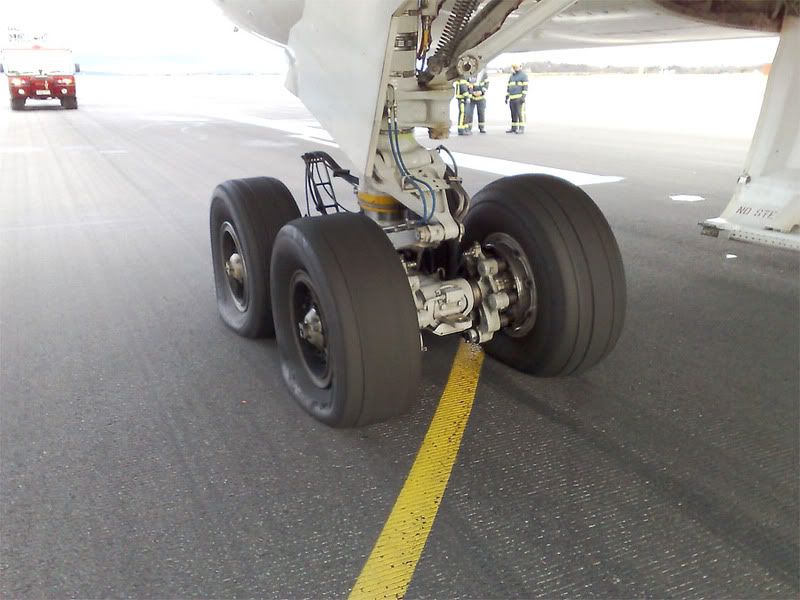
6. The aircraft did not burst the wheels on landing. Two of the wheels deflated because the wheels and brakes were very hot because of the heavy and fast landing the aircraft did. The wheels are designed to do this to prevent a pressure release; this might hurt the ground crew outside the aircraft.
7. The fire service did not smother the brakes with foam or water or “Media” To do this would cause the hot bits to cool to fast and cause other problems. The standard procedure is just let the u/c cool naturally, if you do get a brake fire there are special extinguishers for that. It’s a dry powder that smothers the fire but does not cool it.
8. The Normal brakes on the 767 are powered by the right hydraulic system, so the brakes would have worked normally
9. The reversers are powered by the left and right systems
10. The APU would have been running to provide two sources of electrical power it they had lost an engine
11. Spoilers 3,4,5,8,9 &10 are powered by the centre system so they would not have operated.
All in this entire “incident” was a minor event although I don’t think the people on board woud say so! Perhaps it only made the news because it was a slow news day? The only thing of note for me is that in thirty years in the business I have never seen the fuse plugs go on an aircraft tyre!
Rgds Cking
P.S. Happyonground, You missed me!!!
CkingIt’s not ice they are worried about, its wax. If Jet A-1 gets cold enough wax crystals start to seprate out in the fuel. These will effect the “innards” of the FCU, thats why they heat the fuel before it gets that far.
Jet A-1 can be cooled down to -47C before that happens.
Hear is an artical that says a lot more on the subject
http://www.iasa.com.au/folders/Safety_Issues/RiskManagement/cold_fuel.htm
Rgds Cking
CkingFuel is notably used as a heat sink for oil cooling.
I don’t know the particular Boeing 777 fuel/oil architecture but as far as it involves RR engine, I believe there is a fuel/oil exchanger somewhere…
The B777/trent has a fuel cooled oil cooler for the engine oil system and the IDG (generator) oil system. This heats the fuel before it reaches the engine FCU (Fuel control unit). The fuel tanks are not heated, EXCEPT, the two wing tanks contain heat exchangers for the hydraulic systems. The three heat exchangers (two in the left wing, one in the right) cool the fluid in the L, C & R systems. Any heat passed to the fuel system is a secondary function of these exchangers.
Rgds Cking
CkingAs someone who works in a busy airport I can tell you that I could easily get knifes and other weapons onto a plane easily!
I wish you hadn’t said that!
Cking
CkingThe aircraft is repairable anything is but it might not be economical to repair it. Boeing will have or can design repair schemes to repair all the damage but the insurance company will not want to pay the millions in overtime that the lads will claim for carrying out the repair!
Some times though the airline might be willing to pay the extra themelves to repair the aircraft if they need the plane . For example a few years ago a 737 smashed its tail agains another aircraft at MAN. The repair was so involved that the insurance declared the aircraft a write off. The airline needed the aircraft so much and a replacement was not available that they paid the difference.
Rgds Cking
CkingThis is the third forum I have seen this question chornedsnorkack. Have you tried asking it on WIX, airliners.net or pakistanaviationhistory.com yet?
Cking
CkingPossibly wasn’t an engineer involved in the departure. Not that would have made a difference hear though. Most operators use ground handling staff for the departures. They call the engineers out if there is a problem.
Some operators do insist on an engineer being on the headset during the departure for advice on any after start “glitches” though. We then also do the push back bit too.
I have not had one go with me still attached but I always have an escape route planed out!!!
Rgds Cking


 Sign In







