 Cking
CkingJethro15. Yes but you are able to open them from outside as the operation of the outside handle automaticaly disarms the slide. That is on 747,757,767,777 A318/19/20/21/30/40. BUT NOT ON A 737!!!!!!!!!! On the 737 the cabin crew have to get onto their hands an knees and attach the slide to the aircraft by quick release fittings and has to be disarmed in the same way. Sounds gash don’t it? But they have sold over four thousand of the damm things. (Picture at the bottom of this page http://www.b737.org.uk/emergency_equipment.htm)
Rgds Cking
CkingOld Git (Great name by the way, I’m hopeing to become a sad old git one day myself!) Once a slide has blown it needs to go back to the slide bay for re packing. You can dispatch an aircraft with an inoperative/missing slide but you need to reduce the passenger load by a certain amount. I can’t quote the figures off the top of my head but I think it’s twice what you would think. (i.e. for an eight exit aircraft I THINK you have to off load a quarter of the full pax load) The row was proberbly because the engineer had made them leave about 70-80 pax behind, or perhaps……….. Naa won’t say that bit!!!!
All airlines take a very dim view of accidental slide deployment because of the costs both of repacking the slide, which will run ino the tens of thousands of pounds and the cost of dealing with the punters. At Manchester only cabin crew, trained airline reps and engineers are alowed to open the doors.
The realy nasty exits are the 767 overwing exits. They don’t look like doors, just hatches. Open one and not only will you blow a slide aft of the wing but you will set off an explosive charge in the inboard board spoilers! (to blow them down if they are up) 😮 The A320 overwing exits will also blow a slide if removed but the inboard spoilers are low enough to step over.
Rgds Cking
CkingThe serviceable slide will be supplied to you with a safety or transport pin fitted. This is a pin fitted to the trigger mechanism of the inflation bottle to prevent it going off as you are installing it. You would get a second engineer to check that you have removed it and make a second log book entry to certify that has done it. I cannot recall if it is a CAA requirement or just a company proceedure but I ALWAYS do it. Nobody died of double checking!!!!
Rgds Cking
CkingGood point. I stand corrected.
The 146 doesn’t use turbofans, it uses hair driers!!!! 😉
rgds Cking
CkingETOPS/EROPS is a very big subject. It is also very interesting as it involves just about all the departments involved with air transport. I have been involved with the engineering side of ETOPS for about ten years now and still keep finding things I didn’t know about the subject.
Tri and quad jets tend to operate under EROPS conditions. I can feel another twenty questions coming on!…
EROPS is ETOPS for aircraft operating over inhospitable terrain. As engine failiur is not the only reason to need to land there have to be plans for diversions over some of the longer poalr routes. For example a sudden fuel leak over Siberia would require you to land sharpish! It wouldn’t matter if you were a 747 or a A330 you would need to land on two miles of concrete quick!
There’s another part of the subject for you. It’s ok saying that you can get an airliner into an airfield, can that airfield support it? Is there enough hotel rooms in the area to cater for three hundred people? Could you get the aircraft out agian?!!! The subject is huge.
Wankel engines? Name me an airliner that uses them
Geared fans? High bypass turbojets are sometimes classed as ducted fans so a geared fan would be the same.
Ditching requirements? You don’t ditch a jet airliner, it breaks up on impact and the bits sink like a stone. If you are luck enough to survive this, your life jacket, if it inflates, will keep you afloat for several hours. You will be dead from cold within twenty minutes mind you!!! Ditching is a myth, just hope and pray it dosn’t happen to you!
Rgds Cking
CkingThat is the cleanest 737-200 I have ever seen! I wonder if it was there for painting?. The reason I say that is that the horizontal stab is at an unusual angle. (They move it about during painting to get at the bit underneath)
It is also quite rare to see a 737 with the gravel deflector in this country too. Some of the rough field 737’s have spray bars fitted underneath the engine intakes to “blow” any debris clear of the intakes but they don’t appear to be fitted to this one.
Good spot, thanks for that Grey
Rgds Cking
CkingHear is a picture of the same seals (Correctly fitted) on a 767 taken this morning.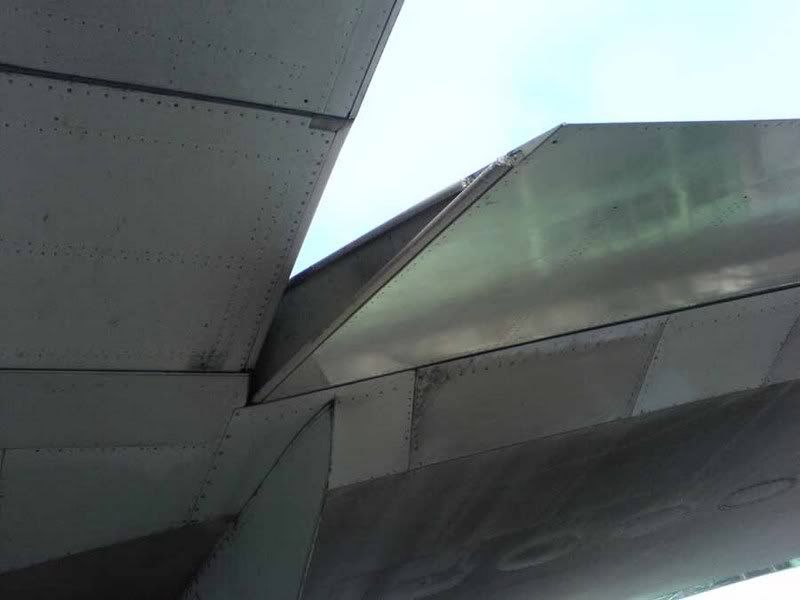
The seal is about 1″ X1″ and is of a “D” cross section. It is slid into a track riveted onto the aileron. It is stopped from sliding out again by a piece of locking wire.
Rgds Cking
CkingIt’s a seal between the flaps. Nothing to worry about. There are yards and yards of the stuff sealing odd gaps between the flaps and the spoilers. In fact there is a length sealing the gap between my garage door and the floor!!! I doubt if there was a bump when it fell out too. It is fitted to reduce the aircrafts fuel consumption. If all of it were to fall out the aircraft’s fuel consumption would increase by 0.00000000001 %
Rgds Cking
CkingThe serious bit is that I’m not on the repair team! The overtime that is going to be earned on that……. 😉
Rgds Cking
CkingI don’t know the etiquette of linking to other sites. I don’t want to look like a right PPRUNE. 😉
Rgds Cking
CkingIt’s got a crack in the casting in the wing that they hang the main U/C on. This casting is the bit they build the wing around! The repair is a major one and will require an awful lot of special tooling, fasteners and skills. It is the kind of job most of us would walk away from! The word on the street is eighteen weeks plus to do it.
There are pictures of the crack out on the net. It is also plainly visable from the ground so every time I turn a 330 round now I always have a good look at that area.
Rgds Cking
CkingAnyone see this programme? I’m sure there’s a perfectly simple answer to this question, but why don’t airliners have car type seatbelts with shoulder restraint?
The lap straps are there for two reasons. To stop you flying out of your seat during turbulance and to stop you sliding forward when the aircraft has an abnormal landing. What I mean by that is, in an abnormal landing you will be in the brace position with your head on your knees, arms above your head and legs “locked” against the floor. This is to stop your limbs flying forward and ,most importantly to stop whiplash injuries to your head and neck. Car type seat belts would prevent you adopting the brace position
Since the only type of crash you stand any chance of surviving is the abnormal landing type, i.e. the crew has some degree of control over it. The lap straps are satisfactory.
I did’nt watch the programe but I can guess the contents! Did smoke hoods get mentioned? Most passengers ignore the safety briefing anyway so to try to tell them how to put on a smoke hood would be a waste of time! Serious aircraft cabin fires are thankfully rare. In the air they are rarely survivable and on the ground the time spent messing aroung looking for a hood and figureing out how to put it on would be better spent on getting off the plane!
Rgds Cking
CkingThere was an interesting artical in Flight about this a few years ago. BA’s medical kit was considered the industry leader and a lot of airlines, including VS just copied the contents list. A lot of airlines medical departments co operate and have regular conferences to improve the contents of the kit too.The medical kit is a standard kit across the BA fleet and they also carry a defib.
The artical went on to say that in the US when the call “Is there a doctor on board?” is made, an awful lot of doctors will not say anything because they are afraid of being sued if the person dies!
Rgds Cking
CkingI’m a child of the cold war, anything east of Dover is Russian!!!!!
I stand corrected 😮
Rgds Cking
CkingRussian tyres are often run down to compleaty bald. I noticed that there were at least four bald ones just on the left hand side alone. Any way, the thing is flying to Russia not going by road! 😀
Grey Area, get your coat
Rgds Cking


 Sign In







