Got the photo….thanks much.
I wasn’t pointing and laughing – just following the thread and making a comment, as is the general point of forums I thought? Just seems a lot of effort for a few seconds on screen, I also mentioned how good the rest was and was curious at this, especially blowing it up.
Sorry, I wasn’t meaning you….I apologize for implying that. What I meant was these kinds of threads run every once in awhile and the tone seems overly critical to me. What are filmmakers supposed to use to represent MIGs? When some of these films were made it’s not like the Ruskies were leasing out their Air Force. The guys aren’t making the films for that 0.0001% in the audience who can tell the difference between a SBD and a TBD, or a B-17E from a B-17G. It’s entertainment, folks.
They want your money, and the less they spend of their money to get your money, the happier they are. If that means dipping into the film bin to avoid spending a $100,000, what would you do? For those of us smug film critics who laugh at their efforts at accuracy…well, don’t plan on getting your history from Hollywood. That guy on the grassy knoll will get you every time.

Tora B-25
Why in “Tora Tora Tora”, which allowing for the aircraft available with no CGI etc, does a fine job, did they butcher a B-25 with a single fin, just to be blown up by a “zero” diving into the hanger? Its on screen for seconds, but stands out (OK, to me) a mile?
It was supposed to replicate a Douglas A-20. There were no B-25s at Hickam during the attack but there was a squadron of A-20s. There were few A-20s around for film use in 1969, but there was one derelict B-25 available. It is, indeed, hideous, if you look closely but the idea was presented well and for the brief shot works pretty well.
To look at some of these posts on this topic, I guess the filmmakers should have commissioned Douglas to open the production line again to crank a few out for the film. It is so easy to point and laugh when you’re not paying the bills.
Hawke always said he was CIA but I have my doubts. In 1965 when you get caught gun running A-26 Invaders it was an easy to say you were doing it for the CIA. The actual court case details were a bit more interesting. Authoritative author Dan Hagedorn, on page 101 of his book Foreign Invaders, notes Hawke’s “lame attempt” to tie his smuggling to the CIA. In the end, though, Hawke was acquitted by a jury of his peers.
Most of his time after 1966 appears to be tied up with filmwork or can be accounted for, so his time in Southeast Asia flying for the CIA would have had to been brief at best.
A man who’s legend may have been greater in his mind, though his documented accomplishments were certainly legendary.
The B-25 in question (Tora Tora Tora) was s/n 44-30478, civil N9754Z. It had indeed been damaged in May 1965 when a drunken pilot took it for an exciting joyride. For Tora, the filmakers mounted one of the vertical stabilizers as a single fin to allow the B-25 to somewhat resemble (loosely) a Douglas A-20. It appears in the film in very short scene when the Japanese fighter crashes through the roof of the hangar and explodes. The B-25 survived, though heavily damaged. Its ultimate fate?
There were no reported B-25s at Hickam or Wheeler on December 7, just a squadron of A-20s. That the filmmakers went to such a length to replicate an A-20 on scene is indicative of the efforts they made to get it as accurate as possible.
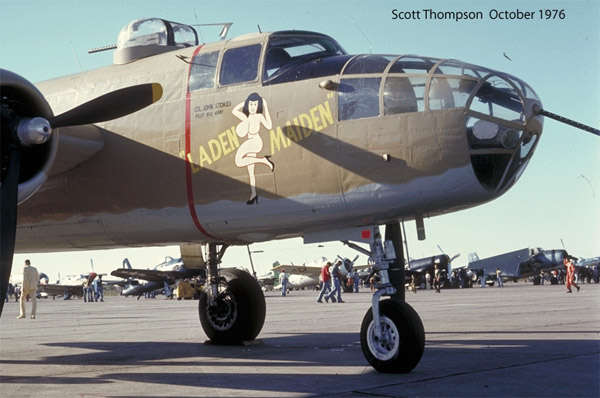
Laden Maiden, aka 44-30925, in better days with the CAF (John Stokes, really) at Airsho ’76 at Harlingen. It carried the same name in Catch-22 when operated by Tallmantz Aviation out of Orange County Airport, California.

The standard A-20s had the second set of controls in the gunner’s compartment aft of the bomb bay, I think the thought being the gunner could keep the airplane stable enough to bail out of if the pilot was disabled. In the standard A-20G the area behind the pilot’s seat was decking to walk on to get to the cockpit from the wing inner section (after the pilot climbed up steps on the fuselage aft of the wing). The aft set of windows are non-standard on N3WF and support a passenger seat aft of the pilot position. The round metal structure appears to be a mod-after-the-mod and might support some sort of test equipment once installed there. I have the civil file on this airplane and will add more if it reveals anything further.
My brief records on this airplane shows it was delivered to the AAF in January 1942 and originally earmarked for the RAF as BZ501. However, it was instead sent to Russia via Lend-Lease and that RAF serial reallocated to A-20G 43-21999.
Yep, I have all that, and the registration has been revoked by the FAA so it isn’t current. I was hoping for some details of the crash and/or why it was operating in North Africa in 1962.
The excellent AeroVintage (http://www.aerovintage.com/b17news.htm) site has this to say:
…used to film Dr. Strangelove…
I have to correct what I wrote on my website and duplicated here regarding this airplane as there is documented evidence that B-17G F-BEEA was the camera ship used to film the air-to-ground scenes used in Dr. Strangelove. I have to correct my long-mistaken information. What is peculiar is that Columbia Pictures owned N9563Z at the time yet contracted with the IGN to use one of their B-17s for the filming. Peculiar.
Here is the Pima A-20G back in May 2005:

By the way, the A-20 book at Crowood is going out of print very shortly and won’t be available any longer from them.
http://www.crowoodpress.co.uk/2004/book_details.asp?ISBN=1+86126+670+7
Aerovin,
Many thanks for the update.
Any photo’s you can post, or shall we wait for that issue of FP to arrive ?
.
I’ll try to post a photo later today, though I think there is also one available right now on the WIX listing.
A-20G 43-21627 is the airframe that was moved from Chino to Pima last year and is undergoing an active restoration to static condition as we speak. Expect the airplane to be completed in the 2008 timeframe. I was able to inspect the airplane in some detail in May and it is exciting to see the airplane begin to come back together. The skin on the aft left portion of the fuselage is being left unrestored with the paint and combat damage to be left intact and part of the static airplane. There are some interesting tidbits about this A-20 that I included in an article that FlyPast magazine should be running in the next few months. The museum has most of the major parts needed but the wings will require much work.
I’d have to say C-47/DC-3. Besides the general shape and arrangement the right landing gear is indicative.