How come so many fighters had wooden props ?
Because Aluminium was in short supply and wood is a good vibration damper


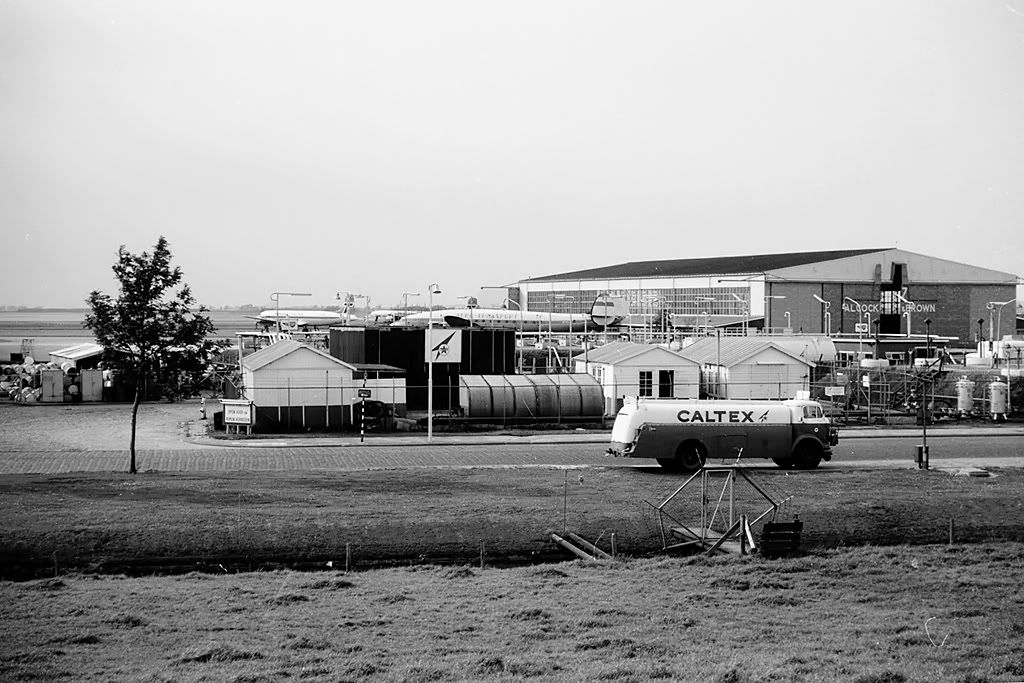
So I stand corrected, from left to right Hangar 9,8 and 7
Here a picture of Hangar 7, probably taken from the other side :

Are you sure it is Schiphol ?
I wouldn’t have a clue why we Dutch would put a Britsh Aviators on “our” Hangar :rolleyes:
Also in the 1960’s cars in the Netherlands had license plates on both sides.

Hangar 7 and 8 which were build between 1949 and 1953
In fact most of the propeller trials plotted on the graph were carried out on the same aircraft – K9791. That’s why the data is so significant in showing the effect of propeller type – and crucially thickness – on performance when operating at these speeds.
Without directly measuring the Torque output of an aircraft engine there is no exact horsepower number available.
Yes if you have the rpm, fuel flow, pressure altitude, the temperature, moisture content, manifold pressure you can make a good calculation but it is still not perfect. If I see the speeds mentioned in the Vickers Spitfire table i don’t see any significant speed differences.
Fred Nicole off the coast of Cannes on the French riviera on Sept 9th 1951
We in the Netherlands also have a frequent post by Pampa.
We don’t mind someone promoting it’s own website not at all.
It is the total lack of participation in the forum, he never answers questions on his own started threads, let alone comments on threads started
by someone else.
A forum should be a community were we talk and listen to each other not a kind of one way traffic like television….
We already use non-original items here in Europe, such as camshafts and aftermarket modified followers…and, of course, ultimately, Retro cylinder heads
Hello Pete,
I believe only Roush Aviation in the USA manufactures the mentioned parts under PMA FAA approval. These parts are reversed engineered and are not manufactured under license/permission of Rolls Royce.
American PMA FAA parts are accepted replacement in the USA by the FAA but are only accepted without approval of EASA if they are non-critical flight items. I don’t think that Camshafts , Followers, Mayor engine castings are under this category.
If my memory serves me well, the Vickers Vimy replica original had Mercedes engines installed. When it flew to the USA, Mercedes started a lawsuit to prevent their engine being used as such over American soil. They re-engined it with American V-8’s.
Same for Boeing replicas of the Peashooter for which the Boeing Company forbid to use their name.
I can already see the Rolls Royce lawyers thinking of an accident caused by an Rolls Royce Merlin engine failure which could be traced back to an aftermarket part.
Ofcourse I am not an expert and could be wrong, so if you know such a Merlin flying around in Europe I would be more then interested, so I could see under which provisions they got their approval.
Pim
Early Birds Foundation Netherlands
Mustang P-51D, 44-74923

I know under American Experimental Category almost any modification is possible.
But here in Europe a Rolls Royce Engine needs a original Rolls Royce Cylinder head with Rolls Royce papers.
Don’t forget data plate restorations are done as a repair, not a rebuild……..
The B-52s told the carrier folks to look down. The paint job on the B-52 made it hard to see from above, but as it got closer, the sailors could make it out, and the water the B-52 jets were causing to spray out. It’s very, very rare for a USAF aircraft to do a fly-by below the flight deck of a carrier.
I am very interested of seeing a picture of a jet aircraft in level non supersonic flight which causes this water spray effect
Great to read and crop sprayers have appeared in this thread so you needn’t feel hard done by. But your second two sentences in your penultimate paragraph are inaccurate, exaggerated and unrepresentative.
unrepresentative maybe for most military pilots.
But except for properly trained display pilots, no one has any reason to fly so low except for showing off………
It would be interesting to find out the performance penalty for the Mosquito carrying such a heavy load.
First “Cookie” drop by a Mosquito was on February 23, 1944 on Düsseldorf ( source http://www.aviationclassics.co.uk )
Düsseldorf – London 265 Nautical Miles
Berlin – London 505 Nautical Miles
Please look at the picture carefully, on both engines one blade is bent forward and the other are bend backward !
My gues is that if you look at the damage on the nose that the plane slide over the grass sideways in the direction this picture was taken
P51 Mustang Horizontal Stabilizers are flush riveted with a knife edge countersunk in the skin. Dimpling the skins and the ribs would have been better but was not considered effective enough for the supposed longer fatique life……
These parts are for display only and are not going to an airworthy project.
If so and you “repair” them as mentioned, can you please engrave “scrap” on it ! Although you mention for display only, scare parts have the tendency to be re-used long after anybody remembers how you “repaired” this casting………………