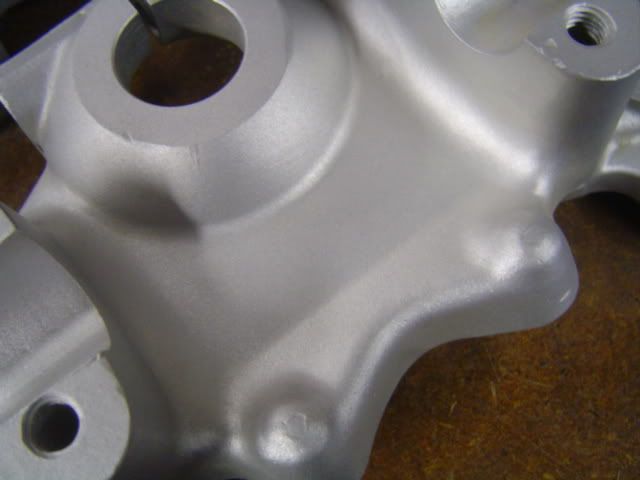
Hi folks,
Sorry for my delayed appearance – have had problems with my internet access the last couple of days.
I have attached 2 shots of the piece I originally posted about.
Many thanks,
TEC
I’d go either plastic then baking soda route, or the vapour blasting if there’s someone nearby who does it.
However, having said that & loooking at the size I’d first try the homemade soda blaster I linked to earlier…
The great thing about using baking soda is the local authorities really like people using it & hosing it down the drains as it neutalizes all the nasties that other people throw in the drains.
Shouldn’t cost more than a fiver to put together & the soda will (or should) take off the corrosion. If it was mine I’d probably glassbead blast it because I like the finish it leaves.
Can someone explain to me in laymans terms whats involved in a compass swing :o:o:o
Basically tow the thing around 360degrees, stopping every so often to make sure the compasses on the aircraft agree with the rest of the planet.
Given all the hullabaloo about cad & the fact I live in the land of wacko environazis it’s a bit odd that the place I use to get my cad plating done is smack in the middle of a residential neighbourhood…
When I fire up the blasting cabinet I open the door next to it, lift the vacuum outside & then put a hose from the vacuum exhaust port around the corner into an adjacent shrubbery…… which is where my neighbours retarded cat sits 🙂
Where might you find cadmium plating on an aircraft and how do you identify (and avoid) it?
If it’s old & either silver or gold, it’s probably Cad.. Cad #1 is silver, Cad #2 is gold… there’s also an OD Green version. Pretty much all AN/MS/NAS hardware is cad plated.
Don’t gnaw on the bolts etc 😉
With cad plated stuff I just dip it in muratic acid for a few seconds, takes it right off…
We stiill haven’t found out what the actual Merlin parts are that the OP refered to….
Incidently, came across this page about buffing:
(I recall that soda blasting requries parts to be very carefuly washed prior to coating/painting if applicable)
IIRC There was an interesting thread on here some time back regarding how the RAF discovered that beed blasting alone of alloy could peen over the edges of corrosion pits and whilst leaving the surface appearing corrosion free, entrapping corrosion underneath. There was even a link to a report provided. Worth a read if you’ve never seen it before.
A good wash with hot soapy water will suffice after soda blasting to take care of that issue. Then just prep as you normally would for paint.
I read the RAF report about that issue, I wasn’t convinced.
Why on earth is there one at Cowes???
ZRX61
what a good idea with the ouly scotchbrite I will have to do that as I have fine white powder over everything.
That’s on the atmospheric port, not the vac port 😉
You can also tape used automotive air filters over the hole. Lots of cars use ones that are about 1.5-2in thick. The one my Chevy S10 uses looks to be about perfect. It has the advantage of having a rubber seal on one side that will seal against the cabinet 😎
Lots of good stuff at that TP Tools site 🙂
ZRX61
Nice images, what are they of? and tell me more about the grade of glass beads. I just buy the glass beads about 20 litres in a bag.
Anyone know how to seperate the glass beads from the powdered glass beads. I have about mixture of 40 litres and too tight to throw it out, but I am getting too much dust in my blasting cabinet and it makes it harder to see.
Any clues?
by the way we are talking parts that will fly again one day here.
cheers
I use 120grit & 80grit glass bead. Do you have a vacuum hooked up to the exhaust port of your blasting cabinet? Mine remains pretty clear of dust as the vacuum sucks it out. Don’t use a normal shopvac, blasting residue/dust kills them pretty quick.
I use this set up:
http://www.tptools.com/p/868,53_960-Pro-Blaster-RH-Door-Abrasive-Blasting-Cabinet.html
Only mod I’ve done is to add a filter to the port on the rear of the unit to stop dust escaping & covering everything within 20ft of it. The *filter* is actually an oily scotchbrite pad duct-taped over the hole.
Those parts are old Kawasaki triple clamps, KZ1000, Z1 & H2 🙂 Don’t have any pics handy of aircraft parts I’ve blasted, but I’ve blasted wheels, valve covers (P&W) brackets, inspection panels, hardware (prior to re-plating), engine mounts, canopy frames, guns, bomb shackles, exhaust stacks (& more P51 header tanks than I can remember) & various other forgings & castings with glass beads.
Carbs get soda and/or plastic blasted.

We use baking soda (not baking powder) as a pretty much standard abrasive when cleaning dinosaur bones. ssometimes an encrustation of calcite or ironstone (siderite) will make us bust out the dolemite or aluminum oxide, but 99% of the time it’s just plain old baking soda.
Works like a champ, but if the operator isn’t experienced, he can do a heck of a lot of damage…
We use the baking soda for blasting, but baking powder to remove the black residue from polishing, so I think we’re all pretty much on the same page 🙂
High pressure glass bead blasting (say 70-90 psi) will remove too much metal and leave a rough almost sandpaper finish
Depends on the grade of bead……..


Trick when using metal polish is flour, good old household flour, self raising or plain 😉
We use baking powder 🙂
Thanks for all of your informative replies guys.
The part is a cast piece and I have given it a good wash with soapy water to remove some of the grime.
I think I am going to put the polishing wheels on the bench grinder and give that a go!
Cheers,
TEC
Post a pic of the part before ya get started, we might be able to save you some time & effort 🙂