 one0nine
Useless comparison, because the styles of combat were so vastly different between the Western and Eastern fronts. Cases in point:
– Hans Phillip. He was a master of Eastern Front combat, downing nearly 200 aircraft before being posted as Kommodore of JG 1 in the spring of 1943. He managed to reach 208 victories before being shot down and killed just a few months later (October 1943).
– Kurt Brandle. Another highly experienced Ostfront fighter, he was posted as the Kommandeur of II./JG 3, but shot down and killed by Spitfires on 3 November 1943, not long after being transferred from the Eastern Front.
– Siegfried Schnell. He was a “Spitfire expert”, downing over 49 Spitfires between 1940 and 1944 with JG 2. He was transferred to the Eastern Front on 11 November 1944 to take over IV./JG 54, and was shot down and killed within two weeks.
What worked in one theatre did NOT work in another.
Lynn
one0nineHoly crap, it’s like Walter Soplata moved to the Netherlands… they’ve got a seriously impressive array of hardware. And am almost positive that I have a shot of their F-4C 64-0745 during combat ops in Vietnam… I’m going to check when I get home, and send them a scan if they’re interested. I’d love to see them repaint it properly, if that’s the case!
Lynn
one0nineThe Stuka is more accurate, but it’s biggest failing is that it required complete German air superiority to be effective. The Il-2 could fight it’s way in and out, at least with more hope of survival than the Stuka.
It’s the difference between a dagger and a club, really… the dagger will always be more effective, but will only work in a certain set of circumstances. The club, however, can be swung from a distance and will certainly achieve the desired results if applied forcefully enough. That seems to sum it up pretty well.
Lynn
one0nineAha! One I can identify! 😎
That’ll look great, will it be at Thunder over Michigan? :diablo:
one0nineNo indeed. As a design, the 109 is fundamentally flawed and wasn’t really suited to further development. It probably would have been superceded as a front line type had the war not started in 1939. I wonder why the type wasn’t dropped as the FW190 came on stream and the resources pushed at that and other types – the continuing need to produce large numbers of machines presumably as the war position became more and more desperate for the Germans.
No more flawed than the Spitfire, being the same basic configuration. The aircraft had reached the end of it’s development life in it’s current configuration by mid-1943 with the G-6/AS and G-14/AS; note that the K retained the same exact configuration, with only minor internal equipment arrangement differences (and of course more horsepower). To put it in parallel with the Spitfire, the Mark IX would probably be a close equal in terms of development; note that the Mk XIV retained only the basic fuselage and horizontal stabilizer form from the earlier Spit models, with a completely different engine, wing, and vertical stabilizer designed to cope with the gobs of torque produced by that massive Griffon.
The 109 was the finest fighter in the world through early 1943, with the development peaking with the G-2… only the Mark 21 Zero would have a legitimate claim for equal greatness in the same time period. Every 109 model afterwards was a reactive development rather than proactive, including the /AS models. The basic G-6 was a step backwards in many ways, sacrificing manouverability and performance for firepower, and the K-4, while a very capable aircraft, still lacked a number of features which were considered standard on Allied combat aircraft at that time, including cockpit adjustable aileron and rudder trim, gyro-stabilized gunsights, and much more reliable all-weather capability. Credit the Allied bombing campaign for creating such a pressure-cooker environment that Messerschmitt and it’s various satellite factories were forbidden to explore any significant developments as it might interfere with production of the current models.
The 190 was a fine aircraft as well, but the BMW 801 crapped out above 18,000 feet or so… lots of work took place to try and rectify this through the war, but it wasn’t until the lashed-up D-9 entered service that the 190 got any kind of decent high-altitude performance.
one0nine“at least half of Victoria’s bush musta burnt by now”
Ahem. Keep it clean please, dear boy.
…says the man named “Snapper”… 😀
one0nineWelcome back Jules, glad to hear you’re on the mend… I also have no questions, but just wanted to thank you for being available to answer our questions, and wish you a Happy New Year! 🙂
Lynn
one0nineExcellent juxtaposition here, Gary…
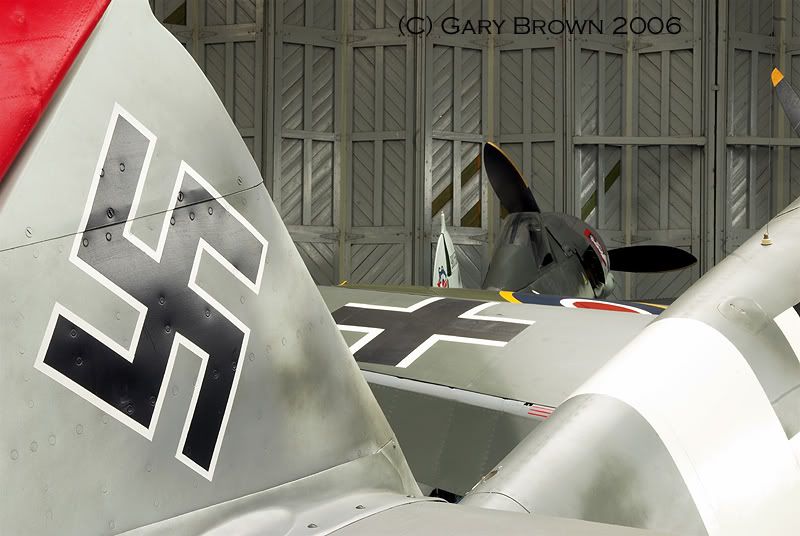
Although it looks like you really had to clamber up, around, under, and through a veritable forest of Spitfires to get this pic! Not that that is a bad thing, mind you… 🙂
As regards the Spit “diorama”, that’s a ripe photo op for a re-enactor’s group to pose a Kubelwagen and some suitably attired chaps milling about. Pity no one was around to record it’s first flight!
Excellent work, once again-
Lynn
one0nineNice shots! I didn’t realize they had a CR.32 in any fashion… that’s quite a spectacular piece. And I have to say, that Triplata (the Hispano-engined 109) is one of the sexiest versions of the 109 out there… yet it’s completely ignored in model form, what a pity!
Thanks for the photos-
Lynn
one0nineJeepman and Mark V have hit the nail square on the head… without intending to derail this thread, perhaps a visual representation of just what I do might help people understand why such things are important to me.
I’m in the process of finishing the second (and last) Modellers Datafile on the later Bf 109s for Scale Aviation Modelling International. There will be 25 different kits reviewed in this, all but one built by myself (the last one is the enormous 1/18th scale 21st Century G-6). Here are a few examples:
Bf 109G-6 WNr 160756 of 3./JG 4, flown by Uffz. Rene Darbois… this is the example which resides in the NASM in Washington, and these are the markings in which the aircraft was captured. (Otaki 1/48)

For comparison, here are a couple shots of the actual aircraft:


I did my level best to match the camo scheme and tonal contrast to actual photos. Other examples of my work:
Bf 109G-6/AS WNr 412640 of Ofhr. Herbert Bertholdt of 4./JG 27, based at Fels am Wagram, Austria… Bertholdt was shot down and killed in this a/c on 8 July 1944. (Fujimi 1/48)

Bf 109G-10 of 2./JG 300 (Revell 1/72, modified and corrected)

Bf 109G-6 of Hptm. Franz Dorr, Gruppenkommandeur of III./JG 5, Gossen, Norway March 1945 (Trumpeter 1/24, markings masked and painted)

As you can see, I place a great deal of importance on research and accurate paintwork, but my work is seen by only a fraction of those who would be treated to the sight of a (recreated) Focke Wulf. That’s a tremendous opportunity to showcase history “in the flesh”, so to speak, and when that opportunity is lost for whatever reason, it’s a source of disappointment. The world won’t stop turning, of course :), but those thousands of us to whom historical accuracy is important won’t stop working towards that goal.
Cheers everyone, and Merry Christmas!
Lynn
one0nineThanks for the insight, Mark V… it’s genuinely appreciated. In your experience, how involved are owners during the painting process, once the bird is actually in the shop? I seem to recall from threads here on the board that SX336 had quite a bit of hands-on involvement during the finishing stages of her restoration, and the results were nothing short of stunning; is this level of attention not the norm?
Thanks again,
Lynn
one0nine{rant on}
What’s wrong with painting it in a fantasy scheme? It smacks of laziness and a conscious disregard for the history of the type itself. I can just imagine the outrage here if AB910 were to be repainted in some garish, glossy, completely fictional scheme. Perhaps the real issue is that it doesn’t matter since it doesn’t wear the RAF cocarde?
It doesn’t cost any more or take any more effort to do it RIGHT. I already stated it’s his plane, his money, so yes, he’s free to paint it as he wishes. Hell, he can paint the S.O.B. purple with “Milka” sponsorship on the wings and a giant Teletubbie on the vertical fin if he wants, it’s his baby. However, I’m equally free to state that I feel it looks like crap, and you’re absolutely right I’d paint it in an authentic scheme if I were fortunate enough to own one.
{/rant off}
one0nineThanks for that Fluffy, and if that’s the gloss black Spitty, that’s gonna be dead sexy when it’s done! (And AUTHENTIC! :diablo: :diablo: :diablo: )
Cheers, and Merry Christmas!
one0nineA couple Spit-specific questions:
– Am I correct in assuming the gear mounts into the wing, not to a carry-through bolted to the fuselage (like a 109)? Never thought to look, but this pic seems to suggest the former.
– I note you masked off the rudder; do you need to paint the ailerons and elevators separately as well, for balance considerations, or was this only on earlier models of Spits?
And that’s an awfully dark green for an RAF scheme… should be interesting to see what comes out of this! 🙂
one0nineI’m sure it’ll be wicked to see airborne, especially in a tailchase with a Spitfire, but it’s awfully disheartening to see that the aircraft’s painter graduated (with honors, no less!) from the Jerry Bruckheimer School for the Historically Challenged.
One would think that out of NINETEEN THOUSAND AIRCRAFT, they could pick at least one attractive and historically accurate scheme… **sigh**
But, it’s his plane and his money, after all.


 Sign In







