 StarfishPrime
TBH , i dont think active cancellation is anything more than a myth , unless they can somehow predict frequency of radar pulse before hand.And to be fair , with all the requirements that would be need to perform active cancellation , idont think it can perform any better than cover pulse jamming.
If the aircraft already has a very low RCS, by cancelling part of the pulse, it would reduce detection, and future AI EW systems development with be able to predict the algorithm being used to shift frequency.
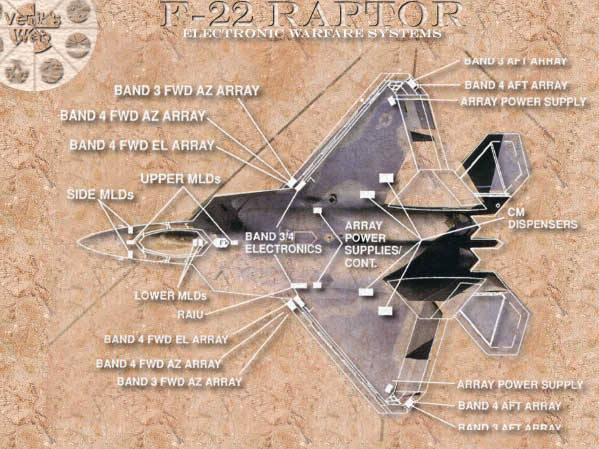
StarfishPrimeZoom in BAE brochure of ASQ-239 reveal even more interesting information , the aperture of the system seem to be consist of various Vivaldi antenna next to each others, what could be the reason for that planar array configuration ? electronic beam steering ? ( so ASQ-239 itself is also an AESA jammer ?)
Given positioning on wing LE/TE I would also think active cancellation. You also have them facing in the direction where the RCS spike would be highest, i.e. perpendicular to wing/tail edges.

StarfishPrimeI wonder what would be easier for the DIRCM install, popup turret, permanently expose VLO qualified turret, or keep it under an EOTS-like faceted window?
Spring loaded pop-up head positioned on spine behind cockpit would be my choice.
StarfishPrimeWhen I say that FBW/M53 modification would put it in the same class as the F-16 I dont mean exactly equal. Im just saying that there would be significant improvement that would make it near to what the F-16 is.
I don’t see it though.
StarfishPrimeFBW and upengining the F-1 could put the F-1 in the same class as the F-16. The F-16 also has a relatively high wing loading and was designed for high rate of turn, not high AoA maneuver. But once you introduce FBW then large wings with low wing loading become a better option. The reason that the F-1 has such a high wing loading is that with the absence of FBW a jet can be very stiff and so the large tail surfaces compared to the wing area give the F-1 extra control and maneuverability.
The F-16 had a TWR well over 1:1 and LERX.
StarfishPrimeOr maybe it ain’t a radar missile and flares won’t do diddly against IIR, hence the DIRCM.
StarfishPrimeOnly if you regard 0.89 as excellent but then Gripen NG regards 0.88 as good so… Wing loading was also quite high at 89lb/ft^2.
StarfishPrimeWhy do you suppose fitting FBW and an M53 would have changed much, the F-1 was never a near exceptional aircraft in the first place. It wasn’t even the best Mirage, or even the second best.
StarfishPrimeI can make a good guess.
StarfishPrimeIf it’s an Israeli munition that caused that explosion then it’s not materially different and yet, you know that was not my point.
Anyway, RT is not a valid source unless you want me to post videos of Russian action in Syria on the BBC?….
News is news, both show different perspectives and I watch both to get a fuller picture. But I don’t imagine a video like that above can be faked. They levelled entire neighbourhoods, and when not bombing they’re bulldozing other neighbourhoods.
StarfishPrimeHe doese not need to prove anything. That manufacturers often attent to bump range using such method is YOUR assumption. Doesn’t work that way. And it would be silly btw. Real clients have access to those data…
Why wouldn’t they? Rafale clearly did for their 1,000+nm figure. Figures have no meaning unless you know they’re for the same mission profile, which these definitely aren’t.
If it’s expecting combat, i.e. war-scenario, it would definitely drop them to reduce RCS, and maximise time on station.
It’s also false to compare range based on two completely different profiles. Optimum altitude vs climbing and descending between 5,000ft and 25,000ft. So it was never apples to apples from the start. You not only have to factor in the increased fuel consumption at lower altitudes but also the diagonal distances in climbing and the increased engine workload during the process. Once you do that the F-35’s DTs combat radius at optimum altitude is well over 800nm and more still if you drop the tanks, which you wouldn’t ordinarily do on a routine surveillance mission.
StarfishPrimeIt is generally accepted that dropping large explosive weapons or weapons which target areas of land in an area populated by civilians is unacceptable. Look at the discontent Israel provoked last time it moved into Gaza (using weapons far more accurate and far less destructive than Russia/Syria are). What were your reactions to that conflict?
There is plenty of evidence that the bombing of Aleppo has and is involving weapons which are being deployed indiscriminately. The Assad regime sees anyone still in that section of Aleppo as an enemy and is consequently trying to kill them. Russia wants Assad to stay, so they are targeting them too.
The international community views those people as civilians.
You’re kidding me right. How is this any different?
StarfishPrimeMe, no. There’s no conspiracy of greed
What do you call carefully planned tax avoidance then? What do you call price-fixing cartels? The revolving door system? Corporate sponsorship of election campaigns, particularly in the US? Companies are basically buying policies and politicians. Unless all this accidentally happened, then it was done deliberately and is hence a conspiracy by virtue of the very definition of the word.
StarfishPrimeSame problem as Mosul. In some cases they can’t get out, some are being prevented from leaving, some don’t want to leave because it’s their home and there’s nowhere for them to go.
Well then that’s the fault of the terrorists for not letting them leave and using them as cover. You can’t not attack an enemy just because they’re using a human shield. Take the 9/11 incident, if the USAF had got to the 2nd and 3rd planes in time, they’d have shot them down regardless of the passengers.
StarfishPrimethe range figures were for combat patrol 800 nm away with over 30 minutes on station,
if a fight occur, it will drop tanks, fight, and return home after missiles are depleted, presumably.
guessing 30+ minutes on station equals 100-150 nm range
If it’s expecting combat, i.e. war-scenario, it would definitely drop them to reduce RCS if nothing else, and maximise time on station. Can you prove it retained the DTs? What is the range on internal fuel? What was the mission altitude? Did it include flying at 5,000ft?
Gripen NG has a very poor internal fuel fraction, inferior even to the Rafale/EF.
One way range on internal fuel is only 2500km, which is 675nm each way, with no time on station, at optimum altitude and no weapons and no T-O/landing.
http://www.jsfnieuws.nl/wp-content/NLGRIPENPRESSBRIEFAug08.pdf
So that leaves about 500nm with 30 minutes on station with weapons, including T-O/landing at best, while F-35 manages 760nm. Double fuel with 3 DTs and add weapons and you only start approaching the claimed figure if you drop the tanks. Drop down to 5,000ft and climb up to 25,000ft a couple of times and that will soon drop too.


 Sign In







