I really need some mainwheel rams and clack valves to complete the hydraulic system. Do you have any ?
And if anyone has three main wheel rams….
The one we do have was dropped into our workshop one day. Apparently some eagle eyed type had spotted it in on a harvester that was being scrapped down south somewhere. It had galv water pipe fittings *******ised into the ports and is seriously corroded, but salvageable to static condition.
PP, we feel your pain – we have had the tyres off 4 wheels now to asses the condition of them – not an easy task, particularly the more heavily corroded ones.
Im not sure if this is helpful but i have S98182 as being ‘Pulley Bomb Inst’. Numbers don’t quite match but possibly an associated …
Bingo. Confirmed independently offline. Apparently the bearing for the bomb winch. Thanks for that.
We have the FBVI/TIII parts manual and the Swedish NF19 illustrated parts manual. These both can be very frustrating as they deal with anything foward of the firewalls as complete assemblies. Likewise, for example in the Swedish book the entire radiator assembly is given a single part no.
The FB VI Pilot’s Notes. Copies available via the internet.
Can anyone enlighten me as to which area of the airframe the part number refers too: J981018
thanks,
That refers to the elevator as a complete assembly. The elevators are not ‘handed’, which is interesting.
HR399, are there any dataplates on your aircraft that correspond to Hornet/Vampire onwards ?
On the Mosquito the entry door and electrical/fuel gauge box on the starboard side occupy the zone where Hornet/Vampire dataplates are.
On DHA PR41 there is refererence in cockpit diagrams and corresponding logbooks to an engine dataplate on the port side, above the usual plate above the throttle controls instructing on RPM,pitch settings.
The engine dataplate is missing from the cockpit of NZ2328. The engine dataplates are present on the engine bearers, and I can think of a few a bit like David’s above riveted onto other sub assemblies (and painted onto the fuselage bulkheads, but I am not aware of an airframe data plate with constructor numbers etc in the cockpit. I’ll look into it today.
While we are at it, and somewhat O/T, does anyone recognise this part, which is attached to the top of the bomb bay aft bulkhead, inside the fuselage. It appears to be a bearing or bush of some sort, with a X98xxx part number, but we have never seen another one on any other Mossie, and no possible combination of the numbers we can make out are in any of the parts manuals. Something like S.98186(0?)A. Any guesses?
[ATTACH=CONFIG]231654[/ATTACH][ATTACH=CONFIG]231655[/ATTACH]

Wooden fuselages of Hornets, Mosquitos and Vampires were frequently (but not always) painted with the construction number of the airframe on the side of the cockpit exterior, prior to being finally painted. I have also seen the actual serials being chalked onto the fuselage sides prior to being painted in the factory too.
With that in mind, any idea what this number might be? It was found under the fabric on the fuselage of NZ2328/TE758, immediately aft of the trailing edge on the port side, and appears to have been stenciled on.
[ATTACH=CONFIG]231634[/ATTACH]
The ‘Propellor Speed Control’ changes the RPM at which the engine is effectively governed. The constant speed unit then holds the propeller (and hence engine) RPM at that setting (as far as possible) by varying the blade angle as engine power is increased or decreased by the movement of the throttle. Google ‘Constant Speed Propeller’ for any number of better explanations.
I have been thinking/wondering along the same lines, as we have similar challenges. The trick would be to develop a smart phone App. I will be interested to see how this discussion progresses…
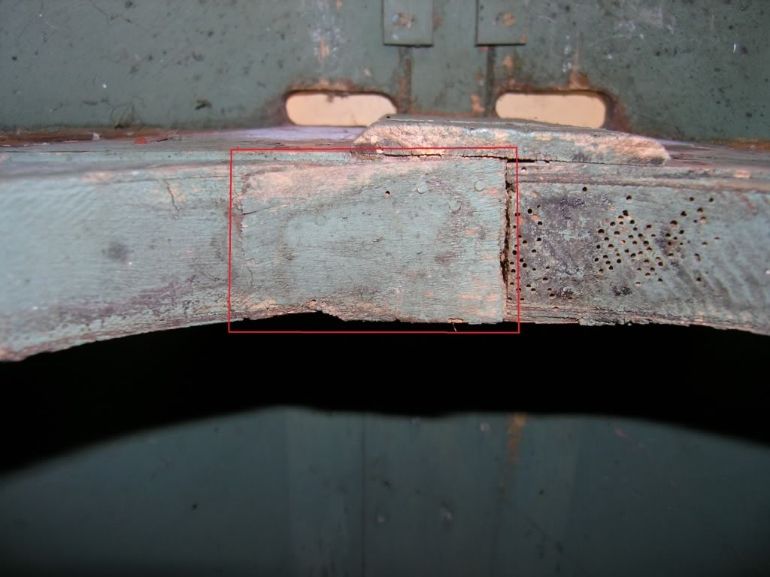
Just to add some photographs to this very interesting thread, here are a couple of examples of wartime build quality from the fuselage of Mosquito TE758 (Later NZ2328). Firstly, the underside of bulkhead #6, looking up.
The two halves of the bulkhead are out of alignment vertically by about 1/8″ (!), so a small scrap of wood (outlined in red) has been tacked to the underside of the bulkhead and planed to the profile of the opening in the bulkhead. This bulkhead also had several sheared screws that had been hidden away under the doublers
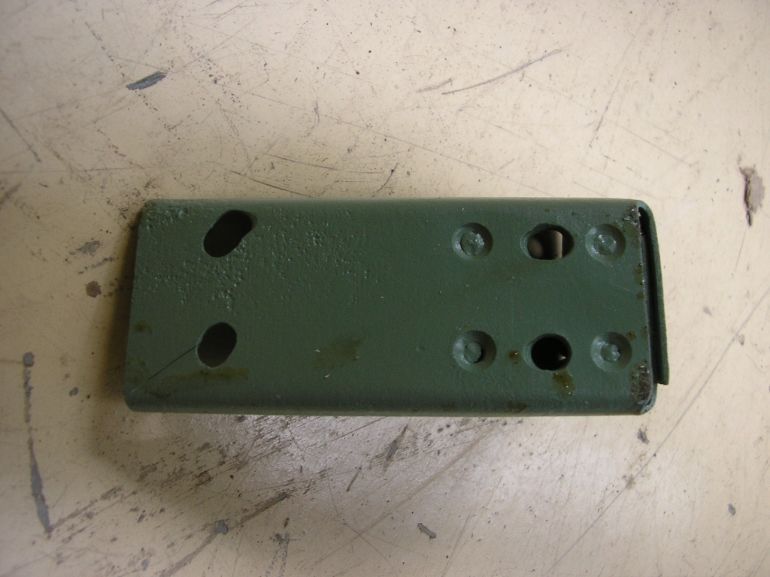
Secondly bracket for hinge #5 – aft bomb door:
The bolt holes in the hinge bracket have been ‘eased’ to match the casting of the hinge. We are finding a lot of slotted holes in this area – perhaps indicative of a wider issue…. And yes, it got painted before re-rivetting – hard to get good help sometimes :eagerness:.
PM sent.
There are an awful lot of metal parts to find to rebuild a Mosquito -the easiest way by far to to find a donor aircraft in the same way as KA114. I hope they go that route .
Easy is a funny old word. Donor aircraft with metalwork in a usable state are pretty thin on the ground. Even having the remains of KA114 AvSpecs still built a lot of metal parts, and had to search high and low for others.
There are an awful lot of metal parts to find to rebuild a Mosquito -the easiest way by far to to find a donor aircraft in the same way as KA114. I hope they go that route .
Easy is a funny old word. Donor aircraft with metalwork in a usable state are pretty thin on the ground. Even having the remains of KA114 AvSpecs still built a lot of metal parts, and had to search high and low for others.
Hang on a bit – I have the Swedish parts catalogue for the NFXIX, which should show canopy details. Bear with me and I’ll see if I can find it again.
Bruce
I was looking at that drawing yesterday as I catalogued our spare canopy panels. The NFXIX is the same as the FBVI, in terms of perspex and framing details.
Within a few months? My 😀 stands.
In addition to this the fuselage and wing parts would be immediately available from NZ without the additional modification costs.
Immediately? 😀