Seat 2A
April 02, 2005
Vancouver to Hong Kong
Cathay Pacific First Class
747-400 B-HOV Seat 2K
240p-755p Flight Time: 12:43
NOTE: Pictures covering travel onboard Cathay Pacific Flights can be found RIGHT HERE.
Spring and winter got reversed this year in the Pacific Northwest. The biggest winter storm of the season arrived on the fifth day of spring and hasn’t really let up since. The mountains have been getting large amounts of snow
At a time when most ski areas are starting to wrap up their seasons, many of them here in Washington State are just now opening. It seems fitting that for many, opening day is April 1st, or April Fool’s Day.
Springtime not withstanding, I awoke this morning to yet another gray, rainy day. I never thought I’d say this about life in the Pacific Northwest, but the fact is I haven’t seen much in the way of sunshine since winter!
After running a few last minute errands in Bellingham, I headed up I-5 to Vancouver. The big border crossing at Blaine was pretty busy for a Saturday. Electronic signs above the interstate advised that there would be a thirty-minute wait. I timed it. Twenty-seven minutes. Close enough.
After dropping the car off, I headed straight for the Cathay Pacific check-in counters. No dawdling for me. I’d been looking forward to this day from the moment I stepped off my last Cathay Pacific flight and I was anxious to return to the world of Cathay’s First Class service as soon as possible.
Today, that service began with an empty First Class check-in counter and continued with a Fast Track lane through the security checkpoint. Nobody was ahead of me, not even a few Business Class passengers. It was almost dreamlike to just stroll up to security and have friendly, smiling agents waiting there just for you. Reality quickly reasserted itself when one of the agents decided that my laptop was worthy of a few swabs with the explosive residue detection wipes.
Cathay Pacific’s First Class Lounge is located just beyond security, up on the fourth floor. The lounge I visited last year served both Business and First Class passengers. It was not air-conditioned and the buffet area offered only a sparse selection of dim sums and hot noodles along with peanuts and Asian snack mix. I had heard that Cathay’s Vancouver lounge had recently been refurbished and was now much nicer than the mediocre facility I visited before. Well let’s just head right on up there and find out, shall we?
Just outside the entrance to the lounge is a life sized cardboard cutout of a Cathay Pacific Flight Attendant. These cardboard cutouts seem rather popular with the Asian airlines – I have seen examples from China Airlines, Singapore Airlines and now Cathay. A hostess greeted me from behind a long counter, inspected my boarding pass and then escorted me into the First Class Lounge. Along the way, she oriented me to the location of the wash rooms, the workstations and the buffet. Boarding would be announced at a little after 2:00pm. Please make yourself comfortable and enjoy the lounge.
Right away it was obvious that Cathay had done an excellent job of refurbishing this facility. Polished black marble floors, potted plants, comfortable seating and big picture windows made this lounge a pleasant place to while away an hour or two before departure. Outside the windows on the ramp below us was a pair of Air Canada A340s, both sporting the new weird greenish white livery. Soon they were joined by a Lufthansa 747-400. Isn’t it about time Lufthansa considered a new livery?
Turning away from the window, I headed over to the other side of the lounge to take stock of the epicurean delights on offer. Along one wall was a nicely stocked buffet area that included a tray of sushi with wasabi and ginger, a nice selection of small sandwiches and wraps, small bowls of Macadamia nuts, and a hot bowl of wontons and something unrecognizable. In a self-serve refrigerator were nice looking, individually made up fruit plates along with a good selection of juices and soft drinks. Red wine from Chile and white wine from Australia accompanied the usual variety of bottled spirits. The champagne was Pol Roger and the beer selections included Molson and Heineken.
I put together a colorful plate of food, grabbed a cold Molson with a bowl of Macadamia nuts and headed over to one of the three Internet capable computer terminals. I really wanted the desk space more than the computer, especially since I was able to plug in my own laptop and access the Internet via the lounge’s Wi-Fi availability. A couple of phone calls, a couple of emails, an Internet purchase of travel insurance and suddenly it was 2:15pm and boarding was announced for CX839 to Hong Kong.
In the boarding lounge, a large group of high school students was being shepherded together by their teachers with a small talk being given about proper behavior onboard the airplane. A field trip to Hong Kong! Man, would that ever be exciting – even in Economy Class! I envied the thrill those kids must be feeling to travel so far away at so young an age. All my school field trips were aboard busses and never went any farther than a hundred miles or so.
There was no separate jetway for First and Business Class passengers so although I didn’t have to wait in line to enter the jetway, I did have a fair wait inside the jetway to actually get onboard the aircraft. At the door, two Flight Attendants welcomed passengers and I was directed to cross the aircraft and bear left. As usual on a big airplane like the 747, it looked to be sheer bedlam back in Economy Class with lots of people up and about, trying to stow their carry-ons and squeeze into their aisles. It’s weird how when I’m flying Economy, I don’t give all this noise and commotion a second thought. When I’m fortunate enough to be sitting in First or Business Class however, it’s with an almost palpable sense of relief that I take that left hand turn and accelerate smoothly into the peace and quiet of the forward cabins.
Today, it was with great pleasure that I was able to continue on through Business Class and enter into the rarified atmosphere of Cathay Pacific’s First Class cabin.
Ahh…
Soft Chinese melodies floated through the cabin like a gentle breeze on a spring afternoon. A Flight Attendant approached, welcomed me by name and introduced herself as Jennifer. She assisted me in stowing my carry-ons and hanging my jacket, then returned with a tall glass of Krug Champagne. That’s right, folks – Cathay still serves the good stuff!
Next, a male Flight Attendant appeared. Would you care for a lobster appetizer, perhaps? But of course! A small plate of shredded cabbage topped with a nice portion of sliced lobster tail was soon delivered. Mmmm!
Champagne and lobster – this is how a proper flight should begin.
Hot towels were next, followed by sleeper suits and amenity kits. Renowned clothier Shanghai Tang makes Cathay Pacific’s sleeper suits and this year’s version is black with green trim. The suit comes with slippers and an eye mask. I still have a couple of last year’s suits that were gold with red trim. Since I don’t expect to be sleeping much on this flight, I reckon I’ll mail this one home and add it to the collection.
This year’s Amenity Kits feature products from skin care specialists Elemis. A small brochure included in the kit reads as follows: Brought to you by Cathay Pacific, the world renowned Elemis range of advanced skin care products is uniquely designed to provide life-enhancing solutions for every man and woman… helping to re-awaken your senses on your journey into sensory heaven.
What is it with skin care and all this New Age mumbo jumbo? The Molson Brown Spa at British Airways’ Heathrow Lounge Pavilion is famous for its massages and skin treatments that suggest you’ll be the beneficiary of not only better skin tone and circulation but an enlightened sense of being as well. As for journeying to sensory heaven, I’m only going to Hong Kong but so far the comfort of my First Class seat, the sounds of the soft Chinese music and the taste of the champagne and lobster were stimulating my senses quite nicely, thank you.
This year’s amenity kit includes the following Elemis products:
Lip Rescue
A fresh, wild mint balm to support, nourish and moisturize the lips. Use at anytime to keep lips in perfect condition.
Skin Survival Cream
Helps improve the appearance of fine lines, whilst nourishing and moisturizing the skin. Apply liberally to face and neck throughout the flight, especially after shaving.
Moisture Mint Shave Gel
This peppermint shaving gel provides intense moisturization and protects the skin from irritation. Apply to the face and neck to soften the beard ready for shaving.
Also included are a basic toothbrush and toothpaste set, a bottle of mouthwash, a set of earplugs and a lint brush. As First Class amenity kits go, I think this is a very nice little kit. I’ll send it on home with the sleeper suits and it’ll make a nice Christmas stocking stuffer.
In the center console across from me was a large selection of Asian and Canadian papers. There was even the international edition of USA Today. I selected a copy of the International Herald Tribune and listened as the Captain made a short announcement welcoming us aboard. He promised us a smooth journey over to Hong Kong and indicated a planned flight time of twelve hours and forty-four minutes.
Pushback was right on time. I love the sound from up in the forward cabin as those big Rolls Royce engines spool up, then whistle into “second gear” as we begin our taxi out to the runway. Upon completion of the safety video, Head Purser Karianne stopped by to welcome each passenger aboard and thank us for our patronage of Cathay Pacific.
The menu and wine list were presented during taxi. Cathay’s menus are always very attractively designed. The cover usually features an artistic photograph of fruits or vegetables, a stylish hint of the Epicurean delights to be served aloft. Today’s menu featured a close up of a tasty looking morsel of herbed prawn. I’m hungry already! Let’s see what’s for lunch:
Vancouver to Hong Kong
LUNCHEON
Caviar and Fine Fish Delight
Caviar and Fine Smoked Salmon served with Warm New Potatoes and Crème Fraiche
Soup
Seafood Chowder
Salad
Baby Spinach with Grilled Romaine and Warm Goat Cheese
Served with Sundried Tomato and Oregano Dressing
Bread Basket
Assorted Bread and Rolls
MAIN COURSES
Grilled Lobster with Garlic Butter Sauce
New Potatoes and Mixed Vegetables
Sautéed Chicken with Kung Po Sauce
Steamed Rice and Black Mushroom in Oyster Sauce with Boiled Shanghai Pak Choy
Roast Herb Crusted Lamb Rack with Mint Flavored Lamb Jus
Roasted Red Skin Potato Wedges and Fresh Seasonal Vegetables
Noodles in Soup
With Braised Beef Brisket
*** ***** ***
Cheese Board
A Selection of Fine International Cheeses
Served with the Traditional Accompaniments
DESSERT SELECTION
Wildberry Gateau
Chocolate Soufflé
Vanilla Ice Cream
Double Milk Custard with Ginger
Tea and Coffee
Pralines and Cookies
So many choices … and four desserts! I was glad I hadn’t eaten too much in the First Class Lounge.
We took off into a gray and drizzly sky but soon climbed above the cloud cover, allowing bright sunlight to flood the cabin. After a week of continual clouds and rain, I quite welcomed that first warm glow of sunshine. I was the only one however. Everyone else in the cabin slammed down their window shades quicker than a pack of vampires! I almost expected to hear a collective hiss as my fellow passengers recoiled from the bright world outside their windows and replaced it with blissful darkness illuminated only by artificial light. Go figure.
Our initial route of flight took us up over Vancouver Island. We then passed between Prince Rupert and Queen Charlotte Island before adapting a more westerly heading that took us a little farther from land but still essentially paralleled the Alaska coastline. Being as it was a little after 3:00pm with a big luncheon service soon to come, I decided to keep a couple of my window shades up. Besides preferring natural light to artificial light, I’d also checked out the weather report for coastal Alaska and knew that the clouds would disappear and we’d soon be treated to some pretty fine scenery. In the meantime, I reclined my seat and perused the Wine List:
WINE LIST
Champagne
Krug Grand Cuvee Champagne
White Wines
Franciscan Oakville Estate Chardonnay 2001
Vincent Girardin Meursault, Vielles Vignes 2001
Red Wines
Corton Grand Cru Louis Max 1996
Foley Santa Maria Valley Pinot Noir 2001
Chateau Lynch Bages 1997, 5éme Cru Classé
Dessert Wine
Chateau Roumieu “Haut-Placey” Sauternes 2001
Port
Ramos Pinto Quinta de Evamoira 10 Year Old Tawny Port
***** ***** *****
Aperitifs and Cocktails
Campari * Martini Rosso * Martini Extra Dry * Harvey’s Bristol Cream Sweet Sherry * La Ina Dry Sherry * Gordon’s Dry Gin * Stolichnaya Russian Vodka * Bloody Mary * Screwdriver
Whiskeys
Chivas Regal 12 Years Old
Johnnie Walker Blue Label
Glenfiddich Ancient Reserve Single Malt Whiskey
Gentleman Jack Bourbon
Canadian Club
Cognac
Hennessey XO
Liqueurs
Grand Marnier * Cointreau * Drambuie * Kahlua * Bailey’s Irish Cream
Beer
International Selection
I’ve never really been much of a whiskey or bourbon drinker, but then I’ve rarely had occasion to be served any of the top shelf stuff. Today I decided to try out the Gentleman Jack Bourbon. Again, being as I’m not a regular drinker of bourbon, I requested only a small glass, served “on the rocks” or over ice. Apparently, my request was misunderstood because what was ultimately delivered was a full ten ounce tumbler with just a little bit of ice.
Oh my God! I’d need wheelchair assistance off the aircraft if I drank all that! Though I hate to see good alcohol go to waste, there was no way I was going to drink anywhere near what was in that glass. I managed to communicate this clearly and concisely to a different Flight Attendant who quickly replaced my large glass with a smaller wineglass of the amber elixir.
As for the Gentleman Jack’s, it was very good. True sippin’ whiskey as they say. I might just have to buy a bottle to keep around the cabin for special occasions out on the porch.
Speaking of special occasions, it was time for lunch. A trolley was wheeled out with all the accouterments necessary to setting a quality table. Crisp white linens, sparkling glasses and cutlery, a salt and pepper shaker, a bread plate and a toothpick completed the ensemble. Once my table was set, I was asked if I’d care for a glass of wine.
Hmm… How about a glass of that Lynch Bages 1997. Over the past couple of years, Cathay’s First Class clientele had sung the praises of the 1995 vintage loud and clear. I was fortunate to enjoy a couple of glasses of that fine wine during last year’s travels aboard Cathay to South Africa. Would the ’97 be a worthy successor? I thought so.
Luncheon service started with Cathay’s revered caviar and salmon presentation. This was done in the grand old tradition via the trolley and I watched with considerable anticipation as my plate was artistically put together with generous spoonfuls of caviar, sliced salmon, chopped red onions, eggs and crème fraiche sprinkled with finely chopped shallots. Also included were four pieces of Melba toast and a lemon half. Sheer decadence!
The seafood chowder was neither New England style nor Manhattan, but it was fairly thick and had generous portions of seafood and potatoes. Good stuff. It was followed by a nice salad that was highlighted by the delicious Sundried Tomato and Oregano Dressing. The dressing was presented in an individual small pitcher placed next to the salad. This was a nice touch that other airlines would do well to emulate.
For my entrée selection, I ordered the Grilled Lobster with Garlic Butter Sauce. I’d never had lobster as an inflight entrée before and was looking forward to seeing what Cathay’s chefs had come up with. Two other passengers across the cabin from me had also ordered the lobster and I watched with interest as their entrees were delivered.
My entrée as delivered certainly looked impressive. The big red lobster tail took up about half the plate and the potatoes and grilled red and green peppers made for a nice looking combination on the other half of the plate. Unfortunately, my lobster tail was about 70% shell and only 30% meat. I got all of three bites out of it. The tail I was served would have made a better appetizer. Still, most of these International First Class airline meals can be quite filling – occasionally overly so. I was looking forward to cheese and dessert so on the plus side I at least minimized the risk of feeling too full after the meal.
By the way, I accompanied the lobster with a glass of the French Meursault. That was the best wine of the flight in my opinion. But don’t take just my word for it. This wine won “Best First Class White Wine” in Business Traveller Magazine’s “2004 Cellar In The Sky Awards”. I’ll be looking forward to more glasses of this on flights to come.
Plates were cleared and it was time to move on to the cheese service. To be honest, what I was really looking forward to was a glass of that tasty port that Cathay proffers. A cheese board bearing six different cheeses was brought to my seat and I was allowed to select my preferences. I selected four including a tasty blue cheese and also requested a glass of the port. Very nice…
Four different dessert choices! How many airlines offer that? I chose the Wildberry Gateau and was not disappointed. It was presented in much the same style as the Pear Charlotte I had on last year’s flight between Vancouver and Hong Kong. It consisted of a thin layer of chocolate cake topped by a berry soufflé garnished with berries. This was a delicate and delicious dessert, washed down with a couple of cups of Cathay’s very good coffee.
It’s worth noting here that on Cathay Pacific at least, requesting a cup of coffee with your meal will get you much more than just a cup of coffee. What you get is a coffee service that includes a pot of coffee, a pitcher of cream, sugars, a small plate of pralines and a chocolate mint.
Even though the lobster portion was too small, overall I felt this was a very tasty and satisfying meal. After plates were cleared and my table stowed, I reclined my seat and took in the beautiful view of the rugged Alaska coastline outside my window. The clouds cleared just outside of Juneau and those of us who cared to look were treated to spectacular views of some of North America’s most impressive coastline. Mountains, glaciers and clear blue sky punctuated by some of the tallest mountains on the continent. Mt. St. Elias rises to over 18,000 feet while just behind it and to the east is Mt. Logan, Canada’s tallest at 19,550 feet.
As I sat there relishing life in Cathay Pacific’s First Class, it occurred to me that on this very date just one year ago I was similarly ensconced in the forward cabin of a British Airways 747 flying high over Australia’s Great Sandy Desert enroute to Singapore. That flight, BA 18, may be my favorite flight ever. It leaves Melbourne in the late afternoon, just as the shadows begin to get longer and the sky takes on a deeper shade of blue. After a leisurely round of cocktails and canapés, dinner is served over the Simpson Desert southeast of Alice Springs. The flight time of just over seven hours allows for a service that is relaxed and unhurried. After dinner, as the sun sinks below the western horizon, it’s time to recline that big comfortable seat, enjoy another glass of fine wine and perhaps watch a movie. There are over thirty to choose from. Time flies by all too quickly in such comfortable surroundings and before you know it, you’re over the Sea of Java and Singapore is only an hour away. Arrival in Singapore is a little before 10:00pm, leaving plenty of time to get into the city for a good night’s sleep.
Meanwhile, back over the deep blue Pacific, we were cruising along at 35,000 feet while battling a staunch 42 mph headwind. This reduced our ground speed to a leisurely 574 mph, allowing that much more time to enjoy the views of Alaska’s Seward peninsula, rising spectacularly just off our starboard side. Not long after this however, clouds began to gather so I closed the shades on nature’s highlights and decided to check out this month’s offerings on Studio CX.
When it comes to inflight entertainment systems, I cannot imagine a finer product than Cathay Pacific’s Studio CX. It is unquestionably the finest inflight entertainment system that I have ever experienced. The range of movies and television programs is absolutely stunning, and of course the ability to bring them up on demand, with pause, rewind and fast forward functions is simply superlative. In all fairness, I’ve not flown First Class aboard some of the other top notch IFE providers such as Singapore or Emirates but I’m sure that Cathay’s Studio CX would compare favorably with whatever product they offer.
Now if only Cathay would offer inflight Internet access…
I decided to watch Meet The Fockers. It would be interesting to see such fine actors as Robert DeNiro and Dustin Hoffman reduced to gags in a B comedy. And Barbara Streisand – I didn’t even know she was still alive! Well, I got a good laugh out of this movie and on a couple of occasions couldn’t help but let loose with a hearty guffaw that hopefully did not overly disturb the peaceful tranquility of the First Class cabin.
By contrast, the elderly Chinese woman across the cabin from me in Seat 2A sounded alternately like an old steam engine or an old camel – gasping and wheezing one moment, snorting and snuffling the next, punctuating these episodes of respiratory distress with the occasional hacking cough. I wasn’t entirely sure she’d survive the flight. The Flight Attendant kept her plied with seemingly endless pots of tea and darned of she didn’t toddle off the plane under her own power once we reached Hong Kong.
After the movie, I switched back over to the AirShow. We’d left Alaska behind, crossing over the Bering Strait just south of Big Diomede and Little Diomede Islands, where Russia and the U.S. are just 10 miles apart. We’d also crossed the International Date Line at that point so I had to figure out how to move my watch ahead to April 3rd. Maybe it was time to lay off the alcohol and switch to something mellower. I ordered a Cathay Delight and decided to put in some work on this report while occasionally monitoring our progress on the AirShow.
After crossing into Russian air space, we adopted a south-southwesterly heading and flew down the length of the Sea of Okhotsk before then over flying the Gulf of Shelekhova. At this point, Hong Kong was just 3,605 miles away. About as far as your typical flight between most western European capitols and New York City.
I sure wish I could’ve had the windows open for our journey down over Eastern Siberia. The few peeks I did sneak revealed a snow-covered world of big mountains, frozen rivers and long, wide valleys. Outside our windows, the late afternoon sun shown brightly but with local time in Vancouver now approaching 10:00pm, many passengers had their seats fully reclined and were trying to get some sleep.
The menu listed some refreshment items in addition to a light dinner to be offered prior to our arrival into Hong Kong. Let’s have another look at that menu:
REFRESHMENT
French Baguette with Artichoke and Crabmeat Dippings
Noodles in Soup
With Chicken, Chinese Mushrooms and Choy Sum
Prawn Congee
Accompanied by Oriental Pancake
Rice with Minced Pork Patty and Salted Egg Yolk in Hot Pot
Served with Clear Chicken Soup
The French Baguette is served with a hot artichoke and crabmeat dip and is downright decadent, if not off the scale in the cholesterol count. I’m not a big fan of congee and the minced pork patty hot pot is nothing special. However, one thing I did learn after last year’s travels with Cathay Pacific is that their soups are not to be missed. Last time, I ordered the Noodle Soup with Braised Beef Brisket. It was one of the finest Asian dishes I’ve ever had, be it in the air or on the ground. That same soup was available on today’s flight but the chicken and mushroom soup sounded like an interesting combination, especially with the addition of the Choy Sum, whatever that is. I ordered a bowl of it along with another Cathay Delight.
Cathay’s soup presentation is very nice indeed. I was presented a red tray bearing a covered bowl of soup, a small plate of hot chilli paste, a soup spoon with its own little holding dish and a set of chopsticks. The chicken soup was good, especially with the addition of that chilli paste. Even so, I have fonder memories of that beef soup. Hopefully it’ll be available on one of my flights home next month.
We’d been aloft a little over seven hours so far and there were still another five hours left in the flight. Twelve hours is a long time to remain sat in one place, so if only for the opportunity to just get up and move around a bit, I decided to take a stroll back into Economy and Business Class. We all know how comparatively crowded and cramped Economy Class travel is. It’s no better or worse on Cathay Pacific. What surprised me was how comparatively crowded the New Business Class looked. I’ve read more than a few Trip Reports that make this Business Class sound quite good. I guess it would certainly seem that way if your main point of reference were Economy Class travel. Alas, I’ve never flown anything but First Class aboard Cathay so from my perspective that new Business Class doesn’t look very nice at all. Three across seating in the main cabin… eegads! (Shivers!) If you must travel in Business Class, definitely try to get a seat upstairs.
Have I become a spoiled rotten Trip Reporter? Probably. Have my flight reports lost their luster and objectivity because I’ve lost touch with FlyerTalk’s Business and Economy Class constituency? You be the judge. I’m just saying that when viewed from the perspective of a suite in Cathay Pacific’s spacious and luxurious First Class cabin, the comparative space and comfort in Cathay’s Business Class cabin represents a substantial drop in the quality of the travel experience.
Our 7:50pm arrival time in Hong Kong was the equivalent of 3:50am back in Vancouver. Since my travel budget has never allowed an outlay of over $100.00 a night for a hotel room (Single room rates at HKG’s only airport hotel start at over $200.00 USD per night) I knew I’d be overnighting in the airport as a transit passenger. Hong Kong International is a huge airport and the hustle and bustle of passengers going and coming would not likely die down until after 10:00pm. Since it was unlikely I’d be able to find a nice quiet place until at least then, that meant I’d have to be up and about until the equivalent of about 6:00am my time. As such, it made sense to get in a bit of sleep now before we arrived so that I’d be in better shape once we arrived at Hong Kong.
As I was reclining my seat, Jennifer stopped by to ask if and when I’d like to be served dinner. This was not a full dinner service but rather a light meal, on a par with what’s called dinner aboard many domestic First Class flights these days. She’d be willing to start the service as late as 6:00pm Hong Kong time, so that’s what I opted for. As for my meal selection, what did I do with that menu? Ah, there it is, under the Studio CX catalogue:
DINNER
Appetizer
Fresh Seasonal Fruit
MAIN COURSES
Braised Pork Spare Ribs Wuxi Style
Steamed Rice and Stir Fried Choy Sum
Superior Fried Noodles with Crabmeat
Stir-fried Pak Choy
Oven Roasted Chicken Breast stuffed with Wild Mushrooms and Brandy Cream Sauce
Saffron Risotto, Glazed Baby Carrots and Zucchini
BREAD BASKET
Assorted Bread and Rolls
*** ***** ***
Tea and Coffee
Pralines and Cookies
Oven Roasted Chicken Breast stuffed with Wild Mushrooms and Brandy Cream Sauce. Try repeating that name yourselves. Doesn’t it just roll beautifully off the tongue? I ordered this and then reclined my seat and stretched out fully. Ahh… Jennifer returned and laid a soft wool blanket over me. Sleep came soon after.
I awoke (or was I awoken?) right at 6:00pm. The AirShow indicated that we’d just passed over Beijing. The air temperature was –83 degrees Fahrenheit. My table was quickly and efficiently set and another glass of that delicious Meursault was delivered. The chicken dinner was almost as good as it sounded. I say almost because the Brandy Cream Sauce was certainly flavorful though hardly creamy.
We began a long gradual descent into Hong Kong at about 7:15pm. An informative film about the Hong Kong airport was shown and then the IFE system was shut down for the remainder of the flight. Well dang! I was just in the middle of only the second CSI episode I’d ever watched and I must say the show had held my attention thus far. Ah well, I’d have to catch up with the rest of it somewhere over the Philippines tomorrow.
We made a nice landing in Hong Kong and I briefly considered that perhaps all landings seemed nice up in First Class because the cabin is such a long ways from the main landing gear. Especially on a 747. By the time we parked at Gate 21, one of the closest gates to the main terminal, it was 7:45pm. We were five minutes early.
To me at least, a sure sign of an excellent flight is when you regret arriving early, or in my case – arriving at all. This flight epitomized the standard of service for which Cathay Pacific is world renowned. That’s not to say it was perfect, but it scored high marks in all the areas that are intrinsic to a superior air travel experience. The First Class Lounge in Vancouver was comfortable and well stocked, the Flight Attendants were gracious and attentive, the food and beverages served aloft were of superior quality and the seat and Studio CX contributed greatly to a comfortable and entertaining flight. Time just flew by, making this twelve hour and forty-three minute flight feel like a much shorter one.
Seat 2AVANCOUVER TO CAMPBELL RIVER
Bus, Car and Ferry
Today’s plan called for getting from Vancouver over to the city of Nanaimo, located across the Strait of Georgia on Vancouver Island. Once there, I’d find a place to stay and catch a bus the next morning up to Port Hardy, located on the northern end of the island.
Getting from the Vancouver Airport across to Vancouver Island is easy. A company called Pacific Coach Lines operates a bus service direct to Victoria via the BC Ferry out of Tsawwassen. They sell thru-tickets to Nanaimo as well, but the bus will only take you as far as the mainland ferry terminal at Tsawwassen. From there you take the ferry across to Nanaimo. This sounded just fine to me, and so I shelled out $27.00 CAD for the trip to Nanaimo.
There was just one problem. The ferry didn’t actually dock in Nanaimo. It docked at Duke Point, about ten miles from Nanaimo. This was kind of like landing out in Virginia at Dulles Airport when your ultimate destination was downtown Washington DC. The ticket agent told me the only way into Nanaimo was via taxi. Is there any city bus, I asked. She didn’t know. Oh well. I’d figure it all out once I got there.
BC Ferries does a brisk business between the mainland and Vancouver Island. The most heavily traveled crossings are between the Vancouver ports of Tsawassen or the more northerly Horseshoe Bay across to Victoria and Nanaimo. However, there are many other crossing points as well.
My boat today was named the Queen of New Westminster. Aside from this ferry, I wasn’t aware that New Westminster – much less Old Westminster – had ever had a Queen. Ah well, they’ve got one now in the form of this ferry, and quite a large and spacious Queen she is. Built in Victoria, BC in 1964, the Queen offered spacious passenger seating areas, a snack bar, a restaurant serving full, plated hot meals and even a children’s area. Crossing time was about an hour and a half, during which I enjoyed a tuna sandwich and that morning’s Globe and Mail.
At Duke Point, I quickly discovered that the only way into Nanaimo was via taxi. I approached an available cab and asked how much it cost to get into Nanaimo. $35.00 to $40.00 was the reply. Oh my God! That’s highway robbery! Five minutes later I was standing alongside the road into town where I quickly got a ride from a nice couple who took me directly to the city bus station.
My ultimate destination on Vancouver Island was Port Hardy, located on the northern end of Vancouver Island, about 250 miles up the East Coast highway from Nanaimo. From Port Hardy, I’d be boarding another BC ferry the following evening for the twenty-two hour passage up to Prince Rupert, BC. There’s one bus a day from Nanaimo to Port Hardy. It leaves Nanaimo at 8:30am, arriving in Port Hardy at 3:40pm, allowing plenty of time to connect to the ferry which departs at 6:00pm. My original plan had been to spend the night in Nanaimo, but right now it was 1:00pm and there was a 2:45pm bus heading up to Campbell River, about a third of the way up to Port Hardy. The Port Hardy bus would pass through Campbell River tomorrow at a little after noon. After so many early morning wake up calls, it was an easy choice to go to Campbell River today so I could sleep in tomorrow morning.
So far, everything was working out quite nicely. The only thing that wasn’t was the weather. It had returned to its usual winter pattern of cloudy days with occasional wind and rain. Tomorrow’s forecast called for intensified wind and rain. As if on cue, the rain started falling in earnest that night in Campbell River. The wind woke me up the next morning.
March 26, 2005
Port Hardy to Prince Rupert
B.C. Ferries
M.V. Queen of Prince Rupert
600p-430p Travel Time: 22 Hours
To say that it was merely windy would be quite an understatement. Gusts were approaching 40-50 mph and the rain was falling in sheets. It was an impressive, if somewhat disheartening display. Only three days ago from the vantage point of my window seat some 30,000 feet overhead, it had looked so calm, sunny and beautiful down here. Now I was faced with riding a ferry through this. Good thing I didn’t throw out that Chilean sea sickness medication I thought as I listed to port and caught another hour of sleep.
Thankfully, by noon the worst of the weather had passed and when I boarded the bus to Port Hardy, it was merely cloudy with occasional light rain. As we rolled through the suburbs of Campbell River and finally turned north on the main road up to Port Hardy, it occurred to me that exactly a week ago at this time I was down on the other side of the planet, choogling along through Tierra del Fuego on a steam train. What a difference a week makes! A week from today I’d be comfortably sat up in the First Class cabin of a Cathay Pacific 747-400, flying between Vancouver and Hong Kong. A week after that I’d be tossin’ back a cold one in Alice Springs after a long day in the Alice Springs Desert Park. Daydreaming sure is fun, especially when it’s reality based!
The bus dropped us off at the ferry terminal right on time. The town of Port Hardy itself is located about a mile away. I had hoped that there’d be a store nearby the terminal, but there was nothing. Oh well. Hopefully the food on board the boat would be affordably priced.
When I made these reservations three months ago, I’d requested a cabin since it cost only $45.00 USD more per night than a mere seat. At that time no cabins were available, but I was put on a waiting list. Having heard nothing by email from BC Ferries, I assumed that nothing had cleared and so I was prepared to make the best of it in the passenger lounge with my Thermarest pad and sleeping bag. Imagine then my surprise and delight upon checking in to discover that my accommodation request had cleared off the waitlist and I did indeed have a cabin assigned to me.
Is it my own or will I be sharing it? I asked. It’s all yours, was the reply. Yippeee!
Just before boarding was announced, a chartered bus arrived and disgorged a large group of Royal Canadian Sea Cadets. They were all boys and girls who looked to be between the ages twelve and sixteen or thereabouts. All of them were decked out in their black dress uniforms, complete with black wool Captain’s hats. Three or four similarly bedecked chaperones maintained order amongst the group. All of them toted a full sized duffel bag. It was quite a group.
Boarding began at about 4:30pm. Foot passengers were allowed to board first, followed by cars and trucks. As with my experience two weeks earlier on the Navimag ferry in Chile, it was raining as we walked the one hundred or so yards from the ferry terminal down to the boat, named the “Queen of Prince Rupert”. Thankfully it wasn’t as heavy a rain, nor did we have to walk as far.
We entered through the vehicle deck and climbed a couple flights of stairs to get up to the lounge deck where passenger seating and the Purser’s Office were located. At the Purser’s desk, I paid the additional $55.00 CAD for my cabin and was handed a key to room L-8. The L stood for Lounge Deck, so no more narrow stairways for me – at least not while wearing my big backpack. As I walked down the hallway and counted off the room numbers, I took note of how much space there was between doors. Either I’ve been upgraded to a suite or they’ve put me in another four-bunk room, I thought. Finally I reached L-8, the last cabin at the end of the hall, and opened the door.
Oh My God! What a room! It wasn’t a suite but it might as well have been after some of the accommodations I’d stayed in of late. I would guess the cabin measured 8’ by 10’, not including the ensuite toilet. Along one wall was a set of comfortable looking curtained bunk beds. I lay down on the bottom one and was thrilled to discover that there was room to spare for my nearly 6’ frame. Each bunk had a reading light and a small shelf for books or personal items.
A small couch sat alongside a table built into the wall. An electrical outlet was conveniently located alongside the table. Good! I’d be able to recharge my laptop. I even had a window between my bed and the table. This was no porthole, either. It was a big curtained window that let in lots of natural light. The bathroom had a full size flush toilet and a sink with hot and cold running water. Hand towels and washcloths were hung on a nearby rack.
Needless to say, I was positively thrilled with my accommodations. This was going to be a nice ride, regardless of the weather!
Once I’d gotten everything in my cabin squared away, I headed out to take a look around my new home for the next twenty-two hours. The Queen of Prince Rupert was built in Victoria, BC and entered service in 1966. At that time, she was considered the flagship of the BC Ferries fleet, and with good cause. Measuring 310 feet long and weighing in at 5,860 tonnes, she was the first ocean going ship in the fleet and the only one to offer staterooms.
My cabin was on the Lounge Deck, the largest on the ship. The cabins were located at the rear of the ship. My cabin was one of thirty-two cabins on the deck, twelve of them outside cabins with windows. All of the inside cabins had been allocated to the young Sea Cadets, most of whom were now out of their uniforms and conducting a localized ship inspection of their own – namely each other’s cabins. Every cabin, regardless of location, included its own ensuite toilet facilities. Showers were located across from the Purser’s office. Between the cabins and the Purser’s area was the Theater Lounge. Movies were shown here as well as the occasional documentary. At the forward end of the Lounge Deck was the main passenger seating area. This was the largest room on the ship and had reclining seats for about 125. People were spread out all over the place – both in the seats and on the floors. Makeshift camps comprised of floor blankets, sleeping bags and coolers had sprung up in most every open space. There was all manner of humanity spread about, from families with young children to retirees to backpackers. I was happy to have my cabin because this room was a noisy place.
Up a wide stairway from the Purser’s Office was the Promenade Deck. It featured the restaurant and gift shop. The restaurant was set up cafeteria style and looked very inviting. Not in a pretentious kind of way but rather a comfortable, homey kind of way, much like a rustic roadside café. I found myself looking forward to dinner and I wasn’t even hungry.
I took a quick look at the deck above, only to find it contained more passengers cabins. Apparently nothing else. Above that was the ship’s bridge and officer’s quarters. Everything I needed was on my deck and the one above. Satisfied, I returned to my cabin and put in some work on this report.
The deep bass bellow of the ship’s horn announced that departure was imminent. Soon, I felt as much as heard the big engines power up as the boat shuddered and slowly backed away from the loading dock. Port Hardy sits in a pretty little cove surrounded by spruce covered mountains, so all my attention was directed towards the scenery for the next half-hour.
The coastline of British Columbia is dotted with hundreds of islands and pierced by numerous fiords. I’ve flown over it hundreds of times and often wished I could be down there on the ocean blue sailing amongst those green spruce covered islands. Seventeen years ago I rode the summer day trip between Prince Rupert and Port Hardy. The sailing took fifteen hours and it rained the entire way. The current winter schedule takes twenty-two hours and makes stops in some communities not visited on the expedited summer schedule. Hopefully the weather will be a bit nicer enroute.
Alas, low clouds and rain were the order of the day. Still, given the heavy winds and rain I experienced earlier this morning, things could have been a lot worse. I found out later that we were on the northern edge of a substantial weather system that had dumped over three feet of snow in parts of the Cascade Mountains down in Washington State. The storm was a most welcome development because the winter of 2005 had thus far been one of the driest ever in the Cascades. Most ski areas were closed – some had never even opened. I flew through Seattle numerous times during February and was amazed at how pleasant and sunny it always was.
At 7:45pm, the last call for dinner was announced on the ship’s PA system. Thankfully, these announcements didn’t blast into the cabins but I could easily hear them from the speaker out in the hallway. Unfortunately, I could also hear screams and laughter from the rambunctious sea cadets. Occasionally a stern adult voice could be heard admonishing them to keep it down, after which they’d be good for about twenty minutes. While I would have preferred a quieter ride, I remember how excited we were as kids to go anywhere and I doubt we were any quieter. As long as it was quiet by about 10:00pm, I could live with it.
Up in the dining room, the specials were listed as breaded pork chops, barbecued spare ribs and roast beef. These were served with the usual accompaniments like a green salad, rice, mixed vegetables and/or potatoes. There was even a horseradish sauce for the roast beef. Also available were everyday standbys from the grill like a cheeseburger, grilled chicken sandwich, fried chicken tenders or fish and chips. Prices in Canadian currency ranged from $5.99 for the burger to $9.99 for the roast beef or pork chops. A self-serve cooler was stocked with a variety of desserts as well as pre-made sandwiches and beer. I had the breaded pork chops and was not disappointed.
I considered buying a beer but at $5.75 per bottle, I thought the price was a bit steep. Later, I asked the cashier about the lack of a bar on board and was told that there used to be one years ago but drunks had caused more trouble than not and so it was removed. Beer and wine were still available, but only during mealtimes. That meant alcohol sales ended at 8:00pm.
I like a couple of cold ones and the camaraderie of a good pub as much as anyone, but I’ve also been on boats and trains where alcohol has been a problem before and it’s generally not a pretty scene. While I think it’s a shame we couldn’t have a nice pub on board, under the circumstances I’m totally supportive of the decision to remove the pub. Few things irritate me as much as losers who can’t drink peaceably.
Tonight’s movie was announced as Ocean’s Eleven. I’ve seen this film a couple of times now so I decided to head back down to my cabin and enjoy the sanctuary it provided. Honestly, I was so impressed with that cabin that I quite enjoyed the comfort and solitude that it offered. I was very fortunate that I cleared the waitlist, particularly in light of how nice my cabin turned out to be. And, at only $55.00 CAD more per trip than a seat, my cabin was one of the best travel bargains going.
As I looked out my window at the rainy evening outside, I thought there’s something quite nice about having a warm room and a comfortable bed aboard a big boat on a night such as this. Because our route up to Prince Rupert took us primarily through the Inside Passage, the waters were calm and the ride smooth. Even the sea cadets were quiet after 9:00pm, having been ordered to bed by their commanding officers. By 11:00pm, I was also sound asleep.
During the night I slept through two stops in McLoughlin Bay and Ocean Falls. When I awoke at about 7:00am, we were about two hours from Klemta, our final stop before Prince Rupert. After taking advantage of the shower facilities – good and hot with decent water pressure – I headed upstairs for a ham and cheese omelette with coffee. As with the passenger lounge below it, the dining room was surrounded by windows on three sides. I took a table at the front of the room and enjoyed the view. The narrow, misty channels and spruce covered shoreline actually looked rather nice against a backdrop of twenty shades of gray. I was reminded of my trip through New Zealand’s Doubtful Sound many years ago. Even so, I would hope to someday see both areas under sunshine and blue skies. Given the normal weather patterns in both locales however, some might say I have a better chance of winning the lottery.
Our arrival into Prince Rupert was about an hour and a half late, not that I was complaining however. This was one of the most enjoyable boat rides I’ve ever had and if any of you visiting the Pacific Northwest or British Columbia should have the time to visit coastal B.C., I highly recommend making a trip up the Inside Passage as part of your adventure. It’s worth noting that the ferry from Port Hardy generally has good connections with the Alaska Marine Highway. You may have to overnight in Prince Rupert for a night but if you’re in too much of a hurry to do that, you’ll probably be flying anyway.
PRINCE RUPERT, BC
Prince Rupert is known as “The City of Rainbows”. It is a name well earned, for Prince Rupert is also the rainiest city in Canada. It receives an average of about 100 inches of rain per year. The city has a population of 17,000 and is supported primarily by forestry, fishing and tourism. I paid a visit to the Museum of Northern BC and discovered that this area has seen substantial human activity for over ten thousand years.
Just 80 miles north of Prince Rupert is Ketchikan, Alaska. It is said to be the rainiest city in North America, receiving over 150” of rainfall annually. There’s a funny postcard out of Ketchikan that shows people cowering in the street as a stray ray of sun breaks through the clouds and illuminates them. The caption reads “Sunshine terrorizes Southeast Alaskans”. The only relief is to quickly run inside and jump into a cold shower. I wanted to cruise up the on the Alaska Marine Highway but the schedule wouldn’t accommodate my limited time in Prince Rupert.
My two full days in Prince Rupert were spent at my usual leisurely pace. I’ve never been one to arrive somewhere and immediately rush out and try to see this or do that. I’ll get around to it when I get around to it. And if I don’t get around to it, then I don’t. It’s a poor approach to work but a laid back approach to travel that suits me well. As such, I woke up each morning at around 8:00am, showered and wandered into town in search of a good coffee shop. I found a couple of very nice places and in one got caught up in a conversation on travel around the South Pacific and Australia. Australia? Why it so happens I’ll be heading there in just a few days. And on it went from there.
I spent one entire afternoon in the Museum of Northern BC and another walking a coastal trail out towards the ferry terminal. Given the amount of rainfall that the area gets, its forests are quite spectacular indeed and I was quite fortunate to get one afternoon that was merely blustery. Rainy weather not withstanding, I wouldn’t mind returning to Prince Rupert for another couple of days. It’s a nice place.
March 30, 2005
Prince Rupert to Prince George
ViaRail Comfort Class
“The Skeena”
800a–830p
I’ve driven to Prince Rupert many times in order to catch the Alaska Marine Highway ferry up to Skagway, Alaska. During the final forty miles of the drive, the highway enters the spectacular Skeena River canyon where it parallels not only the river but also the Canadian National Railroad tracks. On one trip, I happened to share the canyon with ViaRail’s westbound “Skeena” as we both sped towards an early evening arrival in Prince Rupert. While I had to pay attention to the narrow roadway alongside the tracks, passengers on board the train were relaxing and enjoying the view. I love riding trains and knew then that I’d have to someday ride the train through this beautiful canyon. Now, thirteen years later, my dream has become reality.
The Skeena is not a glamour train. Starting from Jasper, Alberta, the Skeena travels 813 miles across the middle of British Columbia to Prince Rupert. Unlike it’s celebrated cousin, ViaRail’s world famous Canadian, The Skeena doesn’t have a long and storied history. As well, its route through western British Columbia, while very pretty, is not nearly as dramatic as that enjoyed by passengers on The Canadian during its journey through the heart of the Canadian Rockies.
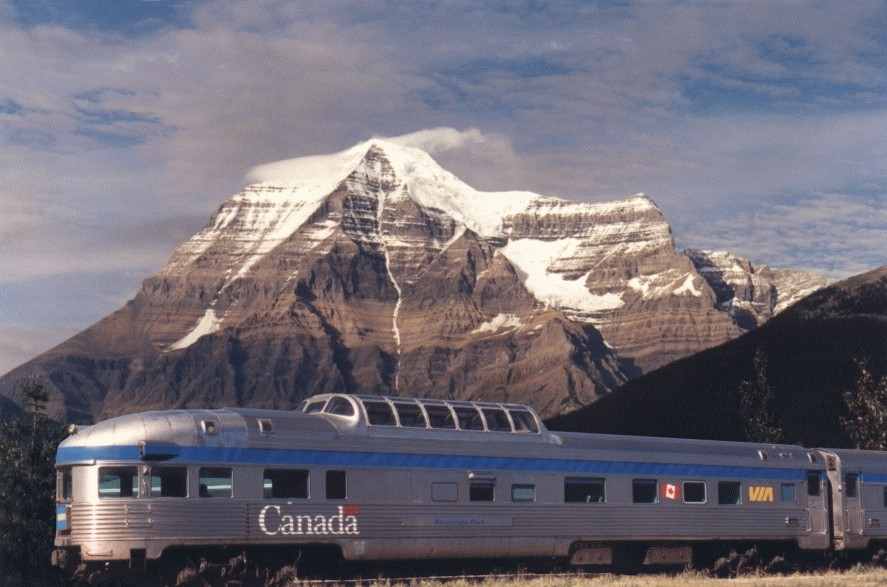
All that aside, The Skeena is one of the few remaining trains anywhere on the planet to be equipped with classic 1950s era dome cars. Collectors own most surviving examples and only ViaRail still offers scheduled service aboard trains equipped with them. Amongst rail fans and anyone who appreciates the glamour of post WWII rail travel in North America, domeliners like The Skeena and The Canadian will always be special trains.
ViaRail’s dome cars are old Canadian Pacific Railroad stock, built in 1955 especially for the CP’s brand new Canadian. There are dome coaches and dome lounges in addition to the beautiful dome observation lounges that bring up the rear of the train. These are called “Park Cars” because they are named after various National and Provincial Parks in Canada. They are normally reserved for the exclusive use of First Class passengers, meaning those passengers holding sleeping accommodations.
*** ***** ***
I thought I’d be able to walk to the ViaRail station in Prince Rupert, but it has relocated to the ferry terminal outside of town. Though inconvenient for me, the move allows ferry passengers arriving in the morning from Alaska or the Queen Charlotte Islands to more easily connect to the 8:00am train to points east. Interestingly, a new containership terminal to be completed next year will mean the relocation of both the ferry and railroad terminals to a location closer to the city.
The taxi dropped me off at the station in a driving rain. It was raining so hard that in the short time it took me to step out of the cab, remove my pack from the trunk and step into the station, I actually got pretty wet. Wet enough that I decided to change my shirt.
Inside the station were about a half a dozen people. Where is everybody? The ViaRail ticket agent exchanged my electronic ticket for a paper one and told me that the load was pretty light today. I’d say so. Ultimately, only fourteen of us boarded in Prince Rupert.
The train pulled into the station just ten minutes prior to departure. Headed up by a single F40PH engine, the remainder of the train consisted of just two cars – a flat top coach and the dome observation lounge “Kootenay Park”. That was it. I do believe this is the shortest train I’ve ever ridden upon.
During the off-season, the Skeena is operated as an all-economy class train. As such, the inclusion of the dome observation lounge was a real treat because these cars are normally reserved for First Class passengers.
With only fourteen passengers to board, we were loaded and ready to go within five minutes of boarding. There was no baggage car since the coach had baggage storage shelves at each end. Tickets were collected by the conductor, some last minute paperwork was exchanged through the vestibule window and we were on our way, smoothly gliding through the Prince Rupert suburbs and out into the rainforest south of the city.
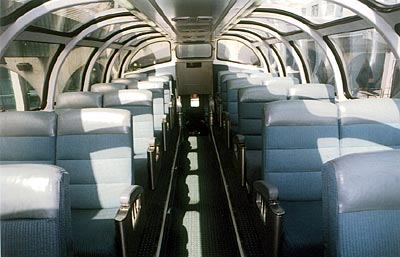
I didn’t spend but five minutes in my seat before gathering my gear and relocating to a seat upstairs in the dome car. The dome is accessed via a small stairway and offers
24 seats under the glass, six rows of 2-2. The views is forward and above as well as to the sides, perfect for viewing the mountains above and the river beside us as we rolled out of Prince Rupert and into the Skeena River Canyon. Now if only the rain would stop.
In the language of the Gitksan people, Skeena translates into River of the Mists. The river has been a trading route and fish source for thousands of years. Over its last forty miles, the Skeena is as wide or wider than many of the channels that I’d recently sailed through in both Chile and British Columbia.
At one point, we stopped briefly as the train crew pointed out a two hundred year old native rock painting. The painting depicted an eagle, of which there are many along the Skeena River.
Our speed through the Skeena River Canyon was about 50 mph. I thought the pace was perfect for enjoying the scenery enroute. By contrast, trains like the French TGV and Japanese Bullet Train rip along the tracks at speeds three to four times faster. I’ve never been all that impressed with ultra high-speed travel. This includes the Concorde. I’m into the experience of travel, of getting there. Super fast planes and trains are for people who are more interested in the destination. The less time they have to spend getting there, the better.
To be sure, we all face situations where time is of the essence and travel needs to be accomplished as quickly as possible. In general though, if the time and price are right I’d much rather drive or take the train than fly. The pace is slower and more relaxed, I get to see and enjoy the country I’m traveling through rather than over, and there’s often a diner or lounge car in which to enjoy a meal or mingle with fellow travelers.
Leaving the Skeena River canyon, the train passed through pretty valleys and small towns surrounded by high mountains. Approaching the town of Smithers, we passed by Hudson Bay Mountain. I’ve seen this mountain many times under sunny skies and its quite impressive. The view of the Kathlyn Glacier upon its upper reaches is said to be the best view of a Glacier from any train in North America. Unfortunately, low clouds obscured any chance of seeing the glacier, much less the top of the mountain. Later, big fluffy snowflakes started falling as we paralleled the Bulkley River. High mountains gave way to rolling hills as we entered B.C.’s Lake District. As we slowly rolled into Burns Lake, a popular fishing and vacation area, one of the train attendants took time to check a nearby eagle’s nest for sign of chicks. I commented that it seemed a bit early for chicks but she replied that she’d seen some last week out at Fraser Lake. No doubt the unusually warm winter has jump-started some of the natural processes.
Food on today’s train was nothing to write home about. The menu was strictly take away and was highlighted by pre-fab sandwiches and instant noodle soups. There were a couple of microwaveable entrée dishes but neither of them looked particularly appealing. During the summer months, the selection is considerably better.
About an hour out of Prince George, we passed through the town of Fort Fraser. It was announced that this was where the final spike was driven in to complete the Grand Trunk and Pacific transcontinental railway in April of 1914. That railway went on to become today’s Canadian National.
At a little after 8:00pm, we saw the first lights of Prince George, the largest city in Northern BC with a population of about 75,000. Approaching the city from the west, those first lights turned out to be about the only lights because there really wasn’t much of a western suburb. We passed by lumber mills and old warehouses and when we finally did enter an area of bright lights and city streets we were just a few blocks from the train station.
Alighting from the train, I headed over to the National Hotel located just across the street from the station. I’d discovered this hotel via the Internet when searching for budget accommodations in Prince Rupert. While I couldn’t argue with the hotel’s convenient location, the place had a rough look about it that wasn’t captured in the glossy photos posted on the website. The lobby was open but there was nobody working the front desk. A sign directed potential guests to register with the bar next door. Hmm… My doubts about this place were confirmed when I watched three of the hotel guests lurch into the hotel. One of them asked me for some spare change.
I headed back across the street to the train station where I booked a clean, quiet room at the Downtown Motor Inn for just $45.00 CAD per night.
March 31, 2005
Prince George to Vancouver
Air Canada Jazz 2825 Economy Class
DHC-8-300 C-GKTA Seat 1B
1230p-200p Flight Time: 1:24
My flight down to Vancouver didn’t depart until 12:30pm so I enjoyed a late breakfast and a leisurely morning in Prince George before catching a shuttle out to the airport. The terminal was nearly empty when I arrived, so check-in was accomplished quickly.
Prince George is served by Air Canada Jazz, WestJet and a couple of smaller regional airlines. Until just recently, it was also served by Fokker 100s from low cost carrier JetsGo. Two or three months ago when I’d made my reservations for this segment, I gave serious consideration to booking my flight aboard JetsGo. Not only was it an airline that I’d never flown before but it also operated the Fokker 100, an aircraft fast disappearing from North American skies. Ultimately, I chose Air Canada’s Jazz because its Tango fare was substantially lower than anything offered by JetsGo or WestJet at the time. JetsGo recently filed for bankruptcy and ceased all flight operations, so today I was doubly thankful to be booked aboard Air Canada.
The aircraft for today’s flight was a DeHavilland Canada DHC-8-300, one of the most popular regional propjets ever built. It was painted in Jazz’s green livery, which features a simple green maple leaf on the tail and the stylized “Jazz” title across the forward part of the fuselage. Other colors for this livery include red, orange and yellow. Autumn colors. Green was an appropriate color for today, the 10th day of spring.
This one hour flight down to Vancouver didn’t offer much in the way of service, but then not much was expected from an airline teetering on the brink of bankruptcy just one year ago. I had a Coke and a bag of surprisingly tasty sesame sticks. Unfortunately, the cloudy skies deprived us of viewing some of the pretty scenery between Prince George and Vancouver. After last week’s sunshine, it seems I’m travelling through this region just a few days too late.
Upon landing in Vancouver, I collected my pack and headed off to pick up a rental car for a weekend down in Seattle.
Seat 2AMarch 23, 2005
Miami to Seattle
Alaska 17 First Class * Breakfast
737-900 N320AS Seat 1A
800a-1100a Flight Time: 5:52
If you didn’t know where to look, it would be very easy to miss Alaska Airlines’ tiny little check-in counter at Miami International. It’s located at the entrance to the E Concourse but is obscured by a big bank of escalators that access the train out to the E gates. Alaska operates just one flight per day into Miami, so I suppose they should be happy they have a counter at all as opposed to, say, a podium.
I checked my pack all the way through to Fairbanks and then headed over to the Club America, located landside at the entrance to the F Concourse. I had a long day ahead of me – three more flights covering 4,430 miles – and I required massive infusions of coffee, orange juice and a couple of oatmeal raisin cookies. The receptionist remembered me from my November trips down here. It must be the beard. I’m probably the only guy in South Florida with a beard longer than 1/8th of an inch. The Don Johnson look from Miami Vice is still in, I reckon. Up in Alaska, we’re more partial to Grizzly Adams.
Alaska Airlines has a posted policy requiring passengers to be at the gate, ready to board thirty minutes before scheduled departure. For the most part, I ignore this policy. Furthermore, Alaska’s policy states that ten minutes before departure, all passengers should be onboard the aircraft so that doors can be shut and the aircraft finalized for an on time departure. Alaska truly endeavors to accomplish this goal and those who ignore the ten-minute rule do so at their peril.
I arrived at the gate about 20 minutes before departure. Large masses of humanity heading in the opposite direction brushed by me as I neared the gate. Where are all these people coming from? Ah ha! The inbound from Seattle had just arrived. The marquee board at the check-in counter reflected an on-time arrival for the inbound flight. Needless to say, I wasn’t too happy about this because had I known of the delay, I would have been back in the Club America downing quarts of coffee and orange juice. The sign at the podium showed an 8:10am departure. No way we’re turning a 737-900 around in just 30 minutes, I thought. Think again, 2A. By the time 8:10am rolled around, we were onboard the aircraft and waiting for the final paperwork. Well done, Alaska!
One thing I don’t particularly care for with regard to Alaska’s inflight service is its choice of newspapers. Alaska insists on handing out the Wall Street Journal, the world’s most boring newspaper. Are we all suit and tie clad business executives up front? A look around at today’s passengers would strongly suggest otherwise. How about a copy of the New York Times instead? Or anything with just good solid reporting of world and national news that also has a sports section.
Soon we were pushing back from the gate and taxiing past a big, dirty A340 from Aerolineas Argentinas. That plane was in serious need of a good cleaning. The captain welcomed us aboard, indicated a 20-30 mph headwind along our route of flight and announced our estimated flying time as five hours and forty-eight minutes. He ended with that old standby line “If there’s anything we can do to make your flight more enjoyable, please don’t hesitate to ask.”
Aside from the advertised service, which is generally always delivered, I’m at a loss to figure out what else the crew might be willing to do. I mean, I heard that a Boeing test pilot once successfully took a Boeing 727 through a barrel roll. Can we please try that at some point during the flight with this 737? I’d really enjoy that!!
We had a great group of Flight Attendants for this flight. They all must have gotten a good rest last night because they were all bright eyed and bushy tailed as opposed to the beady eyed and beaver tailed variety one occasionally encounters on these early morning departures. Perhaps because of the effort in getting this plane loaded, closed up and off the blocks by 8:15, breakfast orders were not taken until we’d leveled out at 35,000 feet. We were offered a choice between a cheese omelette or a quiche. Normally, I’d be interested in a quiche but the thing Alaska calls a quiche is one of those pre-fab jobs with way too much crust and not enough eggs. I went with the omelette, along with – you guessed it – coffee and orange juice.
On flights over three hours, Alaska begins its breakfast service with the presentation of a fruit plate. Today’s offering included slices of pineapple, cantaloupe and honeydew melon. The only bread offered was a warm apple filled Danish pastry placed on a doily in the corner of the tray. The fruit plate was tasty enough but on a flight of almost six hours, Alaska really should offer a proper bread service. Danishes, sure, but how about some croissants or bagels?
The best omelet I’ve ever eaten aboard an airplane was two years ago on an Alaska flight between Seattle and Miami. It was billed as an Asiago Cheese Omelette and was topped with sliced mushrooms and green onions. Accompanying it were roasted potatoes, sautéed spinach and turkey sausage. The omelet was actually fluffy, and the spinach, roasted potatoes and turkey sausage were much healthier accompaniments than the fried fatty items one often receives with breakfast.
Today’s simple cheese omelette was served with greasy potatoes and greasier sausage. It was about as unhealthy a combination as you can get, especially with only an apple Danish for the bread course. Frankly, it was a disgrace not only to the kitchen that prepared it but also to Alaska Airlines for serving it. Once upon a time, Alaska’s top executives including the CEO used to sit down to one of their weekly meetings and be served airline food. I doubt that’s the case anymore.
Unfortunately, inflight food is generally a no win proposition for the airlines. No matter how well prepared and presented the food is, amongst the one hundred and fifty or so passengers on board, somebody’s always going to find something to complain about. Even so, I don’t think it would be too much to ask of Alaska or any airline to prepare its First Class dishes in a healthier style. That means less fried items and more broiled or baked items. I don’t think it costs any more to broil or bake as opposed to frying, though it may take a bit longer.
Consider breakfast in America. As a whole, most Americans like eggs for breakfast. For a First Class hot entree on a five hour flight, I should imagine it would be quite possible to scramble up some eggs with veggies (with or without the cheese, it’d still be good) or prepare a nice omelette like Alaska used to serve. As accompaniments, they could offer roasted rather than fried potatoes and maybe a broiled tomato or asparagus or spinach if meat is deemed too expensive. Offering a sweet, fatty Danish pastry as the only bread item is just plain senseless. How much more would it cost, if any more, to offer a plain bagel? Remember, we’re talking transcontinental First Class service here.
Alaska’s First Class food service was once of such a high standard on short to medium range flights that the cutbacks enacted in the past year have not set well with its frequent flyers. The food related postings over at FlyerTalk’s Alaska Forum attract a lot of comment, most of it negative.
Perhaps the most appreciated perk in any Frequent Flyer program is the ability to upgrade to First Class. However, when passengers are asked what aspect if the inflight experience is most important to them, in survey after survey they have pointed to greater personal space and a quiet and relaxed environment as being the most highly rated aspects of a nice flight. Complimentary cocktails and elite lanes at security check points rate much higher than a better quality omelette or healthier breads.
A big part of Alaska’s rationale for cutting services in the forward cabin is that First Class simply doesn’t produce the revenue to support a nicer meal service. Okay, so then follow the early example provided by fellow Alaskan carrier Wien Air Alaska back in the early 1980s. Drop this now ridiculous façade of a First Class service and call the forward cabin Business Class. Meals, if any, will be the same as Economy Class but drinks will be complimentary. What you’re really buying is space. Wien even took it a step further and would not allow children under twelve to travel in the Business Class cabin.
Anyway, I’ll get off my soapbox now because our descent into Seattle has begun and soon all seat backs and tray tables will have to be returned to their full upright position and all electronic equipment must be yada, yada, yada …
We parked next to the Alaskaair.com jet and I headed down to the boardroom to catch up on my email.
Seattle to Anchorage
Alaska 177 First Class * Dinner
737-400 N779AS Seat 1F
330p-725p Flight Time: 3:23
On the way up to the gate, I ran into the postmaster of the tiny Post office in my hometown of tiny Ester, Alaska. He was headed with some of the boys to Mesquite, Nevada for a few days of sun and golf. I wished him well in his pursuit of par or within ten strokes of par. I also advised him to watch for the postcard I sent to him from Argentina. I’ve been going away on trips like this for years and Bill’s been more than patient in boxing and storing all my mail. In return, I try to send him postcards from every different country that I visit. I also try to put as many stamps as I reasonably can onto the postcard. This makes the card more colorful and also takes up space that I would otherwise have to write in. I send a lot of postcards and they all have at least three stamps on them if possible, plus an airmail sticker.
Awaiting me at gate C-11 was Alaska’s 737-400 N779AS. What, again?!! In all my years of travel with Alaska Airlines, N779AS is far and away the one aircraft I have flown more than any other plane. Today’s flight on this plane would be my fourteenth for 9,780 miles.
The Pacific Northwest has been in the throes of an extended drought over the past year. The lack of snow in the Cascades has been tough on local ski areas and will mean another summer of high fire danger in the region’s forests.
On a positive note, it’s also meant that Seattle has enjoyed what must surely be a record for the number of sunny days it’s experienced this winter. Today was a very sunny day indeed and I had my camera ready and loaded at my side in seat 1F, the scenic side for viewing all the mountains and glaciers on northbound flights.
Our First Class Flight Attendant was from Ireland, and although it had been some years since she’d actually lived there she still retained a good bit of that melodic Irish lilt. She stopped by now to take our drink orders and read us the dinner options:
Seattle to Anchorage
DINNER
To Begin
A bag of pretzels to accompany the beverage of your choice
Salad
Baby Spinach Salad with shaved red onions, chopped eggs and bacon
Presented with Balsamic Vinaigrette
ENTREES
Grilled Chicken Breast with Red Pepper Pesto Sauce
Served with red skinned mashed potatoes with green and yellow zucchini sautéed with thyme
Beef Tender Tip with Demi Glace Sauce
Accompanied by rosemary roasted potatoes with stir-fried broccoli, carrots and red onion
** ***** **
Dessert
Chocolate Silk Pie
Ah, if only Alaska served Guinness! Instead I settled on a MacTarnahan’s Scottish Ale, quite possibly the finest beer served aloft anywhere in America. To accompany my beer, I opted for the Grilled Chicken Breast with Red Pepper Pesto Sauce. Like N779AS, this is about the fourteenth time I’ve had this entrée. Where once one could fly Alaska and reasonably expect a different selection of entrées every week, now it seems the same two choices are served system wide for an entire month. Thankfully I rather like this chicken entrée but even so, I can’t help but think of that old Far Side cartoon that depicts a dog being served a bowl of food and the dog thinking “Oh Boy! Dog food again!!”
Our flight this afternoon took us up along the East Coast of Vancouver Island – the very same side of the island I’d be traveling up in just two days time. The deep blue of the Georgia Strait coupled with the dark green of the spruce covered Gulf Islands looked wonderfully inviting in the late afternoon sun and I prayed that this good weather would hold for just a few more days. We continued up the coast of British Columbia, passing about forty miles west of Prince Rupert before entering Alaskan air space where we got good views of Ketchikan and Mount Edgecombe, the southernmost volcano in Alaska. All the while I was enjoying my chicken dinner whilst chatting with seatmate, a retired sales rep for Starwood Hotels. Unfortunately, she had misplaced her reading glasses and was unable to read any of the many magazines that she’d brought along for the trip north. Perhaps to compensate for the lack of stimuli normally provided by her magazines, she struck up a conversation with me early on in the flight. I obliged her as best I could with tales of great and not so great hostels that I have visited, as well as offering her a running commentary on the fantastic parade of nature’s beauty gliding by beneath us. For example, did you know that the last time Mt. Edgecombe down there acted up was on April Fool’s Day, about twenty years ago? Some pranksters hauled a load of old tires up there, doused them in gasoline and lit them afire. The resulting smoke caused quite a stir in nearby Sitka but when the authorities helicoptered up there to see if the volcano was reawakening, all they found was a bunch of smoldering tires arranged to spell “Happy April Fools Day!” Before long, seatmate was sound asleep and I returned to my reading.
Actually, it occurred to me as we were flying past Mt. Edgecombe that just two days ago I was flying past all the Chilean volcanoes between Puerto Montt and Concepcion. Today I’ve seen six of the Cascade volcanoes as well as the southernmost of the Alaskan volcanoes. There are something like 22 volcanoes within 100 miles of Anchorage and if it remains clear, you can see quite a few of them during the approach for landing. That’s a lot of volcanoes to see in just three days.
Flights like this are why they put windows on airplanes.
In Anchorage I transferred to a smaller 737-700 for the short forty-minute flight up to Fairbanks. Unfortunately, high clouds obscured any view of Denali but it mattered little to me. I’d traveled 10, 730 miles over the past four days, from the bottom of the planet almost to the top. It was good to be home again.
March 24, 2005
Fairbanks to Seattle
Alaska 192 First Class * Dinner
737-700 N607AS Seat 1A
100p-656p Flight Time: :41 / 2:58
Despite checking in regularly with the friendly folks at Alaska’s Partner Desk in an effort to get a seat on a later flight out of Fairbanks, my efforts came up empty and I was forced to stick with my original reservation, a seat on the 1:00pm departure down to Seattle. I should add here that I certainly don’t bear any ill will towards Alaska Airlines for the paucity of available award seats out of Fairbanks. Generally, I find getting award seats on Alaska to be a fairly easy process and as I said, the staff working the Partner Desk are a friendly, capable and patient lot. The reality is that it’s March and a lot of people are looking to get out of town. I’m happy to have a First Class seat on a daytime departure rather than the dreaded 2:00am night owl down to Seattle.
In any event, my failure to get on a later flight meant I had just seventeen hours here in Fairbanks, of which I was hoping to sleep for at least eight or nine. That left me with very little time to deal with the myriad of tasks that I needed to accomplish before setting off on the next leg of this journey.
Accomplish them I did, however. Starting with a haircut, I then stopped by the insurance agency, the post office, my storage locker to restock on books and music and finally the Fred Meyer store on Airport Way to restock my coffee and vitamin supplies. By 11:00am I was ready to have lunch with friends at Lemon Grass – the other good Thai restaurant in town – before parking my truck and being dropped off at the airport. See y’all in May! Watch for postcards!
Through some fluke in reservations, I was assigned Seat 1D between Fairbanks and Anchorage and Seat 1A from Anchorage down to Seattle. On the flight out of Fairbanks, I sat next to a lady chemical engineer who knew a lot of the same people I know in Fairbanks. This included the head lab tech at the refinery in North Pole who I used to know when she was a housekeeper at the Park Hotel in Denali National Park back in 1984. Even back then, despite her seasonal position as a housekeeper, Gail had her Masters in Chemical Engineering. She’d just arrived in Alaska from North Carolina and was looking for something to tide her over while she checked out the job market in up in Fairbanks on her days off. We had a good time chatting about old acquaintances and before we knew it, we were on final into Anchorage. There, we went our separate ways, she down to Seward and me across the cabin to seat 1A.
Out of Anchorage, a few clouds had gathered but we still had pretty good views of most of the glaciers and big peaks along the way. Dinner was – you guessed it – another serving of Grilled Chicken Breast with Red Pepper Pesto Sauce. I never did try any of the dessert, but it looked pretty good, rather like a chocolate cheesecake.
Seattle to Vancouver
Alaska 148 First Class
DC-9-80 N958AS Seat 1A
1010p-1102p Flight Time: :33
The MD-80 was originally known as a DC-9-80 when it was first introduced in the late 1970s. Why change the name to MD-80 for this most successful variant of the DC-9?
In May of 1979, an American Airlines DC-10 crashed on takeoff from Chicago’s O’Hare Airport. The pylon that attaches the engine to the wing separated from the wing with catastrophic results. There were no survivors. The subsequent NTSB investigation indicated improper maintenance practices by American contributed to the crash but more importantly, design flaws in the aircraft exacerbated the situation. All of the DC-10’s hydraulic systems – the main and back-ups – were located in the leading edge of the wing. All of them were severed when the engine and pylon swung upwards under full takeoff thrust. Boeing’s 747 and Lockheed’s L-1011 had their main and back-up hydraulic lines spread throughout the wing. Why didn’t McDonnell Douglas?
Two earlier incidents involving DC-10s also pointed to design flaws. Both involved the rear cargo door’s inability to stay closed inflight. Under pressurized flight, the sudden depressurization resulting from an open rear cargo door resulted in a partial collapse of the rear passenger cabin floor. Often this affected cables that controlled the rear ailerons. In the first incident, another American DC-10 was able to limp into Buffalo. In the second, a THY Turkish DC-10 crashed outside of Paris, killing all aboard.
In the wake of the Chicago crash, the domestic DC-10 fleet was grounded. Questions were asked, investigations were launched and ultimately it was alleged that McDonnell Douglas had taken some short cuts in the DC-10 design in an effort to enjoy the competitive edge gained from being able to get the DC-10 into service before Lockheed’s L-1011.
Of course, the mainstream media put the DC-10 story front and center. The result of all this was that a lot of negative publicity was generated towards not only the DC-10 but all McDonnell Douglas products. Just like that, the successful legacy of the “DC” brand evaporated. More than a few people refused to fly upon any plane that started with a “DC”.
At the same time, McDonnell Douglas was working hard towards generating orders for its new DC-9-80. All this negative publicity towards McDonnell Douglas in the aftermath of the DC-10 incidents was not helping sales at all. So – starting with the DC-9-80 and extending to all future commercial aircraft, the “DC” was replaced by “MD”. It’s worth noting that the Douglas Aircraft Corporation had become McDonnell-Douglas some years before the DC-10 entered service, but given the success of the “DC” brand with such stars as the DC-3, DC-6, DC-8 and DC-9, it was decided to stick with “DC” for the ten.
Had there not been any problems with the DC-10, the MD-80 would still be a DC-9-80 and the MD-11 would more likely be a DC-10-50. After all, what is the MD-11 if nothing but a stretched DC-10 with improved aerodynamics? It’s like the difference between Boeing’s 747-200 and 747-400.
I once got an email from a FlyerTalk member asking why I always listed the MD-80 as a DC-9-80 in my reports. I do it because that’s what the airplane was called when I first started flying it and if you look on any of the air worthiness certificates posted inside the aircraft (either above the front door or in the cockpit), that’s what it’s still called.
I like the DC-9-80. I’ve logged over 125,000 miles aboard it and I’ll be logging another 130 miles on tonight’s short flight up to Vancouver. Short would be the operative word here. With a total flight time of just thirty-three minutes, there wasn’t much time for any more service than a cold beer and a bag of pretzels. The only shorter flights I’ve been on aboard DC-9-80s have been inter-island hops on Hawaiian Air in the 1980s and a ten mile, seven minute flight from San Francisco to Oakland aboard Alaska Airlines a few years ago.
In Vancouver, we parked next door to a big HMY Harmony Airways 757 arriving from Las Vegas. It was unloading at the same time we were so I wasted no time in disembarking to hopefully beat the big glut of passengers soon to be descending upon immigration.
Vancouver International is a beautiful airport. Wood, glass, steel and stone have been combined to create an attractive, spacious and functional facility. Unfortunately, the designers did not create any dark and quiet places to sleep. The entire airport was brightly lit and down in the baggage claim areas, all night TV blared from the baggage carousels. I did find a reasonably quiet but well lit lounge area where I set up camp with four or five other weary travelers. While they tried to get comfortable atop banks of chairs, I unfurled and inflated my Thermarest Pad, pulled out my pillow and threw my sleeping bag over me like a quilt. I slept comfortably until my alarm went off at 6:30am.
Seat 2AMarch 21, 2005
Punta Arenas to Puerto Montt
LAN Express 80 Economy Class * Lunch
A319-100 CC-CPE Seat 11J
1240p-250p Flight Time: 1:44
Punta Arenas is the southernmost city in Chile. It is home to about 130,000 people and is the Chilean gateway to Tierra del Fuego and Antarctica. I had a pretty fair walk around the downtown district last night and I liked what I saw – lots of old colonial buildings and, in the heart of the city, a beautiful tree lined plaza dominated by a statue of Magellan.
Today was the 75th anniversary of the Chilean Air Force. The downtown district was filled with men in uniform and a number of streets were closed for a big parade. I was sorry that I couldn’t spend a couple more days here.
Punta Arenas’ Ibanez International Airport is located 22km from town. For $3.50, you can catch the local airport shuttle service or splurge and pay twice as much for the taxi. Was that a collective moan I heard coming out of the New York metropolitan area…?
The government of Chile appears to have invested a fair amount of money into its airports over the past ten years. This is especially evident in smaller cities such as Punta Arenas, Puerto Montt and Concepcion – all of which sported nice new terminals with jetways. The primary beneficiary of these jetways appears to be LAN Chile. The competition, namely startups Sky Airlines and Aerolineas del Sur, are generally relegated to ramp space in front of the older terminals. Only in Santiago do they have a chance at a jetway.
LAN Chile’s domestic operations are handled by LAN Express, which does not offer First or Business Class. When I arrived at the counter, there was a good sized crowd waiting to check in for the flight to Puerto Montt and on to Santiago. The five agents working the counter along with the one expediter working the line did an impressive job of keeping the line moving and getting people smoothly on their way. My backpack was checked through to Santiago and I was issued an exit row seat for the flight up to Puerto Montt. I asked for an exit row on the milk run between Puerto Montt and Santiago as well but was informed that exit row and bulkhead seats could only be allocated at the airport of origin. Hmm…
Another new and welcome addition to LAN’s product is a collection of airport lounges called Pacific Clubs. Though my Economy Class ticket would not by itself gain me entrance to any of these clubs, my Priority Pass membership would.
In smaller airports like Punta Arenas, the Pacific Clubs are also small. Very small. How small are they? I’ve been in living rooms that were larger. Even so, the lounge was a welcome respite from the noisy crowd out in the gate area. In one corner was a small bar offering the usual non-alcoholic drinks. The bar also served as the reception area. I was checked in by an attractive young lady who also prepared me a café con leche and a plate of cookies. Interestingly, the only alcohol available was wine. Across from the bar was a pair of Internet ready computers. In addition to computer terminals, most Pacific Clubs now offer Wi-Fi wireless access as well. A TV and a couple of couches completed the furnishings.
The only downside to this lounge visit was a man sitting at one of the computer terminals who spent the entire time yakking loudly on his cell phone. He was a couple of spots ahead of me in the check-in line and talked all the way through that, too. Talk, talk, talk, talk, talk! If any airline should someday allow people to use their cell phones while inflight, they’ll see the last of my patronage. I’m not anti-cell phone, but for many travelers flights can great places to finally relax, sleep or catch up on some work after a long day of whatever. Having one or more people sitting within a row of your seat yakking away, loudly or not, would be nerve wracking in the extreme.
No boarding announcement was made in the lounge but I could hear the announcement outside in the gate area. At the gate awaited a gleaming Airbus A319, resplendent in the dark blue, silver and white livery of LAN Express. The aircraft was outfitted with 136 dark blue seats and as I walked back to my exit row seat, I wondered how many airlines sport cabin interiors in any color other than dark blue. I’m sure there are still a few but dark blue is far and away the most popular choice.
Back in the colorful 1970s, most US airlines employed all manner of bright colors and intricate patterns in their seat fabrics. Braniff’s seats were multi-hued yellow, orange and red, National’s DC-10 cabins were a mix of tropical lemon yellow, orange and melon. Eastern’s seats were upholstered in an attractive pattern of multi-hued blues and purples. As we became more conservative through the eighties and nineties, darker and more somber colors began to proliferate.
That said, I thought the cabin in LAN’s A319 looked very nice. Clean and uncluttered. That is until all those colorfully clad passengers started filing in and ruined the effect. As for the outside of the airplane, I think LAN has one of the more attractive liveries out there.
Service started with a basket of hard candies passed around just before pushback. A flight attendant stopped by my seat in the exit row to ask me if I spoke Spanish. Verifying that everyone in the exit row speaks the predominant language of the country is an excellent idea, I think. I assured the FA, in Spanish, that I could speak well enough to be of assistance in the exit row should the need arise.
The Captain welcomed us aboard and gave the usual flight details; first in Spanish, then English and finally French. French? I don’t believe I’ve heard French spoken even once in Chile though I did hear plenty of German. Still, if there were any French speaking passengers on board, I’m sure they would have been positively exultant because if there’s anything a Frenchman loves to hear, it’s his own language!
Our 12:40pm departure coupled with a scheduled flight time of almost two hours meant that luncheon would be served on this flight. Today’s offering was slices of baked chicken breast presented with peas, potatoes, a dinner roll and a custard dessert. I thought it was all quite good, especially in these times of diminished quantity and quality of inflight meals.
The far south of Chile is a land of rugged mountains, massive glaciers and azure blue lakes. On a clear day, a window seat is a must when flying between Punta Arenas and Puerto Montt. Unfortunately, localized cloudiness obscured what is otherwise one of the more scenic flights on the planet. Thankfully, the clouds cleared somewhat later in the flight and as we descended into Puerto Montt’s Tepual Airport, I got a nice view of Osorno volcano to the north of the city.
In Puerto Montt, I had a three hour layover until the departure of my connecting flight up to Santiago. It was time well spent in the Pacific Club while bringing my Alaska to Ushuaia report up to date. I was well over a week behind on that so the long layover was doubly appreciated.
Puerto Montt to Santiago (via Temuco and Concepcion)
LAN Chile 565 Economy Class * Snack
737-200 CC-CSP Seat 1L
455p-900p Flight Times: :29 / :24 / :44
Speaking of getting behind, you might be interested to know that I’m writing the portion you’re now reading from the back row of a Greyhound bus. At present, we’re winding through the spruce forested mountains of Vancouver Island enroute to Port Hardy. Where will I be when I get around to writing about today’s travels… Hong Kong?
LAN Express offers plenty of daily flights between Puerto Montt and Santiago. A three hour layover was not necessary, but since I wanted to fly LA 264, the two-stop milkrun up to the capitol city, that’s the way things worked out. Adding to my layover was a slight delay in
boarding while the mechanics changed out a tire on the 737-200 slated to operate today’s flight.
Nonstop flights between Puerto Montt and Santiago take only an hour and twenty minutes, so as you might imagine this flight making two stops enroute offered some pretty short flight times. It was a nice sunny evening as we climbed out of Puerto Montt and made a big sweeping turn to the north. Our first destination was ZCO, otherwise known as Maquehue Airport serving Temuco, Chile. Temuco’s a large agricultural and forestry center, attractively set in verdant farmlands surrounded by equally verdant rolling hills. Flight time was twenty-nine minutes so thre was no service of any kind enroute. Not even beverages. Up in bulkhead window seat 1L, I had the entire row to myself and spent the entire flight admiring first the volcanos north of Puerto Montt and then the setting sun as we descended into Temuco.
Twenty-five minutes later, we were airborne again, this time for only twenty-four minutes as we winged our way further north to the city of Concepcion. Our landing at Carriel Sur Airport was textbook smooth and as we parked in front of the old terminal building we were joined by a 737-200 from Sky Airlines.
The Flight Attendant informed me that we had a full load from Concepcion up to Santiago so I quickly gathered up my well spread out belongings before my seatmates arrived. Flight time up to Santiago was announced as fifty minutes and once we’d leveled out, a snack would be offered. Oh boy! I was more thirsty than hungry but as one who generally views airline meal service as a form of inflight entertainment, I anxiously awaited the meal offering as well. Small trays were distributed, each bearing a cream cheese and tomato relish filled roll, a mysterious white pastry dessert and a coffee cup. To this day I’m not sure what that dessert was supposed to be. It tasted like something that had once been moist but was left out in the sun for a few days. One small bite was enough of that.
Baggage delivery in Santiago was surprisingly fast and soon I was on my way into the city center where an air-conditioned room at the Ciudad de Vitoria Hotel awaited me. Total mileage flown today came to 1,680 miles. Only 8,810 more miles to go until I get back home to Fairbanks.
March 22, 2005
Santiago to Miami (via Guayaquil and Bogota)
LAN Chile 565 Business Class * Breakfast, Lunch, Snack
767-300 CC-CEN Seat 5A
915a-830p Flight Time: 4:35 / 1:26 / 3:06
In arranging a pick-up time for my ride out to Santiago’s Benitez International Airport, I was offered a choice of 6:00am or 9:00am. Since my flight didn’t leave until 9:15am, I was hoping for something a little later. Alas, it was a busy morning so a 6:00am pick up it was.
On a positive note, my early arrival and check-in left me that much more time to enjoy LAN Chile’s Neruda Lounge. Interestingly, as I was walking down to this lounge, I passed by LAN’s Mistral Lounge and decided to stop in there and check it out. The attendant took one look at my Business Class boarding pass and did her best to convince me that I’d really be better off at the Neruda Lounge. Apparently, the Neruda Lounge is a dedicated First and Business Class lounge with all the attendant amenities whereas the Mistral Lounge is somewhat more basic by comparison. Anyone can buy a visit to the Mistral Lounge whereas only Business and First Class passengers may access the Neruda Lounge. From what I could see of the Mistral Lounge, it looked comfortable and pleasant enough but I nonetheless thanked the receptionist and continued on down the concourse to the Neruda Lounge.
The Neruda Lounge supplied two things that I really needed at the time. Breakfast and an Internet connection. A buffet area offered peach, orange and raspberry juice along with sliced fruits, a tray of ham and cheese sandwiches and a plate of sweet rolls and cookies. The All Chilean Breakfast if ever there was one. I put together a plate with a bit of everything and relocated to one of the empty workstations. An hour later, having successfully communicated my imminent arrival to interested parties up north, I gathered my gear together and headed up to the gate.
Boarding was well underway when I arrived and a fairly long line had formed. Usually in cases like this I just take a seat and wait for the crowd to thin out but this group seemed to be boarding at a decent pace so I took my place at the end of the line. Moments later, a uniformed LAN agent approached and asked to see my boarding pass. Ah, Business Class, she said. Come with me. Still not quite sure how she’d managed to identify me as a Business Class passenger, I nonetheless followed her straight to the podium where my boarding pass was pulled, my stub was returned and I was subsequently welcomed to board. Yeah! Now that’s the kind of service I like!
The 767-300 operating today’s flight up to Miami was painted in LAN’s old livery, the one with the curved red line below the windows. I like the new livery much better. Still, I’ve never refused to board an aircraft because I didn’t like the livery and I wasn’t going to start today. This was especially true for this flight, one I’d really been looking forward to because it made stops at Guayaquil, Ecuador and Bogota, Colombia. I’d never landed at Bogota’s Eldorado International Airport and was looking forward to seeing the Colombian countryside during our approach as well as some of the many vintage jetliners I knew were parked there. As well, I’d never flown these routes, so I was looking forward to adding them to my over 650,000 miles of unduplicated route mileage around the world.
The First Class cabin was full for the first leg of this flight up to Guayaquil. All of the passengers were men between the ages of fifty and sixty-five. All of them were dressed in business suits. It was like a flashback to the 1960s.
Back in the Business Class cabin, pre-packaged pillow and blanket sets had been placed atop each seat. Seating is 2-2-2 and out of the twenty-eight seats available, only six were occupied. A Flight Attendant soon appeared, relieved me of my jacket and returned three minutes later with an amenity kit. Perhaps because this is not an overnight flight, the amenity kit I received contained only a pair of socks, some earplugs and an eyeshade.
As I began to get settled into my new home for the next twelve hours, I reflected on how vastly different the boarding process is when flying First Class on a Boeing 747 as opposed to flying First or Business Class on a 767. Upon entering the 747, you make a left hand turn and are almost immediately cocooned in the peaceful tranquility of the First Class cabin. It’s just you, your fellow passengers and two or three ever-helpful Flight Attendants. Coats are taken, cocktails and canapés are delivered and the overall transition from the harried environment of the crowded airport concourse to the serene world of International First Class begins the moment you enter the airplane.
Unfortunately, the same cannot be said for the boarding process on the 767. Today’s flight offered an excellent example of why. As I was getting my carry-on baggage stowed away and the Flight Attendant was attempting to relieve me of my jacket, the aisles were filled with people trying to make their way back into the Economy Class cabin. A mother with not one but two screaming infants in tow trundled by, followed shortly thereafter by a middle-aged couple hauling a number of bags and boxes well in excess of the one carry-on (plus a small personal item) per passenger limit. A Wide Load sign should have preceded them. During a stall in the Stampede to Economy, two guys decided to take a seat in the Business Class cabin, perhaps to sample the seating comfort. When the line resumed its procession, they remained in the seats. At first I thought they were fellow Business Class passengers until a Flight Attendant stopped by, asked to see their boarding passes and subsequently shooed them off behind the curtain like errant cattle that had strayed from the drive. G’wan, now… The advertised peace and serenity of First or Business Class would not begin until well after takeoff.
Takeoff took 42 seconds by my watch. I time all my flights starting with the takeoff. This is not done so much to provide you all with stirring minutiae of the flight (Oh my God! Honey, come quick! Look at this! This guy was flying on a 767 out of Santiago and it took 42 seconds to take off! Isn’t that just the most unbelievable thing you’ve ever heard?!!) but rather to give me a sense of where we are when I look out the window during the flight. I started this practice on domestic flights within America where AirShow maps are rarely seen. I have driven, ridden trains and hitchhiked through all fifty American states many times over. In the western third of the nation, there are only nine counties that I’ve not yet set foot in. From the course of its rivers to the location of its cities, I know the geography of America better than most. Because I’ve been there. To me at least, it’s fascinating to look at the country from a vantage point 35,000 feet above it, and know what you’re looking at. As for flights outside of North America, well, old habits die hard. Even if I’ve never been through the lands below me, that doesn’t mean I don’t have some sense of where I’m at. I love to look at maps like most people like to eat. They inspire me to go see more of the world.
This morning’s inflight service started with hot towels that were neither hot nor scented. Does any airline do a consistently good job of presenting this Japanese treat known as Oshibori Towels? Maybe Japan Air Lines. It really seems to be hit or miss with most airlines, and I mention it simply because a properly presented hot towel is truly as refreshing as it is relaxing.
A menu along with the wine list had been placed in our seatback pockets prior to boarding. The menu covered each segment of today’s 4,380 mile journey to Miami. On the flight up to Guayaquil, we’d be served a hot breakfast. Here is a transcript from the menu:
Santiago to Guayaquil
BREAKFAST
TO START
Orange Juice
Coffee or Tea
OUR COLD DISHES
Fresh Seasonal Fruit
Yogurt or Cereal
WARM ENTREES
Cheese Omelette
Served with crisp bacon and steamed asparagus
Ham and Edam Cheese Sandwich
Served on country bread with fresh butter
FROM THE BAKERY
Choose your selection from our variety of bread served with butter and preserves
Although many hotels and hospedajes throughout Chile and Argentina include a complimentary breakfast in their rates, I never once saw eggs offered. The national breakfast of both countries seems to be juice, coffee and sweet breakfast breads or pastries. A larger version of that breakfast would include fruit, cereal and yogurt. I hadn’t had an egg breakfast since my flight down from Miami. As such, a ham and cheese sandwich for breakfast was out of the question.
The omelette was fairly decent as airline omelettes go. That is to say it wasn’t greasy. The crisp bacon was not quite what I expected, however. Where I come from, bacon is served in strips. What I received with my eggs was a pile of crispy pieces of bacon. These were little tiny pieces of bacon, like Bacon Bits. Not that I’m complaining, however. The bacon tasted fine but the presentation was … interesting. I really liked the cereal. It was kind of a mixture of crunchy granola and puffed rice. Overall, this was a savory and satisfying meal.
Guayaquil sits 2,250 miles to the north of Santiago. Flying time was just over four and a half hours, so after breakfast I had plenty of time for a short nap. I needed it. I didn’t get to the hotel in Santiago last night until 10:00pm, didn’t fall asleep until about midnight and was up and at ‘em at 5:30 this morning. Thankfully, LAN’s Business Class seats have excellent recline. As well, the pillows are large and the blankets are thick. I slept quite comfortably.
When I awoke some two hours later, I fired up my tiny 6” PTV and tried to bring up the AirShow. It hadn’t been on earlier in the flight and it still wasn’t on now. A quick consultation with the Flight Attendant confirmed that unfortunately the AirShow was not working on this aircraft. Outside my window high clouds obscured everything below, so I ordered a cup of coffee with Baileys and read for awhile.
Our approach into Guayaquil took us past the eastern edge of the city before then making a big turn and landing to the south. Below us a huge river wound through the outskirts of Guayaquil before emptying into the nearby Pacific Ocean. What river is that, I wondered. I’ve always had a fascination with rivers. All that water – dark, silent inexorable energy flowing somewhere far away. Where does it go? When I was about nine years old, I mapped out every river in my home state of Colorado. Where did those rivers start from and where did they end up? As I got older, I started rafting them. The Green, the Colorado, the Yampa, the San Juan… the list goes on but I digress. In any event, I later found out that the river below us was the Guayas.
The last time I flew into Guayaquil was in 1983 aboard a brightly colored Ecuatoriana 720B. Sadly, Ecuatoriana and its wildly colored aircraft have been relegated to the dustbin of history, as has Boeing’s high performance 720B. This shorter version of Boeing’s 707 was originally introduced with pure jet engines rated at just over 13,000 pounds of thrust each. The “B” variant was outfitted with the much more powerful Pratt & Whitney JT3D-3B turbofans, each generating 18,000 pounds of thrust. It was a real sportster, going from zero to over 600 mph in mere minutes! Cruising speed was listed at a swift 615 mph. Unfortunately, the smaller size of the 720 combined with four of those ever thirsty JT3Ds resulted in unacceptably high seat mile costs and the airplane was retired from most US airline fleets by 1975. US operators of the 720B included American, Braniff, Continental, Northwest, Pan Am, Pacific Northern, TWA, Western and United. The last 720B in scheduled passenger service was operated by Middle East Airlines until the early nineties. The dimensions of Qantas’ 707-138 were very similar to the 720B, though Qantas’ little 707 had much greater fuel capacity for longer international flights.
As we taxied in to our gate, we passed a venerable Bristol Britannia, also known as the “Whispering Giant”. What a museum piece! The Britannia formed the backbone of BOAC’s trans-Atlantic fleet until the onset of the jet age. Throughout the 1960s and into the early 1970s, Loftleidir Britannias flew budget minded vacationers back and forth between America and Europe via Iceland. This aircraft parked in Guayaquil looked as if it hadn’t flown anywhere in quite some time.
As we approached the terminal, it was obvious that since my last visit Guayaquil’s Simon Bolivar International Airport had seen some improvements with the addition of a somewhat more modern looking terminal building that included three jetways. We parked at one of them, next to LAN’s southbound 767-300, inbound from Miami.
Guayaquil is located only about 100 miles south of the equator, so the climate is very much like Singapore’s. Hot and humid. As such, oppressive heat and humidity invaded the aircraft cabin the moment the doors were opened. Thankfully, air-conditioning was restored once we’d been hooked up to a ground based Auxiliary Power Unit. Apparently, the one on board our 767 was not functioning.
During the time we sat parked at the gate, the ramp filled with an eclectic assortment of South American jetliners that included a TAME F-28, a TAME 727-100, an Aero Gal 737-200 and a COPA 737-700. Very few airlines around the world still operate the 727-100 in revenue passenger service, so it was quite a treat to see that TAME (Transportes Aereos Militares Ecuatorians) aircraft. If it’s still flying next time I’m down here, I’ll have to book a flight for old time’s sake. That 737 from COPA operates one of the longest scheduled 737 flights in the world, the 3007 mile flight between Panama City and Los Angeles. So far as I know, there are only two longer flights operated by 737s ~ Air Pacific’s 3,163 mile flight between Nandi and Honolulu and the 4,058 mile flight between Munich and Newark operated by Lufthansa via PrivateAir. That’s a long time to sit in a narrow-bodied aircraft though to be fair, Lufthansa’s aircraft is operated in an all Business Class configuration.
Out of Guayaquil we boarded maybe a dozen people, if that many. As we taxied out to the runway, the captain welcomed us aboard and estimated our flight time to Bogota at one hour and twenty-five minutes. We took off to the south, circled around the downtown district and accelerated north up to Colombia.
The menu indicated that we’d be served a Hot Snack on this sector. What we received would be called a hot lunch anywhere else. Here’s the menu transcript, and now that we’ve arrived at an appropriate time of day, I’ll also include the wine list.
Guayaquil to Bogota
HOT SNACK
TO START OUR SNACK
Champagne Henriot, Brut Souverain
FROM THE BAKERY
Choose your selection from our variety of warm breads
AS THE MAIN ENTRÉE, WE OFFER
Grilled Loin with Mushroom and Cabernet Sauce
Accompanied by Tomato Provenzal and Lyonnaise Mashed Potatoes
A FRESH SALAD
Assortment of fresh greens with seasonal garnishes
OUR DESSERT
“Alfajor” filled with dulce de leche and banana, served cold atop vanilla sauce
Freshly brewed gourmet, instant coffee, decaffeinated coffee, tea or herbal teas
Liqueurs
WINE LIST
Champagne
Brut Souverain, Champagne Henriot, Reims, France
Red Wines
Anakena Cabernet Sauvignon Reserva 2003 – Valle del Rapel
Ramirana Gran Reserva Syrah 2003 – Valle del Maipo
Bodega Salentein Roble Malbec – Alto Valle de Uco Mendoza
Porta Carmenere Reserve 2004 – Valle del Maipo
White Wines
Concha y Toro Trio Chardonnay–Pinot Grigio–Pinot Blanc 2004 – Valle Casablanca
La Fortuna Sauvignon Blanc 2004 – Valle de Curico
Port
Graham’s Late Bottled Vintage Port 1997
Once again, there was no pre-meal offering of Champagne. The steak was fine, especially the sauce, but the “Green Salad” never did happen. What we received instead was a wedge of some lightly flavored cheese, a scoop of cream cheese with some brown flaky stuff sprinkled atop it that looked suspiciously like fish food and lastly, a piece of asparagus sitting atop what might best be described as a mass of indefinable protoplasm. It was brown and mushy and didn’t have a lot of flavor. I ate everything but the mystery mush.
By the way, the Cabernet Sauvignon from Anakena was magnificent! I’ll be looking for a bottle of that when I get back home. Hopefully I’ll have more success than I did during my search for the delicious Warre’s 1986 Reserve Tawny Port that BA used to serve its First Class clientele.
As we began our descent into Bogota’s Eldorado International Airport, I gazed out my window at the lush green mountains and valleys below. I took particular note of some villages perched high upon some fairly steep mountainsides, their only access apparently by foot or horseback. And, like Caracas, a large number of people lived within three hundred meters of the runway. In Bogota, that number would be several thousand, given the size and depth of the barrio that had grown up parallel to the runway.
Like many South American airports, Bogota’s Eldorado is a veritable museum for classic airliners. Many people are surprised to learn that Colombia was one of the very first countries to provide commercial air transport to its citizenry. Avianca is one of the world’s oldest airlines. In fact, passengers were being flown around Colombia seven years before anyone ever purchased an air travel ticket in the United States.
Many people think KLM Dutch Airlines is the world’s oldest. However, that distinction must go to Chalk’s Ocean Airways, which commenced service in February of 1919 from downtown Miami to Alicetown, on the island of Bimini, Bahamas. KLM wasn’t even founded until October of 1919 and didn’t begin service until May of 1920. The third oldest airline is Avianca, followed by Australia’s Qantas. Mexicana is the oldest airline in North America and Northwest is the oldest of the US majors, commencing service in July of 1927.
Chalk’s still operates between Miami and Bimini as well as providing service to Ft. Lauderdale-Hollywood International Airport and the only scheduled service to Paradise Island and downtown Nassau.
Eldorado International is fairly large airport, about the same size as Helsinki’s Vantaa International or Auckland’s International Airport. As we made our way from the runway to our gate, we passed by all manner of vintage propeller and jet powered aircraft. There were lots of DC-6s, a couple of DC-3s, a Convair and even an old Curtiss C-46. More than a few of these aircraft were still operational, especially the DC-6s, arguably the finest propeller driven transport aircraft ever built. Certainly it is one of the most durable. Back home in Fairbanks, we regularly hear the distinctive drone of the DC-6’s four big 18 cylinder piston engines since the DC-6 is the backbone of Northern Air Cargo’s fleet.
Of particular interest to me was a small herd of 727-100s basking in the late afternoon sun over at the air freight area. As a child of the jet age, I was quite a fan of the 727and I wasn’t the only one. Commercial jetliners were still novelty when 727s were introduced in 1963. Back then, people would actually go out to the airport to look at the new jets and the 727 was a real crowd pleaser with its distinctive T tail and steep takeoff climbs. Because of the 727’s ability to land or takeoff from shorter runways, it was often the first jet ever to serve many small to midsize airports. My first flight aboard a 727 occurred in 1964 when we flew from Denver to New York (via Chicago) to see the World’s Fair. In the years since then, I’ve logged over seven hundred flights and more than a half million miles aboard 727s.
Throughout the 1960s and 1970s, Colombian airlines were strong supporters of Boeing jetliners. Avianca, SAM, AeroCondor and ACES all flew predominantly Boeing fleets. During those years, if you ever saw a McDonnell-Douglas jetliner in Bogota, it was being operated by a foreign airline. Speaking of foreign, does anyone out there remember the French built Caravelle? The little twinjet with the triangular windows? It was hugely popular in Colombia and amongst the world’s nations, only France had more Caravelle operators than Colombia.
On the subject of DC-9s and their variants, I should note here that Colombian domestic operator Aero Republica operates a large fleet of DC-9-30s and MD-80s. Avianca now operate some MD-80s as well. Overall however, McDonnell Douglas did not sell a lot of DC-9s to South American airlines.
At the gate, we parked next to an Avianca 767-200 that looked quite nice in its new Summa Alliance livery. Once the Bogota bound passengers had disembarked, those of us in transit to Miami were informed that we would have to gather our gear and exit the aircraft as well. We received transit cards at the door and then had to walk all the way down to immigration. There, we made a U-turn and headed up the escalators where we went through a security checkpoint, complete with wanding for all. We then walked all the way back down the concourse back to Gate 8 where a huge line had formed for yet another security check. This time, boarding passes and passports were being inspected, after which we were subjected to yet another walk through the metal detector followed by another round of wanding. Okay then, are we safe yet? No! Our carry-ons were then X-rayed, followed by a personal inspection. All the while, well armed soldiers from the Colombian military looked on. I wonder how this compares to flights out of Tel Aviv?
Given the size of the crowd being re-inspected at the gate area, I expected we’d have a pretty full flight over to Miami. This would turn out to be true back in Economy Class. Up in Business Class, only about half the seats were occupied and thankfully none of them were next to me.
Following a lengthy take off roll to the east, we climbed into the late afternoon sky and headed off across the Caribbean to Miami. During the first half-hour of the flight there were some really pretty cloud formations but unfortunately the angle of the sun sitting low in the Western sky prevented me from getting any lasting impressions with my camera.
Flight time to Miami was announced at three hours and ten minutes. The menu indicated that we’d be served only a sandwich on this sector. Had I boarded this flight in Bogota where we were scheduled to depart at 4:55pm, I’d have been a bit disappointed that we weren’t offered something a bit more substantial. As it were however, I’d been well fed with a full breakfast and lunch on the way up from Santiago so I wasn’t all that hungry anyway. For any of you that are, here’s the menu transcript:
Bogota to Miami
SNACK SANDWICH
TO START
Fresh fruit juice, tea, coffee and milk
Toast served with butter and preserves
GOURMET SANDWICH SELECTION
Seared Canadian Loin and Mozzarella Cheese Sandwich
Served on baguette bread with pesto
Canadian Ham and Dutch Cheese Sandwich
Served warm on a whole wheat bread loaf with parslied butter
SWEET OFFERING
Layered cake filled with prune preserves, topped with Dulce de Leche sauce
For this, my final flight of the day aboard LAN Chile, I decided to start with a Pisco Sour. Then I had two more. They are the one cocktail that LAN Chile does a nice job with. On the flight down to Santiago, I ordered a Bloody Mary. Ay Carramba! What a bloody disaster! It tasted as if it had been made with tomato drink rather than tomato juice. It brought back memories of a backpacking trip some years ago when we brought along a fifth of Vodka and a baggie of Tang, the orange flavored fruit drink that astronauts were rumored to enjoy. I always enjoyed Tang on its own but mixed with the vodka as a Tang Driver, it was revolting! Needless to say, I’ve never touched a drop of Tang since.
As for the meal service, the description of the sandwiches was much more appetizing that what was ultimately presented. I would definitely not use the term “Gourmet” to describe the sandwiches I was served. I’ve eaten a lot of sandwiches over the years and I know the difference between a good one and a mediocre one. When it comes to your basic everyday sandwiches sold in most restaurants and take away places, Chile and Argentina may well have the world’s worst cold sandwiches. If you like a lot of bread and only tiny portions meat and cheese that have been sliced with a razor blade, you’ll like sandwiches from these countries. At least by my standards, which are easily met in most any American deli, supermarket or sandwich shop except for Subway.
Not to digress too far from the main Trip Report but remember I’m talking about cold sandwiches here. The Barros Luco or hot beef sandwich widely served throughout Chile is excellent. Some Argentinean restaurants make a pretty fair steak or Milanesa sandwich as well.
Finally, we started our descent into Miami. From the time I boarded this morning, I’d been on this aircraft for almost twelve hours. From the time I’d left Ushuaia two days ago, I’d traveled 6,300 miles to get up to Miami. For so many Americans, Florida is considered to be way down there. Indeed, the southernmost point in the contiguous United States is at the bottom of the Florida Keys at Key West. For me at least, the idea of having been over 5500 miles in a straight line south of Key West is pretty neat. I’m already looking forward to my next trip!
*** ***** ***
Overall, I thought LAN Chile did a pretty nice job. Although their First Class product is highly regarded, I certainly wouldn’t rank their Business Class amongst the top ten or fifteen in the world. Even so, it was more than adequate and a far cry better than what lie beyond the curtain back in Economy Class. Also worth noting, the 75,000 mile Business Class award via Alaska Airlines’ Mileage Plan is one of the all time great values out there. I encourage all of you to make a visit to Chile and Argentina someday soon, while the getting’s good.
*** ***** ***
By the time I’d cleared customs, it was about 9:30pm. The arrivals hall was hot and humid and I felt like I had some sort of cold coming on so despite the 8:00am departure time of my Seattle flight I decided to look into getting a hotel. I’m $226.00 ahead of budget, so why not?
Alas, it seemed that every hotel in the area was sold out. I called about a dozen of them and only one said they had a room. Then they put me on hold and didn’t come back. I called them again. Again, they put me on hold and didn’t return. I imagined that it must be bedlam at that hotel and moved on to check others.
Finally, I asked a couple of hotels why they were so full. Is there a convention in town? It’s the season and it’s Spring Break were the answers. Huh?! Spring Break? Why would you want to come all the way down to Florida with its beautiful white beaches and sparkling blue waters and then stay in an airport hotel, miles from the beach? Spring break? So is it kinda crazy at the hotel? I asked. A little bit, was the reply. It’ll get a lot worse this weekend.
A little bit crazy… that’s all I needed with an early wake-up call and a cold coming on. Rowdy, noisy college students liquored up to excess and stumbling around the hotel, puking in the hallways and falling off of balconies. No thank you. I’ll stay in the airport and get a peaceful night’s sleep. And – that’s exactly what I did. I’ll spend the savings later in the week on a hotel in Canada.
Seat 2ATHE JOURNEY CONTINUES: From the Bottom of South America to the Top of Australia
When I first started putting this trip together back in November, the idea of spending only three weeks in South America sounded about right. Even then, I would like to have stayed a week or two longer but travel schedules three weeks hence forced me to limit my stay. Now I’m regretting that I wasn’t able to spend two or three months longer.
It had been six years since my last visit to South America. That trip, like the one before it, was spent primarily in and around Chile. This would be the first trip that I’d ever spend any real time in Argentina, a country that I’d visited only briefly in the past due to the much higher costs associated with staying there. Now, with the devaluation of the Argentinean dollar to today’s new Peso, I could afford a much longer visit. And, knowing what I now know of Argentina, even were the exchange rate to return to its pre-2001 level, I’d still come back. In a heartbeat.
Argentina is a country of warm people, colorful culture and spectacular natural beauty. And let’s not forget the food! The meals I’ve eaten over the past couple of weeks here have been creatively prepared and absolutely delicious. Add to this the fact that Argentina is currently one of the world’s great travel bargains and you’d have to be crazy not to at least consider a visit. As for me however, though I’d like to stay awhile longer, other factors have forced me to pack up my belongings and return now to the far northern side of the planet. At least for awhile.
The primary culprit in this untimely egress is the BC Ferry schedule between Port Hardy on the northern end of Vancouver Island and Prince Rupert, three hundred miles farther up the coast of British Columbia. Northbound sailings are weekly during the winter months, but unfortunately after March 26th there are no available departures until April 10th. By then I’d be nine thousand miles southwest of Port Hardy in the middle of Australia’s Northern Territory.
Another factor further limiting my choice of Canadian travel dates was my award ticket on Cathay Pacific between Vancouver and Sydney. Regardless of whatever Frequent Flyer Plan you may be affiliated with, it’s never easy to procure First Class award seats on Cathay Pacific. This seems to be especially true out of Cathay’s West Coast North American gateway cities. Though I first contacted Cathay via the Alaska Airlines Partner Desk back in early November, the only First Class seat available in the first two weeks of April was on April 2nd out of Vancouver. Numerous subsequent checks have not yielded any later departures. Life is tough, ain’t it?!
On a positive note, my flight out of Vancouver is aboard Cathay’s mid-afternoon 747 departure. It leaves Vancouver at 2:40pm and arrives in Hong Kong thirteen hours later at 7:50pm. This means the entire flight will be in daylight – far preferable to those horrible midnight departures where I’d see nothing, get offered a meal at a time when I don’t want to eat and essentially sleep through the majority of my First Class experience. Why anyone would want to do that is beyond me.
Oh yeah, I forgot. Most people could care less about flying or inflight service. It’s an airplane, not a hotel or a fine restaurant. What was I thinking?! My love of flight has blinded me to the bigger picture. Oh well. There’s no prescription for my affliction, so you’ll just have to bear with me or head back to the Trip Report Forum and find something better to read.
Cathay Pacific offers arguably the finest First Class service in the world. I wouldn’t want to sleep through any more of it than I absolutely have to. I’ve even reserved a seat on the right hand side of the aircraft so that if we should fly within view of Anchorage or Fairbanks, I won’t miss the view of home. If it’s clear, I’ll even place a call to friends down there from my seat side telephone and tell them quick, run out and look up! I’m in that silver jet traversing your clear blue skies. I’ve actually done this before. It’s pretty cool.
Before boarding that flight however, I’ll be climbing aboard ViaRail’s domeliner “The Skeena” in Prince Rupert and rolling through the beautiful Skeena River canyon and Bulkley River Valley to Prince George. I’ve driven the Yellowhead Highway along this route many times and every time I see those gleaming rails running through the Skeena River canyon, I tell myself I’ve got to ride that train someday. That day is now imminent.
My flight between Hong Kong and Sydney is another daylight flight, departing at 9:00am. Upon arrival in Australia, I’ll head straight to Adelaide, take a nice weekend in Glenelg, and then hop aboard the only south to north transcontinental train in the world. That would be Australia’s famous “Ghan” between Adelaide and Darwin. It’s been seventeen years since I last visited Darwin and now I’ll be coming back in somewhat nicer style than my last visit when I arrived by bus.
I love itineraries like this. I think it’s right up there with last year’s run between Tasmania and South Africa. And, given the many thousands of miles to be traveled in International First and Business Class, along with multiple segments on trains, boats and busses and an antique trolley, I think it could make for a pretty good trip report as well. You be the judge.
By the way, I read recently that FlyerTalk’s membership roll now exceeds 50,000 members. That is a remarkable figure and congratulations are in order not only to FlyerTalk but also to all of those members who contribute towards making FlyerTalk such an enjoyable place to visit.
50,000 members means that we also have a lot of new visitors to the Trip Report Forum who may not be familiar with my style of Trip Reporting. Although the title of this report indicates a trip from South America to Australia, you’ll not be reading about all the neat things to see and do in either of those locales or anyplace in between. My reports are primarily about getting there as opposed to being there. While I enjoy being there every bit as much as the next guy, I’ve always had a passion for the mechanisms of travel as it were. I love riding in planes, trains, boats and cars. As such, this report, like all my others, will focus on getting there. If you’re looking for a report about being there, just hit the back button on your browser and I’m sure you’ll find a wide variety of Trip Reports more to your liking. We have some fine writers here at FlyerTalk and many of the reports are quite good, not to mention thorough.
Continuing now with my Continent to Continent theme – following a less than direct routing, of course – here is the story of my journey from the tip of South America to the top of Australia. Flight time is projected at over fifty-two hours, and the first of many fine meals will be served shortly after we’ve reached our initial cruising altitude. We’ve got 28,000 miles to cover so let’s get this report on the road.
March 20, 2005
Ushuaia to Tierra del Fuego National Park
Train At The End of the World
NOTE: Pictures covering travel between Argentina and Canada can be found RIGHT HERE
On my last day in Ushuaia, I headed out to Tierra del Fuego National Park for a ride on the Ferrocarril Austral Fueguino, the southernmost railway in the world. The train is called the Tren del Fin del Mundo, or The Train at the End of the World. The railroad was built at the turn of the century with most of the labor being supplied by prisoners sent to Ushuaia for re-offending. Like Tasmania in Australia, Tierra del Fuego was reserved for the worst of the worst prisoners. The narrow gauge train was used to haul wood into Ushuaia from the forests of what is now the National Park. Unfortunately, plenty of evidence from the logging can be clearly seen from the tracks. Even so, it’s a very scenic ride that follows the Pipo River into the mountainous terrain of the park. If you take the morning train, you can spend the day hiking in the park and then catch the afternoon train back to the park entrance. Total cost, including roundtrip transport to the park from Ushuaia: $25.00 USD.
The next morning, I boarded an early morning bus from Ushuaia up to Rio Grande and then switched to another bus for the journey across Tierra del Fuego to Bahia Azul where we transferred, bus and all, onto a ferry for the crossing to the mainland. From there it was only another seventy miles into Punta Arenas.
Tierra del Fuego translates into the Land of Fire though its hard to imagine any fire could be maintained in all the wind and rain that are known to hammer this region. Along the way, the landscape ranged from rugged mountains to sparse tundra and rolling hills. The Argentinean and Chilean border stations are located on some of the most barren, windswept terrain on the entire island. They looked exactly like the kind of forlorn outposts that people are threatened with being sent to if they screw up on the job. Total travel time was ten hours. It is possible to fly between Ushuaia and Punta Arenas – the flight takes only forty minutes – but at present there are only two flights per week. Today was not one of those days.
In Punta Arenas, I stayed at the Hostal Carpa Manzano and bought my most expensive meal of the trip: $11.00 for Rabbit Stroganoff. Delicious!
Seat 2AMarch 18, 2005
El Calafate to Ushuaia
Aerolineas Austral Economy Class
DC-9-80 LV-WGN Seat 4E
450p-603p Travel Time: 1:02
Following a bumpy six hour bus ride through lots of road construction zones and detours, I was dropped off at the El Calafate airport. This came as a surprise to both the driver and myself. The airport is 20km from town, so being dropped off there saved me a lot of time as well as taxi fare. Unfortunately, since I was unaware that the bus actually stopped at the airport, I’d simply had my baggage tagged to El Calafate and thrown in with everything going there. Unfortunately, retrieving it required the removal of about ten other backpacks. The driver didn’t seem too happy about this but I pitched in and helped him out, then tipped him $5.00 for his trouble. Still friends? Si, senor. Buen viaje!
Like Puerto Natales, El Calafate is a touristy gateway town, in this case to Los Glaciares National Park. Of particular allure is the massive Perito Moreno glacier, one of the few advancing glaciers left in the world. Hikers are also quite taken with the Fitzroy range and its spectacular granitic spires that rise sharply into the sky. While I don’t mind missing the town, I’ll certainly have to come back and spend some time in the National Park.
The El Calafate Airport is a surprisingly modern and pleasant facility. Built in 1995, it employs an attractive combination of stone, glass and steel while sporting a restaurant, bar, VIP Lounge and a single jetway. Set along the beautiful azure waters of Lake Argentina, it is an exciting airport to fly into or out of.
Given my earlier than planned arrival at the airport, I had plenty of time to check in and then visit the restaurant for lunch, beers and some much needed work on this report. Any of you who’ve written a trip report of any detail know how much time can go into the creation of these things. During the non-flying portions of my travels, I really don’t spend much time dealing with these reports because I’m busy getting out and about and enjoying my actual destination. However, give me an hour or three in an airport lounge or restaurant or onboard a long flight and there’s nothing I’d rather do than work on a good Trip Report.
At 4:00pm, an announcement was made advising Ushuaia bound passengers to head for security and on to the gate lounge. No problems there, and I especially enjoyed not having to remove my boots or laptop. As an added bonus, a bar was set up at the far end of the gate lounge so I had another Quilmes Lager while watching a Fuerza Aerea Argentina F-28 fire up its little Rolls-Royce Spey turbofans and taxi off to the far end of the runway. Surprisingly, this attracted a fair amount of interest amongst the assembled passengers, many of whom gathered at the windows with their cameras at the ready to catch a shot of the take off. I haven’t seen anything like that in America since the 1970s.
Finally, our Austral MD-80 landed and parked at the jetway. Rest assured the event was well chronicled. Once an independent airline, Austral is now a wholly owned subsidiary of Aerolineas Argentinas. While this no doubt helped ensure the future viability of Austral as an airline, it unfortunately resulted in the repainting of the Austral fleet in the relatively drab blue and white livery of Aerolineas Argentinas. Ironically, back in the 1970s, AR sported a very attractive two-tone blue and white livery. After the airline ran into financial troubles and sold a controlling interest to Iberia, the color scheme was modified to something simpler and less expensive, though decidedly less attractive.
Boarding was an orderly affair, though there was no preferential boarding by class or row number. As I entered the aircraft, I was immediately impressed by the attractive Business Class cabin. It offered two rows of eight well-padded blue leather seats. The seats were arranged in a proper 2-2 configuration, not the chintzy 2-3 configuration favored by some otherwise good European airlines. Why European business travelers, who pay high fares for those Business Class products, tolerate such poor seating is beyond me.
The load down to Ushuaia was about 50% with nobody sitting up in Club Condor. Flight time was announced at fifty-five minutes and minutes later we were climbing away from the airport and banking beautifully over Lake Argentina. I fired off a shot of the airport below and then reclined my seat and enjoyed the interplay of sun, clouds, blue sky and snow capped peaks.
Before long, the beverage cart made an appearance and I asked for a Coke. Imagine my surprise however when just a couple of minutes later a Flight Attendant began distributing small plastic trays of that old Argentine staple – ham and cheese sandwiches. Thankfully I keep a good supply of Grey Poupon mustard packets in my pack, so I enjoyed the sandwiches even more.
Soon, we began our descent into Ushuaia Airport. The views of the water and surrounding snow capped peaks were stunning. As we turned for our final approach over the Beagle Channel, we flew right past downtown Ushuaia and its busy waterfront before finally touching down smoothly on the single east-west runway. After two weeks and almost 14,000 miles of travel in just about every class of service imaginable aboard planes, busses and a big boat, I’ve finally arrived at the bottom of South America or, as they say down here – “El Fin del Mundo”.
Seat 2AMarch 14, 2005
Puerto Montt to Puerto Natales
Navimag Shipping Co.
M.N. Puerto Eden Cabin 302
400p-1230p Travel Time: 3 Days, 2 Hours
I awoke to a rainy day in Puerto Montt. Alas. I might have been disappointed except for the fact that Puerto Montt is generally a rainy place anyway, so today’s clouds were hardly a surprise. I spent the morning in town buying postcards, stamps and seasickness medication. Then I had a tasty Chicken Cordon Bleu lunch and made my way out to the Navimag Ferry Terminal.
Navimag is a Chilean shipping company that serves the southern coastal communities from Puerto Montt south to Puerto Natales, a distance of about eight hundred and fifty miles. For many years this area was inaccessible to cars and its only link to the outside world was the weekly boat. These days there is a rough highway called the Carretera Austral or Southern Highway but that road doesn’t go all the way to Puerto Natales and itself involves a number of smaller ferry trips to get across the many fiords along the southern coast. If you want to drive from Puerto Montt to Puerto Natales and on to the larger city of Punta Arenas, you must cross over the Andes and head south down through Argentina before crossing back over to Chile at El Calafate or Rio Gallegos.
Although the bulk of Navimag’s revenues come from transporting freight, its ferries also serve as a vital transportation link for local Chileans and, increasingly, for the many visitors who head down to Patagonia and on to Tierra del Fuego.
Four different levels of accommodations are offered aboard Navimag’s boats. There are three different types of cabins offering anywhere from two to four beds and varying degrees of space and amenities such as ensuite toilet facilities or a larger window. The least expensive accommodations are in the bunkroom – fourteen bunks per room. There are two of these rooms and this is the class of accommodation a poor Alaskan bus driver such as myself was limited to. The cost was $275.00 USD and included all meals aboard the ship. Thankfully, the Puerto Eden had undergone some renovations to its cabins back in 1998 and perhaps the biggest improvement could be seen in these budget accommodations.
The last time I rode the Puerto Eden was twelve years ago. We paid $124.00 each and stayed way down in the bowels of the boat. I remember descending down dark narrow stairway after stairway and ending up in a cramped triangular shaped hold up in the bow of the boat that sported eight three tiered bunks for a total of twenty-four beds. The chamber was dimly lit and certainly not a place you’d want to do anything other than sleep. Now, there are two bunkrooms sleeping fourteen that are located on the same deck as the 300 series cabins. From the pictures I’d seen on the Navimag website, these rooms were substantially more cheerful and I was perfectly comfortable in booking one. Had it been the old style, I would have paid more for a cabin.
I had made my booking over the Internet and so arrived at the check-in counter with only a printed sheet indicating my reservation, its record locator and that I had paid in full. Interestingly, despite a scheduled 4:00pm departure, passengers are requested to check-in by 12:00n. I had missed this portion of the fine print and so did not present myself to the check-in counter until about 1:30pm. Thankfully, this wasn’t an issue. In fact, the bunkroom was full so I was placed in a four-bunk cabin and handed a set of keys. Oh yeah! I felt like doing one of those dances like Snoopy the dog in the Peanuts cartoons but a pair of crusty old German tourists were standing right behind me with a look that said “Let’s get a move on, Buster”. I gathered my gear together and relocated to an open seat in the boarding lounge.
At 2:30pm, a pre-trip briefing was given, first in Spanish then in English. It basically described the boarding process – 100 and 200 numbered cabins first, then the rest of us in the 300s. At 3:00pm, we boarded. There were no covered gangplanks or boarding bridges. The vessel was docked about 250 yards away from the boarding lounge and unfortunately, what had started out earlier in the day as a light rain had turned into a pretty good downpour. The entrance was through the rear of the ferry, up the ramp and into the lower cargo hold where all the semi-trucks and trailers would be parking. By the time I’d reached the ship, I was indeed a bit damp. Ah well, I had three days to dry out.
After enough passengers had gathered in the hold, we were led onto a big platform elevator and taken slowly up to the deck above. This elevator is used for raising semi-trucks to the upper deck and about fifty of us were able to fit onto it.
The three hundred series cabins were located on the upper cargo deck and upon locating my cabin I discovered that all of my cabin mates had already arrived. Sophie, Laura and Anna would be my cabin mates for the next three days. They were nice girls all, every one spoke English (Sophie was from Uruguay and spoke fluent German and Spanish as well) and none of them were snorers. Me on the other hand, I probably look like a snorer but I’m quiet as a cat. I also speak English.
Sophie was working as a tour guide for a group of twelve young Germans who were accommodated in the next three cabins down the hall. She was cheerful and energetic and beloved amongst her charges. They had arranged for a small bouquet of flowers to be placed in our cabin for her. Anna and Laura were a couple of girls from Colorado who’d grown up together in Grand Junction and were spending three months traveling around Chile and Argentina. We all got acquainted while unpacking (as much as one can be said to unpack from backpacks into a room with no dressers and only two hooks on the wall upon which to hang jackets) and then headed out to investigate our new home for the next three days.
It was fascinating watching the boatmen load and especially park the large semi-trailers. We’re talking about backing big truck trailers into spaces so tightly that the trailers were within 6 to 10 inches of each other on each side. Obviously this involved a coordinated effort amongst a good number of spotters and the driver. Then, each trailer had to be secured with chains. By the time the deck was full, the trailers were parked so closely together that there was no way a man could walk between them.
Our 4:00pm departure time came and went. At 5:00pm an announcement was made inviting all passengers to the lounge / dining room for a welcome aboard briefing about the trip. We were told about meal times, restricted areas, cultural presentations along the way, the daily Happy Hour, etc. and informed that we were welcome to visit the bridge at any time except when the ship was navigating narrow channels or entering/leaving port. Besides scenery, there would also be daily briefings about the areas we’d be traveling through that day as well as documentary films and movies at night. We were also informed that due to some delays in getting the cargo loaded, our departure time would now be at 6:30pm. A small groan arose from some in the crowd. What’s the hurry, I wondered? It’s not like we’re stuck in an airplane seat for an extra two hours.
Ultimately, we didn’t raise anchor and depart Puerto Montt until shortly after 8:00pm. A cheer went up from the assembled masses in the lounge. Many of us had been taking advantage of the happy hour prices on Pisco Sours or drinking delicious Kuntzmann Lagers, a delicious relatively new Chilean beer from Valdivia. Indeed, it was a festive atmosphere and it was certainly good to finally get underway. This ought to be a great trip!
Although we were still in port, the dinner service began at 7:30pm. All meals were served cafeteria style – grab a tray and grab some food. Regardless of cabin accommodations, everybody was served from the same menu. Tonight’s dinner included a corn and tomato salad, dinner rolls, cream of asparagus soup and a nice sized slab of tasty pink salmon topped with a piquant sauce and served with rice. Dessert was fresh fruit. Bon apetite. All meals included a dinner roll, salad and soup. Breakfast was always scrambled eggs, ham and cheese, a roll, cereal, yogurt and fruit. I thought the food was excellent throughout the trip.
Not long after finishing dinner, we felt a slight shudder as the 348 foot boat began to power away from the docks and head out into the Golfo de Ancud. It was neat watching the lights of Puerto Montt slide by as we glided down the channel. I joined Sophie, a couple of her German charges and an American couple out on the deck for beer and cigarettes. I’m not a regular smoker but when a Dunhill was offered, I accepted. Dunhills are quality smokes and mine sure tasted good with a bottle of ice cold Kuntzman Lager. Das Gute Bier.
About 11:30pm, I called it a night. My bunk was just barely long enough for me but was otherwise very comfortable. Each bunk included a reading light, a small shelf for personal belongings and curtains for privacy. I slept quite comfortably each night. Toilet and shower facilities were located at the end of the hall.
With one major exception, the next two days were spent cruising through the endless channels that comprise Chile’s Inside Passage. Most of these channels are anywhere from one to three miles wide, though some were narrower than two hundred yards. The narrowest was only eighty yards wide. Steep mountains rose from the water’s edge and lots of small rocky islands dotted the channels. Seals were a common sight, and one afternoon we even saw a group of tiny penguins gathered on a small island. Unfortunately, the weather for most of the trip was not all that nice – low clouds, a light breeze and the occasional light rain. The clouds obscured many of the mountaintops.
Blustery conditions not withstanding, there were always lots of passengers out on the decks. I met a lot of interesting people – Max, a lifeguard from Santa Monica, Ian, an Outward Bound instructor from Canada, Gary and Amelia from South Africa, now living in Spain, Karl, an urban planner from Germany. There were quite a few Germans (Aren’t there always? Germans love to travel!) a splash of Aussies, a handful of Americans, two Scots and a sprinkling of Brits. The rest were Chilean or Argentinean, though they were outnumbered by about 7-3 by the foreigners. Many of us were backpackers, and more than a few were on their way to hike the circuit through Torres del Paine National Park. I did this hike last time I was down here. It takes about six days to complete the circuit as you travel around the Torres del Paine (Towers of Paine) through lush forest, barren tundra, over a high mountain pass and down along Lago Gris and the massive Gray Glacier that empties into it. It’s a spectacular and easily accessible trek into the heart of the Patagonian wilderness. Highly recommended for those that don’t require five star lodging every night.
The one major exception to our inside passage cruise is called the Golfo de Penas. It is the one portion of the journey where the boat must venture out into the open ocean. Whereas our passage through the channels was calm and tranquil, the journey through the Golfo de Penas can occasionally be quite rough. The last time I did this trip, I swear the waves out in the gulf had to be twenty to thirty feet tall. The winds were howling and you could feel the boat climbing a good three to four seconds before cresting each wave and dropping down into the trough. It was not a pleasant time and almost all of us lost our dinners. This time I was determined to get across the Gulf in a better fashion.
Late on the afternoon of our second day, the wind picked up and the rain began in earnest, as if a harbinger of the rougher conditions yet to come. Off in the distance, we could see the end of the channel and the entrance to the open ocean. I began to feel the first swells long before we’d entered the opening. I hurried downstairs to take my seasickness pill, hoping that it wasn’t too late. Then I hopped into my bunk and spent the next twelve hours in bed. Dinner came and went. Not for me, thanks. Seasickness is no picnic and I wasn’t going to chance it. Thankfully, we had a much better crossing this time than last. I heard later that the waves out in the gulf were generally no higher than about six feet, so we were quite fortunate. Even so, there was enough motion about the boat that had I not taken that Marezine, a landlubber like me would have been sick for sure.
On our final morning, we traveled through the English Narrows, where the passage is only eighty meters wide. About half the passengers were out on the various decks, taking in the view as well as the intermittent sunshine which was a huge improvement on the past three totally cloudy days.
Arrival in Puerto Natales was at noon. Securing a big boat like the Puerto Eden is a team effort and it was interesting to watch the flotilla of small boats and dock workers that came out to meet us and grab ropes. Once the boat was secured, we had to wait a further forty-five minutes for the lower deck to be off-loaded with enough trucks so that we’d be able to safely and easily disembark. The loading job on that ferry would have done a Chinese puzzle designer proud.
I shared a taxi into Puerto Natales with a couple I’d met early in the trip who lived out in Joshua Tree, California. He was an Amtrak Car Attendant who happened to know a couple of the same people who had attended my cars over the years. It’s a small world.
They had booked three nights in town and had all kinds of excursions lined up. Myself on the other hand, I was trying to get down to Ushuaia as soon as possible. Future plans didn’t leave me with much time in South America and I wanted to have as much time in Ushuaia as I could. While they checked in to their hotel and grabbed a shower, I started investigating my options towards an expeditious transit to Ushuaia.
Alas, there were none. At least, there was nothing more I could do today. My two year old Lonely Planet indicated that there was a 9:00am flight with Aerovias DAP from Natales to El Calafate which would time up perfectly with the 12:30pm Austral flight on to Ushuaia. I called DAP and was informed that there hadn’t been any service between Natales and Calafate for almost two years. Hmm… nothing like an up to date guide book! (I still swear by Lonely Planet guides, though. They are the best!) Well, I could take a bus down to Punta Arenas later this afternoon and catch the 9:00am nonstop to Ushuaia from there. Nope, it’s not operating either came the reply. But it’s listed on your current website, I stammered. Well, it’s not operating any longer was essentially the response.
Right. On to plan B. I booked myself a seat for the next morning on the 7:30am bus across to El Calafate, Argentina. This bus was scheduled for a 2:00pm arrival. This would time nicely with the 4:50pm departure on Austral’s flight down to Ushuaia, arriving at 6:00pm. This was the only way that I’d be able to get to Ushuaia the next day. That would leave me all of the following day in Ushuaia before I’d have to start making my way back across to Punta Arenas where I had a 12:40pm appointment on the 21st.
After getting everything arranged and paid for, I headed back to meet my Californian friends and we wandered down the street to a nearby parrilla for steak and beers. Afterwards, we had a good wander about Puerto Natales while Dorothy took about one hundred pictures of various buildings, their colorful doors and some of the many murals we passed. Besides being the southern terminus for the Navimag ferry, Puerto Natales is also the gateway to Torres del Paine National Park. As a result, it’s a pretty busy place during the summer months. Add today’s influx of ferry passengers and the streets were positively teeming with foreign humanity. The town seemed to have really grown since I was last here ten years ago, but then tourism to this part of the world has grown as well.
Later, we stopped for more beers before finally bidding each other farewell and heading our separate ways. We all had early mornings the next day. I collected my gear and headed off to the Hostal Oasis where $18.00 got me a room with a TV, a private bathroom and a continental breakfast. Only two months ago in Australia, that same amount was getting me a dorm bed.
Seat 2AMarch 10, 2005
Buenos Aires to Bariloche
Via Bariloche Tutto Letto Classe
230p-1020a Travel Time: 19:50
Via Bariloche is regarded as one of the finest bus companies in Argentina. They offer comfortable accommodation and superior catering aboard the most modern equipment available. I rode with them six years ago between BA and Bariloche when only Coche Cama was offered. It was a memorable experience, highlighted by both the excellent onboard service and the beautiful scenery as we approached Bariloche. Today I would be trying out Via Bariloche’s new Tutto Letto Service featuring the new fully reclinable sleeper suites, upholstered in reech, Coreeenthian Leatharr.
Hey! Even Ricardo Montalban would have crowed about the plush green leather seats that graced the upper deck of my Via Bariloche Marcopolo Paradiso 1800DD cruiser. Each seat even came with curtains for those desiring a little extra privacy. Three TV sets were mounted from the ceiling for our movie viewing pleasure and cold air shooting out of the vents took much of the swelter off the hot Buenos Aires day. As I settled back into my comfortable seat, I found myself actually looking forward to this twenty-hour journey aboard a bus much like one might look forward to a thirteen-hour flight in Qantas First Class across the Pacific.
Departure was on time and after about a half-hour on the road, Antonio, our bus attendant, came upstairs with a tray of tasty looking cookies followed by cups of hot tea or coffee. It’s worth noting that tea and coffee were always available via self-service urns located downstairs in the galley. Also located downstairs was a large, non-smelly bathroom, well stocked with soap and paper hand towels.
The first of three movies, an early Tom Hanks flick called That Thing That You Do, was shown shortly after our departure from Buenos Aires. Not long after the movie ended, Antonio returned with a tray of ham and cheese sandwiches for a between movie snack. The next movie was some lamentable comedy with Ben Stiller and Jack Black so I took some time out to recline my seat and nap for a spell.
Following a pretty sunset, dinner was served. A tray was delivered bearing potato salad, a packet of Melba Toast and a dinner roll. Soon after followed the hot entrée that consisted of sliced beef and vegetable casserole rolled up into a log, accompanied by a corn and potato casserole. The entree looked like a badly organized version of one of those Swanson Hungry Man TV Dinners – most of the ingredients appeared to be all mixed together. Most importantly though, it tasted pretty good. I was reminded of some of the fine Midwestern fare I’d been served aloft on Ozark Airlines back in the 1970s.
Following dinner, we were offered a choice of whiskey or champagne. Hmm… an interesting way to end the meal… I went with the champagne and was presented with a tall plastic flute of the bubbly libation that actually tasted much better than the cheap stuff United Airlines serves on its domestic flights.
Who’d have ever thought one could have such an enjoyable time while traveling across country on a twenty-hour bus trip? Sleep came easily as I reclined my seat to its fully flat position and tossed the thick wool blanket over me. I slept soundly until daybreak.
The final one hundred miles of roadway coming into Bariloche are quite scenic as the highway winds up and over some large hills, around a large lake and finally descends down into Bariloche, one of South America’s most beautiful destinations.
BARILOCHE
Bariloche, once known as San Carlos de Bariloche, sits in Tyrolean splendor upon the shores of Lago Nahuel Huapi, a beautiful alpine lake nestled against the eastern rise of the Andes Mountains. Through most of its early years, Bariloche was a playground for the Argentinean elite. The architecture is distinctly European, but accented quite favorably through the use of regional hardwoods and local stone masonry. The downtown district looks very much like Aspen or Vail, sporting exclusive boutiques, quaint restaurants and lots of chocolate shops. Chocolate is seriously big business in Bariloche and deservedly so. I sampled some from two different confectioneries and was quite impressed. This was not my father’s Hershey bar.
Bariloche is also home to some of Argentina’s finest skiing, hiking and boating. This, coupled with the evolution of the tourism industry and the affordability of travel to and within Argentina has made Bariloche a principal destination for more youthful and decidedly less elite backpackers from the world over. The nightclub scene is also quite healthy in Bariloche and for many Argentine students, it is the destination for post graduation celebrations. In many ways, the town reminded me of Queenstown, New Zealand although the surrounding mountains are a bit larger and Lake Nahuel Huapi is about three times the size of Lake Wakatipu.
My home for the next two nights would be the Hotel Internacional, offering a functional if somewhat bland room for just $53.00 Pesos or $19.00 per night. It was conveniently located just one block off the town plaza and included breakfast each morning between 7:00 and 10:00am.
As per my style, I spent a leisurely first day in Bariloche. I enjoyed a fine luncheon at the cozy Café Alpina, followed by a stroll about the town plaza and down to the lake. A stop at the post office for stamps (Everything in Argentina is very affordable except postage. It costs $1.40 USD to send a single postcard to North America) was followed by a visit to the train station to check out some of the old Patagonian Express railway cars parked there. Later, I returned to Bariloche in time to get myself booked on a six hour excursion by boat the next day out across the lake to Nahuel Huapi National Park and the Arrayanes Forest. This meant an early dinner (9:00pm) and a 9:00am wake up call.
This excursion started from Puerto Panuelo, located 20km from town just below the spectacular Llao Llao Hotel. I visited the Llao Llao twelve years ago and it is a classic old fashioned grand hotel built in the fashion of Canada’s spectacular lodges at Banff and Lake Louise. It’s location, on a hill just above the lake, affords its guests sweeping vistas of the lake and surrounding mountains.
Two companies offer essentially the same excursions around the lake. Where they differ is in the boats that they employ. One uses a sleek, modern catamaran called the Cau Cau. The other works with a 68 year old steamer that used to carry the rich and famous around the lake. That would be my boat, the M.N. Modesta Victoria. She was designed in Holland and shipped over to Argentina in 1936. After being sent overland by rail to Bariloche, she was reassembled and entered service on Lake Nahuel Huapi in 1937. As I strolled up the gangplank and into the open lounge area of the ship, it was easy to imagine this moment sixty years ago as waiters handed out glasses of champagne while a small quartet serenaded the well dressed passengers with spicy Argentine melodies.
After about an hour and fifteen minutes of cruising, we docked at the Bosque de Arrayanes, or Arrayanes Forest. This is the only known Arrayanes forest in the world. The Arrayanes tree is known for its dense, cinnamon colored wood that is said to feel “cold”. It grows in dense clusters and were it not for a beautifully constructed circuitous walkway through the forest, a hike through these trees would not be a pleasant experience at all.
After an hour’s stop amongst the trees, we re-boarded the Modesta Victoria and motored off to Isla de Victoria, the largest island on the lake. Here we would have almost two hours to hike through the Experimental Forest or wander about the island’s many trails. Bariloche is at about the same latitudes as the Oregon/California border so I wasn’t surprised to find myself walking through groves of giant Sequoias and shady Maple trees. I also discovered the tallest Ponderosa Pines I’d ever seen. With these three trees at least, the experiment was a success. I didn’t recognize all the other species but regardless I spent a real nice hour hiking around the island.
For those who weren’t quite up to a longer hike, a wide graded trail led up to a small restaurant that included the ever-present gift shop. The real highlight of the restaurant was its large deck that offered spectacular views of the lake and its islands as the sun made its descent in the late afternoon sky. Behind the restaurant was a chairlift up to a lookout point.
We docked back at Puerto Panuelos just after sunset and I made my way out to the tree that served as the stop for the #20 bus that would take me and about eight others back to Bariloche. When I signed up for this trip, I could have purchased a round trip transfer from Bariloche for $16.00 Pesos but since the bus was only $2.00 Pesos each way, I figured I could spend the difference on a good dinner in one of Bariloche’s many fine restaurants. As it was, the entire half day excursion, including my $16.00 Peso park entrance fee and the $4.00 I paid for the bus came to just under $20.00 USD. I highly recommend this trip regardless of the price!
*** ***** ***
Although this was my third visit to Bariloche in the past twelve years, I could have easily stayed much longer. My regret at leaving Bariloche was tempered considerably however by the journey yet to come. This journey continued the next morning aboard a shiny new TAS Choapa bus that carried myself and about thirty other backpackers across the Andes Mountains into Chile.
The best way to get from Bariloche into Puerto Montt is with a company called Cruce de Lagos. The region from Bariloche across the Andes to Puerto Montt, Chile is called The Lakes District. It is appropriately named as the area is dotted by a good number of large navigable lakes set amidst the splendor of the high mountain peaks and snow capped volcanoes of the Andes.
The trip involves traveling by boat across five or six lakes that are each connected by road. Although it’s possible to do the entire crossing in just one day, many choose to stay for a night at a hotel on one of the lakes before continuing on to Puerto Montt the next day. I wanted to take this trip but it was unfortunately (and surprisingly, given the season) sold out on the day I needed to go.
*** ***** ***
Puerto Montt is a bustling port town of about 130,000. Down along the waterfront, the colorful wooden buildings could easily make a very nice jigsaw puzzle picture. It also has some excellent seafood restaurants, always a must for me when I’m in town.
The first time I visited Puerto Montt was twelve years ago. Back then, one could take a train down from Santiago. It was a twenty-four hour ride aboard what was essentially a working antique and was billed as the southernmost passenger train service in the world. (Though I believe New Zealand’s Southlander was more southerly when it still served Invercargill) The sleeper cars were of German heritage, built in 1929. From the outside, the paint was peeling and the cars were rusting, not to mention all the dirt and grime that had built up over years of not having been properly washed. They looked as if they’d been in Dresden during the WW-II bombings. Inside however, they were immaculate with beautiful wooden walls, old-fashioned lighting and a dining car that served up fine Chilean fare on white china and red tablecloths. If you weren’t in a hurry, this train was a comfortable and pleasant way to travel between Santiago and Puerto Montt. It took twenty-four hours to cover the 760-mile journey. Modern busses traveling along excellent paved highways were making the trip in thirteen hours though, so it wasn’t surprising that train service to Puerto Montt finally came to an end about ten years ago.
Although Puerto Montt and nearby Chiloe have been destinations for me in the past, this time I am here in transit. Tomorrow afternoon I will board the big Navimag ferry Puerto Eden for the three-day journey down to Puerto Natales, the gateway to Patagonia and Torres del Paine National Park.
Seat 2AMarch 5, 2005
Buenos Aires to Tucuman to Salta
Flecha Bus Premier Suite
Marcopolo Series 2000 Bus Seat 3
800p-440p Travel Time: 17:50
My bus for tonight’s journey was a Marcopolo Paradiso GV-1800 DD motor coach. Built in Brazil and powered by a Mercedes engine, the 1800 DD is one of the most popular inter-city motor coaches in all of South America. If it were an airplane, it would be the equivalent of a 747-400.
Measuring over 45’ long and rising over 14’ high, this bus featured premium class seating on two separate levels. Downstairs were four rows of wide plush seats arranged in a 2-1 configuration. These were Coche Cama seats for those traveling in Clase Ejecutivo. At the front of this cabin was a large lavatory and a stairway leading to the upper level of the bus where the Premium Suites were located. Next to the stairway was a doorway leading to the driver’s compartment. I took a quick look around and then headed upstairs.
The entire upper level was dedicated seating for Premium Suite passengers. The seats themselves were no wider than the Coche Cama seats downstairs but each row of seats was separated by a small privacy divider, much like some airlines have to separate their non-suite First Class sleeper seats from the row behind them. On each divider was a leg rest that could either fold back towards the seat to become a leg rest or be extended straight out towards the seat to become part of the flat sleeping surface. It was a simple, but very impressive design. At the rear of the upper level was the galley.
My seat was right at the very front of the cabin, over the top of the driver’s compartment. As such, my seat was not only next to a large side window but also had a huge forward facing windshield right in front of it. Talk about a 180-degree view! It was the best seat in the house!
A pillow and blanket had been placed at each seat and I was pleased to see that the pillow was of decent size and density, not like those cheap tiny fluffy things that most airlines pass out. As I took my seat and started to settle in for the long trip ahead, I reveled in the cool breeze emanating from the air-conditioning vent. It had been a muggy night in Buenos Aires and right now that air-conditioning felt downright heavenly.
As for seating comfort, this was one of the more ergonomically comfortable seats I’ve ever sat in. It was comparable in size to what you’d find in domestic First Class or International Business Class. Although there was nothing electronic about this seat, the recline button was easy to use and the total recline was as advertised. This was going to be a very comfortable ride indeed. Now if only there were had laptop hookups…
Just as we were backing out, the Bus Attendant stopped by, welcomed me aboard and asked if there was anything I needed. I assured him that I was more than comfortable and looking forward to enjoying the view from such an excellent vantage point. He returned shortly thereafter with a set of headphones and then collected the blanket and pillow from the empty seat beside me. As we pulled out of the Terminal and headed out into the Buenos Aires traffic, I reclined my seat, put up my feet and began to truly relax. We were finally underway.
As we accelerated smoothly along the highway out of Buenos Aires, it occurred to me that from the time I’d arrived in Buenos Aires, things had fallen into place as easily as if their places had been prearranged. This despite the fact that I’d arrived without reservations of any type, be it getting from Ezeiza into town to getting up to Salta, eight hundred miles distant. Looking back on it, my timing was impeccable. I cleared customs at 6:00pm, was on a bus into the city at 6:30pm, arrived at the Retiro Bus Terminal at about 7:15pm, had a ticket purchased by 7:45pm and was now sitting in a plush easy chair while speeding out of Buenos Aires aboard one of the world’s finest busses. Such a life!
Dinner started with hors d’oeuvres. Each of us were presented with a wrapped cardboard box that contained some tiny cheese crackers, a tiny bread roll and two shish kebobs of cubed cheese, ham and an olive skewered with those little plastic swords. Any further comparisons with BA’s First Class ended here, I reckon. Still, how many of us have ever been served a hot meal on a bus, with hors d’oeuvres no less?
My reverie was interrupted by the return of the Bus Attendant. Would Senor care for some wine with his meal? Por su puesto! Tinto o Blanco? Tinto, por favor.
Dinner was presented in a prefabricated plastic serving tray, about 9” x 12”. The tray included a cold rice and peas salad with a piece of deli sliced ham, a dinner roll, a packet of bread sticks and a slice of sweet cake. The main course was brought out hot from the kitchen and was presented in a rectangular tinfoil serving dish. I peeled off the cover to reveal a somewhat dried out looking slice of roast beef with a good-sized portion of mashed potatoes and gravy. This meal was on par with an Economy Class airline meal and while it wouldn’t score many points on presentation, it was otherwise filling and reasonably tasty.
After the meal, it was time for the movie. Tonight’s selection was Master And Commander, an interesting selection given Argentina’s defeat at the hands of the English just twenty-three years ago. I’d only seen this movie once when it was in the theaters and I remembered really liking the soundtrack. It was good to see it again, albeit on a 13” TV screen. Afterwards, I checked out the audio options but found only a lot of Madonna sounding stuff, lots of squeaky voiced divas backed up by drum machines and synthesizers. No thanks.
I spent the next couple of hours reading one of the five books I’d brought along for this trip. Finally, about 11:30 I shut off my light, reclined my seat, adjusted my pillow, threw on my blanket and lapsed into a most comfortable sleep. Rarely have I slept so well in a seat, either earthbound or airborne. That includes my nights spent in BA Suites.
I awoke in the morning to coffee and a small tray of sweets – cookies and Melba toast with a sweet caramel vanilla spread. Certainly not the most nutritional breakfast but a tasty early morning snack nonetheless. Actually, it wasn’t all that early. I’d slept until a little after 8:00am – on a bus no ness! Soon, we arrived at a large white arch over the highway that signified our entrance into the Tucuman province. A sign indicated that all vehicles must stop for an agricultural inspection. The guys manning the post had guns, too. Evidently, the Tucuman province is dead serious about its agricultural inspections.
We’d departed Buenos Aires in darkness so it was quite nice to awaken to a bright sunny day. The surrounding countryside was quite verdant, a nice mix of farmland dotted by small patches of trees. Unfortunately, the big windshield in front of me had been splattered with thousands of large and small insects during the night. It was a real mess and evidently would not get cleaned until trip’s end.
We arrived in Tucuman, a large city of over 300,000 people, at a little past 10:00am. Judging by the size of its bus terminal, Tucuman is at the very least a transportation hub for the northern provinces. There were 30 slots for busses and the terminal doubled as a small indoor shopping mall. Unfortunately, it was Sunday and most everything was closed. With almost three hours until my connecting bus to Salta was to depart, I checked my big backpack into a baggage storage place (Only about $1.50USD for the day as opposed to $10.00 for the day in Melbourne’s airport back in January) and set out in search of non-sugary sustenance. The terminal sported a good-sized restaurant on the premises, so I headed right in and soon was dining on a big plate of broiled chicken, salad and French fries. Since I’d sat next to a wall outlet, I was also able to plug in and recharge my laptop.
My connecting bus up to Salta offered Semi-Cama service that, while nowhere near as nice as the Suite Premium service, still offered a much nicer seat than anything I’d find back home. It was only a four hour trip to Salta, during which I read a bit and enjoyed the views as the land went from rolling green farmland to large green mountains.
Salta sits in a basin surrounded by those large green mountains. The bus descended down into the city and pulled into a rather nondescript and dirty little bus terminal. I had not made any reservations for a place to stay but was confident that I could find something both adequate and affordable in Salta, a city of over 400,000 inhabitants.
Given the devaluation of Argentina’s currency, it is possible to find excellent accommodations at a fraction of what one would pay in America or Europe. Of course, your fancy hotels such as a Sheraton will always be very expensive compared to everything else, but all I required was a comfortable, air-conditioned room in the $20.00-30.00 per night range. Salta has a number of hotels that would fit this description and I decided to try the Petit Hotel, located just a few blocks from the city center. It was listed as a Mid-Range hotel in price and came highly recommended in the Lonely Planet guidebook. It was described as follows:
The Spanish villa style rooms at the foot of Cerro San Bernardo are excellent and well worth the tariff with great mountain views.
This sounded just fine to me and so I headed for the nearest locutorio. Locutorios are basically small telephone offices where one can call either locally or long distance from private booths and then pay for the call afterwards. They are much less expensive than using pay phones on the street. In most cities, they can be found just about every other block and of course a bus station is also a good place to find one.
Ten minutes later, I was being shown to my room at the Petit Hotel. The hotel has about twenty rooms, most of them situated around a large courtyard that has a small swimming pool in the middle. My room had air-conditioning and cable TV with a gazillion channels. It didn’t have a table though, so the friendly gal working the front desk located one along with a chair for me and I was set. The price: $57.00 Pesos or just under $20.00 USD per night.
Dinner in Argentina is generally not eaten until late, so many restaurants don’t even open for dinner until 8:00pm. As such, I had plenty of time to shower and relax before heading into town. Although the Lonely Planet offered a number of suggestions for eating out, I decided to go with the recommendation of the front desk clerk. She recommended three different places that specialized in regional fare and so I headed in towards the city center in search of one or all.
The place I ended up at (For the life of me, I cannot remember its name) was simply superb! As soon as I was sat, I was brought a basket of sliced French rolls along with a complimentary plate of marinated onions, carrots and eggplant. This tasted surprisingly good as a spread on the bread. For dinner I ordered what turned out to be a pair of small steaks topped with eggplant and cheese, surrounded by a delicious sauce. The presentation was very artistic and the taste was fantastic. Total cost: $5.00 including tip.
I spent three days in Salta and found the city a very laid back and enjoyable place. I could easily spend a month here. Salta is known for it’s well preserved Spanish Colonial architecture and I quite enjoyed just walking into and around town, amongst the many colorful buildings and the green shady parks. Unfortunately the streets around the central plaza were under construction so what would have been an otherwise very nice place to spend some time was instead noisy and dusty. Regardless, there were plenty of other interesting little nooks and crannies to explore and enjoy.
A number of excursions into the surrounding mountains were available, but with only three days in the region, I decided to just hang loose in Salta. Personally, with only a three-day stay I think running all over town trying to see all of its cultural sights, etc. is overrated. I like to just hang out and enjoy the local scene, sit in the plaza and languish over coffee and medialunas with the morning paper. Go walk around town in the afternoon, stop into a museum or bookstore, eat some nice meals at local restaurants… etc., all truly boring stuff that I really enjoy. Mind you, I enjoy the occasional excursion too but without a doubt what everyone else would rush off and try to do in their first two days it would take me a week or more to get around to. I make a lousy travel companion for people who just have to see and do everything.
I really liked Salta a lot and am quite certain that this is a place I could easily come back to for a two or three week visit. Without a doubt, I know that I will do just that someday soon. In the meantime, my ultimate destination remains Ushuaia, two thousand miles south of Salta at the opposite end of the country. I had a lot of ground to cover and very little of it would be by air so I bid farewell to the friendly staff of the Petit Hotel and hiked back over to the bus station where a sleeper seat awaited me on the 12:45pm departure down to Buenos Aires.
Interestingly, dinner on this bus was not served onboard but rather at a restaurant. The movie had just ended when we pulled into a truck/bus stop at a little past midnight. I don’t know about the other passengers, but I sure was surprised when it was announced that a complimentary dinner would be served inside while the bus was serviced and fueled. And what a dinner! It started with a cold plate of ham and cheese, followed by a small salad, then a big quarter roasted chicken served with vegies and roasted potatoes. Greyhound, are you listening?! Arrival in Buenos Aires Retiro Terminal was at 9:30am the following morning and I quickly headed over to the Via Bariloche Bus counter to purchase my suite seat ticket down to Bariloche.
Seat 2AThe airport in Ezeiza is about 20 miles south of the city center and prices into town range from about $1.00 on the #86 bus (if you’ve got about an hour and a half to spare) to about $30.00 in a taxi. I took the middle road and headed over to the Manuel Tienda Leon Bus Company where a comfortable air-conditioned bus would get me into town for just $8.00 USD. Better yet, they would, at no extra charge, arrange for me to be taken from their downtown terminal directly to my desired destination, the giant Retiro Bus Station.
I wouldn’t be at all surprised if Buenos Aires’ Retiro Bus Terminal is the world’s largest. Housed in a gigantic building that is over a quarter mile long, the station has slots or “platformas” for seventy-five busses. There are three floors – the top one is for ticket sales only, the middle one for shops, restaurants and departures and the lower floor for freight and baggage storage.
The entire top floor of this massive building is dedicated to ticket sales only. Think about that for a moment. Tickets are sold on both sides of the building so that’s almost a half-mile of ticket offices. I would guess there are about one hundred long distance bus companies operating out of Retiro.
Thankfully, ticket sales are grouped by geographical zones so if, like me, you were traveling to the northwestern provinces of Argentina, you’d head to a set area of numbered ticket booths and all the companies serving the northwest would be found there. This also means that a big national company like Andesmar might operate ticket counters in six or seven different parts of the terminal.
Before I continue any farther, I should emphasize just how important bus travel is to moving Argentineans around this long and wide country that they live in. Argentina is the world’s eighth largest country, stretching over two thousand miles from north to south and covering over 1.7 million square miles. About one third of Argentina’s 37 million inhabitants live in or within one hundred miles of Buenos Aires. Although the majority of the population centers are found in the northern half of the country, the far south is well served by both planes and busses as well.
Like many countries, air travel was historically very expensive in Argentina. Trains handled most of the transportation needs in the early twentieth century but, as the highway infrastructure was slowly improved over the past fifty years, busses began to play a larger role in the country’s transportation needs. As for the railroads, old equipment and poorly maintained rail beds along with disgruntled and demoralized employees contributed to slower trains and unreliable service. Meanwhile, just across the border in Brazil, some of the world’s finest busses were being produced and marketed throughout the region.
Many people, when thinking of Latin American busses, envision an old school bus, garishly painted with dingle balls and crosses decorating the top of the windshield, packed from the roof to the last row of seats with all manner of humanity, farm animals and assorted baggage and farm implements. Of course, none of these busses would be complete without the little statuette of Our Lady of Guadelupe mounted upon the dashboard to assist in the safe completion of the journey. Once upon a time that type of bus was more common than not in most rural areas. Some examples still exist today in extremely rural areas as well as most any Rainbow gathering.
The modern long-distance inter-city busses serving Argentina, Chile and Brazil are very likely the finest of their type in the world. Certainly they are far superior in comfort and amenities to anything I’ve ever seen or ridden on in America, Europe, Australia or Africa. Above all else, for the Argentines who have suffered through more economic turmoil than most of us will likely ever know in our lifetimes, these busses represent affordable, comfortable and reliable inter-city transport at about one fourth the cost of taking the plane.
Just how nice are these busses? Let’s compare for a moment with the finest examples in America and Australia, both of which I’ve ridden recently. American and Australian busses, operated by companies like Greyhound and McCafferty’s, uniformly offer four across seating, arranged 2-2. Seat pitch would be about 32” with minimal recline. Televisions are generally available for movie viewing but as there are no headphones, the entire bus is forced to at least listen to whatever film is playing. Onboard toilet facilities are available, as is air conditioning and stops are made along the way at appropriate mealtimes. All things considered, America and Australia offer decent service aboard pretty nice busses.
In Argentina, three different levels of service are available on most major inter-city markets. All long distance busses offer air-conditioning, water and toilet facilities.
Servicio Comun: Four across, 2-2 seating. Many of these busses also offer television.
Semi-Cama: Four across, 2-2 seating but much-improved seats with deeper padding, leg rests and much greater recline. Seat pitch is about 43”. Movies and music channels are standard, and some companies offer headphones. Hot or cold meals and/or snack services are generally offered on longer trips. A bus Attendant is on board for all services.
Coche Cama: For those who don’t know Spanish, cama means bed. This service offers three across, 1-2 seating. The seats are wide, deep and plushly upholstered, about the same as a 767 First Class domestic seat but with more padding. Seat pitch is about 50”. The recline is about the same as the original First Class sleeper seats of the 1970s and 80s. Blankets and good quality pillows are provided. Movies and music channels are standard, as are headphones. Hot or cold meals and snack services are always offered on longer trips, along with wines and cocktails. A bus Attendant is on board for all services.
Finally, some routes are beginning to see an improved version of Coche Cama called Cama Suite. The services and amenities are the same as Servicio Cama with the main difference being that the seats recline to a full 180 degrees.
Without a doubt, bus travel has been elevated to an art form down here in southern South America. Even though I could very easily afford plane travel given the current exchange rate, I do enjoy a quality travel experience, not to mention all the beautiful Argentinean countryside I’d not get to see were I taking the plane. So – let’s switch now from the runway to the highway. I’m sure I’ll enjoy the ride.
*** ***** ***
The title of this Trip Report says I’m headed for Ushuaia, down at the bottom of South America. My present destination of Salta is located up on the Tropic of Capricorn, not too far south of the Bolivian border. Why am I heading north then? Oh, you know me – or at least those of you who’ve actually managed to read my Trip Reports from start to finish in years past do. I’ve always liked getting there every bit as much being there, so I rather prefer taking the long way wherever possible.
One of my favorite travel related quotes describes my approach, indeed my passion, perfectly:
So – off to Salta it is then. I’d done some investigation on the Internet, but even then I had no idea how many bus companies there were in Argentina, especially serving the Northeast. Books like lonely Planet and sites like Virtual Tourist named only two companies offering service between BA and Salta. When I arrived at the terminal, I was prepared to take a direct bus to Salta with a company called Nuevo Chevallier. Coche Cama seats all the way to Salta, a distance of 800 miles, were priced at just $125.00 Pesos, or about $43.00 USD. No way I was going to travel in anything less. Not at such affordable prices! It was Saturday night and I felt reasonably confident that I wouldn’t have much problem finding a Coche Cama seat up to Salta or Tucuman, a large city just four hours south of Salta.
I was wrong.
I had no problem finding the ticket offices serving the Northeast Region. They were just to my right as I entered the building. At the Chevallier counter however, I was informed that there were no more Coche Cama seats available for today. A later bus would be offering Semi-Cama service though.
Thanks, but no thanks. I’ll keep checking. The time was about 7:15pm when I began my search and over the next three or four companies that I visited, I was shocked and dismayed to discover that the company either didn’t offer Coche Cama or the bus that did had already departed. There were still a few more offices, so the search continued. If I didn’t find a bus tonight, I’d get a hotel and head up tomorrow as I’d already been assured by a couple of companies that seats were available then. Finally, I arrived at a company called Flecha Bus. It was 7:30pm.
“Are there any Coche Cama seats up to Salta, tonight?” I asked the pretty young lady working the counter. “Not directly”, she replied, “but we can take you to Tucuman where you’ll have a three-hour layover and then connect to another bus to Salta, arriving at 4:30pm. It’s Coche Cama to Tucuman and Semi-Cama to Salta.”
Yes!!! My heart soared as I grabbed for my wallet and hollered “Sign me up!”. Actually, it was nothing quite that dramatic, but serotonin levels did rise perceptibly and what I really said was closer to “Qué Bueno! Vendame uno asiento, por favor!” At the same time, I noticed a poster on the back wall depicting a big, wide comfortable 180-degree flat seat called “Premier Suite”.
“Perdoneme,” I asked, “but is that Premier Suite Service available on the bus to Tucuman?”
“It is.” she replied. Would I rather one of those seats?
“How much will it cost?” I asked.
“$148.00 Pesos” she replied. Wow! That was only about $30.00 Pesos or about $10.00 USD more then the Coche Cama service.
Moments later, I was in possession of a ticket granting me passage aboard the finest bus travel experience money could buy in Argentina, or at least on the Buenos Aires – Tucuman route. Total cost for this eighteen hour journey, including the Semi-Cama seat between Tucuman and Salta came to just $58.00 USD. By contrast, the cheapest airline seat I could find on the Internet priced out at about $120.00. It didn’t leave until the next morning. Had I opted to take the Semi-Cama service to Salta, I could have gotten there for about $35.00.
My bus to Tucuman was scheduled to depart at 8:00pm which left me about fifteen minutes to make my way down to the second level, buy a couple of bottles of water and find my bus. Interestingly, my Tucuman bus was not assigned a specific departure platform. Instead, I was told that the bus would be departing from somewhere between platforms 55 to 70. Out on the platforms, the scene was chaotic with lots of people milling around, looking for busses, waiting for busses, smoking, etc. Inside the terminal it was equally crowded. By the time I’d located platforms 55 – 70, it was 7:52pm.
The first Flecha Bus I saw was headed for Mar del Plata, a popular resort destination on the Atlantic Coast five hours south of Buenos Aires. I passed three more Flecha busses before I even knew they were from that company. As I soon discovered, no two Flecha Busses are painted alike. At least the title FLECHA BUS was emblazoned billboard style across the side of each bus. I kept walking. By now it was 7:54pm and time was running short. What if my Tucuman bus had a sign in the window showing a different destination than Tucuman and just happened to stop at Tucuman along the way? Not likely, I thought, since the next city of any consequence beyond Tucuman would be Salta or Jujuy. Finally, at 7:55 I found my Tucuman bus. The driver was standing at the door downstairs having a cigarette and chatting with one of the passengers. When I showed up, he collected my ticket, then called a baggage handler who promptly threw my pack in the big cargo hold at the rear of the bus and then demanded a tip.
“Tip!” he said.
“Huh?” said I, not sure if I understood him correctly. “Propina” is the Spanish word for a tip.
“Tip!” he repeated, and actually held out his hand.
Outside of the movies, I’d never seen such a brazen request for a tip. I reached into my pocket and handed him a Peso, the equivalent of $0.34 cents. He seemed pleased and scurried off to his next job.
Finally free of my pack’s encumbrance, I grabbed my daypack and headed back to the bus entrance. It was finally time to board the bus equivalent of a First Class suite on a British Airways 747. Let’s do it!
Seat 2AIt costs $100.00 USD for US citizens to enter Chile. This is called a reciprocity payment since the US started it all by charging Chilenos the same amount a couple of years back. On the plus side, it’s a one time payment, good for the life of your passport. Unfortunately, my passport expires in two years.
Since my “connecting” flight to Buenos Aires wasn’t scheduled to depart until the next afternoon at 3:10pm, I decided to splurge and shell out $45.00 for a room at the Hotel Ciudad de Vitoria. Granted, this hotel was no Sheraton, but the rooms were comfortable and included all the usual amenities like mini-bar, color cable television, hair dryer in the bathroom, etc. Upstairs on the 17th floor was a beautiful swimming pool along with a decent exercise room and a sauna. A good sized continental breakfast was also included in the rate. I’ll be staying here again on my return, if only to pick up my nice tweed jacket which I placed in storage with the hotel.
March 5, 2005
Santiago to Buenos Aires
LAN Chile 445 Business Class * Hot Snack
767-300 CC-CRH Seat 5A
310p-520p Flight Time: 1:27
In Santiago, a number of different companies operate busses to get you to or from the airport. Only one, however, offered door to door service. It cost $7.00 USD and got me out to the airport quickly and comfortably.
LAN Chile offers a separate check-in area for its Premium Class passengers, though oddly it is located on the complete opposite end of the terminal from LAN’s general check-in area. Once I’d figured this out, I hiked on down there and checked in without a problem.
Except one. On LAN’s website, this flight is listed as being operated by an A340 and since I’d only flown aboard Cathay Pacific’s version of this bird, I was really looking forward to checking out LAN’s version, especially to see if that First Class cabin looked any more plush than the one on the 767s. I’d only recently managed to get booked on this flight, specifically to fly the A340, but had not yet gotten around to getting a seat assignment. When, per my request, the agent assigned me a bulkhead window in seat 5A, I asked what kind of aircraft this was since 5A is also the bulkhead window in the 767s. Alas, today a 767 had been substituted for the A340. Well, dang!
On the plus side however, there was a lounge. In fact, there was for me at least a choice of lounges. My Business Class ticket would gain me entrance to LAN’s Salon VIP Neruda Lounge but my Priority Pass would gain me entrance to two others as well. Since Santiago is LAN’s home base, it was a pretty sure bet that they operated the finest lounge in the airport. As well, the Neruda Lounge was located right next door to my departure gate so I headed there straightaway.
The lounge is located one floor below the departures area and is accessed via a rather inauspicious entryway shielded by floor to ceiling opaque glass. Inside however, it is a fairly nice facility though surprisingly small given the number of flights that LAN operate out of SCL. Large windows offered a decent view of the ramp, though this view was obscured somewhat by a big metal walkway leading down to the jetway from the boarding lounge above. Across the airport, on the other side of the runway, I saw two of LAN’s A340s – one in the new colors and one in the old. Hopefully my 767 might suffer a mechanical and they’d have to bring over one of those A340s!
A buffet area offered miniature sandwiches, a tray of fresh sliced fruits, a plate of small cakes and cookies and a bowl of mixed nuts. A variety of spirits and liqueurs were also available, along with all the wines that were presently being served in LAN’s Business class this month. I poured myself a Bailey’s on ice and grabbed a couple of mini-sandwiches before heading over to one of the six workstations located at the far end of the lounge.
These workstations were wonderful! Each one was fairly large with wrap around wooden slat walls that afforded a good measure of privacy. There was a good two meters of desk space and four of the workstations came equipped with internet connected computers. As an added bonus, LAN provided free Wi-Fi connections for all whose laptops were so equipped. I spent a pleasant two hours in the lounge catching up on this report.
About twenty minutes before our scheduled departure time, the call to board was finally made and about a dozen of us headed upstairs and onto the aircraft. It was a very light load over to Buenos Aires today – maybe seventy people on the entire airplane. There were perhaps a dozen of us in Business Class. I took my seat at 5A and gratefully accepted a nicely chilled Pisco Sour along with a little bowl of mixed nuts. Hot towels followed soon after. This flight was off to a nice start.
I mentioned earlier that Santiago’s Benitez International Airport is one of the world’s more scenic airports to fly into or out of. This is particularly true when flying across the Andes to Buenos Aires. After take off, it only takes about twenty-five minutes to cross the Andes but the views are spectacular, especially given the size of the peaks – many of them well over 15,000 feet tall. Should any of you be so fortunate as to someday fly this route, be sure to ask for a seat on the “lado cordillera” or mountain view side of the aircraft.
Flight time to Santiago was listed at one hour and twenty-seven minutes so the Flight Attendants wasted little time in getting the service underway. Menus were distributed once we’d leveled out and drink orders were also taken at that time. It quickly became clear that today’s crew was quite a notch above yesterday’s group. The lead FA even announced the foreign languages spoken amongst the crew – excellent English along with Portuguese and German. Here is the menu transcript:
Santiago to Buenos Aires
HOT SNACK
TO START OUR SNACK
Champagne Henriot, Brut Souverain
FROM THE BAKERY
Choose your selection from our variety of warm breads
AS THE MAIN ENTRÉE, WE OFFER
Homemade Spinach Pascualina
Served with roasted tomatoes and steamed asparagus
A FRESH SALAD
Assortment of fresh greens with seasonal garnishes
OUR DESSERT
Fresh Seasonal Fruit
Freshly brewed gourmet, instant coffee, decaffeinated coffee, tea or herbal teas
Liqueurs
Champagne was indeed offered to start this meal, though I settled for a glass of mineral water. As always, the meal was presented on a tray all at once. I quite enjoyed the Spinach Pascualina, which was kind of like a spinach pie with a flaky Greek style pastry crust. Still, I must take some issue with the term “Homemade” as it applies to this particular dish – or any airline dish for that matter. I just can’t quite see any of LAN’s chefs painstakingly slaving over their comparatively small home ovens and then delivering the completed dish to the airport commissary.
Regardless of its origin, the Spinach Pascualina was a very pleasing entrée and once again, crisp delicious asparagus accompanied it. As an added bonus, a choice of warmed rolls, presented in a nice basket, was offered for the first time. We never saw this yesterday. Coffee with Baileys brought this repast to a delicious conclusion and, after a flight time of just one hour and twenty-six minutes, we touched down at Buenos Aires Ezeiza Ministro Pistarini Airport and parked between a TAM A320 and a LAB 767-300.
Though short, this flight exemplified why LAN Chile has garnered such a fine reputation amongst Latin American carriers, not to mention all airlines. I thanked the Flight Attendants for their fine service and headed off to immigration, pausing only briefly to admire the shiny blue and white Lloyd Aereo Boliviano 767-300 parked next door.
Seat 2AMarch 4, 2005
Miami to Santiago (via Caracas and Lima)
LAN Chile 563 Business Class * Breakfast, Snack, Lunch
767-300 CC-CEK Seat 5A
615a-830p Flight Time: 2:48 / 3:33 / 2:56
LAN Chile operates out of the new and modern A Concourse at Miami International. Although there was a moderate line for Economy Class check-in, the Business Class (Clase Ejecutivo) check in counter was deserted save for one forlorn agent just waiting someone, anyone to check in. That would be me.
Check-in was quickly accomplished, after which I asked if the aircraft operating this flight offered a First Class cabin. On LAN’s website, all 767s are shown in a three-class configuration although some are now being reconfigured to a new two-class configuration as I type. If mine were the new two-class configuration, I wanted to get a seat further forward than my assigned seat, 5A.
After being informed that the aircraft did indeed have a First Class cabin, I asked if First Class service was offered on this flight. The LAN website indicated only Business and Economy Class were offered. I was told that one could upgrade to a First Class seat for an additional $150.00 USD but that the service would be identical to that offered in Business Class. Ah. Well then, I’ll keep my seat in Business Class, thanks. My seat was in the first row of Business Class, directly behind the First Class cabin.
LAN Chile is justifiably famous for the quality of its First Class catering. Since my flight today would offer a breakfast, hot snack and then a lunch, I would have gladly paid $150.00 for a chance to enjoy such a renowned inflight service. Without the First Class catering however, paying an extra $150.00 for the chance to sit in a slightly wider seat located just six feet in front of my present seat just didn’t seem worth the expense.
Next I asked if a lounge were available. Si, LAN Chile does have a lounge but it doesn’t open until 6:00am. Alas. I thanked the agent, collected my boarding pass and headed off to a nearby Starbucks for a tall Sumatran before proceeding through security and down to the gate.
No doubt some of you may be wondering why I’m taking this early morning milk run in Business Class when I usually redeem my miles for First Class, which LAN does indeed offer between Miami and Santiago on its nonstop flights. Aside from the fact that LAN’s nonstops operate late at night in each direction, I was particularly attracted by the exotic routings available via the multi-stop flights. For me, one of the most enjoyable parts of any flight is during the half-hour before landing and after takeoff, when the aircraft is flying at slower speeds and lower elevations. The sightseeing possibilities are excellent and many of South America’s western airports are situated in extremely scenic areas. As for the routings, LAN offers a number of attractive thru-flights with stops in places like Cancun, Havana, Bogota, Guayaquil, and Punta Cana. Today’s flight would make calls in Caracas and Lima before landing in Santiago twelve hours and fifteen minutes later. Total flying time would be almost nine and a half-hours, all of it in bright daylight. Then there are all those meals – three of them along the way. And finally, as an added bonus, I’d be logging my three millionth mile flown during the Lima to Santiago flight. In all, I’d have a comfortable seat, be well fed along the way, and get to see some fantastic scenery along the way. I can certainly think of worse ways to spend a day!
** ***** **
Boarding was well underway by the time I arrived at the gate lounge. Since nothing on the concourse was open anyway, I decided to head right onboard. At the entrance to the aircraft was a trolley stacked with various newspapers, so I paused to pick up a copy of the Miami Herald before proceeding onto the aircraft. Before boarding, I also took note of the registration. CC-CEK. This was the same aircraft I flew between Easter Island and Papeete ten years ago.
At the door, two pretty raven haired Chilena Flight Attendants greeted me and directed me towards the left-hand side of the Business Class cabin. As I passed through the First Class cabin, I was surprised by how austere it appeared. There was just one row of dark blue upholstered seats, arranged 2-1-2. The cabin itself is really quite plain with white, non-carpeted walls and no pictures or emblems. The Business Class cabin actually looked more inviting.
LAN’s 767-300s offer 28 Business Class seats in a 2-2-2 configuration. They are all upholstered in the same dark blue fabric as First Class. The seats are comfortably wide and offer excellent seat pitch, about 60”. Even though my seat was at the bulkhead, I had plenty of space in front of me to spread out. Also included were electronically controlled recline, leg rest and lumbar support. Very nice.
At each seat was a prepackaged pillow and blanket. I stowed my gear in the overhead and was just getting ready to sit down when a Flight Attendant stopped by to relieve me of my jacket. She returned shortly with a tray bearing glasses of orange juice or water. Un jugo de naranja, por favor.
In the seat pocket in front of me were all the usual trappings along with the menu for today’s flight. I immediately delved into it and was at once impressed by both its size and content. In terms of size, the menu was as large as most First Class menus and featured twelve pages covering the welcome announcement, foods served and a listing of LAN’s Panel of Chefs.
With the boarding just about completed, it was apparent that we’d be flying a pretty light load out to Caracas this morning. First Class was empty, Economy was only sparsely populated and Business Class had only six seats filled. There was plenty of room to stretch out.
Just before pushback, Flight Attendant Danilla arrived to present the amenity kit and take my breakfast order. As amenity kits go, this one was nothing special, but then this was a daytime flight as opposed to an overnight one. The kit came in a large dark blue cloth bag and contained a set of socks, an eyeshade and a set of earplugs. That’s it.
Take off was to the Northeast and quite powerful. I was actually pushed back into my seat, which only served to heighten my excitement and anticipation towards this trip officially getting under way. Not surprisingly, we were airborne after only a 23-second take-off roll.
Service began almost immediately after we’d leveled out. First came a tray of hot towels, followed soon after by a blue linen tablecloth and finally the breakfast trays. Here’s what was offered on the menu:
Miami to Caracas
BREAKFAST
TO START
Orange Juice
Coffee or Tea
OUR COLD DISHES
Fresh Seasonal Fruit
Yogurt or Cereal
WARM ENTREES
Scrambled Eggs with Mushrooms
Accompanied by steamed asparagus and roasted tomatoes
Cheese Blintz
Fine crepes filled with cream cheese and ricotta, topped with blueberry sauce
FROM THE BAKERY
Puff pastry and maple syrup roll. Choose your selection from our variety of bread served with butter and preserves
I selected the Scrambled Eggs for my entrée along with a bowl of cereal. I was a bit surprised when the entire breakfast was presented on a single tray, but then it’s been awhile since I’ve flown in Business Class. Even so, you’ll get no complaints from me. The food was delicious, especially the eggs and accompanying asparagus spears. The cereal was Raisin Bran. The fruit bowl consisted of a strawberry, kiwifruit and cantaloupe. Although no choice of bread was ever offered per the menu, the multi-grain roll that came on the tray was warm, crisp and delicious.
After breakfast, I checked out the inflight entertainment selections. LAN has put together a very nice booklet describing the various movies and musical choices. All of the A340s and some of the 767s offer twelve different movies, in addition to the usual television fare like old episodes of Friends, the Discovery Channel, etc. Unfortunately, my 767, perhaps being one of the oldest in the fleet, offered only five or six movies plus the television features, none of which interested me. I pulled up the tiny (6” diagonal screen) PTV and watched the SkyMap for a bit and then reclined my seat and tried to get some sleep before our arrival in Caracas an hour and a half later.
Wow! What recline! Without a doubt, this seat reclined farther than any other non-flat reclining seat I’d ever sat in. I reclined all the way back, adjusted my pillow, threw on my blanket and woke up a little over an hour later to a beautiful, clear morning over the deep blue Caribbean Sea. We were just south of Bonaire and soon began our descent into Caracas.
Caracas’ airport sits almost directly upon the Caribbean coast, separated from the water by a fair sized ridge upon which numerous people actually lived. I’ve always been amazed by the proximity of housing to the airport runways in many Latin American countries. No doubt the land is a lot more affordable there.
As we taxied into our gate, we passed at least a dozen old DC-9-30s and 737-200s. Many of the DC-9s wore the colorful yellow, red or blue livery of Venezuelan domestic carrier ASERCA, though examples from both LASER and Aeropostal were in evidence as well. All of the 737s belonged to RUTACA, another brightly colored Venezuelan start-up. Off in a separate corner of the airport was a collection of old 727s and a few more DC-9s in various states of repair and/or disrepair.
The temperature outside was announced as a muggy 28C. With passengers disembarking out of one door and food service workers entering from another, it wasn’t long before the cabin began to become uncomfortably warm. Regardless, I’d already decided to go inside and have a look around the gate area so I grabbed my daypack and headed off the aircraft.
Caracas’ Simon Bolivar International Airport will never be mistaken with Singapore’s Changi or any other modern and spacious facility. The gate area would best be described as Spartan, highlighted by lots of linoleum, plain white walls and glass. A couple of very small gift shops and a candy shop were nearby, along with an equally small coffee bar. On a positive note however, the terminal was blessedly air-conditioned. Ahh…
When the boarding announcement was made, the entire gate lounge rose almost as one and surged towards the jetway. To their credit, they quickly formed a long but orderly line and the whole process went fairly smoothly from then on. The line was quite long, so evidently we’d be flying nearly full down to Lima. Unfortunately, there was never a preliminary call for Business or First Class passengers, nor was there a separate line for either of the Premium classes. When I did finally board however, I was thankful to find that seat 5B was still empty even though almost every other seat in Business Class was taken. First Class held a middle-aged couple and their infant son, who wailed unhappily until well after takeoff. Poor kid. I’ll bet his ears were killing him.
Flight time down to Lima was announced as three hours and thirty-one minutes. As we climbed away from the airport and made a big sweeping turn to the south, I was treated to some excellent views of the Caribbean coastline along with a nice shot of downtown Caracas.
Despite the 11:20am departure time, the meal service on this sector listed as a Hot Snack. Here’s the menu transcript:
Caracas to Lima
HOT SNACK
TO START OUR SNACK
Champagne Henriot, Brut Souverain
FROM THE BAKERY
Choose your selection from our variety of warm breads
AS THE MAIN ENTRÉE, WE OFFER
Filet of Beef Medallion topped with Red Wine and Tarragon Sauce
Accompanied by parslied mashed potatoes and sautéed green beans
A FRESH SALAD
Assortment of fresh greens with seasonal garnishes
OUR DESSERT
Fig Custard served with fresh figs
Freshly brewed gourmet, instant coffee, decaffeinated coffee, tea or herbal teas
Liqueurs
—
Alas, the menu described a service that was a bit nicer than what we ultimately received. To begin with, no Champagne or any other pre-snack beverages were ever offered. Our drink orders were taken as the meal trays were delivered. Missing from the trays was any form of salad. I asked the FA about this and she apologized profusely, explaining that the caterers had neglected to include them.
Oh well. Otherwise, this was a pretty tasty meal. The dessert, described as fig custard, was really more like a fig cake, but it went down pretty well with that bat urine LAN calls coffee. Whaaaat?!! Bat urine?! Yes, that’s what I said. On a trip back to the galley for water, I saw the FA mixing up cups of instant coffee. Sacrilege! Especially for a South American carrier. I did however notice that gourmet coffee was listed on the menu. Perhaps that needs to be asked for specifically. Even though instant coffee is widely served in Chile, I would have thought an airline of LAN’s reputation would have offered its premium class passengers the good stuff first.
The SkyMap provided much of my entertainment as we flew down the eastern side of the Andes past a magnificent parade of massive mountains including Mt. Chimborazo, the world’s tallest volcano at just over 20,700 feet (6,267 m). For this segment at least, you really want to be sat on the right hand side of the aircraft. My seat on the left-hand side afforded me some nice views of long, muddy rivers winding like giant anacondas through the lush wetlands below. Thankfully, I was able to relocate to an open window seat on the bulkhead across the cabin from me.
During our descent into Lima, I was surprised by how brown and arid the surrounding hills looked. A wind must have been up down there as well because the entire countryside looked dusty. When we landed, the pilot seemed to apply the reverse thrust extra forcefully. Perhaps there was a dust cloud ahead of us!
The last time I visited Lima’s Jorge Chavez International Airport, it was 3:00am and if there was a terminal building with jetways, we never parked by it. This time we did pull up to an actual terminal building and a jetway was attached to the aircraft. Unfortunately, through passengers were not allowed to disembark.
As I mentioned earlier, one of the great benefits of flying during daylight hours is all the extra stuff you get to see. Take Lima’s airport, for instance. It is a veritable graveyard for all types of classic jetliners! As we taxied in towards the terminal I saw a group of three 707-320s and an old DC-8-33 fitted with the old water injection pure jet engines. Sadly, all of them were covered with grime and didn’t look like they’d be flying again anytime soon. Also noted in various states of disrepair were a variety of old 727-100s and F-28s, including many from Peruvian operator AeroContinente. I also saw a Russian TU-154 of indeterminate ownership along with an ancient TU-134 in the colors of Imperial Airlines. Contrasting these derelicts was a spotless totally white DC-8-62. Oooooo – what a beauty! Then there were the props and helicopters…
We boarded a full load for the 1,500-mile flight down to Santiago. This included the late arriving and second to the last to board gentleman assigned to seat 5B. Ah well, having that seat free for two out of three flights wasn’t bad. Unfortunately, this poor guy was sick with something or another. He spent a good part of the flight early on back in the toilet, and when he did return, he groaned once and then issued forth a series of little coughs every few minutes. I prayed I wouldn’t catch whatever he had and tried to discretely draw my breath from the side of my seat away from him. One thing I don’t need at the beginning of this or any trip is to be bedridden with a case of South American Whooping Cough or whatever he was suffering from.
Prior to pushback, a Flight Attendant presented us with a new choice of pre-flight beverages. Gone were the juice and water and in their place were glasses of champagne and Pisco Sours, the national cocktail of Peru. Also included were little ramekins of mixed nuts. I had a Pisco Sour, which tasted very much like a Margarita but with something slightly tangy lurking in the background. Some of you old timers out there may remember that Pisco Sours were the featured libation in the International Lounge, located upstairs on Braniff’s big orange 747 that plied the Dallas to Honolulu route from 1971 until that airline’s untimely demise in the early 1980s.
It’s worth noting that the same cabin crew worked this flight from Miami all the way through to Santiago. That’s a long day – just over twelve hours. On the plus side however, they all were able to get back home for the night. I also noticed that the FAs seemed to rotate amongst each other as to who got to work the First and Business Class cabins.
Interestingly, I was addressed in English only twice during the trip, and then not until well into the second leg, long after it should have become apparent that Spanish is not my first language. Mind you, it is not my intent to be linguistically ethnocentric here. After all, I got plenty of opportunities to practice my rather rusty Spanish. However, on an airline of LAN Chile’s caliber, a OneWorld carrier operating a flight out of its busiest North American gateway city, I would have expected at least one or two flight attendants to confidently speak proficient English, especially amongst those working in the Premium Class cabins. I would not have the same expectation on a flight within Chile or South America. My Spanish is certainly passable, but again, any native speaker would easily discern that it is far from being my first language. Based upon the English language versions of the inflight announcements that I heard, I know I spoke better Spanish than any of the FAs working LA563 spoke English. It’s also possible that they continued to speak Spanish to me because I responded to them in Spanish.
Soon after we’d leveled off, hot towels were passed out followed by the presentation of what has to be one of the nicest looking Wine Lists I’ve ever seen. It wasn’t the wines on offer nearly so much as the book in which the choices were presented. The covers had the look and feel of real cork while inside were photographs and full descriptions of each wine offered. I noticed that the Wine List cover indicated it was the Executive Class Wine List. Whoa… I can’t imagine how nice the First Class List must be! Here’s a listing of the wines offered:
WINE LIST
Champagne
Brut Souverain, Champagne Henriot, Reims, France
Red Wines
Anakena Cabernet Sauvignon Reserva 2003 – Valle del Rapel
Ramirana Gran Reserva Syrah 2003 – Valle del Maipo
Bodega Salentein Roble Malbec – Alto Valle de Uco Mendoza
Porta Carmenere Reserve 2004 – Valle del Maipo
White Wines
Concha y Toro Trio Chardonnay–Pinot Grigio–Pinot Blanc 2004 – Valle Casablanca
La Fortuna Sauvignon Blanc 2004 – Valle de Curico
Port
Graham’s Late Bottled Vintage Port 1997
The menu indicated that we would be served a full luncheon on this flight. This flight apparently has been catered at each stop along the way. Let’s see what the folks in Lima’s flight kitchen have whipped up for us this afternoon…
Lima to Santiago
LUNCHEON
TO START
Champagne Henriot, Brut Souverain
FRESH GARDEN SALAD
Fresh seasonal vegetables served with olive oil and Balsamic vinegar
AS THE MAIN ENTRÉE, WE OFFER
Filet of Beef with Mushroom Sauce
Grilled filet of beef medallion served with mushroom sauce, accompanied by mashed potatoes with corn and sautéed carrots
Our Master Sommelier suggests Cabernet Sauvignon Reserva 2003 Vina Anakena, Valle de Rapel
Sauco Chicken Breast
Chicken breast topped with Sauco Sauce, accompanied by a timbal of potatoes au gratin and sautéed snow peas
Our Master Sommelier suggests Ramirana Gran Reserva Syrah 2003 Vina Ramirana – Valle del Maipo
Loche Squash Gnocchi
Loche squash gnocchi topped with white wine sauce and Parmesan cheese
Our Master Sommelier suggests Carmenere Reserve 2004 Vina Porta – Valle del Maipo
FROM THE BAKERY
Choose your selection from our variety of warm breads
OUR DESSERT
Algarrobina Mousse topped with “ranfanote”, a typical Peruvian topping of honey and pecan nuts
Selection of fresh, seasonal fruit
Freshly brewed gourmet, instant coffee, decaffeinated coffee, tea or herbal teas
Liqueurs
I chose the Sauco Chicken Breast and was not disappointed. I received a good sized portion of moist and tender chicken, covered in a creamy peach colored sauce that was a little sweet, but not too sweet. Good stuff. I especially liked the sautéed snow peas, one of my favorite vegetables. As for the dessert, well, it was quite simply one of the finest tasting desserts I’ve ever enjoyed aloft in any class. Delicious! Even with a cup of that horrid coffee.
By my calculations, it was somewhere in the middle of my third bite of Sauco Chicken that I passed the three million miles flown barrier. I celebrated with a gulp of tasty red wine. I flew my one millionth mile in 1985 on my birthday aboard a United DC-10, First Class from Seattle to Denver. Believe me, it took some finagling to work out my flights so that this could happen on my birthday. At the time, as a result of my successful participation in United’s 50 State Marathon, I had an unlimited First Class pass good for travel anywhere within the fifty United States. On the week before my birthday, I calculated that I’d need to fly a little over 31,000 miles to get the one millionth mile on my birthday. I think I went to Hawaii and back four times that week!
Our approach into Santiago took us right down the Pacific coastline, paralleling the crest of the Andes. We flew right by Aconcagua, though there were a few clouds around its summit. Because of the proximity of the huge peaks of the Andes along with the beautiful Pacific coastline, Santiago is truly one of the world’s most scenic airports to fly into or out of. We landed smoothly on a beautiful late summer evening and moments later I was bidding adios to all the FAs as I strode off the airplane and on towards my South American adventure. It’s good to be back south of the equator!
As for LAN’s overall service on this flight, I’d rate it a 7 out of 10. The main reason for this average rating is that the service seemed uneven. That is to say sometimes there were preflight beverages served, sometimes not, sometimes champagne was offered, sometimes not, (It was never offered at the start of the last two meals per the menu), nuts were offered with drinks only on the last segment, there was no salad with one meal, instant coffee being routinely served rather than gourmet coffee and finally the FA call button was never, ever answered. It worked because I heard it and saw the light above my seat, but rather than ring it incessantly, I just went back to the galley for whatever I needed.
We all have our bad days and LAN Chile’s reputation indicates they’ve had many more good days than bad. Besides, I wouldn’t call this a bad flight, just one that could have easily been better. LAN’s a much better airline than what I experienced today.
Seat 2AMarch 2, 2005
Fairbanks to Anchorage to Seattle
Alaska 148 First Class * Dinner
DC-9-80 N949AS Seat 3A
320p-927p
This day began as so many of my initial departure dates do ~ with a hectic morning of last minute packing, bill paying and errand running. I then bid so long to my friend Tundra Rich and his pet rat “Quarantina” and sped into town to meet my friends Irish Lee and his wife Baggs for a few games of pool followed by lunch at Fairbanks’ premier Thai restaurant, the Thai House. Fairbanks would seem an unlikely place for a Thai restaurant but the city boasts five of them, two of which are outstanding.
After dropping my truck off at a friend’s cabin, Lee drove me out to Fairbanks International. A big electronic sign displaying the current time and temperature is mounted at the entrance to the airport. The day was cold, cloudy and windy and the temperature was listed as 11 degrees. Days like this are perfect for jetting off to warm weather destinations!
For elite level members of Alaska’s Mileage Plan or those flying First Class, check in at FAI is always handled quickly and easily. Even the security checkpoint was deserted when I arrived. The agent checking boarding passes and IDs was reading the Fairbanks News Miner Sports section as I arrived and we chatted briefly about spring training and the prospects for his favorite team, the Atlanta Braves. We both agreed they should win their 12th straight division title, especially with the addition of my favorite pitcher from the Oakland A’s, Tim Hudson.
At the gate, I was met by a pleasant surprise in the form of Alaska’s DC-9-80 registered N949AS. Now I realize that most passengers could care less about the aircraft they’re flying upon, so long as it’s airworthy and reasonably comfortable. However, most passengers don’t log their flights. And, amongst those few that do, many don’t record the aircraft registration numbers.
I’ve been logging my flights since I was about eight years old and I’ve been recording the aircraft registration numbers since about my 50th flight, back in 1972. As of this day, I’d logged 3,352 flights for 2,991,990 miles. Over 300 of those flights and almost 200,000 of those miles had come aboard Alaska Airlines. As one might imagine then, I’ve flown on a lot of Alaska Airlines jets. In fact, I’ve flown on almost the entire Alaska fleet.
The significance of N949AS is that it is the last DC-9-80 (or MD-80) that I haven’t yet flown in Alaska’s fleet. After this flight, I’ll have flown them all. Coincidentally, last month I logged a Denver to Seattle flight aboard N764AS, the last of Alaska’s 737-400s that I hadn’t flown.
So, as it now stands, I’ve flown all of Alaska’s 737-400s, all of the DC-9-80s, all but two of the 737-900s and all but four of the 737-200s. Long ago, I’d logged flights aboard every 727-200 in the Alaska fleet. I’ve also flown aboard the sole winglet equipped 737-700 (N619AS) but have yet to fly aboard, much less spot even one of the new 737-800s. Someday…
Following a rather prolonged take off roll, we climbed into the low cloud cover above Fairbanks and were in sunlight only moments later. Unfortunately, everything north of the Alaska Range was socked in, so I reclined my seat, pulled out my book and enjoyed an ice cold MacTarnahan’s Scottish Ale along with the packet of almonds that I’d purchased for this flight.
About 100 miles out of Anchorage, over Trapper Creek, the skies cleared and those of us on the left side of the aircraft were treated to beautiful vistas of the Susitna River drainage and the upper Knik Arm.
Our layover in Anchorage was a short one and so I had just enough time to grab a copy of the Anchorage Daily News and make a couple of quick calls from the gate area before heading back onto the aircraft for the 3 hour 6 minute flight down to Seattle. Dinner would be served on this segment and our 5:00pm departure promised a nice sunset as well.
Although Alaska Airlines hasn’t employed menus on its flights between Anchorage and Seattle since back in the 1970s or earlier, I snagged a copy of the meal manifest from the lead FA and can now present to you the dinner offerings in menu form:
Anchorage to Seattle
DINNER
To Begin
Two bags of peanuts to accompany the beverage of your choice
Salad
Baby Spinach Salad with shaved red onions, chopped eggs and bacon
Presented with Balsamic Vinaigrette
ENTREES
Grilled Chicken Breast with Red Pepper Pesto Sauce
Served with red skinned mashed potatoes with green and yellow zucchini sautéed with thyme
Beef Tender Tip with Demi Glace Sauce
Accompanied by rosemary roasted potatoes with stir-fried broccoli, carrots and red onion
** ***** **
Dessert
Pumpkin Cheesecake
I’ve seen this menu before, just two weeks ago on a Seattle to Chicago flight. I also had it back in September on another Anchorage to Seattle flight. Two tries at the beef have convinced me not to try it again. It’s certainly edible, though not a very good cut of meat. The Red Pepper Pesto Sauce is the real star of the chicken entrée, and thankfully there was still one available when it came my time to order back in row 3.
Upon completion of a most satisfactory meal, I pulled out my trusty laptop and put in some work on this report. I really like Alaska’s First Class seats in the MD-80 fleet. For me at least, they seem to be just the right width and softness. Though not as wide as the seats in Alaska’s older 737-400s, they may still be the widest First Class seats in any MD-80. Now if only Alaska could see fit to give each First Class seat another couple of inches of legroom.
The more I fly domestically, the more I appreciate legroom over most any other aspect of the flight. On most airlines, unless it’s a transcon length flight, the meals are no longer noteworthy. Since I’m not a big 250 lb. or more guy, the width of the seats has never been an issue for me. It’s all about legroom.
On our approach into Seattle, an announcement was made detailing connecting gate information for Alaska’s flight to Miami. No other flights were mentioned, even though Alaska operates a number of late night flights to places like Washington DC, Orlando, Portland and Spokane. Evidently a large number of people off this flight were, like me, heading down to Miami.
March 2, 2005
Seattle to Miami
Alaska 19 First Class * Snack
737-900 N319AS Seat 3A
1015p-651a Flight Time: 5:05
This Miami flight was scheduled for a 10:15pm departure. Regardless of what class I’m traveling in, I have never liked traveling in the middle of the night. Above all else, I really enjoy life under sunny skies rather than starry skies. There’s a reason why I choose window seats over aisle seats and at night that reason is completely negated. Secondly, I enjoy sleeping at night and one simply can’t get a quality sleep on a short five-hour transcon such as this that doesn’t include a bed. Unfortunately, Alaska offers just one flight per day between Seattle and Miami and this is it.
The aircraft for tonight’s flight was a 737-900, the longest derivative of Boeing’s most popular airliner ever. One of the nice things about Alaska’s version is that the First Class seats have a couple more inches of pitch than any other aircraft type in the fleet. If I must fly during the night on Alaska Airlines, I couldn’t have asked for a better aircraft.
Not surprisingly, most of the people seated around me in the First Class cabin were the same ones I’d traveled down from Fairbanks with. One exception was my seatmate who had started his day in Spokane. He explained with a yawn that he’d been up since 4:30am and as such, it was all he could do to keep his eyes open past the safety demonstration. He reclined his seat the moment we became airborne and was still asleep when I awoke about a half-hour out of Miami.
In between all that, I read for a bit and passed on an initial snack offering that included a small bowl of tomato and olive salsa served with a packet of Tropical Sesame Crackers. Soon after that, I fell into a fitful sleep, finally awakened for good by the aroma from the delicious warmed Danishes that accompanied a small plate of sliced melon for the pre-arrival snack service.
We descended through overcast skies and, after a nice landing, taxied through a light rain to our gate out at the end of the E Concourse. I don’t believe I’ve ever been out on the end of this concourse because it required a short train ride to get us over to the main terminal. Perhaps it’s part of the new Miami International Airport? The numerous posters displaying artist renditions of the new South Terminal made the future MIA look quite nice indeed. I have no idea how long it’ll be before all of this terminal construction comes to fruition but it occurred to me as I was walking down to Baggage Claim that if Miami can do it, certainly London Heathrow should be able to as well. Shouldn’t they? Lord knows Terminals 1 and 3 are long overdue for a proper renovation.
After claiming my pack off the baggage carousel, I picked up a rental car and sped off to the nearest Security Patrolled Service Plaza where I reclined the front seat and caught another three hours of quality sleep. When I returned to consciousness, I headed down the turnpike to Florida City where I stopped for lunch at Rosita’s, an excellent if somewhat unpretentious looking Mexican Restaurant that I first discovered in the wake of Hurricane Andrew back in early 1993. Tourists hardly ever go in there and the staff is more than happy to allow me to practice my increasingly rusty Spanish with them.
Later, I drove thirty-eight miles down to Flamingo, located at the very bottom of the Florida Peninsula in Everglades National Park. This is far and away my favorite road in the entire state of Florida and a drive I highly recommend to anyone with an afternoon or a day to spare while visiting South Florida. Even if you were never to see any of the many different species of birds and reptiles that call the park home (an unlikely event), the scenery alone makes the drive well worth the effort.
I made it back to Homestead in time for a quick visit with Bob and Christy and their Australian Red Healer, appropriately named “Stubby”. They’re old friends who used to drive at Denali and are now full time N.P.S. Rangers at Biscayne National Park. They recently returned to Florida after seven years wearing the green and gray at Zion National Park in Utah. They are both naturalists extraordinaire and their love of nature is matched only by their passion for drinking beer. Needless to say, they are thrilled to be back in a place where real beer can be easily bought at most any time of day. They drink more beer than any two people I have ever known and it has been my great pleasure over the past twenty years to join them for many a session on back porches in Denali, Everglades, Zion and Acadia National Parks, not to mention many places in between.
As nice as it would have been to stay the night and help finish of the rest of their beer, I was faced with a 6:15am departure and a long day of travel ahead. They had the next day off and so wouldn’t be hittin’ the sack until late. I’d thought about getting a hotel earlier in the day but decided that $50.00 was just too much money given the amount of time I’d be able to actually stay and enjoy the room. The airport would be noisy until midnight, so that was out too. Instead, I headed back to the Snapper Creek Rest Area, parked in the shadow of a nice big tree, reclined the front seat fully, pulled out my pillow and sleeping bag and slept undisturbed until my alarm went off six hours later at 4:00am. The money I saved tonight I’d put into a nice hotel in Santiago tomorrow night. By the time I hit the road at 4:15am the next morning, I was only 25 minutes away from MIA.
Seat 2AThe idea behind choosing BA was to get as much bang for my award mileage “buck” as I could. Using the longer BA routing gives me THREE long First Class flights with all the attendant service. Using the Qantas nonstop gives me one flight, late at night, most of which I’d sleep through.
My choice of airlines has nothing to do with getting to Australia efficiently. I love to fly, especially in International First Class. My normal lot is back in steerage, so the whole idea is to get as much time in First Class as I possibly can. I’ll derive just as much enjoyment (if not more!) being wined and dined in the nose of one of BA’s 747s as I will somewhere on the ground in Australia – a country I’ve traveled to over a dozen times.
Bottom line – if there were an airline affiliated with Alaska’s Mileage Plan that offered top flight First Class service and took four or five days to get to Australia via say South America, Africa, Europe, and then Asia, I’d be on it.


 Sign In