 Blackcat
But what competition does the 209 have?
like?
British and French designs are too large, Japan cant sell theirs, Sweden only sells to those who wont use it in war, Russian SSKs suck, that leaves Dutch and maybe Italian designs.
I did not knew that, when was that subs in service? …do u mean by length? ….. Swedens can be written off with just another Joke on the map, they better get a life first, another punny parasite who talks big. Will u enlighten as to h the Russian SSKs suck?
The duchies had their sub designs from the US and thats what they made ss for the Italians its really news, as what i knew was they were more so the makers of small submersible and sp-op subs.
But one thing that I shud not miss is that the $itchy Italians who did not sell the IN submersibles in the 80’s for carrying on-board the IN’s carrier is now ready to sell everything and make it cheap in here and sell it for a good return (after all 1Euro = ~ 60 Rupees) …. now thats a first-rate confidence, as its an Italian $itch who is in control back in India.
The XXI had an oversized sail that accounted for a third of its underwater drag(a feature which the russians indeed copied all the way into modern nuke designs), draggy/noisy flood holes, steering problems with the shape of the stern of the hull.
First of all it was Amrikkans & the Brits who got almost the entire German naval & other stuffs and so was the case with the Type-21.
And r u proving over here that u’ve not yet see even the pics of the French Rubis & Scorpene and other submarines? But then I’d definetely like a taller conning tower for the SSBNs as I’d be comfortable enough to have my body under the water for as much depth as possible when in telescopic depth. But one imp & primary factor that u ignored was thet the conning tower imparts stablity to a submerged sub.
As for the designs, the French & the Germans just recently shed their U-boat/WW-II looks in the form of Scorpene & U-212/214 while the earlier ones screamed —- smoothened U-boats — where as the Rusians dumped it with Kilos.
I hope u meant the Russian SSBNs, when u mentioned abt steering problems coz of the shape of the stern. Wud u let me know, as to how then the Russians are capable enough of doing ‘Carzy Ivan’ with their SSBNs if there is a whole lot of problems with steering the subs?
BTW, can u tell a bit more abt the probs that u saw with the flood holes on the Russian subs? …..
The concept of high underwater speed is one the germans should have gone with from the beginning of the war instead of build Donitz’s beloved WW1 U-boats(which is what the type VII was).
NO! ……. what they shud have done shud have been to pull out/throw in the bin what they had to accept after WW-I —— and that is to built Surface Combatants. The German lost the naval one only coz they did not have enough surface combatants. Just think of a scene where the Germans had enough surface combatants to have good cover for thir U-baots and a good enough number of Bismarks to kick the $hit out of the Brits. Now the ‘battle for Bismark’ was like Lion Vs Hyenas, where the latter triumphed for the additional invaluable strength that the numbers gave …. as for me I believe in that (Surface combatants) as it would most likely have ensured that the the Colonial RN wud have become History even if the Germans did not win.
Ill admit Im not very knowledgeable about current SSK warfare. But Im going to guess that sensers and weapon systems on a Kilo dont match western standards.
As for ur this quote and the above quote of Sucking Russian SSKs , i put this one from a westerner (dated article), as anything other than than western source wud seem undigestable for the ohsoooorationale western minds.
The Russians’ greatest success has been the 2337-tonne (2300-ton) Project 877 design, designated the ‘Kilo’ by Western intelligence. Designed by the Rubin Bureau (formerly TsKB-18) to a staff requirement issued in 1974, the design split into two parallel projects – the Granay for the Soviet Navy and the Warshavyanka for export. The first boat, built at the Komsomolsk yard on the Amur River in the Far East, was launched in September 1980 and entered service 18 months later. Production lines were also set up at Gorkiy (now Nizhny Novgorod) and Leningrad (now St Petersburg), but construction is now concentrated at the Admiralty Shipyard in St Petersburg.
Project 877 was designed to exploit the new ‘Second Captain’ concept, in which a single central computer performs both fire control and ship control functions automatically. Most functions are controlled from a central panel, with fire control data entered automatically for the first time, and diving and machinery control and even weapon-loading automated. This is now common in Western submarines, but it was a major technology step for the Russians, and the crew of 52 is small for such a big SSK. An Albacore was adopted, with raft-mounted main and auxiliary machinery. Unlike earlier Soviet SSKs, the design emphasises underwater performance.
In its basic form Project 877 has four internal reloadable torpedo tubes and two external tubes. The Project 877E variant, intended for export, has six internal 533mm (20.86in) launch tubes, but cannot fire wire-guided torpedoes. Project 877M for the Soviet Navy has only four internal tubes, but all capable of firing wire-guided torpedoes. Project 877EM has six
internal tubes, two of them for wire-guided torpedoes, and the family has since been extended to incorporate a new combat system and other improvements. Project 636 differs in being slightly longer, and has a more powerful air-conditioning plant and better accommodation to appeal to Middle East and Far East customers. Including allies, the Project 877 has been supplied to six navies, and the total built is 24 for the Soviet/Russian Navy and 18 exported.
and do mind that Russians have been into more automation than their western counterparts in the subs and the mid-70 design Kilo is one among them. Where as even now, the so-called technology addict have not achieved sub-100 mark in their new SSNs. Now call it as ‘they simply did not wanted it to be’ or whatever but for those who put the top most priority for a products safety/zero casuality as a design philosophy to have ignored automation in itself is questionable as lower numbers in itself ensures better evacuation and hence maybe zero-casuality.
One has to wonder how they can have that many problems. Subs should last many years as long as they are properly maintained.
Yes, and thats something that many ignore, but only when it comes to subs which is east to the Dreamlands.
BlackcatA Skipper under attack with ride a layer in order to help confuse the incoming, he would porpoise the layers and drop a few countermeasures on either side of the layer to help throw it off. then he’d either go deep and silent (the Russian way) or blow and surface running at all speed (the American way). IMHO a good Skipper will think about what happens after the worst case, at least on the surface some of the crew can survive, down deep if you’re hit no one will survive.
Now the tactics depends on certain things and as for me its as follows – skippers nerve; confidence in his CMs; confidence in his subs strength; saving his ship; safety of his men.
I put the safety of his men at last bcoz, no skipper has that as his top-most priority when in action, and it just flipps to the top only after every other means of saving his sub have been nearly exhausted.
And thats what one gets to see in the two different approach that the Russians & Amrikkans take. It shows the confidence that the Russians and Amrikkans have in their countermeasures. In the case of the Russians, they show their faith in their countermeasures against the Amrikkans/NATO acoustic homing torpedos by diving deep & silent after employing their CMs where as the Amrikkans (& hopefully NATO) skippers show their faith in their countermeasures against the Russian wake homers by blowing & surface running after employing their set of CMs.
And I wud take the Russian line, coz first & foremost wud be my faith in my CMs & then my subs strength (double hulled & reserve boyancy) to take in punishment and still capable enough to blow out to surface. That is coz its always better to have urself covered under the natural protection (at times) of the ocean layers as u simply don know whats out their in the open untill I’m not in my home/allies waters.
And SSNs are mostly not for staying in the home ground, but rather take the battle to the enemys backyard, so there is little sense in blowing (if all options have not exhausted) with the thought of the ‘home ground’ and then getting hammered on the head.
SSN are huge compared to SSK that’s why they need to hide at depth of ~500m to avoid detection but at that depth it limits their operations to the occeans and not shallow waters.
I disagree, no SSN or SSBN is huge enough to have its belly scratch even a 50m deep seabed. The primary factor is that the N-guys love to saty out of the shores for they are naturally lovers of open ocean and I don thnk anyone who loves open ocean wud love to come back to rest in the shallow water unless the situation deamds it. And I’d take the size as a factor only next to this. But then French Rubis SSN is a very small N-sub which have its non-nuclear design in the form of Scorpene SSK.
SSK are usually for patrol and sea denial close to shore therefor have relatively restricted use of depp diving capabilities because the water isn’t that deep anyways!
And so are SSN/SSBNs. But before the N-power came both Amrikkans and Russians were using the diesel-electric ocean-going SSKs.
And the only ocean going SSK that got sunk after WW-II was the PNS Ghazi which was a refurbished American ocean going SSK that was actually on lease. Hopefully the American training was not good enough or the other party never learnt it quite well. On the contrary was the PNS Hangor skipper’s nerve after sinking the IN’s British junk. He (as usual must have dived deep and silent rather than running like hell) slipped off under the nose of the IN’s ASW assets. Now that has to be attributed to his good never and tactics, maybe the French traning payed off (?) or the French Alize was not capable enough or was in no mood to side with the Indian Navy to have the French built sub destroyed.
BlackcatAlso, i am tired oif this different range thats pops too oftyen for the Bars …. can someone tell me the correct one as of now.
BlackcatThats truee…..I agree with what you guys have said..but however we can always get a rough estimate on how much a fighter costs depending on how much they have been sold to other countries..
I have put together a small list….(hasn’t been updated in a few months)
Many times a lot of deals involve things what I like to call “goodies” which may include any of the following: support, training, spares, technology transfer, license production, etc. All of these costs are in US Dollars.
Purchasing Costs
Hey thats hella good one man, Hats off to u for the efforts. But was not there a thread started by u or someone which was meant specially for the aircraft prices??
BTW, plz do check the MiG-29K for Gorshkov thread, as I think the $43million said for the MiG-29K is not right. Tks.
BlackcatWell sorry for the earlier posts regarding the price of MiG-29K, I’ve re-evaluated the costs and the numbers after going though Srbin’s data base. (tks man)
The deal for a/c in the $1.5 billion Gorshkov deal was for abt $740.35 million which is most likely to include MiG-29K + Ka-31AEW + Ka-28ASW and not just MiG-29Ks as earlier mentioned. Now, if we take that into account, the unit cost of the MiG-29Ks would slid down further from the earlier mentioned unit cost of $45+million.
For that we take the earlier deal for the Ka-31AEW for IN and the the cost of Ka-28s from Srbins data base.
The total cost for the earlier deal for Ka-31AEW was abt $207 million for 9 choppers, which amounts to a unit price of $23million. Where as the unit price for Ka-28 is $8million, from SDB (Srbin’s Data Base)
Taking these as the unit price –
MiG-29K @ $32million each
Ka-31AEW @ $23million each
Ka-28 ASW @ $8million each
In the case of Ka-31s, we either consider that IN is goin in for 4 x chopper config with a 2 x 2 grouping or 6 x choppers for a 3 x 3 grouping for the CBGs situational awareness. Personally, I’d like to take the 3 x 3 grouping. But lets check the cost for both these config.
2 x 2 grouping @ $23million each = $92 million
3 x 3 grouping @ $23million each = $138 million
In the cae of Ka-28 ASW choppers, I’ve a feeling that it could be as high as 10-12 choppers. So I’m putting three options 6, 8 & 12 Ka-28s.
6 x Ka-28 ASW @ $8 million each = $48 million
8 x Ka-28 ASW @ $8 million each = $64 million
12 x Ka-28 ASW @ $8 million each = $96 million
so when we total these we get either of the three, with only the last or the highest config meeting the $740 million mark
>>> $512 (16 x MiG-29) + $92 (4 x Ka-31) + $48 (6 x Ka-28) = $652 million
>>> $512 (16 x MiG-29) + $92/138 (4/6 x Ka-31) + $64 (8 x Ka-28) = $668/$714 million
>>> $512 (16 x MiG-29) + $138 (6 x Ka-31) + $96 (12 x Ka-28) = $746 million
We round it downwards to our needed figure of $740.35 million as the sellers’s dicsount for taking in larger number of choppers than expected.
Now, that cud mean that either Gorshkov is going to be stuffed with these a/c PLUS the 12-14 x SHARs (if it really) with the possible numbers being given below. It depends, if one needs to add that 12 SHARs to the confirmed airgroup of 16 MiG-29s. If not 12, I’d like to count atleast 8 on Gorshkov) —
MiG-29K + Ka-31 + Ka-28 = Total + 12 SHARs = Grand Total
16+4+4 = 24 + 12 = 36
16+4+6 = 26 + 12 = 38
16+6+4 = 26 + 12 = 38
16+6+8 = 30 + 12 = 42
16+6+10 = 32 + 12 = 44
16+6+12 = 34 + 12 = 46
It looks a bit big for many, but I believe Gorshkov might eventually be carring in the range of 35-40 a/c or maybe a bit more. Or say 40-42 looks fine for me Or still, 16 MiGs + 8 SHARs + 6 Ka-31 + 6 Ka-28 = 36 (now 36 becomes the initial Russian & Military Parade figures)
Note – plz do correct the wrong data if any …. and can someone confirm that there was no other deal seperate for the Helos?? …. if no, its sure that MiG-29Ks do not cost over $35 million.
BlackcatNow thats good news indeed. But pitty that it took so long for India to wake up to joint the Russians in developing the AESA. The same cud have happed with the A-50. First we shud have gone with the A-50E which meant that we wud have been operating 3-5 by now and now waiting for 2007 to arrive for the first of that damn Phalcon. And after we had started walking we wud have increased pce with upgradation of the A-50E with AESA variant.
And what do u guys think we made a joke of ourself in 2001 by masing up troops in border and not going in for even a surgical strike???? ….. I believe that it was the lack of that eye in the sky that India & IAF did not risk the pre-emption as the retaliation was definetely the pakistni missiles, the early warning or the mechanism for its intercewption both were being put on hold coz of the damn Isreali offer of Phalcon & Arrow.
Irbis = Snow Leapord?? …. but i thought Bars also meant Sno Leapord.
BlackcatK one good image of Gorshkov, this one from Igorrs posting which was reposted in Naval section by Victor and re-reposting it in here after some resize
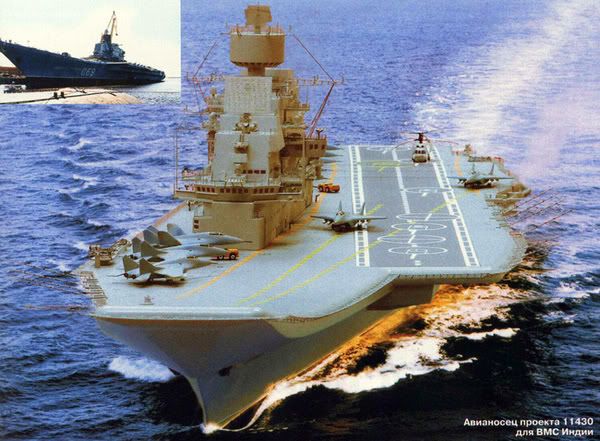
attaching is not somehow working for me.
BlackcatNot always..If an aircraft A has better high AOA performance while aircraft B has better acceleration and better T2W ratio(as well lesser drag) one can imagine that in a turning fight the aircraft A uses its better high AOA capability to negate some of the turn advantages of B by pointing its nose inorder to get a shot out..however if both get say a HMS then both aircraft would have a ZONE(some missiles have a 90 degree zone of offboresighting) around each other which they cannot encroach into without the threat of being shot at..with modern HOBS missiles these zones are getting rather large and therefore negating the negating the need to actually point the nose at a bogey to get a missile lock..therefore in such a scenario the aircraft B would have negated considerable need to do High AOA manuevering to get shots by having the ability to shoot HOBS missiles (so would aircraft A)…However aircraft A would still lack the acceleration or the T2W to speed up as quickly as B..now speed (relative or otherwise) plays a very important role in dogfights and WVR in general..it dictates yur ability to go vertical,stay vertical and gives u greater turn options..therefore in this scenario aircraft B has offset the need to do high AOA inorder to match the superior high AOA performance of aircraft A however aircraft A would still lack the acceleration and T2W required to compete with the aircraft B..infact it would have lost a lot of the advantages it had..aim-9x has 90 degrees offboresight capability which is about the maximum nose pointing an aircraft would be capable of doing (even in the most rediculous of circumsthances)…infact this discussion is all pointless..WVR engagements have become so darn lethal and unpredictable that no matter what platform u are using u still dont have a certanity of geting out alive as long as yur enemy has HOBS missiles and HMS’s..The most advantageous thing would be to have enough RCS advantage (another modern term) as well as a giant aerodynamical+propulsion=speed advantage that u can dictate the terms of an engagement..ie. engage and disengage at will..that seems to be the rationale behind the f/a-22 and seems to be the school of thought the russians are also leaning towards with the pakfa..
Now thats valid when u conside that a/c A has got a huge difference in its T/W w.r.t a/c B.
New technology (HMS) and much better AAMs had become performance levelers. An upgraded F-5E or FC-1 and an upgraded MiG-29 have the same chance now to win an encounter in 2005 under WVR-conditions.
like the case og MiG-21 Bison (21-93) against the USAF F-15C. 🙂
Harry,
That Harrier in the pic is an AV-8, not the SHAR, which has a much smaller wingspan and very nimble.
Yes, its not SHAR but I guess the AV-8 is only just a bit longer which is in no way going into increasing its visual aspect considerably.
Positive. Very good range.
Oh what i meant was abt situational awareness and the data-exchange…. if its posible to have the data readily transferrd to the a/c in the front rather than giving it through the ships.
You are putting words in my mouth. No one called anyone incompetant. The senior SHAR pilots are possibly the best trained dogfighters in the country. They hold their own against the IAF. The French simply don’t allocate that much precedence to WVR and aren’t trained that much for WVR as the INAS 300 and INAS 5519B/552 are. Switch pilots and the SHAR will die very fast.
oops sorry fot putting that in… but then i put it inside this — ‘ ‘ — which in this case did not meant ur words. 😉
Yeah I know French AF don give precedence to WVR, but naval pilots are a difernt men altogether and in their own words, they have excelled against the F-15, F-18 (i heard it somewhere, or am i wrong) ..etc etc, which means that they did have some prety decent knowledge/experience with WVR
Blackcatink,
The fact that the MiG-29K(1) has already flown and gone through a testing programme (although not completed that programme as you point out), as has the MiG-29M and the MiG-29M2 suggests to me that the bulk of the work required for the MiG-29K2 that the IN will be getting has already been done independent of that purchase. This should limit the potential for cost over-runs and delays (which will most likely come from Indian requests for the integration of indigenous or ‘foreign’ systems). If such requests were made for the Rafale also (in order to aid the development of indigenous industry etc) this programme would also be subject to similar delays.
Therefore, I still maintain that the IN is getting a pretty good deal – in no small part thanks to their constant arguing over contract details and prices.
As u pointed put, the bulk of the K programme development might be over, as it actually started in 1999 if we are to take the fact that in Nov 1999, there was a deal signed for the transfer of Gorshkov (the Jan 2004 signing was the grand finale to that deal) after which a confident RAC-MiG opened their own small kitty to continue work on the IN’s MiG-29K programme, the timeline for the delivery was not clear then, but everyone expected it to be around 2002-2003. And from reports its clear that RAC-MiG had initially set the target of 2002 + 3 yrs as the deadline (from 1999) for completion of their K development programme and delivery to meet the IN order, which they hoped to be signed during that period. See the below quote from the article earlier posted —
Sources at Mikoyan say that the schedule of the MiG-29K deliveries have not been agreed with the Indian side yet, but what is certain is that the development of the Indian MiG-29K must be finished by 2002. An official designation for the Indian aircraft has not been chosen yet, but unofficially it is referred as the MiG-29K of 2002.
This means that they had indeed speeded up their work after the first K was pulled out in November 1999. Also to note here that all these development funds have been from the RAC-MiGs kitty (as u rightly pointed out) which means that no Indian money was involved. They even pulled out of the German Air Show to put that money into meeting the Indian order (i’d posted that article somewhere in the forum) last year or so. This was to meet the obligation of delivering the MiG-29Ks to the IN on Time, Note that its not developing, but delivering on time as starting a production after bit long in itself is time consuming and needs some inflow of funds. RAC-MiG have been saving every bit of costs under their control which will also show us as to Y no one has yet seen any pic or video of the MiG-29M2 and MiG-29K like what we get to see abt the Rafales and Typhoons PR department goes with.
In the case of avionics and weapons testing, they might have been completed with maybe some more left (Klub etc). Also, take into account that SMT programme (or the upgrade pakage) has been the bsais for developing new technologies and systems which later helped in the development of the Su-30, M2 which agsin supports the view that the work for the K has been mostly from the internal resources of RAC-MiG. Add to that, all that MKI programme went through and came out with, in the form of integration, further testing etc etc which all definetely will go/went into the MiG-29K programme for the IN.
So its safe to conclude that a major portion of the testing would have been over by 2004 end which made the RAC-MiG to start the serial production (as confirmed by the RAC-MiG press release) from 2005, with some more ‘add-on’ features to be incorporated during the ‘period’ from the feedback from the first machines. Now, these first machines would be what might be arriving this year end, if we take the report which started this thread. And we don have to wait long to see if its true or not as its just 5-6 more months to wait.
sens,
To avoid further misunderstandings, the MiG-29M1 and the MiG-29M2 are not based mainly on the the former MiG-29M and MiG-29K really as the external similarity suggests.
The MiG-29M1 is still not out, but yes the confusion has to be cleared, the M2 is not based on the earlier MiG-29M which started life in the mid-80s. But then, the MiG-29M2 is mostly based on the MiG-29K developed earlier, externally similar, with it even retaining the folding wings but with a higher load than the MiG-29K. Now, that external similarity could have came in simply coz RAC-MiG was sure of the Indian contract and so though it wise to have it retain the modified leading edge, and the folding wing of the K so that the production run of MiG-29s do not include so many changes.
Also, the M1 (single seater) will finally take the designation of M in the future but with a 6,500kg payload capacity than the earlier 4,500kg of the late-80s M in addition to other major changes.
There were two MiG-29K prototypes used to develop the new MiG-29K as well as a prototyp MiG-29M to be rebuilt as MRCA or MiG-29M2. But the new MiG-29K/KUB is based on the MiG-29SMT, which itself creates the basic for the MiG-29M1/2.
well which SMT r u talking abt???? …… the SMT in itself as the baseline version retains the aux-intake in the LERX and to have an increased fuel load, have got an ugly tank on its spine and not-so pretty bolt-on IRF probe. While the MiG-29M2 has got the new LERX, the aux-intake replaced with fuel tanks, folding wings, recessing IFR probe, new spine (but not such as the baseline SMT) and the a/c holds a total of 5,600 kg of internal fuel, where as the MiG-29K have an internal fuel load of 5,100 Kg. In addition to that is, unlike the original mid-80’s MiG-29M, the MiG-29M2 and MiG-29K have a payload of 6,500 Kg and 5,500 kg respectively and will also be having 13-hardpoints in total with the use of multi-racks.
The SMT-II is yet to appear which was to get the best so far developed as the upgradation package. And yes, the SMT programme have been what the Russians used for developing and testing many avionics and systems for the MiG-29s and Su-30.
So I avoid to use the designation MiG-29M and stick to M1, to show that its is a spring-off of the new MiG-29K and not of the former “lightweight” MiG-29M.
When I am wrong in general, please correct me.
But its most likely that the M1 which is to be developed will replace the original M developed during the mid-80s as can be seen from this quote in RAC-MiGs pres release.
MiG Corp. together with “Rosoboronexport”, has supplied its proposals on MiG-29M and MiG-29M2 to participate in the coming tender of the Indian Air Force to purchase 126 fighters.
coming back to ur point …. so, u agree that the MiG-29M2 came in from the MiG-29K with the obvious off-spring being the MiG-29M1 (or let me say MiG-29MKI) that will fill the 126 a/c requirements for the IAF when selected. The first part of evauating a probable MiG-29M1(or M) will be in the form of MiG-29K thats to arrive this year (if we take the report).
Now that gives the IAF a first hand oppertunity to pit the newly acquired Mirage-2000 against the MiG-29K to better evaluate the only real contenders.
Indian1973 ,
I think the brahmos presently is too long for 29K to flare and land safely.
I’m not at all optimistic abt the PJ-10 being carried by the MiG-29Ks. PJ-10 is near to impossible on atleast the carrier borne version, as its a bit long and any high alpha take-off of the like of Ski-jump means the PJ-10 scratching the ground coz of its length (i think so, though i cud be wrong). So the best bet for the MiG-29s to carry them would be from the land bases with a long-run, keeping the alpha low enough to clear the ground from kissing the PJ-10 or vise-versa.
As for the landing probs i don think thats a a big issue, as that ‘bringing-back’ was an issue with the US types mostly, who use to dump it. As for the MiG-29s , from the link earlier posted, it shows that it can land with a heavy load.
Vikraal,
IN has currently ordered 16 iwth a possible order of another 30 planes. So I don’t think the cost will be that high. The bars-29 can also be used to upgrade IAf mig 29’s, so the so called development cost is not an issue. I seriously doubt that the mig 29K would cost as much as rafale. Rafale is yet to get any foriegn orders and unless ADA orders 200+ i don’t see its price dropping anytime soon. What other development cost are you talking about. The missiles would be the standard R-27/73/77 and air born uran or klub. If India uses some materials from the MKI program then it should help reduce the cost further.
U don have to burn ur head over some nonsens remarks from nonsens, MiG-29K is to cost as much as Rafale (as its now) only when the Idiots in the Finance ministry further devalues the Rupee to like 80-100 Rupees = 1 Dollar and the Russian Govt considering their ecnomic recovery revalues Ruble to below 20 ruble per Dollar. Unless that happens, MiG-29s are not in anyway gonna cost as much as the Rafales. But Rafales will definetely cost less than the MiG-29s , if the French are giving the air-frames for Free and we need to only put in the rest into it, like the Gorshkov deal. How abt that? :p
I seriously doubt that figure of 37 mil $ per plane. An aircraft like su-30 mki with french, israeli indian and russian tech in it eould atleast be 50 mil. 22 mil is what the LCA fly away price is supposed to be. I can’t see Su-30mki going for the same. Malaysia bought 18 su-30 mkm for 900 mil, tyhats roughly 50 mil per plane.
U don have to doubt the cost, the share of MiG-29s in the whole deal is like $ 740.35 million which makes its unit price to above $45 milion per copy ($46.272 million, to be a bit more closer) and the extra $14.272 million per plane (the unit price is $32million) accounts for the training, simulators and other supports. BTW, do u know how much is the 2nd hand Mirage-2000 that we bought is costing?
I say the LCA fly-away price is high and thats coz of the many imported stuffs in it and the over-all cost which Steeply rose after the RUPEE GOT DEVALUED …… which means that any production run with a lower flay-away price and any lesser or NO profit margin means the end of Business for HAL.
—–
Also, In my view, there actually is no need for the M2K in the IAF inventory, if its primary achievement which elevated it against its counterparts is ‘precesion strike’ and is needed for just that, but IAF rather consolidate with just three types to meet the air-superiority/multi-role requirements and simplify logictics further with the use of same engines for Tejas LCA/MiG-29 or Tejas LCA/Su-30MKI.
In the case of engine department (as I’ve been maintaining earlier & I stand by that) the best solution wud be a Kaveri MK2 (co-develop with Klimov, with all technology masterd in Kaveri & vise-versa) with a dry-thrust of 9-10t & 12-13t max thrust.
—— << Tejas LCA >> —— << MiG-29MKI >> —— << Su-30MKI >> —— with,
>> Tejas LCA —— being part of the ‘iron curtain’ for the enemy/short-medium range surgical strikes/medium-range escorts in a MiG-29 led strike package/ECM and others.
>> MiG-29MKI —— being part of the ‘iron curtain’ for the enemy/medium-range surgical strikes/long-range escorts for a Su-30MKI led strike package/ECM and others.
>> Su-30MKI —— caters to the demends of the higher segments.
— well, i guess, many – Indians – wont agree to my above a/c solutions nor abt the engine solution.
BlackcatThere were just two prototypes from 1992. Not fully tested and certificated to start with. When all the 16 MiG-29 K/UKs are new ones, they all will be “hand-built”. 700+ Mio $ is with weaponary too I hope.
~ 8 MiG-29s per year compared to 100+ in the 80s. Remembers me on Rolls Royce, where every car is an unicate and no cheap buy by that.
ie if we are to consider that the 50 a/c deal for Algeria and another 50 a/c deal for Venezuela are not going to materialise or that the a/c meant for them are from the ‘old stocks’ and not new built frames.
In addition to that wud be the 126 a/c for the IAF’s requirements, which RAC-MiG hopes to win. So if the deal gets signed in 2006 end, means the production would be much more in ‘tight schedule’ to fill the requirement b4 2010.
Yes, the $700+ million is with weapons, training and logistics included.
There is no alternative to the “skyjump” MiG-29K and India has to stay with it, whatever it will cost. To ease the burden India may be forced to buy/built 126 MiG-29M1/2, which are based on the MiG-29K/KUB. Mirage 2000 and Tejas maybe the looser by that.
what a pun, Twister! …… seems like, u want to make everyone believe that India is struck with the ski-jump and thats b’coz of selecting the MiG-29Ks and b’oz of that to further lower cost India is stuck with buying MiG-29M/M2 …… and WTF do u think abt Tejas & its future and the reason for pulling it into the MMRCA contest?? …… another dirty trick which also can be seen in the media. Let me tell u (or for that matter all Indians) that MiG-29s are not in any way gonna make the Tejas LCA looser as what IAF looks like or what IAF is trying to built up is —–
——– << MiG-21/Tejas LCA class of light fighter/interceptor/MRCA >> ——– << MIG-29/M2K class of medium MRCA >> ——– << Su-30MKI long-range MRCA >> ——–
And what this Twister nonsens said is what actually has been going on in the media for the last couple of years and more, which has been putting its weight behind the M2k-5 or for that matter any western type. With media white wash that India was going to go in for the Mirage-2000V as its N-delivery platforms, then Mirage-2000-5 as the preferred one and is to go in for 126 of them, and that has since been like that with the entire media backing the ‘IAF’s Preference’ and that it was on Top of the list of the a/c that IAF have short-listed etc etc.
But the fact is that (I’ve put one artilce earlier) the said preference or ‘imminent’ deal for the M2K-5 was not there and the MoD had sent the RFI/RFP to Russian, French and Swedish manufactures for their products after rejecting the plan for going in for Mirage-2000-5 in a single vendor deal.. But then, what the French (or maybe the anti-Russians) have been doing is, they have been building up a campaign through the media – bypasing the proper channel – that the French Mirage-2000-5 is/was the favorite one for the IAF and thats what the media has been INSTALLING in the readers mind all these years (if u guys don belive, check every single piece of news article).
So what they have been aiming/planning to do is, REVERSE the deal with a public (media) outcry Or with a more matured game with an ‘influential’ magazine doing some ‘undercover investigation’ and coming up with a story as to how much the IAF loved the M2K-5 with comparison of the performance of the two on the battlefield elsewhere etc etc, to generate a group of well-wishers for the young IAF pilots whom they do not want to see die in MiGs. This will then (if not exposed) will snowball into “KICKBACKS & Russian pressure” that made IAF choose the MiG-29’s against the likes of Mirage-2000-5 or the F-16 (yeah, French have got a new companion against MiG in this case) and scuttle the deal and make IAF wait for longer for the a/c. And thats most likely to happen when the deal for 126 fighters go to the RAC-MiG unless the ‘undercover’ agents of this brainwashing are cleansed.
But the bottom line of the entire media campaign is/was —- IT SHOULD NOT BE RUSSIAN! —– and Y??……. B’coz of the best reasons that the west don wanna see happen – re-emergence of Russia, for which she is dependent on export, now, to see it to it that she don have to spend her pocket (meant for in-house ‘repairs’) for keeping pace with technology and development, but rather bring in part of that money from outside to keep her industry and R&D running so that products don get lagged behind and when Russia as such wud be in a finer position with good pockets, she gets products which is updated and modern, all of which was built up with external funding.
And whan that happens and things gets better, u’ll get to see the bitter news (for anti-Russians & twisters like nonsens) that Russia wud be spending $6.8 Billion on defence purchase this year against the revenue generated from military exports last year which totals to $5.1 billion. This has been what West have been trying hard not to happen all these years – CONTAIN the RUSSIAN MILITARY EXPORTS & SEAL (if possible) or DIVERT the sources of REVENUE GENERATION, thereby putting pressure on the Russian Govt to either cut the spending for new R&D or do that at the cost of her citizens welfare, which definetely would have had a severe backlash.
That will also, tell u guys the stroty beind the constant sweetning for India & the “DIVERSIFYING” formula that so much tops the list of priorities in the military purchases. But as far as I’m concerned, ‘diversifying’ has outlived its life, when the biggest need was in the early 90’s when the spares was hard to come and not reliable (supplies/suppliers/spares/Gov.) So once this ‘formula’ was firmly placed in the echelons of the MoD, all idiots forgot abt JOINT COLLOBORATION which again wud have seen both India & Russia gaining considerably. But this formula had a huge effect that the ‘planners’ had a big breakthrough in minimising one source of external funds that go into Russian industry in the form of India. In the case of India, Israel has been the single biggest node in diverting it. (good examples are – Arrow, Phalcon & many other stuffs)
We do not know what is incorporated in Indian prices. So different prices for every package can be found.
The ‘fly away price’ is always the cheapest and do not cover all costs of the procurement of a fighter.
Do not exspect that your politicans or military will give real prices for procurements. What prices are given by the critical Indian Press, which have further sources to look into.
Say that u like to ignore whats included in the Indian prices. The said $700+ million package includes everything from training to supports. And that makes it over $45 million per copy of the MiG-29K.
And when u talk abt Indian press, do not even dare to forget abt the ‘internal’ chaps (after all whats FDI/FPs in print/visual media meant for?!) that gave a pretty good ‘marketing’ name for the MiG-21s. Hope u meant the Indian Press are very critical abt the Indian Military and the GoI’s ‘over-spending’ on military.
About India there is a lot of “ifs” too in the same way as you guessing prices for Rafale. I wrote before that the MiG-29K had no competition, because of ‘stobar’.
again Twister, ….. put in Bluntly that MiG-29Ks did not have a competitor that really came near to meeting the Indian Navys requirements, which the MiG-29’s met!
The program was stopped, when lost to the Su-33. No longer money from Russia for that and after 1992 there was no money at all and Russia in a deep crisis. The similar MiG-29M with some more prototypes did not reach the production stage either. None costumer could be find for the funding of the future MiG-29M either in the 90s.
And the programme was restarted in 1999 end after the initial signing of the deal by the then Indian Defence Minister. Its after this that a confident RAC-MiG ferried out their 91 vintage MiG-29K.
For public-relation purposes, you can hang as much weapons as possible onto the pylons. That gives impressive pics, but no real capability to use that really.
Like what u get to see on Rafale & Typhoon in air!
For that it will get a carrier and 16 MiG-29K/KUB. There are still some years ahead to generate the software for weapons-integration for all modes and missions. See the first 18 non standard MKIs for that and time-scale! Just handed back to get full standard MKIs for that.
The case of software development and testing related to it becomes valid only if, one consider that the RAC-MiG started their development work on the MiG-29Ks for the Indian Navy only after 16th June 2005, 23:28!
For others, the work on the MiG-29K started after the then Defence Minister George Fernandez signed a deal for the transfer of the Gorshkov in Nov 1999, which also signalled the acceptance of the MiG-29K as the fighter (don get carried away by the Rafale or western mafia), which made RAC-MiG to get the 2 copies of MiG-29K form cold storage for starting afresh for meeting the Indian requirements & orders which was to come anyway. And this was entirely from their own pocket and no Indian money was seperately given unlike the Isreali Phalcon, where they squeezed out $350 milion as advance. In addition to that from 2002 they had 6 other frames actively involved in fight test in support of the programme for the Indian Navy’s MiG-29K programme.
The MiG-29K/KUB will be a cheaper by despite further hidden program-costs.
Not the same fighter generation as the Rafale, but an adequate fighter for the Indian demands
wud u like to name the hidden cost involved?
When India and Russia signed a contract for two programs. Both parties had just exspectations of the costs to cover by that. We can assume, that both parties did so in good faith that all developments will be finished inside their price-scales set for that. That is an optimistic view of the reality, when experiences showed, that most programs will suffer a cost overrun related to something not exspected before or did not work as planned.
ur above theory is valid if and only if the RAC-MiG started their work after 17th June 2005, 09:00!
but the cost could be higher if Navy choose to go in for the Bar-29 or any other newer engine which is under development or the other suppliers increase the price of their products like what happened with the MKI programme, where not only cost was increased but also got delayed due to the sanctions imposed by the US. But overall , i put the rather high cost of the MiG-29Ks on the Indian Navy for not being stubborn in their demands with the GoI and the $astardly Indian politicians.
So far I have not heard from most ‘western programs’, that they run always according to plan and related cost. See actual A-380 delivery delay and the reasons for that. To keep the promised price, the producer can delay the break-even point further into the future, but still in good faith that enough of that will be sold in the future.
Ok so what??? …… just coz west always don get it right does not mean that East too need to get along that way. U and a good bunch of western guys need to get matured to think more rationally than that.
As an example, I’d tell u the case of GRSE, where a ship take anywhere b/n 5-10 yrs to be built and no no its not carriers, just 3000-4000 tonne ships. But this time they pulled it off real quick in the case of a higher tonnage Landing Ship for the Indian Navy. Like wise, CSL have had a good record of completing their ships way ahead of time in the case of merchant shipping, hope they repeat it in the case of IAC (Indigenious Aircraft Carrier) too. But still that damn 7-8 yrs is a bit too long for a 38,000 tonne ship for India’s most moden shipyard …. phoooo…. and thats what many say when they talk abt the punny little CSL but infortunately its the biggest in India too.
In a limited military program there is no need to buy a specific fighter from a single producer only (Rafale N, F-18C, F-18E or F-35C), just with the exception of the MiG-29K and India. Theoretical India can switch to the Su-33, but the rebuilt of the carrier is tailored to the MiG-29K. From Russian companies you will be ashured always, that all goes well and be better than exspected. Like in communist times, when all went according to plan always. That was not the truth at those times and it is not today.
So what r u saying, India shud have sticked with Harriers??….. and h come MiG-29K become an exception??….
Did u trade with Russia in communist times???? … to have that much faith in what u say??….. maybe u need to check out when all India recieved her products that she ordered from the Soviet Russia.
Or is there a rule, that Rafale, F-22, F-35 run into development problems always, when in Russia or India the Fulcrums and Flankers do not?
Seems that some people have a limited view or short memory.
See time-scale and cost for MiG-21BISON, MKI or the Tejas about that.
No sens, its been a rule among the guys like u that all Russian projects will be late, whatever the case maybe, anything otherwise is irrational. Now, don pity urself by turning the table and covering up with what has always been said on product delivery from Russia.
when u say time scale —- did u ever in ur distant dreams think abt the Indian political maturity, their seriousness abt funding the military???……. in addition to that did u ever consider the foreign suppliers in these two programmes, their products cost or say, their price increse, their part in the delay. In addition to that was the delay that was caused from the Indian side. But how will a twister like u ever really remember abt the delays and cost from other suppliers other than Russian. i shud have been insane thinking that u ever though abt that.
BlackcatNo they are not. Especially not in wingspan or wingarea. The SHAR is smaller and much more difficult to spot.
Oh yesh… that cud be the one, the wingspan and maybe the vertical stablisers in the case of same altitude. As MiGs have a VS more in area, But the Harrier have a wider body in that case or say is almost equal with MiGs a bit slimmer in that area.
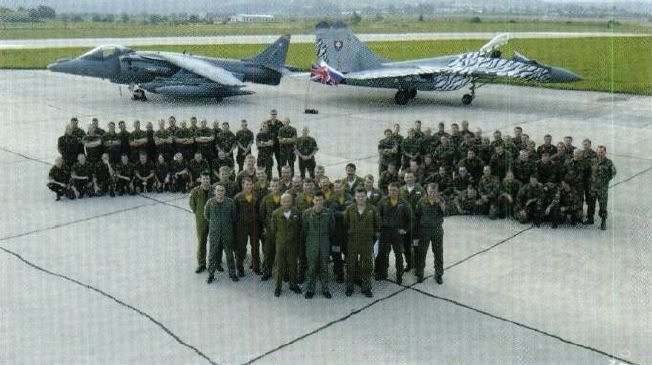
But its good to shatter the over-confidence that IAF might have acquired over the years – so as to be a beter force – and a smilar one for the Indian Navy would just do fine too. I just don wanna think of a situation where in the PAF or any other AF gets such a chance ……
BTW, did the IN in anyway use their Ka-31s in the exercises and did they have any part in aiding the Harriers?? … how has been their performance with the IN and the feedback?
Harry, i got to again disagree to ur notes abt the French being ‘incompetant’ in visual combat and hence got to disagree on ur note abt the French pilots inability to cope with the IN’s Sea Harriers. Moreover, was in that particular case where the 12F went against (visual combat) the Sea Harriers, the E-2C Hawkeye in use to give a better situational awareness to the Rafales? ….. the below article says that the French excelled in close-combat against their Saudi counterparts F-15s & Tornados.
can u put more on the two occations that the IN’s Harriers met the French Rafales? ….. i.e 2002 & 2004 and how much of a difference did each side make out from their earlier experience and how much improved (French in WVR & Indian’s in BVR, if any) was their tactics and efficiency when they met again in 2004.
The below quotes from “Snecma magazine July 2004” shows an alltogether different picture, in which the French have maintained the Rafales superiority in visual combat.
Red Shark: Rafale fighters prove maturity
Snecma magazine July 2004
During a practice mission dubbed Agapanthe 2004, France’s Charles de Gaulle aircraft carrier and its escort group participated in a number of tactical exercises. The Rafale Squadron 12F went up against Saudi F-15 and Tornado fighters as part of the Red Shark exercise, showing that both engines and airframe are fully mature. Join us on a mission in the Red Sea… Text and photos by Henri-Pierre Grolleau
CHARLIE – 44’
The Hawkeye radar operator has spotted nonidentified contacts and passed on the information to the Rafales.
“Lascar Alpha, contact single group bulls 260°, 65, low (3), tracking west.
“- Roger.”In other words, a single group has been detected at 260 degrees, 65 nautical miles from the reference point (“bull’s eye”) at low altitude, heading west. In all probability, it’s the expected attack. Under tight control by the Hawkeye, the formation quickly gets ready to intercept the intruders. Despite the extra weight of the three external tanks, the impressive power-to-weight ratio of the M88 brings the Rafale to supersonic speed in just a few seconds. Once the planes are in radar range, they take over the interception, although Hawkeye tactical operators keep an eye out to signal any new threat. Suddenly, the Saudi formation splits in two, with the F-15S interceptors heading directly for the Rafales, while the Tornados try to slip towards their target at sea-skimming altitude. With the RBE2 phased array radar, 12F pilots enjoy a perfect view of the tactical situation, and the maneuver doesn’t fool them. Lieutenant Lepoutre splits his group into two smaller teams, each assigned to one of the enemy formations.
“Lead is targeting northern group.
– Two, sorted, southern.”
The two Rafales in the first team will handle the first targets.
“Ok, Fox Three on northern
– Fox three on southern.”They simulate two shots of Mica radarguided missiles against the two lead F-15s. In just a few seconds the results have been validated: in a real combat situation, the Mica missiles would have scored a direct hit.
CHARLIE – 37’
At an approach speed exceeding 700 meters/second, everything happens in the blink of an eye. The fighters quickly merge to visual combat, a phase where the Rafale excels. According to Squadron 12F pilots, they score exceptionally high victory rates in dogfights, with the Rafale quickly establishing its triple superiority in terms of agility, power and weapon system effectiveness. Against the Tornados, the Rafales quickly gain the upper hand. The French twin-jet fighter is far maneuverable than the older and heavier English variable geometry fighter, and the Tornados’ fate is sealed. Things are a bit more complicated against the F-15, but the Rafale also quickly establishes its superiority based on state-of-the-art fly-by-wire controls, high power-to-weight ratio and low wing loading. Now low on fuel, the Saudi planes peel off at
low altitude, returning towards the west coast of the Arabian Peninsula.
Or is it that the above missions was carried out after the Frenchies engagements with the IN Harriers??… there by getting to know and learn a lot more abt visual combat and excelled in the same when they engaged the Suadi F-15s?
can someone put the dates (or say the period) when these two missions was carried out — Varuna (2004) & Agapanthe 2004 ?
Blackcatwell the one that i realy want to saee move forward is India taking the base that the Russians are almost vaccating or as said a joint leasing of the base.
Other than that, i hope Vietnam buy some Dhruvs & LCA after 2010
BlackcatHarry, i have some doubts at the visual aspect of Harrier & MiG-29s … i fail to understand h come Harrier is so much smaller than the MiG-29s, they are almost of the same size for the Rafales or the MiG-29s not able to see them. maybe the Harriers advantage was that the RD-33 was smoky.
http://www.acig.org/exclusives/viraat/viraat_2.htm
2.1.1 2004 and 2005 : Sea Harrier vs. Rafale, Sea Harrier vs. MiG-29
Since induction, the Indian Navy had flown the Sea Harrier against all of the IAF’s aircraft and achieved good results, especially against the Mirage-2000. INAS 300 had two opportunities to test their capabilities against the French Flotille 12F operating the vaunted Rafale-M during the “Varuna” exercises in 2002 and 2004. Most of the missions would involve the Sea Harrier playing as the attacker against a fleet of ships defended by Rafales operating from the Charles-de-gaulle. The initial outcome of these missions was somewhat predictable – the Rafales would easily pick up the Sea Harriers almost as soon as they took off from the Viraat, and call for a BVR-kill, ending the mission ! When these BVR calls became rather frustrating, missions were switched to WVR-combat which surprisingly proved to be the Rafale’s undoing! Close-in, the Harriers were mostly not even visually picked up by the French pilots who hadn’t noticed them until it was too late, also being unable to outturn their opponents for the most part. However, it was concluded that this was due to the precedence assigned to BVR by the French and their comparative lack of training for WVR engagements and not much due to the Sea Harrier itself. Pilots of INAS-300 concluded that had they piloted Rafales instead, they would be easily able to make mincemeat out of the Harrier under any condition. One would have noticed that the events and outcome of these exercises were almost similar to the performance of IAF Mirage-2000s against French Mirage-2000s of 1/12 ‘Cambresis’ during the joint exercise ‘Garuda’ in February 2003.
In 2005, the White Tigers flew to the IAF’s AFB in Jamnagar, in order to take on the MiG-29s of No.28 ‘The First Supersonics’ and No.47 ‘Black Archers’ squadrons. Some firing practice against targets towed by the MiG-23MFs of the No.224 ‘Warlords’ squadron, was also carried out. Comparison of turn performance is also a regular feature of DACT, where the ground controller assigns a specific speed for both aircraft and tells them to start turning. At lower speeds, the Sea Harrier was only marginally lower in sustained turn rate but beyond Mach 0.7, became quite hopeless against the MiG-29. What ensued during actual DACT was set to be a massacre – the MiG-29’s superb N019 BVR radar in addition to their outstanding maneuverability besides the HMS, proved more than a handful. In BVR, the Fulcrums could easily lock-on to the Harriers and end the engagement within seconds. Unlike the Harrier, the MiG-29 was capable of sustained +9G performance and was easily able to outturn the former in most regimes. The only chance that a Harrier had against the MiG-29 was to lure the latter into a dive and use thrust-vectored control to break out of the path. However, since each aircraft and squadrons do have their own set of unique advantages and disadvantages catering to specific types of engagements, things did not always go in the MiG-29’s favor. The MiG-29 for instance, has a relatively large planform and smoky RD-33s which allowed the Harrier pilots to visually acquire them out to nearly 27 km. In turn, the Sea harrier is itself, extremely difficult to notice and visually acquire, and was often able to get the jump on the Fulcrum. In spite of the MiG-29 technically outclassing the Sea Harrier, a series of successes lead INAS-300 to conclude that the MiG-29 pilots were ‘Blind as bats’, much to the frustration of the latter ! This was somewhat reminiscent of the first kill by Flt. Lt. Paul Barton over Falklands where the bogey never even noticed the Harrier until it was too late. Despite the superiority of the MiG-29, the White Tigers were very happy with their performance and it was ironic that the aptly titled ‘First Supersonics’, the very first IAF squadron to operate a supersonic aircraft (the MiG-21F-13), couldn’t always get the edge on their subsonic counterparts. Coincidentally, the next fighter type to be operated by the Navy will be the MiG-29K. The exercise also served as an opportunity to test and prove the effectiveness of the new ‘Ghost Gray’ Sea Harrier camouflage scheme.
The Viraat’s and INAS-300’s biggest success was against the IAF during a recent full-scale exercise code-named ‘TROPEX’, where the latter was severely mauled. In one incident, a highly efficient intercept led to the stealthy Sea Harriers catching nothing less than three Mirage-2000s hosed up to an Il-78MKI in an in-flight refueling formation ! What must have been a highly embarrassing situation for the IAF could potentially represent an unimaginable loss of an entire IFR formation due to the opponent’s superior tactics and smarter procedures. Ironically, the IAF’s own evaluation of the Sea Harrier in the 70s, was that the thrust-vectored aircraft had no chance against a supersonic counterpart. TROPEX also included interception and engagements against low-flying UAVs.
BlackcatSounds like Denil has a new avatar 😉
if thats Denil the Isreali member who used to post in the Indian defence forum …. then the doubt exhibited by some of Russia not giving the full details is valid…. as I’ve been maintaining that the best way for Isreal to get hold of Yakhont & PJ-10 tech wud be from the butterly Indian establishment …..
And y the hell shud Russia now believe India? …. as a good majority of Indians and those at top are western minded and have little (if ever) care for Russian security (do u guys rem the recent deal(?) in the red sea) ….. and have been moeving more and more closer to the percieved threat to Russia. So it wud just be a matter of time before the political bosses open up everything for the new friends to see. Which means any Russian system meant to defend their security wud be life ducks in the flight.
That also do not mean that PJ-10 wont do the job, it wud do the job just fine as it had exhibited. But do take care that, ur indigenious system don get in its way an isreali CCM, as almost all CCM that Isreal employed have been after studying the captured opponents weapons, spying and ofcouse through the wast ‘moles’ inside Russia.
And what do u guys think, if at all the person posted that is Denil (an Isreali) got to do with a purely Indo-Russian projct like PJ-10???
BlackcatI got a reply for what i asked for which was in regard to the info on F-119 engine, pointing out what the Russians had to encounter while developing their TVC engines.
Anyone got any better info on these ??
MKI uses titanium made nozzles for its Saturn engines and has little to care about stealth. Cruise drag is not an important factor.
When it comes to the F-119 for the F-22 the world looks much different.
Too much different demands left little to compare.Engine nozzles
Reduction of radar cross section of nozzles Is also very important, and is complicated by high material temperatures. The approach taken at Lockheed is to use ceramic materials. The ceramics may be either lightweight, parasitic sheets mounted on conventional nozzle structures or heavier structural materials forming saw-toothed edges.To compare something western to the Saturn engine nozzles, we are limited to the AVEN-system, but this has nothing to do with the F-22.
Presenting some infos/sources from ‘Saturn’ out of context leads to ….???
shall i know how much is the MTBO for the F-119 and the TTL for the F-119??.. and the life of the nozzle, as per the earlier one that i qouted, it says ceramics have got low life and so not preferred by the Russians in engines ….


 Sign In







