Scorpion82
If you read what was written then you would understand that the 101KS-U detects the missile threat and cues the 101KS-O which then acquires the threat and targets the laser.
Scorpion82Su-27SK (flight manual)
27380 kg – 9220 kg (fuel) – 726 kg (2R27+2R73) – 100 kg (pilot) – 58 kg (shells) = 17276 kg
23250 kg – 5090 kg (fuel) – 726 kg (2R27+2R73) – 100 kg (pilot) – 58 kg (shells) = 17276 kgnot taken into account the links of the tape GSH-301
Not taken into account appear to be the pylons, unusable fuel and consumables incl. hydraulic fluid, lubricating oil and chaff/flare rounds for loaded dispensers.
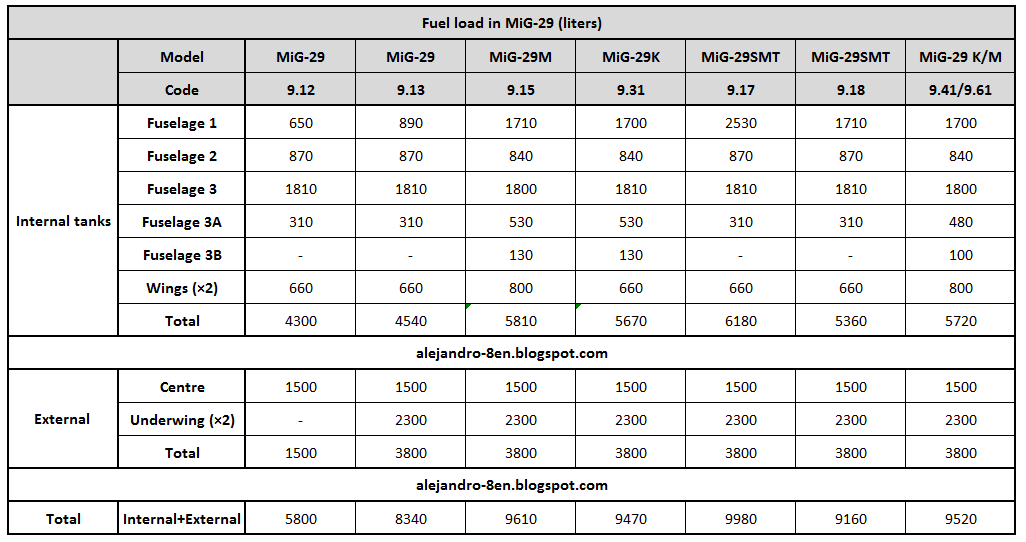
Scorpion82Far more, original MiG-29A did not meet range requirements. Hence the hunchback C version (9.13). MiG made substantial changes in MiG-29M and internal fuel capacity increased by 30%.
This comment by IAF MiG-29 pilot is worth pointing out:
This factor was also pointed out by Yugoslavian pilotos who evaluated MiG-29, F-16 and Mirage 2000.
The table doesn’t look right to me, based on various sources that I collected throughout the 90s already. According to these:
9.12 = 3190 kg
9.13 = 3480 kg
9.15/9.31 = 4500 kg
9.17 = 4775 kg
9.41/9.61 = 5200 kg
Don’t have the twinseat numbers in my head, from memory it’s 600 kg or do less on the 9.47/9.67.
Bear in mind that guel weight depends on fuel density, the capacity in litre is basically a more useful metric.
Concerning the SMT:
9.17 was the original prototype still with the N-019MP
9.17-2 became the 9.19 with the N-010M
9.18 for Yemen lacked the spine and thus increasef fuel and internal ECM, but was otherwise the same.
The original 9.15 was a very different aircraft with revised airframe incl. enlarged tailplanes with saw tooth, F/A-18 style airbrake, different tailcone with twin drag chute and reprofiled LERX. The auxiliary intakes were removed and tanks added (4500 kg in total, some state 4460 kg). It had a quadruplex analogue FBW for pitch control, uprated RD-33K with 5500 kg dry/8800 kg reheat thrust. Empty weight 11.5t, MTOW 21t.
Cockpit had reshaped canopy for improved visibility, increased seat inclination (30°), HOTAS and two monochrome MFDs controlled by HOTAS only.
Avionics included different chaff/flare dispensers with 120 rounds, L150 Pastel RWR, OEPS-29M, N-010 Zhuk (without M), new INS and IIRC new/improved radios, datalink and radio navigation aids.
Gun ammunition was reduced to 100 rounds, but the aircraft featured 4 pylons per wing with 4500 kg total payload.
Armament changes were supposed to comprise R-77, KAB-500L/KR, Kh-29T/L, Kh-31A/P, S-25L and Kh-25MT/ML/MP (never saw those on the aircraft).
That as a brief summary.
Scorpion82beat me to it Austin. Air Marshal Harish Masand’s praise of the MiG-29 is truly fulsome. I also know from interaction with some IAF people in the past, that the MiG-29 truly was considered a fabulous jet aerodynamically, but it fell short on the way the information was presented to the pilot and the resulting situational awareness. Something that was a result of the Soviet GCI based piloting philosophy. And those were the key factors that the SMT and UPG upgrades addressed- the high pilot workload and the poor SA and of course the lower internal fuel volume.
I wish someone would give us an insight into how much improvement the SMT or UPG versions have over the older MiG-29A or the MiG-29M that lacked the improved cockpit avionics and radar and increased onboard fuel, but probably had lower empty weights and consequently slightly better T/W ratio.
The original MiG-29M (9.15) had everything you vlaim it didn’t have and its first flight was on 25th April 1986. It formed the baseline for the original MiG-29K (9.31). The M2 was the twinseat version of the improved M. The prototype was actually converted from thw 4th of 6 original MiG-29M prototypes. The Indian contract let to the development of the new MiG-29K (9.41) and its twinseat version MiG-29KUB (9.47). The ultimate MiG-29M/M2 were based on these, as are the MiG-35/MiG-35D.
Scorpion82Hello Spitfire,
no they weren’t as I have outlined not long ago. So for the flight test evaluation it’s not being considered. But if Switzerland would select Typhoon, it would receive AESA equipped aircraft.
Scorpion82The entire article is misleading. The AESA is in development and will be fitted to Kuwaiti aircraft. A proposal has in fact been submitted by Eurofighter, but a contract has yet to be signed. I’m confident that Germany and Spain will contract the AESA retrofit soon. It would be ready for Switzerland within envisaged timescales. As said Kuwaiti aircraft will feature it. Britain is known to pursue its Radar 2 version for a long time, that doesn’t mean they won’t get it at all as the article appears to imply. IMO big headlines, little substance. As the AESA development is on contract there is no need to include it into LTE, other than integrating it with the new avionics architecture. That’s the reason why it isn’t mentioned and subject of LTE.
Scorpion82Great observation [USER=”7429″]Scorpion82[/USER]. But I think it’s the offset angle and the arrow on teh number 8 is the sensor range setting. Given also the “target” seems to react to the “lock”, we probably have a slew sensor (target is locked by the radar that pass its coordinates to the sensor).
It could be that the scale serves the double purpose of a range and elevation scale. The triangular marker moves slightly over video period, which may suggest marginal range changes at ~8 km. There is also a scale to the lower right which somewhat correlates with the arrow marker on the left scale, especially towards the end of the video. Whether or not the target aircraft reacts to a lock is difficult to say, as the maneuvers are too insignificant. Could well be that the target is bugged by the radar though as TV sensors typically lack autonomous search and are thus typically slaved by another senor. The eventual lose of lock is obviously owed to the target aircraft exceeding the sensor’s gimbal limit. Platans layout appears to have limited gimbal limits compared to a TGP with a moving sensor head.
Scorpion82Sorry but i have to disagree with you on this one. I think that we can not deny that its range information judging by the fact that the cursor changes relatively quickly , considering how what is being ranged is supersonic jet capable of quick acceleration and not a steady ground target. But what really makes me think its range is that the notion of “20km range” has been brought up to the comments , and the poster of the video doesn’t seem to deny it.
(Comments below).
In addition to that , range in formation does seem to be consistantly presented that way in russian aircraft panels , such as the 400 km range given by the radar of the su-35. Picture below
You can disagree ad much as you want, it’s plain simple physics! The marker falls from 20 to 15 in 2 sec or so and moves from 30 to 40 in about 3 sec. At what speeds do you pretend to be flying? Hypersonics? And does the camera lose track of the target when it suddenly exceeds 40? Because it is the elevation gimbal limit that is exceeded.
so no its not range and all and the similarity between this elevation scale and range scales doesn’t mean anything at all. Do the math your self how fast the aircraft must be flying to cover 10 km in 3 sec and or suddenly fall by 5 km in 2 sec or so. It simply makes no sense and it’s quite easy to digest…
Scorpion82Hello chaps!
https://www.instagram.com/p/BrW3Fg3H-UE/?utm_source=ig_share_sheet&igshid=1vt94x8gp6bpb
have a look at this , i don’t know if this has been posted before , but you can see a Su-34 taking a high resolution shot of the su-35 at 20 km then later at 40 km with no visible loss in resolution. Too bad the limit of the rangefinder seems to be at 40km.
Thermal image cameras gradually lose resolution at longer ranges , so i am fairly certain the Su-34’s image system can still recognize the shape of a fighter at much longer distances than 40 km but at lower resolution. Considering its crystal clear at 40km.Ps: it may be weird to see an old system like platan perform like this , but i did hear about modernization plans for the su-34 earlier on , and that they aimed for the electronics complex. So it could be that the EO equipment got updated.
have a nice day.
That scale is not a range scale, considering how quick the marker changes its position and correlating the target aircraft’s movement it looks like an elevation scale. A range scale it’s not.
Scorpion82Discussing the chances of the Eurofighter in this campaign the radar isn’t everything, but it’s certainly important. Wheather Eurofighter gets a chance to showcase Captor-E later on remains to be seen. For the just completed evaluation they couldn’t get IPA8 available in time. The situation may have looked differently had Eurofighter not been the first type to be evaluated. We’ll see, the Eurofighter has evolved quite a bit and so have others. Much of the critcism of the 2008 evaluation was owed to the immaturity of the aircraft and specific systems/capabilities which are fixable and not design inherent.
Scorpion82P1Ea standard but with Captor-E AESA, but no P3Ea standard prototype with the Captor-E? Hmm..
So they’re not demonstrating an AESA equipped Eurofighter then. That doesn’t seem like a good approach, given that all the other contenders now have AESA radar at the latest standard flying, including the Gripen E demonstrator and the Swiss may not be very happy to check its performance on a bench.
It’s quite hard to believe that there isn’t even 1 demonstrator at the technological level of the latest Eurofighter (P3Ea?) that is being built for Kuwait. I guess once again it demonstrates the drawback with the big consortium approach where each partner has its own priorities and its own set of equipment that it wants.
You must understand that P3Ea and Captor-E are completely unrelated, both contractually and from a configuration point of view.
As a side note, P3Ea was originally referred to as P3E only without “a”. I’ll continue to use the current P3Ea designation for the remainder of the post, to make the distinction. P3Ea was contracted as a UK only capability package using the 4-national contract route. P3Ea built on the latest 4-national baseline then on contract (not available) which was P2Eb incl. the Meteor capable Captor-M M-Scan radar.
The Captor-E development contract was signed in summer 2014 and thus after the P3Ea contract and before the Kuwait contract. It was a 4-national contract involving all 4 core nations, but it only covered design, development and qualification of the radar. The above mentioned DDQ activities were planned to be performed on the then latest actually available and mature 4-national configuration which was P1Ea. The designated industry test assets IPA5 & 8 are subsequently configured with a specifically tailored development configuration of P1Ea. Physical embodiment of the Captor-E was not part of that contract and the point of embodiment was subsequently undefined. Embodiment was meamt to be contracted separately and phased in with the next suitable 4-national phased enhancements package, supposed to be P4E back then.
The Kuwait contract was signed in April 2016. The Kuwaiti requirements incl. Captor-E were captured within a separate phased enhancement package. As the envisaged P4E timescales were incompatible with the Kuwait delivery timescales leading the P3Eb interim package was created based on the UKs P3Ea. This led to the eventual redesignation of the original P3E package for the UK into P3Ea.
The core nations have meanwhile contracted a tailored version of P3Eb which is still centred around the Captor-M. P3Eb is much more than just Captor-E integration for Kuwait and IPAs 2, 4 and 7 are already involved testing elements of it. ISPA6 and IPA9 are the assets used to test the Kuwait configuration P3Eb incl. Captor-E.
Hope that shades some light on the situation.
I would prefer to move the discussion to the Eurofighter thread if further questions arise.
Scorpion82This isn’t the “Radar-2” UK spec E-scan radar is it? Or are these supporting the “radar one plus” consortium AESA program?
No it’s the Radar 1+ Export Interim Standard. Radar 2 isn’t available yet.
Scorpion82IPA8 would be the second asset with an AESA and also a twinseat. However, the aircraft currently unavailable and is at a “Frankenstein” configuration with P1Ea and the Captor-E. You are certainly better served with mature operational assets at P3Ea standard and that’s what the RAF has deployed to Switzerland. Forget about one of them being equipped with an AESA. It’s not plug & play.
Scorpion82If you read what Admiral Urcelay told, is that F-35B is out of discussion. It can have more debate about F-35A but not about F-35B coming to Spain on next future. And it is logical, we have islands and it is necesary anfibious force with naval fighters.
And other thing…EF is expensive than F-35A. So, When you tell, that Spain can not buy F-35A because is expensive it does not have any sense to buy more expensive EF tranche 3. This is not logical and this is a political decition anyway.
The reason for get more EF, also political is because need get fast deliveries for to replace older F-18, and it is not possible buying now F-35A.
About what is talking Urcelay is about to buy F-35A around middle of next century when the last F-18 will need replacement, not now. You are talking about diferente things.
The fly-away unit price per T3 Eurofighter is probably not much different compared to an F-35. The primary cost driver for the F-35 compared to the Eurofighter would be the establishment of the support infrastructure and logistics in general. Those costs are significant and are the typical reason why the “system price” is often twice as high or higher than the fly-away price. There are ofcourse other factors such as the overall number of aircraft and how they are spread over units and airfields. Most cost comparisons are apples and oranges as the detailed cost breakdown is usually missing and as different offers are mostly not comparable.
Scorpion82The Starfighter was considered to represent the overall better choice than the Mirage 3 back then and was operated as an interceptor, striker and reconnaisance aircraft. The nuclear strike role was only authorized by the US, France was reluctant to grant Germans nuclear weapons in a similar arrangement.
The F-4 was always considered as astop gap solution and the acquisition of F-4F was a logical choice after opting for the RF-4E to satisfy the recce requirements.
The MRCA requirement indeed included AA as a requirement, hence the Mach 2.2 specification. The IDS ended up as a dedicated strike aircraft to penetrate hostile airspace flying low and fast in all weather conditions and hit important installations and ground forces, plus recce and naval strike for the Marine. And yes its GMR featured AA capabilities, though they were limited. West Germany wasn’t a souvereign state at all and the Luftwaffe only augmented the RAFG and USAFE in the air defence/superiority role.


 Sign In