Scorpion82
ND people complain about the F-35’s weight while ignoring that it isn’t much heavier than a Typhoon (or Mig-29) while having slightly MORE thrust
About 2 t more empty weight for 1.2 t more thrust… That leaves out other aerodynamical factors such as wing loading.
Scorpion82Yeah, if they feel the need to do so. Or, for example, 4 AMRAAM’s/METEOR’s, 1 LDP, (Centre line) 2 LGB’s, 2 1500lt or 1000lt Drop tanks, 6 ASRAAM’s/IRS-T’s.
But personally, (If I was a pilot) for an air to air weapons load, I’d rather have, 8 AMRAAM’s/METEOR’s, 2 ASRAAM’s/IRS-T’s, and two 1500lt or 1000lt drop tanks, maybe even 3 drop tanks, 1 1500lt tank on each wing, and a 1000lt on the centre point. Having 2 Typhoons like that on CAP…You wouldn’t want to try take them on, especially if they’re armed with METEOR’s. That’d be a BIG NO-NO in my book.
For Typhoon to carry such weapon loads the way it can, is quite bl**dy great!
Forget the 1500 l tanks they were rejected many years ago, as they didn’t suit the requirements. These tanks were that from the Tornado and they are way to much performance limited to be sufficiently used by the Typhoon. 1000 l tanks are the only ones cleared for operational use. 2000 l wing tanks similar to that of the Rafale are under consideration for future integration, however.
Scorpion82So, it could take 4 Amraams, 1 ldp, 6 sraams and 4 lgbs? Replacing two lgbs on that pic with two dual sraams?
If required yes, but such a configuration doesn’t make much sense.
Scorpion82NO it WASN’T.
It was designed around a set of REQUIEREMENTS which took inot acount the primary ROLE as first designed by the two main customers, the UKs and the USN.
USAF, regardless of the aircrafdt it will replace now only added the specification i given.
Internal weapon and supersonic Dash speed.
More to it, it was primarily as a STRIKE aircraft in THIS particular role weither the F-16 and to a lesser extend (Navalisation) F-18 are issued form a LIGHT Air Superiority LWF programme.
The requierements for which are TOTALY different from that of F-35.
So technicaly like historicaly it is innacurate to say it was designed to replace them because it is only their A2G role it does replace by design.
The initial thoughts about a new supersonic capable STOVL design for the USMC appeared during the 80s, while the USAF and USN started defining requirements for their F-16s and F/A-18s around 1991. A CALF study was initiated around that time by DARPA to develope a common affordable light fighter to replace various types in all services. The JAST programme followed, before the JSF was finally born in 1995. Pretending the JSF was just thought to be a “pure” strike aircraft escapes my logic. The requirement to replace F-16s and F/A-18s which represent the majority of combat aircraft in the US inventory and which are used for AtA to a large extend either, though A2G has become more important nowadays in current theaters, was part of the JSF concept. Strike as a priority yes, but with no AtA capabilities in mind, unrealistic.
What do you expect to be the USAFs F-16 or USNs F/A-18 replacement in the AtA roles, if not the F-35? When the AtA was completely out of question, why the F-22 heritage?
Structural LIMIT is defined by structural load factor.
International standard for fighter aircraft is today 9 G + 50% = 1.5.
To achieve the SWAP team goals for weight targets the design team (SWAP) did indeed limit (lower) these limits below 9 G since there isn’t ANY margin for the 9 g version and that the others are limited to 7.0 and 7.5 G.
Medium and supersonic speeds LIMITS follow the same rules based on airframe resistance to aerodynamic strain and since the designed limit was already M 1.5+ or Mid-supersonic DASH by requierement, since the last design configuration there isn’t ANY real structural margin.
What I asked for, excuse if that wasn’t clear for you from my post, was is there any documentation which claims the absolute design limited max. mach number is 1.6 for the F-35? Apart of the usual “max. speed” or similar things I haven’t seen anything, which suggests the aircraft can’t go beyond M 1.6 by design.
What doesn’t survive is you looking like you know what you’re bubling about…:D
Just meant, is there any evidence that the structure takes damage when the aircraft is flying beyond M 1.6? Yet we’ll have to wait and see if the aircraft hits that value at all…
Wing profile is NOT supercritical for both as far as i know, and engine INLETS are designed for M 1.8, F-16 A WAS limited to M 1.8 too before a larger inlet and higher pressure recovery level was achievable by the engine allows it to reach M 2.0+
Off topic:
but is there any source for the M 1.8 limitation on earlier F-16s? AFAIK the blk 30 examples (C/D modells) were the first to receive a larger intake to accomodate the F110 with its increased airflow. And all F-16s before are claimed to be Mach 2 capable.
Scorpion82Hey folks, we might see a ‘technology demonstrator’ at the MAKS 2009 this year. 😉 🙂
But is Reuben F. Johnson a reliable aviation writer???Sources:
AVIATION WEEK – When Will PAK-FA Happen? – By Bill Sweetman
Weekly Standard: Just Like US(AF)? -Russia’s fifth generation fighter – By Reuben F. Johnson
Not seriously surprising, though some work has been done before with the MiG MFI and Su-47 experimental aircraft. It’s just logical to assume that this aircraft will need many years before going into operational service and becoming mature.
Scorpion82It’s the mid-supersonic DASH speed they requiered + 0.1 which is even better; as replacement for the HARRIER II which performances it was based upon as for Operational Ceilling in particular, it is what they wanted.
Do you actually take into account that the Joint Strike Fighter was designed to replace the AV-8B, A-10, F-16 and F/A-18 in USAF/USN & USMC service? The F-35 is the modern counterpart of the F-16 in the USAFs Hi/Lo mix and it is meant to complement the F-22 in AtA! In USN service the F-35 will replace the F/A-18 which was the USNs Lo part of the Hi/Lo mix (the Hi part being the F-14).
i’m curious to know if it is in fact not also G-limited when loaded with anything else than AAMs. (9 times 250 kg pulling on internal pylons?).
Indeed a good question.
DESIGNED STRUCURAL LIMIT is 1.6.
Apart from your posts I have never seen any reference which states design structural limit. Would you care to elaborate on that? The F-135 engine is derived from the F-119, while being optimised for subsonic cruise. The intakes has been tested up to mach 2 on a F-16 if the information someone else posted before is correct. So what is left? You speak about the wing sweep and structural limit. Is it stated anywhere that the airframe wouldn’t survive M 1.6?
When it comes to the wing sweep, the F/A-18 has an even lower wing sweep angle, yet it’s top speed is given with M 1.8 and it has very simple, fixed intakes either!
Scorpion82It goes BOTH ways so it is generaly preferable to have some proper standards and rules to be based upon.
Like the word Cruise: (in relation ro engine wear aircraft performance and Range).
Operational Ceiling: which involves a combination of ALL the above (and IS a compromise anyway).
Optimisation.
Designed Limits.
That’s what makes servicemen, technician and pilots do their job prtoperly.
Schorsch puts it i makes guessing much easier and accurate because one knows how to reduce the margin of error.
Educational, too.
True, but you have to take into account, that some of this guessing (higher rated engines…) might not be a fact. It’s in fact quite rare they specifically claim “in a production” aircraft. This can be interpreted as an unmodified aircraft as used in service. That it is a simple exercise to change the FADEC software within minutes is true. As said it may or may not. Such calculations as done by Schorsch, are for sure indicative if done proberbly and I trust Schorsch here, but he self claims that the accuracy is still limited, which is no surprise if you change just some of the data.
Scorpion82A record like achieving M1.72 was most likely done using full engine rating, which may not be available to line F-22 in peacetime, and which may not be part of the official flight envelope.
May or may not! A lot of guessing against a given statement!
Scorpion82Sorry say AGAIN?
What an admition of failure from you than starting by a personal attack, your style and favorite tool…:D
This has nothing to do with a personal attack, it’s an appraisal! But nothing really related to that topic.
HAVE A LOOK AT WHAT YOU WROTE…
Your point was = They DONT and F-35 Operational ceiling is “Equal” or at least 50.000 ft….
One:
IT is the Operational altitude.
The word “practical” is like “cinematics” one fantasy…
It was all about one thing from the very beginning:
The Rafale’s 55k+ ft figure (or take any max operational ceiling figure for any aircraft you want) is NOT equal to the 30k – 40k ft figure of the F-35, which is the regulare, normal, typical, usual (choose the word that best suits YOUR standards) figure. I tried to make you understand that simple fact, but you seem to be incapable to get the point for what ever reason.
BTW english isn’t my first language either, so excuse that I don’t know any word in english or that I sometimes mix up words. With cinematic I indeed meant kinetic, my fault as I haven’t used a dictionary.
Two:
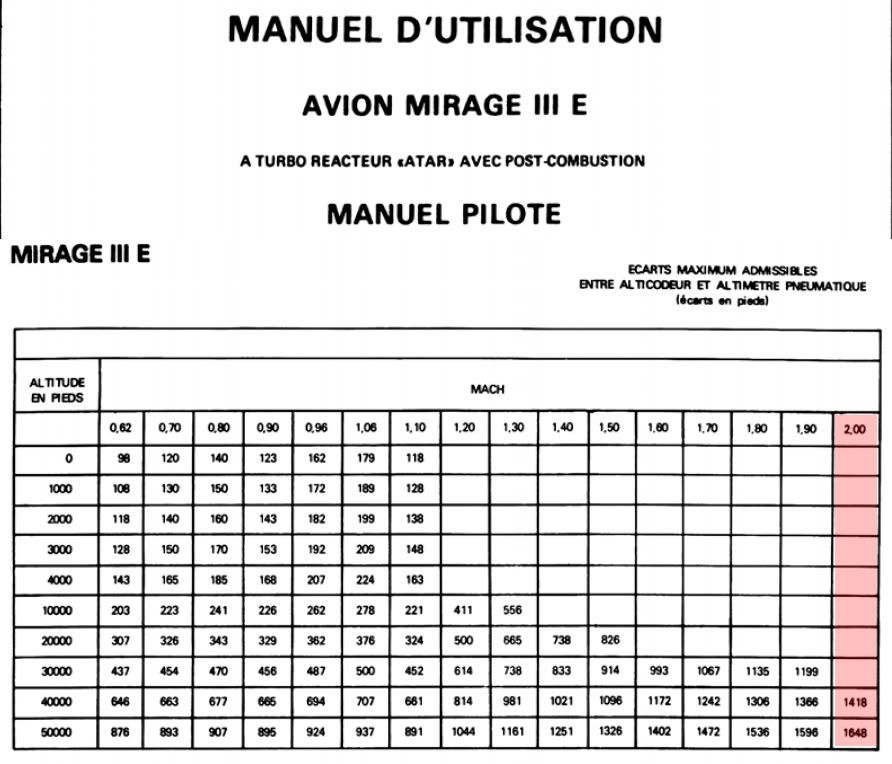
Not our side of reality, proven by not only the 1/2, MN, AdA, and Dassault but also the old Mirage III handbook showing a difference of at least 25.000ft between Maxi and Operational ceiling.
As said I spoke about typical, normal, regulare, usual (select or insert a word that suits your needs) operational ceiling vs. max operational ceiling (max. ceiling is something different). Safety margins are excluded here!
Five:
SEE the USAF webpage giving the Operational Ceilling for F-16 EQUAL to that of Raptor at 50.000ft, another aircraft which you don’t know about the slightest..
http://www.af.mil/factsheets/factsheet.asp?fsID=103LWF requierements were for best turning rates at 20.000 AND 40.000 ft. Not F-35 case.
Ehm what has the Raptor to do with it. BTW it surprises me that while you consistently claim the performance values for french aircraft are just minimum, operational or what ever figures you take any other figure for granted as a maximum. Do you seriously believe the F-22s operational ceiling isn’t better than that of the F-16?
Seven:
With a margin of <> 25.000ft you’re quiet the genius here!!!
Do you actually understand the difference between operational ceiling and max. ceiling (or altitude if you want to choose that word)? The MiG-25 had an operational ceiling of 24 km, but achieved a max ceiling of 35 km+ (world record about 37 km). The aircraft couldn’t fly straight level or lets simply say couldn’t operate at 35 km, but it was able to go there in a zoom climb, much like the Mirage can climb up 75k ft in a zoom climb.
AGAIN you IGNORE reality: Mirage 2000/Rafale have a low wingload for the purpose of retaining high maneuvrability at high altitude and BOTH engines were optimised for high-altitude ( both high and low in the case of M88 i.e ACX requierements)…
So please show me some figures of turning rates vs altitudes or better look at them for your self and figure out the difference between i.e. 25-55k ft if available…
Basicaly trying to demonstrate all the official links and definitions of the word operational and ceillings aren’t right and that AdA squadron specialised in High altitude interception doesn’t regularly fly these mission profiles…
The POINT IS: YOU WERE PROVEN W.R.O.N.G BY ALL OFFICIAL SOURCES INCLUDED: THE AdA AIR DEFENSE SQUADRON 1/2, MINISTERE OF DEFENSE, ARMEE DE L’AIR, DASSAULT AVIATION AND ….. LOCHEED MARTIN.
My only fault might have been some unproper use of the english language, which isn’t my first one. For the rest you simply don’t get the simple points, maybe it’s my expression, maybe it’s your understanding or both…
Problem for YOU Migs 31, Sus and Chinese equivalent STILL can fly at these altitudes and there isn’t any other way to stop them be in in France or the countries our forces protect like Iceland for example…
A lot of aircraft can fly that high, are they doing it in any AtA mission?
Scorpion82Eurofighter should be able to carry 10 missiles and 2 tanks without the help of dual missile rack.
Should be able yes, but the inner wing pylons aren’t used for AAMs.
Scorpion82Is this picture a recent one? I’m guesing it’s a new feature they now have.
This image is one of a couple taken by a spanish guy during the open day at Moron AFB in December or so. So yes it is recent.
Scorpion82= NO my friend it IS the Operational altitude and the 2000 for example is well KNOWN to have fabulous acceleration and reaches its TOP Mach at 37.000ft+ the fastest from subsonic speed; precisely because it was DESIGNED for it.
Otherwise SAID; Dassault, the Top AdA squadron, MN knows their ABC.
YOU on the other hand insist into refusing to admit these FACTS:
1) You are WRONG.
2) You still dont KNOW what you’re tralking about.
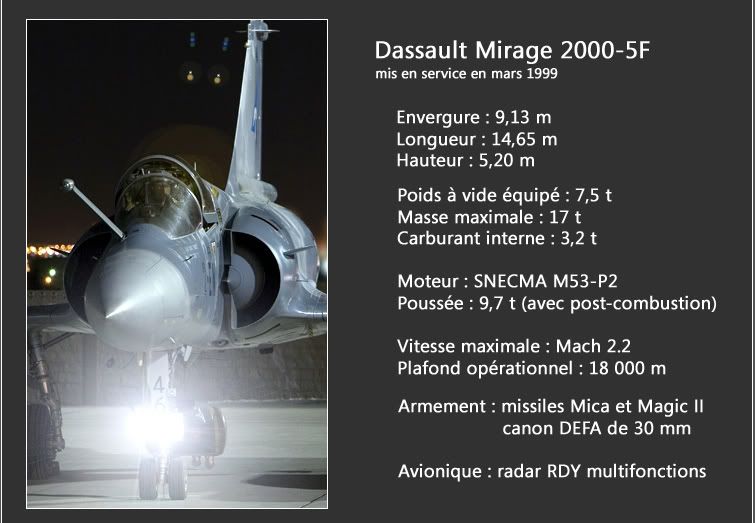
= NO my friend it IS the Operational altitude and the 2000 for example is well KNOWN to have fabulous acceleration and reaches its TOP Mach 2.2 at 59.054ft Operational ceilling the fastest precisely because it was DESIGNED for it.
= BEST performance for the Mirage 2000C (D/A) M53-5 was obtained only at slightly lower altitude i.e. 57.500ft.
= And Yes they regularly TRAIN to fly and FIGHT at these altitudes since it IS the role for which they are OPTIMISED and the threat (Mig 25/31) doesn’t wait for Mr Scorpion agreement to cross borders or for the AdA/MN pilots to be ready, they need quiet an intensive and regular training for role.
These French fighter ALWAYS were designed for interception at the tropopause by requierement since the Mirage III and this means best performances at <> 58,080 ft; the two 5F squadron are well trained at high-altitude interception because it IS their primary role…
They trained to do just that since the IIIC and later IIIE which best performances were obtained at 50.000ft.
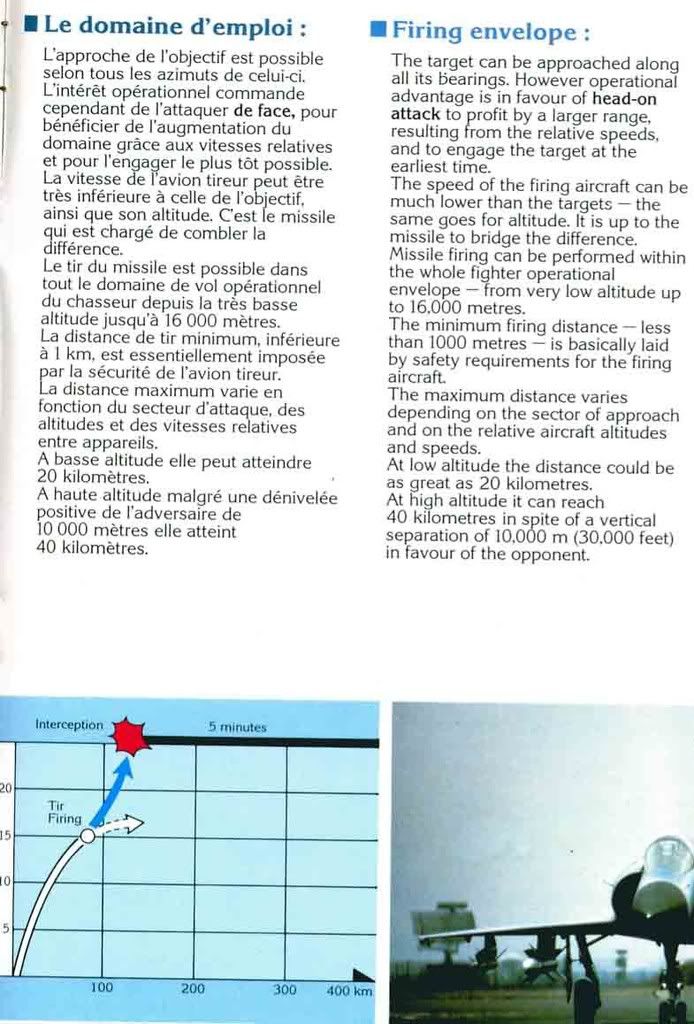
Here to SHUT you off, a composite image which doesn’t need commenting…This nice document also show that the IIIE MAXIMUM ceiling with pressure suite was 75.000ft.
HERE: Typical Mirage 2000C (D/A) Intercept scenario with weapon release at 16.000m (Matra Super 530F), they would have to be able to see for (and TRAIN FOR) a SECOND wave, eventualy using Magics IR AAMs in a frontal attack, and THIS from, sea-level up to 55.000ft without pressure suite.You clearly didn’t study ANY serious documents on the French AdA nor on its role, doctrines and equipment, more to it, there isn’t any sign of the slightest level of comprehension from your side of the words OPTIMISATION and REQUIEREMENTS.
These childish trick of yours deserve the Airfix award for Mickey-taking…
Se below:
Did YOU or disn’t YOU write the above nonsense?
Who is making FALSE allegation and INVENTING himself standards here?
HERE the Official Defense Minister “Newbies” link for you, what does it say???
Mr Scorpion I as opposed to YOU do not NEED to DENY on INVENT Operational realities and take on people personaly while trying to pass myself for a poor victim of agression.
I KNOW my ABC including military since i was precisely equiping the IIIEs with their Matras and AIM9s, which is clearly NOT your case and i am also not exacly a grounded keyboard warrior who pretend to know that a Mirage 2000 best performances are obtained at the upper-limit of its Operational altitude supposed to be <> 55.000ft when the IIIE was capable of 75.000 Maxi.
This Operational altitude is fixed for a set of very good REASON and YOU keep ignoring them and trying to imply they are inexistant standards, infortunately for you these FACTS are well documented and some of us KNOWS about them if you DON’T…
These aircrafts have been designed around a set of requierement including HIGH-ALTITUDE/HIGH-SPEED interception and their performances at these Operational altitudes reflect just that.
As opposed to what you try to imply, these are NOT the “Operational upper limits” but the BEST altitude for performances (that given by the 1/ 2 is the most accurate), they actualy can fly easly higher than that but this would requier them to use a pressure suite for safety reason.
Higher than that in case of decompression your blood would start to boil (I beggin to suspect this happened to you in your craddle time).
As Dassault puts it with AdA/MN standard “Operatiopnal” ceilings imposed by the services once the aircraft performances have been validated Operationaly and for safety reasons. = BOTH 55.000ft (artificialy limited).
As the 1/2 indicates the aircraft ( 2000-5F) REAL Operational ceiling is slightly higher than that.
You of course wouldn’t know since you keep inventing all you didn’t learn and i’m sorry to say it turns out to be a lot.
http://escadron1.2cigognes.free.fr/moyens.php
BTW please post the Oxford definition of the word cinematics.
LMAO, nice to see you finally give up your twisting and spining about who you are Sampaix.
And thank you for perfectly proving my point of operating at such altitudes on an intercept of a high flying target. Do they fly CAPs, sweep missions at that alt? Show me a profile here! Cold war is over and MiG-25/31 doesn’t pose a threat any more!
And BTW try to maneuver at 59k ft and 40k ft you will notice the difference, it’s not all about speed in modern aircombat. The intercepts of this kind, may still happen, but in most cases the missions flown today are CAP, sweep, escort and in these missions your M2k will normally oeprate below 50k ft. The cold war is over old dinosaur and air combat has changed a lot since the 60s/70s where you loaded weapons on a MIII (wow you must be an upper expert by that work):diablo:
Scorpion82Typhoon1
The only thing is that the nuclear role needs special training and procedures so ultimately there will be 40 rafales dedicated to that role with pilots “specialized” in that mission.
Isn’t 40 aircraft a bit much for this role nowadays? That means 2 E/Cs being dedicated to that role?
Scorpion82Anti-ship mission ,hi-lo-hi ,with 2 600 gallon tanks ,4 ASMs and 2 SRAAMs.
Thanks Ishikawa. Maybe the 833 km is just a requirement. Hard to believe that the range will be so much lower than for a F-16 which should be able to do some 1000+ km.
Scorpion82
Please go and tell the 1/7 pilots their knowledge is insufficient, their webmaster incompetent, their aircraft not performant enough at Operational altitude…I SERVED at the SAME A-B it is the SOLE Air Defense A-B of the AdA, so i think these people from the simple PETAF to Pilots knows damned WELL what Operational altitude means…
At 3.2808ft per meter this gives YOU 59.054ft Operational ceilling for the Mirage 2000-5F. Cheers.
59k ft is the upper limit of operational ceiling, of course they can operate there, but they will rarely do it as in normal missions they operate at lower altitudes more effectively.
On purpose during an intercept of a high flying target for example they will do so, but not on a regulare base. Your accusations against me for bluring the difference between upper operational ceiling limit and normal operational ceiling can just be given back. For someone who has a flying license and who is consistently playing the smart guy you know surprisingly few about operational realities.


 Sign In