 Scorpion82
Of course they’re, who wouldn’t ? That doesn’t mean their wishes are either realistic or serious. They have a budget, they should have a better idea of what they can really do with their aircraft and have a timeline about when they can do it. Right now there is nothing. P1E seems to be such an heavy endeavour with fitting the EFT with revolutionary L-16 links, one AtG bomb (that I don’t even know if anyone outside the RAF actually has) and obsolescences upgrades that the EFT consortium just seem out of breath! And with all the T1 been sold (or at least tried to), the T3b cancelled or reduced, it doesn’t seem enough to fund anything really… So unless they sell each screw for 1000 euros… I just don’t get it. And believe you me… I try very hard !!
How so you arrive at the conclusion that Luftwaffe plans are neither realistic and serious, nor that anything is being made? P1E is fully funded, scheduled and well under way. Meteor introduction is scheduled for 2016 and integration on the Typhoon is under way since early 2011. Basic RecceLite functionality has been demonstrated during the Swiss evaluation in late 2008 already, and full integration is currently conducted accoring Eurofighter. The Luftwaffe hasn’t stated a date for RecceLite introduction, but states that it will follow Meteor introduction. KEPD-350 Taurus integration is somewhat farther away, but that’s not problematic for the Luftwaffe which follows a complimentary, rather than concurrent approach in capability. GBU-48 EPW II integration is conducted as part of P1E (not only PW IV as you falsely state) and the TIP version appears to be in development as well and as TIP is merely a modified GBU-48 no new integration should be required. It’s merely fitting one for another and introduction of these weapons is scheduled as well. AESA development progresses as well, albeit it remains to be seen when existing aircraft might be retrofitted and how money aircraft will receive the upgrade in the end.
You are also largely wrong on the T1s. These will only be sold if T3B is ordered according current plans, an exception are the British which currently intend to retire their T1 fleet by 2019. Whether that happens remains to be seen.
On top of that your perception of the P1E is weird as well and as you have been told about the scope of that upgrade already I wonder whether you are just selectively ignorant. P1E isn’t a hardware obsolescence removal programme, but a comprehensive upgrade which in scope is more comprehensive than what Rafales have seen ever since the introduction of the F2.1 more than 7 years ago.
One might argue that Typhoon is in many ways catching up with P1E, though not on all fronts, but it’s important for the aircraft’s future development. Once P1E is established integration of new weapons should be easier and quicker, especially with the incremental approach taken now instead of large block upgrades which are more expensive, time consuming and more difficult to agree upon.
Scorpion82@BlueApple
Some technology being transferred and tailored to the specific requirement of a different carrier isn’t “same arrangement”. According BAES DASS ESM can achieve a better bearing accuracy than Captor. Even the good old SPO-29 of the MiG-29M offered a bearing accuracy up to 5° depending on the wave length of the emitter and up to 10° in the worst case. Selex is stating a bearing accuracy of <10° (less than 10°) which might cover the whole frequency spectrum. So against specific emitters in certain frequency ranges much better results could be obtained.
The following document discusses different approaches in technology and measurement techniques for RWR/ESM systems and states typical” bearing accuracy with 3-10° for non interferometric systems, albeit specific arrangements might achieve even better results. Interferometric systems reportedly offer typical values of 0.1° to 3°.
http://www.phys.hawaii.edu/~anita/new/papers/militaryHandbook/sig-sort.pdf
Scorpion82Wrt the Luftwaffe plans of course its first and foremost a wishlist at this point in time. However it shows the Luftwaffe is thinking about the future of its Typhoons and has plans to upgrade the type and extend its use by employig it in additional roles. The upgrades as stated in those articles aren’t ambitous and thus not unrealistic. However, it remains to be seen whether they materialise or not and when. Integration of additional weapons will come sooner or later amd further updates are required. As of now Typhoons have always seen upgrades ever since they entered service and while we may not see large block upgrades in the future, smaller incremental upgrades are quite a possibility.
Scorpion82Where do you think 11 of Austria EFT come from ?
The Austrian case is somewhat special as it is an exchange of aircraft rather than a simple sale.
Scorpion82@Sintra
It doesn’t. Still have it on my HD.
As there appear to be some discussions/rumours centred around the Luftwaffe’s plans for the Eurofighter, the Luftwaffe has published a series of articles about the Eurofighter which also deals with these questions.
There are four parts and two new article centred around weapons of the Luftwaffe including AA and AG munitions.
http://www.luftwaffe.de/portal/a/luftwaffe/!ut/p/c4/04_SB8K8xLLM9MSSzPy8xBz9CP3I5EyrpHK9nHL9cJBsSqpecn5eagmILEnNK8kEkulFiSX5RXoF-UUlOSCZ0qIioIxeZop-pIGhi5OBmQEMGNZYBLtaelsaWBi4eDoF6Rfk5joCAMN_YFU!/
According these articles it is fixed that the Luftwaffe will operate a fleet of around 140 aircraft which will equip four wings and the tactical training command at Holloman AFB.
While the number is more or less fixed it is still considered acquire the T3B, but sell existing T1s to operate an as homogeneous fleet of multirole Typhoons as possible. A final decision on T3B must be made in late 2013. There is also the option to upgrade the T1s to provide them with multirole capabilities, though this wouldn’t be as effective as buying T3Bs and selling the T1s.
According the articles the Luftwaffe has the intention to retrofit existing T2 and upcoming T3A examples with the Captor-E. As far as weapons are concerned the GBU-48 will come with the P1E, albeit the Luftwaffe may not introduce the new weapon before 2015. Around the same time the Luftwaffe might also introduce the Trojan Improved Penetrator (TIP) version of the GBU-48 with improved penetration capabilities and a light weight 20 kg warhead for reduced risk of collateral damage. Introduction of the Meteor is currently slatted for 2016 according these articles and is to be followed by integration of the RecceLite pod which is already underway. Integration of the Taurus might be further postponed as this capability is already provided by the Tornado and options of introducing HOSBO, SDB or the new PILUM are being considered. In the longer term the Typhoon might replace the Tornado in the SEAD role as well, but that’s not fixed. The Luftwaffe prefers an unmanned solution for the role (UAS), but a manned option might be kept as a back up. Additional enhancements considered for the Typhoon include the integration of the IDM and FMV, ROVER capability for the Litening III and DASS enhancements as well as further improved sensor fusion.
Scorpion82As far as I know, Holland will keep the same trend with military expenditures that Sarkozy had, so I doubt we will see any major changes if he’s elected.
Second point how come France was able to fund all the F3-04T upgrades by cancelling 2 aircraft deliveries and with four countries the EFT isn’t able to fund even half of that despite massive cancellation ?!EDIT: PS: Also the author seems to confirm some suspicions about Germany reluctance to upgrade the EFT in favour of the Tornados…
While the article itself is discussing the situation in Europe as a whole and the French side is mentioned, most of the parts you marked in bolt and apparently discussed below the quote are related to the Typhoon. So why don’t you post it in the appropriate thread?
Scorpion82…
As stated before I will move the discussion where it belongs to. You cna find my reply here:
http://forum.keypublishing.com/showpost.php?p=1872527&postcount=93
Scorpion82The SEER system made by the same company and using the same arangement (dual wide-band antenna per sector) is quoted as 10° RMS by its maker.
(one should notice that this “digital” RWR is quite similar to the proposed upgrade for Typhoon)
There isn’t any claim that the same arrangement or antenna design is used as in DASS, let alone that the SEER is similar to the proposed digital ESM receiver for DASS. So that’s merely an assumption of yours simply based on the fact that the same manufacturer is responsible for the same sub-system which isn’t necessarily a given, as Selex Galileo is a consortium made up of different, previously independent companies.
Notice the two spiral (wideband) antenna at the ends of each pod? These are the RWR antenna, just ask any sepcialist and I’m positive he’ll confirm it.
These are NOT interferometry arrays but “classic” pairs of antenna, an interferometry array requires at least four (but usually five) antennas deplayed in a planar configuration (in a cross although mathematically and dispotistion that isn’t simply linear works).
To quote directly:
“Working as part of the EuroDASS consortium, Selex Galileo produces the 20 major line replaceable units, the 16 antenna assemblies, the 10 radomes and the various smaller parts that make up this sophisticated ESM-ECM and missile warning system.”
There are more antennas than what you describe and different assemblies as well.The ECM antennas for example are operated in TX/RX mode.
Example:
Unless the laws of physics have changed, fitting a TRX creates a significant blind spot. It also prevents the use of cross-eye jamming for that hemisphere.
There’s no cross eye jamming possible without a second ECM antenna right, but there are multiple rearwards facing ESM antennas including the ECM antenna.
A low band antenna is fitted in between the engines and there is a rearwards facing one on the right wing tip pod as well, as seen in this image right next to the TRD covers:
Once again, look at the picture, there are no antenna arrays anywhere.
You just don’t recognise all of them, the radoms are indicative for the position of RF elements of DASS. There are those side looking antennas hidden behind the radoms as shown in the images below:


Is it that hard to get? Don’t you think the the Eurofighter consortium would communicate publicly on such a feature? Dassault did for the Mirage 2k and Rafale, Saab did it for the Gripen upgrades, Boeing for the F-18 Growler, Lockheed for the F-16 Blck60 and the F-35.
Not necessarily, many of the features of DASS are classified. We didn’t know about the employment of AESA technology for years for example. So don’t bet on everything being published for the sake of forum discussions.
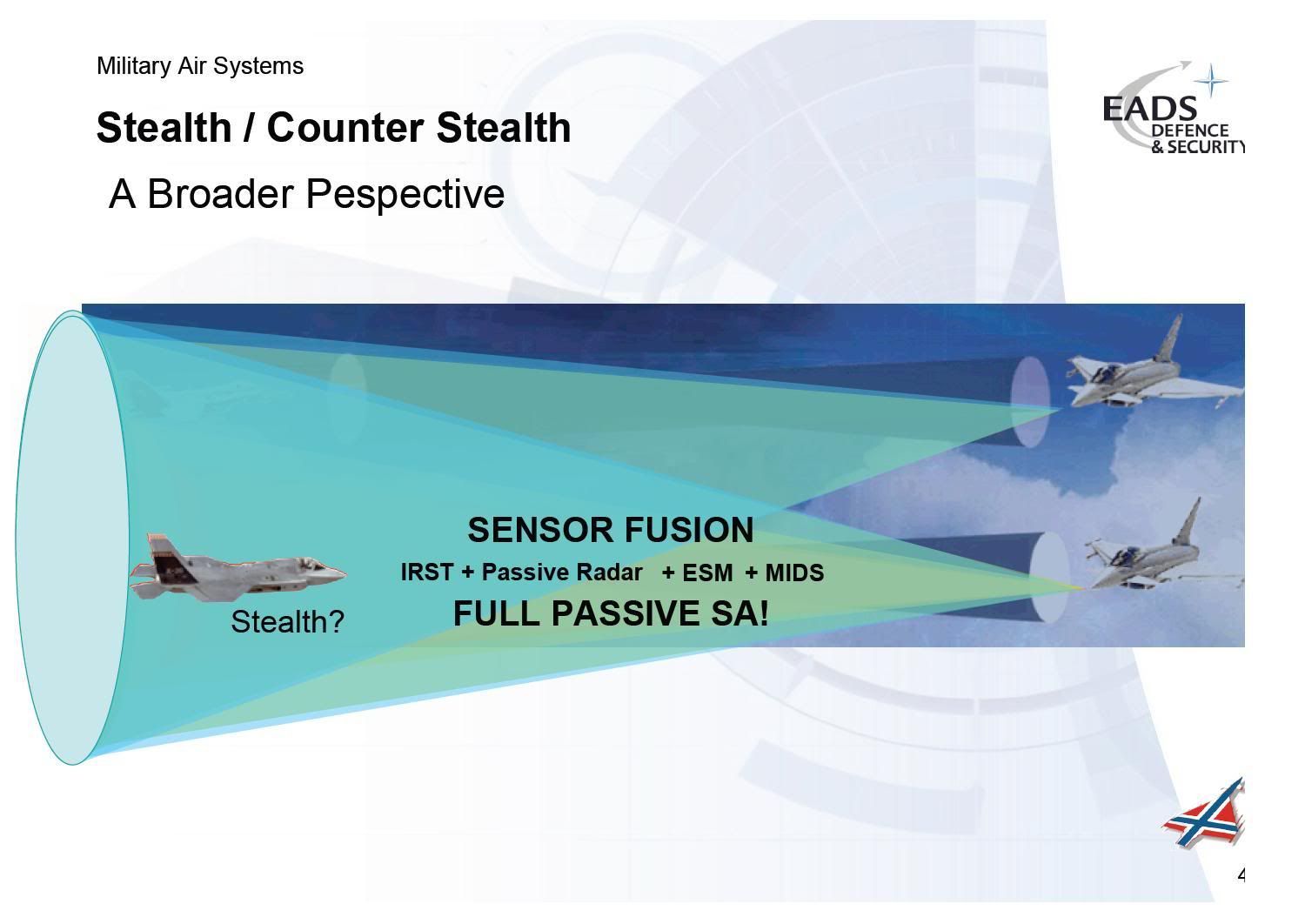
By the time an IRST is able to give you a firing solution by tracking only, you’re already at the merge (not that you were very far at the beginning given the range of an IRST).
Certainly depends on the whether conditions, but at some altitude and in not too adverse whether conditions the detection and tracking capability of advanced IRST designs lies well beyond the merge distance.
Reported by whom?
“The objective of the testing was to fire the AMRAAM missile from a Eurofighter Typhoon whilst its radar was in passive mode”
http://www.eurofighter.com/media/news0/news-detail/article/unique-amraam-firing-with-eurofighter-typhoon.html
And
Captor is a single, narrow-band, antenna, it’s even worse than a dedicated RWR as far as positioning is concerned, this idea is just ridiculous.
True but most fighter radars operate with a similar frquency range. The passive mode might well be limited to cooperate attacks with one aircraft radiating and the other receiving its reflections.
DASS ECM was designed in Italy and the ESM in the UK by different companies. And a third one did the avionics, one whose concept of sensor fusion is apparently limited to the elimination of duplicate tracks when displaying the tactical situation to the pilot (that didn’t really impress the Swiss if we go by their evalution, sensor fusion was specifically quoted as a weak point).
ESM data are also passed to the weapons system as such, not just for eliminating duplicate tracks. If there would be no benefit of using ESM data they wouldn’t be fused in the first place.
There are at least two independent, albeit unofficial sources stating a bearing accuracy of <1° for the DASS ESM sub-systems, maybe they are wrong, but there are no other sources stating any data whatsoever. Thus far I have just seen Rafale fans throwing around with all kind of data like you have done it, with the explanation of “no interferometry”.
http://goliath.ecnext.com/coms2/gi_0199-4725196/Typhoon-arises-the-Eurofighter-Typhoon.html
http://eurofighter.airpower.at/sensorik-dass.htm
Scorpion82What we do know about Typhoon DASS is that the RWR relies on a pair of wideband antennas per sector.
Such antenna pairs with a resolution of ~10° cannot provide a bearing accurate enough for passive targetting, you need an interferometric array for that.
Sorry for the short off topic and we might continue this discussion in the Typhoon news thread, but this can’t be left uncommented. The “~10°” figure is completely unsubstantiated. Even much older systems without interferometers achieved greater accuracy than that. Bearing accuracy depends on a lot of factors including the antenna design, arrangement and technology. With the same antennas, but one being fitted with interferometers you are certainly going to achieve better results, but that’s not an automatism! We don’t even know for sure whether DASS employs interferometers or not. BTW DASS features 16 antenna assemblies hidden behind 10 radoms. Three of these antennas account for the MAWS, the rest for the ESM/ECM sub-system.
Which is why some Typhoon customers choose not to include them…
TRDs are fitted to all Typhoons, spare Austrian ones which lack the DASS altogether. German Typhoons just use different TRDs than the rest of the fleet.
Of course, on the Typhoon if you install a TRD you have to remove one of the four ECM modules, losing coverage for that sector.
As the right wing-tip pod is designed to accommodate two TRDs this is a no-brainer. The rearward facing ESM/ECM antenna offers a wide FoR to provide full coverage of the rear hemisphere.
No it can’t. It lacks the accurate antenna arrays for such job. It also lacks a laser rangefinder.
The lack of accuracy in this case a pure speculation of yours, if not an outright invention. You forget about PIRATE which offers very accurate angular position data, range data, velocity, acceleration, rough target vector and the target ID in STTI mode. DASS adds a range estimate, bearing and emitter ID and Captor reportedly offers a passive mode as well, next to the offboard targeting option via MIDS. A LRF isn’t really passive either!
This means that its only way of getting a firing solution is to use its radar (unless the track is provided by a third party of course).
The data mentioned above should be sufficient even without Captor and MIDS, albeit there is still the same problem as is present for the Rafale or any other current fighter for that matter, lack of MCG and a lesser range of accurate data to provide a firing solution comparable in scope and accuracy to that of the radar.
Typhoon DASS shares the same basic problems than the plane it protects: workshare packages mean that the ESM & ECM were made in different countries and their outputs were never meant to be fused at a higher level because yet another company was making the central avionics.
DASS was merely designed by two companies, like SPECTRA which is designed by MBDA and Thales. That DASS wasn’t designed without any sensor fusion in mind is equally wrong and apparently based on nothing but hot air.
Again sorry for the OT and if there is an interest to continue the discussion we should move elsewhere and leave this thread for what it is meant to be, a Rafale news and discussion thread.
Scorpion82Some DASS components are still based on analogue systems. P1E will increase the digital content of DASS, but only the 5th step of the DASS roadmap will see the installation of a digital ESM receiver. The ESM sub system is just one of many parts of the DASS. That’s all about it.
Scorpion82The main mission of Growler is to provide detection and jamming against all known surface-to-air threats across the full spectrum of EW.
Rafale did exactly that in Libya and AdA was the only air forces able to operate without the protection of the USN F-18G (going as far as refusing it even when it was available).
The Growler is much more designed to provide protection of allied forces by suppressing enemy air defences in the first place. SPECTRA is more designed to protect the aircraft itself, rather than protecting multiple formations over a wide spread area. SPECTRA might be able to protect some nearby platforms under the umbrella. It’s not known whether the AdA was the sole AF able to operate without Growler protection, it was the sole AF which was willed to take the risk. It’s not known whether Growlers were around all the time either when non French fighters were operating in the area.
You can only do that if your aircraft has ELINT/SIGINT capabilities (+ stand off weapons like AASM and a two seater is far better) which are not just a key strength compared to other systems, but a whole new world apart. A self defence suite + a few LGB isn’t going to cut it.
ELINT & SIGINT are electronic recce capabilities. ELINT is used to map enemy radar systems with their position to generate the enemies electronic order of battle, useful for latter mission planning, while SIGINT is gathering intelligence on the signals itself, useful against unknown threat emitters in particular and to update your threat and ECM libaries. The SPECTRA is in this case more or less unique as the EW systems of other aircraft don’t pose full fledged ELINT/SIGINT capabilities, at least not from what’s known, which isn’t everything available however. I think that the AASM is a valuable key enabler for the Rafale as a very flexible stand-off weapon it’s certainly going to enable safe mission execution which otherwise requires more specialised weapons such as ARMs etc.
Scorpion82Towed Radar Decoy, sometimes referred to as towed decoy only.
Scorpion82Scorpion and EElightning, accordding to wiki scramble the Eurofighter gets the new ESM in Block 9: http://wiki.scramble.nl/index.php/Eurofighter_Typhoon#Block_9
‘improved DASS (new ESM/ECM, maybe improved TRD’
Does this mean that aircraft flying with SRP 5.1 have the new ESM ?
Any reply would be helpfull.:o
There will be new dual-polarized ESM/ECM antennas, new DRFM and new TRDs with increased frequency coverage and transmission power, possibly the MK2 variant of the Ariel. It hasn’t been introduced with block 9 which are around for some time now, but these enhancements are merely incorporated as part of the P1E A.
Scorpion82So the Typhoon was ordered by 4 nations with such a defective EW suite at its exhorbitant cost? I find it hard to believe. Glitches show up of course during hefty usage as there are things learnt during field usage, but the jet must have first had to pass qualifying tests….
I doubt that the EF consortium would spend millions on (Swiss) testing if they knew that their crucial EW suite would fail. No country will pay the price of a Typhoon without a good avionics set up. It’s a given.
What I say is that there were known deficiencies with DASS at that time and even later. That doesn’t mean that the entire system wouldn’t work, but that it’s performance may not reflect the hardware’s capabilities. I also pointed out that this has been reported independently from the Swiss eval. The rating of DASS wasn’t bad per se, just not on par with the competitors. Gripens EWS scored almost as high as SPECTRA.
BUT…the real context was to counter points brought about the Typhoon’s radar that Typhoon fanboys tried to position as so crucially important. The Rafale radar was particularly denigrated due to range. The best way to to assess the truth is to build a Rafale v. Typhoon combat case, so that logical defects of this sort of posturing can be spotted. When old fighting paradigms create false beliefs, it is sensible to counter it somewhere…I would argue that one day the PLAAF may fit their Sukhoi knock offs with a big AESA radar, and you would then be able to carry the radar case to that jet.
Ok so you countered a simplistic argument with another simplistic argument. There’re always pros and cons to any approach, neither one is perfect and the designers of an aircraft are always going to make compromises to meet the requirements in the best possible way.
In the MRCA case, given that both were the top contenders, there would be also a natural interest in a Typhoon v. Rafale case scenario.
I think a Rafale instead of Typhoon and the other way round for the IAF would be a better/more reasonable approach than a Rafale fighting Typhoon approach.
The argument here is that it works well with the old fighting method – such as that used by the F-15 or F-14, where you go boldly and openly.
That’s not the only way and it isn’t only simplistic, but wrong to believe that the Typhoon was designed to just best an F-15 or Su-27 in all areas, but still fight in the very same way.
I did not say that the Typhoon would not have access to such AWACS, etc. Only that the Rafale having access to AEW/GCI eradicates the Captor-E’s “edge” totally in painting a long-range radar picture. It also eliminates the azimuth differences in detection from any consideration.
In general I agree with this, but this scenario assumes the best case only and that’s the minimalist approach in the case to make a point, rather than a more demanding assessment.
So to use it minimally like the small RBE2AA seems to defy its large size and radiating power. You would not be using the Captor’s design advantages with a minimalist radar use approach…advantages which of course also bring the trade off that they cue the enemy off early.
It always depends on the mission and scenarios. Over hostile territory you’ll stay silent most of the time not to attract the enemy’s attention, but at times you might be forced to use your radar as the coverage from GCI and AWACS is limited over hostile territory as these assets aren’t near by. In defensive missions you might be forced to you your radar to adequately sort and engage multiple targets, for example enemy raids with bombers and strike aircraft, while dealing with their escorts as well. The passive approach has its limitations especially in scenarios with many bogeys. Also if you are already discovered by the enemy better use your radar to gather more accurate data, sort and prioritize targets and update your missiles in flight.
Wrong there…they are IAF specific since the Indians will go for Phalcons, HAL AEW jets and GCI. My scenarios are just not specific about the Typhoon side because it would not matter if that side had AEW or not. The focal point was “how to eradicate the Captor’s range advantage”.
I did subsequently remove supporting radar assets to show that even without these the Rafale would have enough capability via passive detection providing early warning to the Rafale pack. That’s just in case the IAF lost its additional radar assets. Again this is a hypothetical case of Typhoons v. Rafales, just because we have claims about the Typhoon have an advantage here, another one there, etc. In this case, I used the radar advantages of the Typhoon to show that those advantages can be worked around.
Why is it wrong when you clearly envisage an entirely fictional scenario which will never work out that way for the reasons mentioned above?
Scorpion82Where did I say or imply that? It just serves as a cueing system that someone is painting a target and it means that the target has enough time to react. One reaction could be to switch on radars and/or get updates from other radars. Since the RBE2AA has at least 80 KM “spare” range (versus effective weapon range) there would be plenty of time to react to get into a counter attack position.
Your entire discussion is centered around this argument and you never made an attempt to make a clear cut here, so it isn’t to far stretched to assume that you imply exactly that and I’m obviously not the only one who reads your comments in this way.
My point has been very simple all along: The Captor-E radar does not have a weapon system to match its superior range so a lot of that early warning advantage is really dissipated at some level.
A powerful radar can be good for all sorts of things from raw power in electronic attack modes to improved performance against lower RCS targets. Radar range isn’t static by any means and even if you detect and track a target way beyond engagement range the awareness of the threat leaves more options to prepare an engagement or exercise other options depending on the tactical situation and your mission.
….just why did the Typhoon’s hi-tech EW system score so much lower in the Swiss AF assessment?
….or for that matter why was the basic Hornet’s (…not Super Hornet’s) EW system score so much lower?
From what’s available independent from the Swiss eval DASS had some issues at times, largely driven by software glitches which may explain the performance gap next to other factors I can’t elaborate on yet.
I think it may have to do with geolocation capabilities which are underdeveloped in run-of-the-mill systems. There was a claim by a pilot that the SPECTRA can be used for airborne passive targeting. Perhaps that would work if they could network jets in an effective cross-triangulation method between themselves.
Dassault has claimed this on a website: “The outstanding capability of SPECTRA regarding airborne threat localisation, is one of the keys of the RAFALE’s superior situational awareness.”
How far that goes is beyond me, but if the SPECTRA is effective in airborne geolocation as has been claimed (and this is many times tougher than geolocating static ground emitters) than it means that whenever the Typhoon switches it radar it would be tracked in turn for distances easily up to 200 KM (claimed geolocation range of the SPECTRA according to some).
“up to 200 km” has been stated, but that’s detection and not necessarily localisation of a threat emitter. As you pointed out yourself geo-locating airborne emitters is quite difficult from a single ship and the data obtained are more rough and inaccurate. You can cue your missile and launch it into a basket from where it will try to acquire it target with its own seeker, but if launched at long ranges with minor data only and without any MCG the pk isn’t going to be high.
I basically don’t get the point of your weird scenario anyway as neither China, nor Pakistan will buy the Typhoon, so your scenario makes no sense at all.
My point is that your scenarios are very much centered around a single assumption only which is Rafale with radar silence, plus possibly AWACS/GCI support against Typhoon with active radar and no such support. Whatever scenario you envisage it’s not IAF specific anyway, but for some strange reason you are defending the choice of the IAF by bringing up exactly this scenario.


 Sign In







