 Scorpion82
Yes laser guided rockets would be a good solution, albeit limited in range they would be fast and such a pod could hold a number of rockets, I think it’s definitely a better solution than the Scalpel which looks like an unpowered rocket.
Scorpion82So are the French testing now various contenders prior a selection?
Just performed a google search to gather more info about this weapon. Looks like it’s a very light and cheap weapon, but with limited range and laser only, apart from the “linear seeker” whatever that means.
Scorpion82TVC would be used to reduce the use of conventional control surfaces to cut trim drag, that’s the main purpose. It’s only increasing agility by reducing the drag and subsequently the bleed rates.
Scorpion82That’s a nice paint job.:) Though they could have painted the canards as well.
Scorpion82ALL contestants were found to not meet those requirements at one point.
How is it possible if the commercial bids were never opened?
Scorpion82Passive missile warners ? Are they planning to drop the active MAWS or supplement them ?
That’s a good question, but onw to which I have no answer at this moment. The article interestingly talks about LWR as well, albeit the Typhoon is already fitted with one! Maybe they are looking for a combined passive MLD/LWS device replacing the current LWS. This would be a reasonable option as the current LWS consists of 6 sensors which offer full 360° azimuth and elevation coverage. Further developing such a system into some kind of EODAS would be nice, but hey everyone would like to see this or that on this or that.:D;)
Scorpion82Scorpion :
Are you saying that the Captor-E will detect a 5sqm target at 250km ?
Well , it seems a bit exagerated and I can’t see how that would be possible with the output power at hand . If it is indeed possible , that would mean that many people including myself (modestly) were wrong .
AFAIK , we don ‘t know the output power of the Captor-M , we don’ t know the output power of the actual AESA Captor prototype and we don ‘t know the output power of the futur Captor-E .
You are contradicting yourself here, on one side you claim that you can’t see “how with the power output at hand”, on the other side you don’t know anything about the power output!
What we know is that the Captor has about twice the power output of the AN/APG-65 which is of similar size, but of older technology. I don’t know the exact power output of the AN/APG-65 but a peak power of 5-6 kW is likely so that we are looking at least at ~10 kW for the current Captor. What we know (or at least I know) about the CAESAR demonstrator is that this radar reportedly had 1424 TRMs each with a power output of 10 W. In sum that would be ~14 kW. Of course there is more about it such as power and cooling, thus the theoretical max may not be the practical max, but that’s true for all radars. T2 aircraft have already received considerable ECS and generator updates to provide more power and cooling for upgraded and additional systems and T3 will just improve on top of that. The fact that the RBE2AA currently has some 9.6 kW and is slatted for an increase to 14 kW (IIRC that’s what you said) I see no reason why the Typhoon with more powerful engines and likely higher (guess on my part) electrical power will just do better than this. And the known range figures for the current Captor seem to match these thoughts! Btw. the AN/APG-77 reportedly offers a detection range up to 240 km against a 3 sqm target and its TRMs have a power output of just 4 W!
But it would be very hard for us to rate the futur Captor-E without pulling rabbits out of a hat .
We can at least make reasonable assumptions based on other references and a 50% range increase has been associated with an AESA radar for the Typhoon, the source is arguably quite old, but we know that many AESA radars fitted to US fighters (AN/APG-63(v3)/79/80) offer between 50% and 200% more range than their predecessors. The same is true for the Zhuk-A in comparison to the Zhuk-M, the RBE2AA vs RBE2 or the ES 05A vs PS 05/A and I ask you why the Captor-E should be the sole exception!?
AESA modules count and dish size are 2 very important things , I admit , but it doesn ‘t tell the whole story .
Personaly , I think that Thalès has a good 3 years lead wrt integration , back-end and software compare to the Captor-E . Then , the technology at hand might not be the same . GaAs modules MAY be the same but the way to use them could be different . Bets are on … 😎
All fine, but what we are discussing here is the power output and related range gain over the older radar.
I have been following the Eurofighter 2000 since , well … from the begining .
I am truely disapointed to find out that you discard my posting so easily , Scorpion .
It doesn’t matter how long you are following the programme, fact is you have a lot of gaps in your knowledge about the Typhoon and you have repeatedly demonstrated this very fact. You aren’t even aware of some fundamental basics (maybe that’s just my standard but anyway…) and much of what you obviously don’t know is publicly available since years and you could know it if you would do some more thorough research. I don’t blame you for not knowing this or that, but I blame you for the attitude of not asking for information you don’t know about and instead making claims out of nowhere which are then presented as facts.
I understand , saying that the Typhoon is a “souped-up” M2000 is not easy to swallow but there is not much difference in between the two .
To be honest I don’t care about your souped up M2k claim at all, it’s your opinion and you are free to believe what you want. But I’m not going to let your unqualified comments being passed over as facts!
You forgot that the F-22 ‘s mains screen (and the Rafale ‘s) is a fusion is between all the available sensors with an EMCON concept , as well as showing a God eye view , which is not the case with the Typhoon .
I don’t forget about anything here, you just don’t know it, it’s as simple as that. The concept of the sensor fusion on the F-22 and Typhoon is in fact very similar. They both use fused display formats with a different level of detail, attack, defensive, tactical SA. EMCON works different on the F-22 in comparison to that on the Typhoon or even the Rafale as to my understanding, but the F-22 isn’t the topic here.
No God eye view?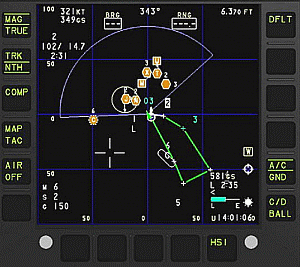
No sensor fusion?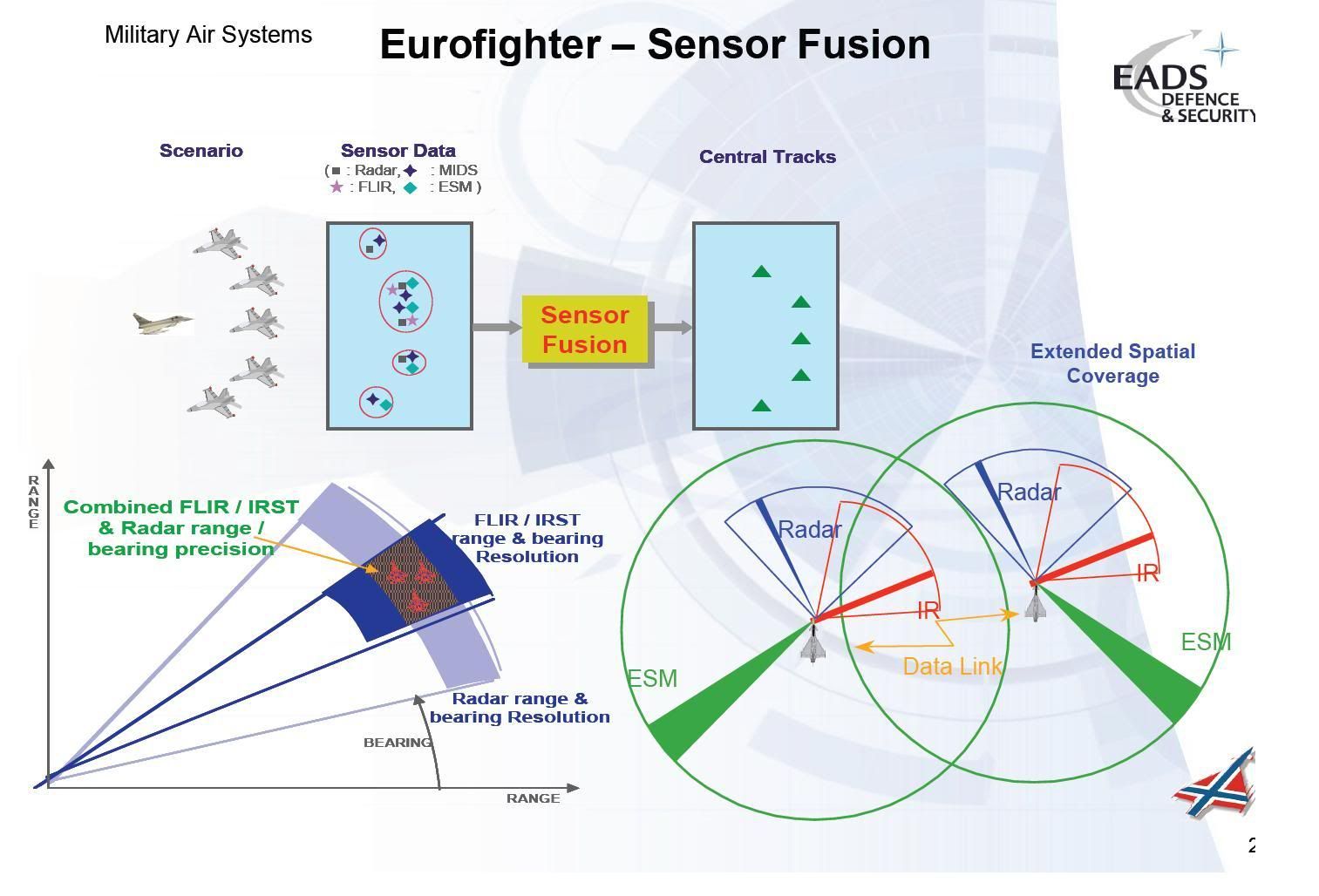
This is exactly what I ‘m saying to you , IF REQUIRED . Yes the DASS has its own display (if the pilot ask for it , left side display) but it can ‘t be fusionned (if I may say) in the main display and with all the filtering needed to only show what what the pilot should take care of , while the rest is managed and recorded for immediat or futur use , as I said earlier on . Here Scorpion , I ‘m not talking aboput MMI but about sensor fusion . MMI will come later :diablo:
And that’s where you are wrong. First it’s usually on the right side, not the left side. Secondly the DASS format shows the radar/IRST scan arc for a reason… Third the most dangerous threats are displayed on the PA format as well and all DASS data gathered are fed into the AIS and fused with the radar data from Captor, PIRATE, IFF and MIDS and are presented in a clear fashion on the PA. The AIS is prioritising threats on base of the input of ALL sensors and assigns letters accordingly which are coherent on ALL display formats. And just for the record sensor fusion is essentially a part of the overall MMI!
Rgr that loud and clear but it is what every 4th gen aircraft do , more or less . Some do better than others …
Really so all 4th gen fighters have sensor fusion of that sort…:eek: One wonders how the Rafale is so “special” at all!
Really , are you sure !? 😮
First : “DASS requires not any input at all if not required” is a nonsense . Read again what you said , english language is cristal clear but you ‘re not . Then , if PIRATE is only used when the radar is off or on stand-by , you know jack about the Typhoon .
DASS is fully automated, but the pilot can manually select some functions if required it’s as simple as that. And I didn’t said that PIRATE isn’t run concurrently to the radar, but that if the radar is on stand-by or off the IRST attack display format is used to manually adjust the scan angles of the sensor. If both are running concurrently the PIRATE is operated in the SACQ mode and is scanning the sector pre-defined by the radar, alternatively the PIRATE can be switched to slaved acquisition mode (particularly useful in covert operations) where it is looking for an offboard contact received by MIDS.
Unless I want ??? 😮 I want EVERYTHING and NOW !
If I have to go through buttons and switches ~if the system is capable of doing so~ to understand what is tracking me , where , how far , I prefer to eject right away , come back to base and ask to fly a Rafale for my next mission ! 😡
You will understand this by the cues provided on the PA. In serious threat situations the DASS format will show up automatically, it’s not like the pilot doesn’t know what is tracking him if the DASS format isn’t selected, he will in fact know from the PA based on the priorities, i.e. non dangerous emitters won’t be displayed with separate cues, but they will be displayed as normal tracks on the PA.
Wrong . Sources , please . :diablo:
Then , to perform such tasks , DASS would need to be in charge of the Captor to manage a true EMCON concept , which is not the case and a mechanical radar is not the best to manage multitasking (ie : SAM tracking at 11km , adverse fighter tracking at 85km , terrain following) which suppose excellent output power flexibility and fast beam stearing .
In fact , the EMCON concept with a mechanical radar is of little use .
In this regard , the Rafale is well ahead and the RBE2-AA will benefit for free of what is already implemented .
You say wrong because you have no clue. Try the DASS_FS.pdf for starters.
Here are some excerpts from this very pdf:
“The DASS also has full control of the RF transmitters and receivers allowing optimisation of emission control and crossaircraft sensor management, including a stealth mode for controlling RF transmitters
in covert operations.”
&
“Mutual interference between the ESM-ECM and Radar is managed by means of a private link between the Radar Receiver and the ESM-ECM Processor LRI. This link supplies the ESM-ECM with Radar operating parameters and enables the ESM to reject received Radar signals. It also enables either the ESM-ECM to blank the Radar or the Radar to blank the ESM-ECM depending on the relative priorities. Interoperability also operates during reversionary modes if the Radar link fails.”
As a general note, before you start shouting wrong and claiming this or that to be fact you should better be sure that you know what you are talking about. As it looks right now you have a fundamental misconception about the Typhoon due to your gross lack of knowledge and that’s what’s so annoying about you. You pretend to be knowledgeable and well informed about the Typhoon, but your knowledge is at best mediocre about this very aircraft. Your knowledge about the Rafale won’t compensate for this!
Scorpion82@Kovy
The gun fairing appears to have moved a bit as this image may show.

@Aurel
And what exactly is wrong with the intakes? Is it that you dislike its looks or do you have any technical explanation of what is wrong with them?
Scorpion82Is there any interference between the lerx and the gun ?
The gun is installed below the apex strakes that’s all I can say so you may expect them not to interfer, but for an accurate answer it would be necessary to consult the engineers.
Here is a photograph:
http://forum.keypublishing.com/attachment.php?attachmentid=157321&stc=1&thumb=1&d=1190132488
Scorpion82@RobL,
EGBU-16 aka GBU-48 is a modified version of the GBU-16 PW II LGB. The GBU-16 is based on the Mk-83 1000 lb GP. The GBU-48 aka EGBU-16 adds INS/GPS guidance this it’s a dual-mode bomb similar to the EPW II currently employed on RAF Typhoons. The sole difference is the bomb body, as the British use their own 1000 lb bombs and fit them with the PW or EPW kits. It is worth noting that the PW IV and GBU-48 aren’t operationally used right now. These weapons will come with the Phase 1 Enhancements upgrade slatted for tranche 2 aircraft. The P1E is released in two part with each part adding new hardware and software. SRP10 is the initial software release for part A, while SRP12 is the final software introduced with part B. P1E development and testing is well underway and in an advanced stage for the part A. The hardware is apparently fitted to the first production aircraft which are flying now and which are used for testing prior being delivered to the customers. It’s expected that the first P1E aircraft (which appear to be designated block 10) will be delivered towards the end of the year, with P1E B following later in 2012.
Detail enhancements include the aforementioned software which is now based on a real time operating system. The original software had to be converted to the new RTOS which makes better use of the new mission computers and which will ease further software upgrades.
The new software will enhance the MMI mainly adding functions for AG operations, including the simultaneous targeting of AA and AG targets, delivering multiple weapons in a single pass, and automatic target recognition software for Captor and possibly PIRATE as well.
Hardware enhancements include new digital radios, mode 5 IFF, new DASS antennas, improved MIDS with vastly increased data transfer capacity and DGPS. It is possible that vectorised maps are added as well and there could be HMSS upgrades to support AG weapon delivery. An active DVI is in the works since quite some time as well, but there are no more recent news wrt its implementation. Digital integration of the IRIS-T and full integration of the LDP with better masking and greater automatism than with the austere AG package round out the P1E. It forms a good base for further maturing Typhoon’s AG capabilities and I expect the AG weapons integration to possibly spool up once the P1E is available and established.
Scorpion82That just means that such an upgrade is possible, as of yet no one has ordered the T1s to be upgraded at all. The Italians are upgrading the IPA2 to T2 standard as well. It is necessary to keep development going as there aren’t many T2 compliant IPAs at all (IPA6 & 7 thus far).
Scorpion82@Twinblade,
yes and no. The Su-30MKI is from IAPO whereas the Su-35/37 are from KnAAPO. Various elements such as the canard configuration, the digital FBW, the AL-31FP engines (a development of the AL-31FU fitted to the Su-37) and the N-011M Bars were ported to the Su-30MKI.
Scorpion82Yeah, 711 aka Su-37 ‘Terminator‘, those MFDs were supplied by Thales in the mid-90s, iIrc.
In 2000 the 711 went through a modification phase were all foreign stuff was deleted and the cockpit displays were changed as well, as shown in the picture above. The AL-31FU were replaced by AL-31F and the FCS was modified to improve manoeuvrability without TVC. The aircraft was re-designated to Su-35 with that upgrade and continued to support the Su-27M/Su-35 development until it crashed on 19th December 2002. The following year the Su-35 development was cancelled and that of the T-10BM, the new Su-35 was started.
Scorpion82Which T1 upgrade are you talking about?
Here are some info on the RecceLite
http://www.rafael.co.il/marketing/SIP_STORAGE/FILES/5/955.pdf
It’s looks more like a tactical system for shorter ranges, but it’s rather compact.
Scorpion82A new Eurofighter World issue is now available here:
http://www.eurofighter.com/eurofighter-world/publications/latest-eurofighter-world.html
Edit:
Had a look at it now, there isn’t much new, but spare the old news and exaggerated marketing stuff there are some info about the proposed Typhoon 2020. Interesting bits include the LERX, passive missile warners and the original LDP position (forward left fuselage station) appears to be back in consideration as well. It’s also being said that an automatic critical altitude recovery mode is to be introduced. It’s additionally stated that the RecceLite is being integrated right now providing Typhoon with a reconnaissance capability.


 Sign In







