 a89
a89According to TASS the OSNOD link will also also be installed in upgraded Su-30SM.
a89Compared to R-73 missile , It offers New Dual Colour IR seeker , Larger Off-Bore Sight and Longer Range , Likely the one we ordered recently.
Hello Austin, are you sure about this feature?
a89Yes, those 34 MiG-29SMT/UBT at Kursk are the ex-Algerians. Some on Russian forums have speculated that with the gradual withdrawal of Fulcrum from combat units, they might be up for sale. I am not sure but personally I don’t think there are enough airframes left @ the factory in Lukhovitsy to complete the order, so they will need to find/cannibalize air-frames from somewhere else. Maybe some of the “vanilla” air-frames the VKS has retired over the past decade are in good condition.
I don’t have the numbers with me but stocks at Lukhovitsy should be exhausted by now. The last were the 16 acquired by VKS in 2016. All the aircraft sold between 1992 and 2014 came from the ones which were inherited from Soviet Union. At the moment of Soviet collapse there were contracts with VVS, Yugoslavia and Iraq (at least).
a89Anyway The bright stuff is the Su-24 is almost gone. Another 4 years of Su-34 production, and it is done.
Production is going to end this year unless another contract is signed.
a89There is a debate on many Russian forums if the R-27s (like on the Belorussian Su-30s and other new VKS birds) are modernized significantly or not, personally I have not seen any conclusive evidence.
Back in May it was anounced that VKS would receive modernised versions of R-27, but no details were provided.
MiG-29 – 15000 $/hour for Russian air force 35000 $/hour for foreign customer
MiG-29SMT – 9000 $/hour
MiG-35 – 7500 $/hour
Su-27 – 20000 $/hour
Su-35S 11000 – 12000 $/hour
F-22 – 68362 $/hour
F-35 – 35200 $/hour
The increase for the MiG-29 for Russian Air Force vs foreign customer is surprising. I assume it has to do with the overhauls and so on. I would not compare Russian data to US (or any other) as it is not clear what is included.
Thanks for the link with the book by the way.
a89The table doesn’t look right to me, based on various sources that I collected throughout the 90s already. According to these:
9.12 = 3190 kg
9.13 = 3480 kg
9.15/9.31 = 4500 kg
9.17 = 4775 kg
9.41/9.61 = 5200 kg
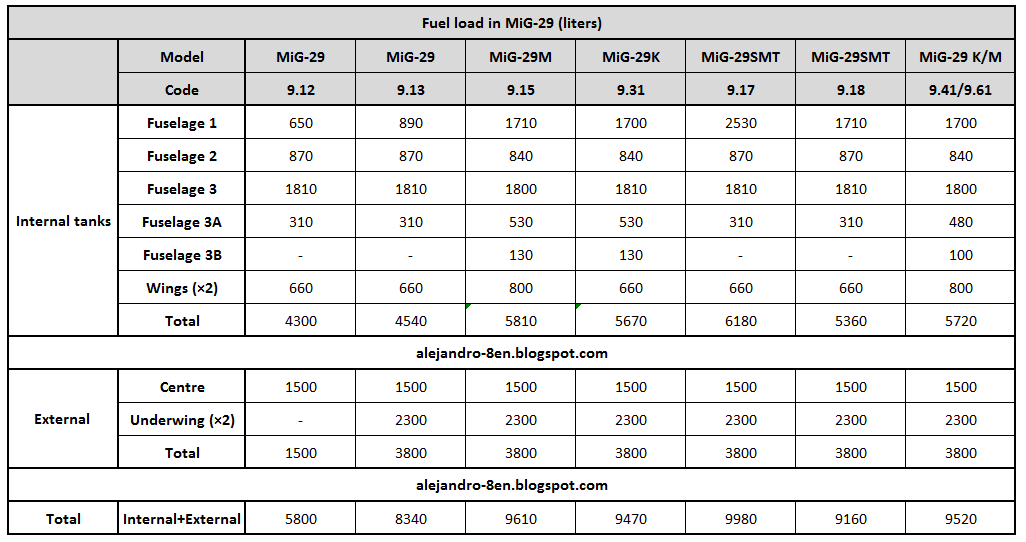
Hello Scorpion, the data come from airwar.ru website and Yefim Gordon’s book on MiG-29 (description based on manual). For some of the latest variants I had to do some simple calculations. Note that the data you provide are in kg.
“Practical aerodynamics of the MiG-29” fuel capacity (0.785 kg/l) in internal tanks – 3300 kg external tank – 1175 kg operational capacity of internal fuel tanks – 4300 liters produced capacity of internal fuel tanks – 4200 liters
Thanks Paralay, does the table come from a book? Do you have the reference?
a89Thank you, do you have any data on target designation? As I understand Link-16 allows an aircraft to fire a missile on a target that has been designated by another fighter or an AWACS aircraft. I think the Soviet Union already tested this in advanced MiG-31 versions.
a89The general consensus from Luftwaffe and USAF pilots who flew ex East German MiG-29s was that while the helmet mounted sights and and R-73 SRAAM were certainly impressive, the found the radar less impressive and the IRST not really worth having.
Back in the 1980s. Note that those Luftwaffe/USAF pilots came from more advanced F-16 versions, or F-4 Phantom upgraded with F-18 avionics. In the 1990s MiG-29s would have fielded M version.
The IRST comment was made by a USAF pilot who spent some time in JG 73. Maybe the system was struggling with reliability because the opinion is not shared by other pilots (including Luftwaffe).
a89How much internal fuel did the MiG-29M carry as opposed to the original MiG-29A or the SMT?
Far more, original MiG-29A did not meet range requirements. Hence the hunchback C version (9.13). MiG made substantial changes in MiG-29M and internal fuel capacity increased by 30%.
This comment by IAF MiG-29 pilot is worth pointing out:
How good were the sensors?
“Excellent. The combination of the powerful Pulse-Doppler radar, IRST and helmet mounted sight with the weapons slewed to the sensors was wonderful and unique since it did not exist on any other comparable aircraft those days.
This factor was also pointed out by Yugoslavian pilotos who evaluated MiG-29, F-16 and Mirage 2000.
a89Russian Su-35 uses a S-107-1 data link. Export version is S-108. A while ago I wrote a small article about it. Sadly there is not much information about Russian data link systems.
Su-57 will use S-111.
a89France has come a long way since the days of the AL-31F being way ahead of the M53 (developing very advanced abilities in certain areas),
Interesting, is this according to the Indian Air Force?
a89Hmm Looks interesting. However the competition for export would be tough as the “medium” AEW market is atm quite saturated with Western and Chinese products. Mainly Western like Wedgetail and SAAB. Chinese also manages to secure some niche with the ZDK-03. Would be nice alternative anyway in case the customer cant by any means accessing western products but dont want Chinese.
Using the Tu-214 as a platform makes sense because it is the long range version. Having said that production in the last few years has been very small, and is likely that the aircraft were built from stored components. In any case it will provide some extra work for Kazan’s KAPO factory. There are also a few in storage.
a89Yeah, to tell the truth, i am a little surprised that they kept the third seat in cockpit, it must be completely redundant by now.. however it sure keeps a nice seat view for the rest of the crew. Think it a total of four now. Was five or six before.
I am not sure for the Il-76MD-90A, but keeping the 3 men cockpit was a request of the Russian MoD in the Il-112V. It is handy when operating from basic airfields without much assistance.
a89[quote]And a couple of shots from Aviastar floor, looks like a couple more aiframes getting close to completion, as well as the production line itself:[/quote]
Not military related, but has anyone commented on that Cairo Aviation Tu-204? They have been in storage for years. Maybe it is being converted to a freighter variant – Russian Post uses several.
a893 million is not a large price difference. 5 a little bit, but not a biggie. They should consider the FA-50 simply due to long term stability over engine support and supplies. Although both the Tejas and Thunder are more likely to be integrated with a greater variety of weapons. Out of curiosity, which of these three has the best range? since Malaysia is vast
Other factors should also be taken into account when determining the cost. The life of the JF-17 is 3,000 hours, and the engine needs an overhaul every 600 hours (data from 2013). I am not sure about FA-50 but should be higher.


 Sign In







