topspeed
Utter silliness, especially considering that you are carrying external stores.
Not on mission like in a diagram without BVR option.
topspeedNo you don’t you know your paper plane will not work and are just trolling to see how long you can drag it along.
Right but even on paper as it is..it has armour for both pilot and engine + concealed weapons against .50 cal machine guns !
topspeed90 km for aircraft with turbofan engines, maybe 150 km with your rocket engine
You may want to check the math that went into that mission diagram. If you use a rocket to quickly accelerate to about M2.5, you will end up at the same altitude you started from about 3 minutes later and 100km further and flying at about M2. During that time, Su-35 flying at M2.2 would have traveled about 120km. So you are still 180km apart.
What is the purpose of that high speed dash anyway? Unpowered glider will not be able to dog-fight a real fighter, and its speed makes no difference. The extra speed would give your missiles a bit more range, but you don’t really need that.
The distances in that diagram are not necessarily made in the time frame it needs…the loop at the top can be just 2 km dia and not 6 km as indicated ( or no loop at all ).
Moore weapon options.
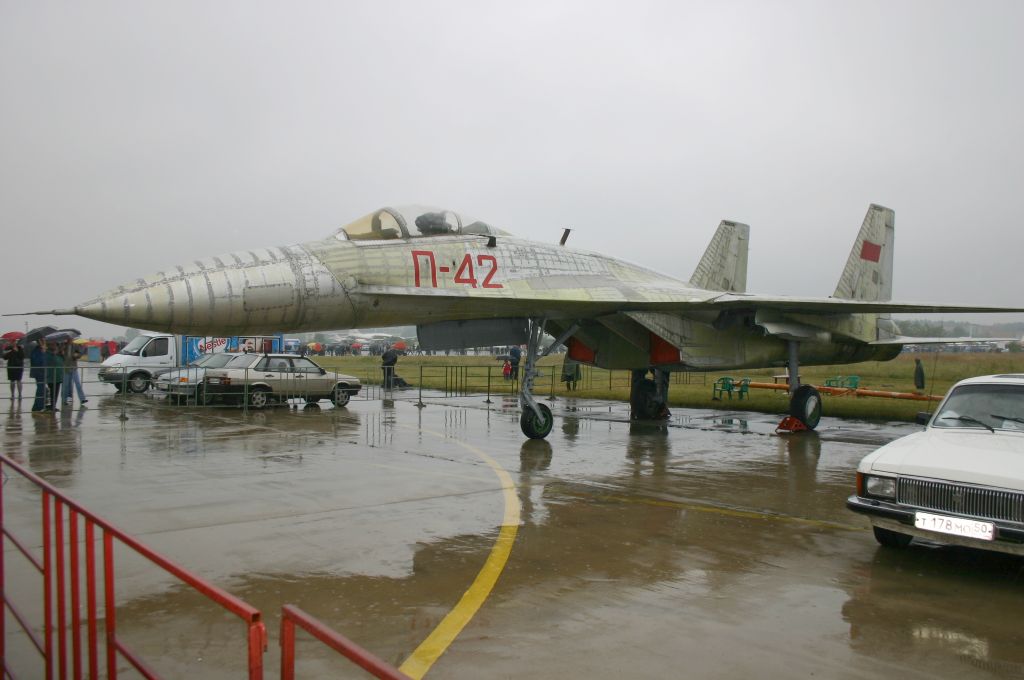
topspeedMostly climb records, afaik, and a big bunch of them too. Some still stand, like the timb to climb to 6000 meters/19700ft, it took a mere 44 seconds in the Sukhoi P-42 as piloted by Sadovnikov anno 1987.
EDIT: And it’s “break”; a brake is a completely different thing.
Ok is timb anything like time ?
topspeedSo, the only Flanker to fly without the wingtip launchrails is, AFAIK, the P-42 record breaker – itself converted from the T10-15 prototype…
Ken
What records did this break ?
topspeedCould STINGERS be used in a small interceptor ?
I checked that Igla and STINGER might fit nicely here.
topspeedplease, F-104 was a normal size plane that had enough room for fuel and a pilot.
your design has no room for a pilot because the cockpit is too small to house both a pilot and a dashboard, no room for the radar you want because the radome is too small.. and you expect it to fly at mach 2.5 when there’s no room for an engine because the space is taken up by your internal bay, let alone fuel to power such a powerful engine. whats even more ridiculous is that you expect it to glide down on those puny wings.
what’s next? your unicorn fighter will be able to shoot down F-22s?
You wish it doesn’t have..this has bigger cockpit than Me-109 G-6.
Also the size ratio indicates that 10.3 kN is enuf to be powervise even with U-2.
But you are right it is very tight so I switched the engine to PW530A of 13 kN. It is only 710 mm x 1520 mm sized.
This does not need any bigger engine and saves weight and space for the rocket boosters.
What GM1 doesn’t have is the endurance at high altitude..it can only take a short spurt there.
topspeedSpaceShipOne is a poor analogy. It achieved supersonic speeds only at extreme altitudes when it was powered by its rocket or when falling along ballistic trajectory. It started gliding only after it slowed down to subsonic speeds.
Your PW535 turbofan will only work to 50-60 kft before it is starved of air and flames out. The altitude record for subsonic flight is only about 70 kft (held by U-2, I think). Even White Knight, also built specifically for high altitude flight could only go to 60 kft. And both of these have special engines and very high aspect ratio wings. Your plane would be limited to about 40 kft while using the turbofan.
It does not matter if you are flying inverted or not. The rocket exhaust trail is quite long and extremely bright in IR spectrum: you will be detected immediately. Su-35 will close in and launch R-77. Once the missile reaches you, you are both in the same situation: out of fuel. R-77 is more maneuverable than you and will blow you into pieces. The End. Attempting the other approach will be even worse. Unlike you, Su-35 can maintain Mach 2.1 at 60 kft. If you both launch missiles, who will have better chance? Powered fighter or unpowered glider?
Your best bet is to fly level at M0.9 at 40 kft using passive sensors. Hopefully, you will detect Su-35’s radar emissions and launch your missiles. Su-35 will likely detect the launch, focus its AESA into that spot, track you and launch its own missiles. In the end, you can hope to trade one of your aircraft for one Su-35, which is a fair trade. However, if Su-35 is flying without the radar, it will close in to about 30 km and rip you apart.
Hehehehe !
I counted the RCS approximately and even the PAK-FAs 400 km detecting radar sees this kinds object only at 18 km..OLS-35 max at 90 km ( when rockets exposed to it..now they aren’t so maybe 50 km ). See the chart I drew..the foe is at 400 km..this higher maneuver needs that the airplane is already airborne loitering.
This plane moves at 748 mph and 654 KIAS…any idea what it means as KTAS at FL 700 ?
U-2 was a good kite but it had 20% heavier wingloading and long wings made it slow too..this has even power to weight ratio on turbofan, but ignites the rockets at 70 000 ft to get going.
topspeeder, climb to 70000ft on your turbofan? and the air it needs will come from…. where?
with such a short wing span, climbing that high would need a high supersonic speed, something your turbofan simply can not provide
in fact, what you’re trying to make is a little bit like this:
[ATTACH=CONFIG]216212[/ATTACH]
chances are you won’t make it work before a couple of centuries…
No sir !
Do you remember how F-104 reached 103 000 ft ? And Ye-66 ( Mig-21 ) 113 000 ft without rockets ?
Let’s calculate a bit..plane empty 2270 kg…few missiles couple rounds for that cannon….zoom flite fuel 300 kg …glides back to base…no lets add another 150 kgs. What do have now ? We have 159 kg/m2 wing loading in a plane that has extremely little drag. This goes easily to 60 km if needed with double the power than D-21 had and half the weight.
This is the extension in the both ends of the envelope that I mean.
topspeedNo, it cannot. The problem with high bypass turbofans is that they have single-stage fan. At supersonic speeds, the fan can barely overcome its own drag.
You severely over-estimate the performance of rockets. Lets say that you want to accelerate from M0.9 (300m/s) to M3.0 (1000m/s) and lets ignore the required climb and increased aerodynamic resistance. So you need 700m/s delta-v. Typical solid rocket with have 260s specific impulse. So the rocket fuel needs to make up 24% of your take-off weight. Add the rocket’s casing and we are up 27%. And that’s just for the acceleration. You would need a lot of rocket fuel to sustain that speed for even a couple of minutes.
Designing for Mach 3 also dramatically increases the cost and complexity. The structure now needs to be made out of titanium or steel or very high-tech (expensive!) composites. And once you reach the speed at 70,000 feet or so, you will light up like a Christmas tree on any IR sensor within 200km.
I am also not sure where you heard that low wing loading is good for supersonic speeds. For comparison, Concorde had 500kg/m2 and SR-71 had 450kg/m2.
Space Ship One had max wing loading 240 kg/m2 and went mach 3 +
http://en.wikipedia.org/wiki/SpaceShipOne
It was also very very simple..like this is.
I use the turbofan to climb efficiently to 70 000 ft.
It becomes a mach 3.0 glider after the 130 000 ft has been reached. Has no heat signature since the air is so thin.
Erratically I printed mach 2.2 for the speed..but just to be at the right place at the right time for AAMs in enough..speed can be lower too.
topspeedYour estimations are WAY off accourding to published OLS-35 data from official sources.
Spudman WP is correct…OLS-35 is pretty much uselees against this small subsonic/supersonic interceptor.
topspeedyes, ok, but that’s just a typo… methinks there are some more serious errors in this thread then just a misspelling of a lens name… 😉
Methinks Finnish Air Force may also in the future operate jets ( of this size ) despite the 10 fold oil prices and less money for the military to operate. We definitely cannot afford current size 5th gen fighters.
New inventions are already emerging to make this happen; http://www.darpa.mil/Our_Work/MTO/Programs/Micro-Technology_for_Positioning,_Navigation_and_Timing_%28Micro-PNT%29.aspx
topspeedyes, Luneberg Lenses are used for the F-22… if you look at their size, they’re tiny compared to the rest of the aircraft.
it is Luneburg lens ( not luneberg ); http://en.wikipedia.org/wiki/Luneburg_lens
topspeedCan anyone stop this clown !????
He’s making that forum a playground for kids in the Kindergarden …
HEEEEELP !
Deino
You are almost begging to get also this thread closed aren’t you ?
topspeed[QUOTE=AdamF;2021156]
So you are saying that an aircraft with double the SFC and 12.5 times bigger out put actually consumes less then the highly developed commercial bizjet ultra low cunsumption engine.
I am not sure how you got that out of my post.You will also need to choose a different engine. PW535 is meant for business jets. It does not have a convergent-divergent nozzle, so it will produce no thrust at supersonic speeds. Even if one was added, its high bypasss ratio means that it will produce too much drag.
It is a bit problematic to go to high supersonic speeds but since F=ma ( still ) I bet it can go supersonic if these flow issues are correctly met. It does produce some drag but due to its diminutive size much less than any bigger afterburning engine..or any afterburning engine in existence. Planes rocket boosters are lit at high altitude and PW535 is just carried along as a weight load. Low wingloading can assure at very high altitude mach speeds up to mach 3 when rocket power is used, thus the PW535 is more or less a loitering engine and used for ground attacks and taking of and in initial climb to intercept ( with rockets at 300 m/s )…not for pursuit.


 Sign In