 Sanem
Sanemin COIN, information is everything
the example of Saudi’s who recently could not effectively fight the border rebels because they didn’t quite know where to attack. also when they did attack they caused a lot of collateral damage, pissing people off
so first of all I would buy recon aircraft. UAVs are best at this, also because they require much less training and simply cost less to fly and maintain. light recon would be the Predator family, or for more political flexible options, buy French, Israeli, Turkish, UK or any Asian (cheap but poorer quality)
for a UAV that can do some serious bombing, high precision, you’d need Israeli stuff, Reapers are too hard to get. if you’re willing to be patient French, Turkish, UK or Asian alternatives are in the works
other than that, helicopters to deploy ground forces to go in. Mi’s are good for this, they can be dual role and are easy to get. UAV helicopters are also becoming available, they’re great for recon and some light attack
SanemOh! Perhaps you mean guerrilla –
derived from the Spanish for war.
as long as we’re being smart asses, it actually means “little war” 😉
as for the topic: guerrilla/insurgent (which I would bet is a distinction made by the western military because “guerilla” has a too positive conotation, one of the poor farmers rising up to fight the rich and corrupted) strategies are based on the concept of fighting dispersed, attacking the larger, more powerful enemy at his weak points (supply lines for one), avoiding an all out battle that the larger opponent would favour, using psychology as the main weapon to defeat the enemy, rather than any real military successes (point and case: Vietnam)
the most important element of the guerrilla/insurgent tactic is however the ability to hide: if the larger/stronger enemy knows where the insurgents are, they will be able to confront them, a battle they will always win. so the most important asset for any anti-insurgent army is information: who they are fighting, and where they are
for this reason, UAV like the Predator series, are far supirior to anything else, because they can provide an unmatched level of information effectively and efficiently. they can spy on the insurgents, invisble themselves, follow them for hours if not days on end, waiting for the perfect moment to strike, and can do so with the utmost precision (and once they finally get around to making micro-amunitions, with minimal collateral damage)
so my vote goes to the Q-1 Predator, if anything because no other COIN aircraft has seen so much action or has had so much succes
to apply this to an actual situation, like say rebels in South Africa, a Predator like aircraft would be the best choice, both in ability and in cost. alternatively you could combine UAVs with light attack aircraft, giving you the best of both worlds, but experience in Afghanistan and Iraq has shown the value of having weapons on the UAV itself, making it a true hunter-killer rather than a pure recon aircraft
also if the UAV operators are in the same area as the UAV, this will greatly reduce cost since you don’t need sattelite grade equipment, add a tethered balloon for improved communications. this system could be more vulnerable to jamming, but that kind of equipment would be too expensive and unwieldy for insurgents, not to mention a dead giveaway of location
Sanemthanks for the clips, good stuff
my money is on sub-scale demonstrator:
– notice the angle it is filmed while taxiing, that suggests it’s small. it’s also filmed from very close by, that’s normally not done, especially with such an expensive, one of a kind prototype
– and you can also see the flap shaking hard while taxiing, which suggests it is very light
pretty cool though: it allows to test the design concept and the software at a minimum cost 🙂
SanemBack to topic, Possibilities I see:
good sum up Snow Monkey 😉
they also share the E-3 Sentry, according to Wikipedia they’re similar models
http://en.wikipedia.org/wiki/Boeing_E-3_Sentry
it has often been repeated that these new UCAVs are only technology demonstrators, not even prototypes, so there might still be room for cooperation here. the whole of Europe buying the same model certainly has its advantages, especially if development budgets are limited. imagine a European UCAV bought by just about every country, flying off UK and French carriers… 😀
apparantly France has interest in buying the Mantis and working on the Tarantis:
http://www.militaryphotos.net/forums/showthread.php?187730-France-to-buy-Mantis-UAV
more info on both projects here:
http://www.defenseindustrydaily.com/Apres-Harfang-Frances-Next-High-End-UAV-06451/
Sanemturrets on UCAV fighters: that could work, their extreme manouverability combined with radar-guided aiming and computer reflexes means anything within gun ranged is going to get shot at from any angle. scary stuff, it could also be used to shoot down incomming missiles, like those ship mounted systems. they’ve also restarted work on guided bullets, although dogfights are probably too fast moving for those
turrets on UAVs: could work. even if the gun is fixed but aimed at a slightly downward angle, it would be an excellent weapon for strafing infantry and vehicles
full turrets might be too heavy for the current generation of UAVs. another problem is the communications lag: you would need a within-LOS operator to adjust for lots of enemy movement
but the biggest contra argument would be that drones are very vulnerable: jets fly by fast and an A-10 can take hits, but a drone will be shot down by rifle fire
which is why I see more use for guided grenades: radio-guided to keep the cost low, these would be cheap and extremely effective
Sanemon spying:
France certainly does spy. back when the F-16 was introduced, they provided stolen corporate documents from General Dynamics that pointed to unresolved issues with the new aircraft. this was around the same time when General Dynamics bribed a Dutch prince into buying the F-16; he promptly donated the money to charity, and than bought the F-16 anyway
the US spies too ofcourse, for example using the terrorist threat as an excuse to intercept EU corporate information that was sent over US satellites
the difference is that France has a lot less information worth spying on, unlike the US. which is why China spends most of its spy effort on the US; who knows how much of the F-35 tech they’ve already stolen :rolleyes:
a little more recent, you be sure that Boeing and Airbus are spying the crap out of eachother; when you talk about that much money there’s a lot of hitting below the belt 😉
on UK-French cooperation:
they’ll always be competitors, even if they’re from the same “family” of countries. budget cuts just reduce ego’s and put the needs before the pride, allowing room for cooperation
cooperation on the UCAVs would certainly have been a good thing. that said, I rather like having so many different countries develop their own UCAV, this way when the dust settles little countries like mine can choose the one most to their liking (or whichever company donates the most to charity :D)
the EU is currently working on a fused air corridor, meaning less fighters will be needed to protect it
sharing a carrier is certainly an interesting option: think of it as sharing a mobile air base. you can double the aircraft available for a mission, have a choice in aircraft to fulfil a mission (the F-35 would be better for ground attack, the Rafale would be better for air defence), you can deploy the AWACS as you see fit, and also you double the number of escorts available for the carrier
Sanem3. if you fulfill the requirements with a stealthy UCAS fighter will it cost significantly less than the above?
both Boeing and NG are working on in-house UCAVs, minimizing the risk of another A-12 disaster, certainly driving down the cost as an off the shelf option. both are said to be purely for the AG role, but AAMs should be easy enough to integrate
on cost, Boeing said the X-45A could be built for 10 million a piece 😮
removing the pilot certainly saves weight and gives more design freedom, and aerodynamic efficiency. these designs are also predicted to have much greater ranges than any manned aircraft (don’t really know why), creating extra savings on the need for in-flight refueling. they can also stay on station for days, reducing the need for flying to and from the area of operations (especially important as aircraft carriers keep increasing their range from target, because of enemy anti-ship weapons)
but any main savings, aside from possible cheaper production and design costs, would come from savings in pilot training. 70% of current flights are for training purposes, take those away and that saves a lot in fuel, airframe wear and tear, accidents… operators don’t have to go through millions of dollars worth of flight training, and skills and tactics can be exercised by simulators and proxy-UAVs. operators can also be anywhere on the planet, a major practical benefit for any navy
Sanempossibly the most interesting VTOL design, the Pogo:
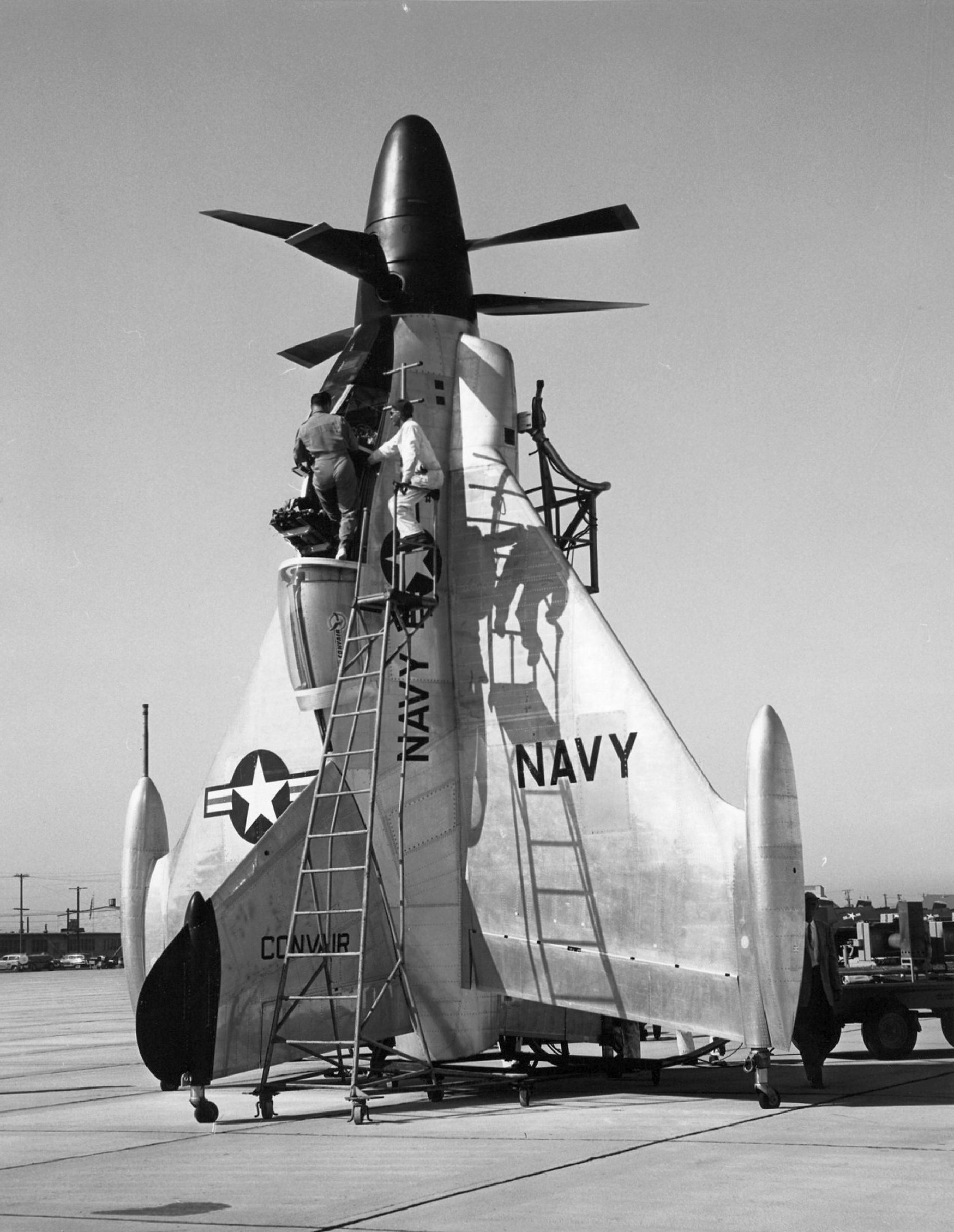
and its possible UAV successor, the V-bat:
http://www.youtube.com/v/kX6Nt85yK7c?fs=1&hl=nl_NL
Mod Edit: No embedded video, thanks.
SanemAn interesting video that shows an autonomous vehicle’s sensors. Although it is a ground vehicle it shows what is possible for UCAVs.
UGVs have it a lot harder: it takes a lot more processing to drive across a road, dodge obstacles, drive in columns… the combat threat is also much more complicated, because enemies are harder to spot, and you have a lot of civilians around
airliners have been flying by computer since the ’60s, ground vehicles have yet to do that in practice, except maybe train and subway systems
Add an acoustic system for incoming fire, an optical detection system for muzzle flash, a Mk 47 grenade launcher and automated suppressive fire mode to that thing.
you want the Ripsaw than 🙂
http://www.youtube.com/v/BiacOOHbqJg?fs=1&hl=nl_NL
Mod Edit: No embedded video, thanks!
tanks are great as UGVs: they don’t care for bad terrain, and they’re the spear point of any fighting so they take the most fire, no place for any human to be
and any infantry close by can control it via a controller, or give it input as to how to move or fight
what a lovely video.. according to it.. a Su-30 and Eurofighter Typhoon are about equal :diablo:
if the ability of the aircraft to do subsonic manouvering is declining because of highly manouverable missiles and other new technologies.. would going back to delta winged, interceptor style designs be more useful in the future?
EF has better tech and better trained pilots, Su’s have vectored engines and are half the price
and hypersonice, near-space flying fighters are the future super-fighters, and natural UAVs (huge G forces, long flight missions)
although I also believe in small, cheap and stealthy X-45c type aircraft, for any country that can’t afford star wars (which is just about all of them)
What’s the rearward opening angle of the AAQ-37, the blind spot?
it seems the lower rear, although there are optics on the front flanks, maybe they cover that area. either way it’s still the hardest angle to look at for the pilot. a UCAV wouldn’t have this problem, it would look 360 degrees, 24/7 :p
SanemWe are talking about ground attack rather than air superiority UAVs now, but considering the lack of AA UAV experience I guess it’s a viable deviation of the topic.
On the pilot: from what I hear he doesn’t have as high a workload as a “flying” pilot, he just sits there and makes sure nothing goes wrong. Which suggests he can do so for more than one aircraft. Especially in the air superiority mission, where aircraft often fly in formation, it would be easy enough to guide them as a formation, rather than follow every aircraft individually, or at least not all the time.
Weapons specialist: in the air superiority role, this guy would be reading mostly radar data, rather than video data. Radar data is much more compact to send through satellite communication, and can also be fused if several aircraft fly together. The specialist will also have easier access to information from other sources, such as pictures taken from ground and high altitude air units, helping him confirm the identity of a target more easily than a “flying” pilot could.
Plus the specialist has the option, if he has several aircraft, of sending one in close to test if the potential target is looking for a fight or maybe trying to surrender. In all the recent air combats aircraft where shot down before they got close, but this is still an important mission, and one which is much more riskier for human pilots: the stealth on an F-35 isn’t going to help much if the enemy has you in cannon range.
Not only is the risk of sending in a drone to inspect the potential target much more acceptable, the drone also has a better chance of survival, since it can perform manoeuvres a human cannot follow and also has better stealth, giving it a better chance of getting away, at which point the other UCAVs can open fire safely.
Which raises the question, why have there been no tests of the air superiority UCAV? Take the X-31, turn it into a drone, and see just how maneuverable it is. Fly in some ground-controlled QF-16s, and see if it can track multiple targets and devise strategies without human help. It would be relatively inexpensive to test, but it could save human lives if the US ever does face an enemy with a half decent air force. Or one who just automates a bunch of MiG-21s and sends them on Kamikaze missions: cheap, expendable, high interceptor speed, they’ll be any bomber’s worst nightmare.
SanemTo fly and maintain a detachment of five MQ-9As requires 172 people, with 62 of those people at the FOL and 110 at the mission control center. And no more than 2 of the UAVs are airborne at any time.
good point, how about this dumb rule that you need 3 men to pilot 1 Reaper? a Global Hawk can fly all by itself, no need for a pilot; the Army uses NCOs, who do no worse than an F-15 qualified pilot; and I don’t know why the third guy has to be present, is he the tea lady?
it should be reduced to just the one observer, clicking with a mouse on the map what route he wants to fly and which area’s he wants to loiter over
the good news is that the workload will be reduced for AA UCAVs: Boeing proved back in 2005 that one operator would be able to control as many as 4 UCAVs, telling them what their mission was, the drones would decide on the rest by themselves
SanemCompanies are obligated to follow the UCAV trend. LMT can’t afford to sell its F-35 at $100+ million, if Boeing can sell the X-45c at even half that price, never mind the $10 million they predicted, but with better stealth and lower operating costs :D.
Militaries only evolve when forced by war, like the USAF was forced to use armed Predators because they are so much cheaper than any manned aircraft. So will any future war provoke the introduction of AA UCAVs, because they are cheaper and just as good or better than manned aircraft.
Here’s a paper on an air interceptor UCAV, target price $15 million:
http://www.aoe.vt.edu/~mason/Mason_f/VTechT1Gavial.pdf
These are my AA UCAV concepts:
– Air space defender: cheap and fast, used for guiding in lost airliners and escorting out Russian spy planes. Famously this role is currently fulfilled by aircraft such as the F-22 and the Eurofighter. Unfortunately both aircraft are amongst the most expensive in their class, between $120 and $350 million dollar, which is extremely expensive. Add to this that their mission forces them to get in really close with any aircraft they intercept, and this makes for an extremely expensive solution.
What I propose is an F-16 type aircraft, if somewhat smaller in size: it would be fast, have decent range and armament. It would be dirt cheap, forgoing radar, and relying mainly on passive sensors. Flying over its own territory, it could be controlled without satellite links.
On its mission, two aircraft would go up. They would be guided to the target by AWACS and ground radar. One UCAV would fly in close to the target, escorting it. The other aircraft would hang back and at a higher altitude, ready to engage. The cost would be $15 million or less.
– Air supremacy Reaper: stripped down, these aircraft would only cost $1 million dollar each. They would fly lazily in large numbers, some of their group equipped with ground attack and HARM weapons, others would have EW equipment, and yet other would be dedicated relay aircraft with communication equipment. They would be automated to fly in formations, but only few of them would actually communicate with human controllers.
They would be guided by satellite, AWACS, manned aircraft nearby or ground units. Any conflicts would start by sending in unarmed decoys, which would absorb any attacks and confirm the enemy status and position. Than the remaining aircraft would launch a counter attack from a safe distance and altitude, engaging the enemy with long-range weapons. This would be especially useful for covering any friendly ground advance, giving them 24/7 instant air cover.
Once the enemy air power has been broken, these stripped down Reaper could be re-equipped with more advanced equipment, such as satellite communications and high quality camera’s and laser designators, allowing them to perform their classic hunter-killer mission. All this at $300 dollar/hour/aircraft, but with no humans risking their lives.
– F22 UCAV nephew: big, stealthy, all the advanced technologies. This thing would be a total killer, using stealth technology to stay undetected and still communicate. It would strike at enemy aircraft at long ranges, sniping undetected. Imagine an X-45c, faster, with two engines and more weapons.
Sanemsome really juicy stuff, back from 2002:
http://discovermagazine.com/2002/aug/featflying
SanemHow would a UCAV identify enemy vs friendly aircraft especially in crowded hostile airspace?
the F-35 can do it. they say it’s thanks to something called “teknologie”, but I heard they really paint the aircraft with the blood of virgins, dark vodoo my friend! here’s a video:
http://www.youtube.com/v/e1NrFZddihQ?fs=1&hl=nl_NL
Mod Edit: No embedded video, thanks!
And there is the factor of air safety, even with well trained pilots there are hundreds of military air crashes every month all over the world. Well imagine if fighters were autonomously or remotely controlled and flown through civilian airspace, that would be a huge increase in air crashes and resulting liability.
shock! horror! the video even shows a bit about the F-35 automatically detecting other aircraft, a drone in this case, suggesting they could avoid collisions! heathens! satanists! burn them all before they eat our babies!
There is just no need for a UCAV fighter aircraft. Even with huge increases in artificial intelligence and environmental sensors it will never come close to doing the job a human pilot can do.
obviously all those UAVs currently flying over Afghanistan are really manned by midgets, that’s why they all have those bulkey heads that look like cockpits. satellite dishes, what an absurd idea, like any human could remotely control an aircraft, even if the UAVs would take 99% percent of the decisions. this reminds me of those Wright brothers, who said they could make an aircraft fly, bunch of loonies…
Saneminteresting point: it reminds me of the film “Toys” with Robin Williams, where he discoveres children being trained on computer simulators to remotely fly robot planes, lol
but I except this step will be skipped in UCAVs: many UAVs are already flown on auto-pilot most of the time, following gps waypoints. add to this the continuing problem of communication lagg and jamming, and I feel that, at least in dog fights, the computer will do most of the actual flying. the “pilots” will be reduced/promoted to commanders, helping the UCAVs decide on tactics and strategies, rather than controlling them directly
although I do believe that dog fights will be rare in the future, as weapons become more effective at longer ranges, an evolution that has been going on for the last 70 years, and becomes more dominating as the technology matures


 Sign In







